The Paraguayan Senate has approved a resolution supporting selling the country’s energy surplus to crypto mining companies, given the price and guarantees that these institutions offer. The declaration criticizes the subpar agreements that sell energy to Brazil for 25% of the fees collected for mining activities, calling to direct this energy to 20 new contracts […]
Source link

CoinNews
Deutsche Bank Survey: Over Half Expect Crypto to Become ‘Important’ Asset Class and Payment Method
A new Deutsche Bank survey found that over half of respondents expect cryptocurrencies to become an important asset class and a method of payment. In addition, 10% of respondents expect the price of bitcoin to be above $75,000 by year-end. Deutsche Bank’s Crypto Survey A recent Deutsche Bank survey of over 3,600 consumers, published this […]


Source link
Top IRS official says ‘pure crypto tax crimes’ on the rise alongside scams

IRS criminal investigation chief Guy Ficco told CNBC on April 12 that taxpayers are increasingly committing tax crimes involving crypto.
Ficco said the IRS has seen an increase in “pure crypto tax crimes” that fall under Title 26 of the US Code, which includes federal income tax violations.
Crimes considered pure tax crimes involve failing to report income from crypto sales and hiding or shielding one’s actual basis in crypto.
The issue will likely persist. Ficco observed an “uptick” in tax-reporting crimes and expects the IRS to bring forward more charges this year and in the future.
Until recently, IRS investigations have primarily been a part of broader investigations into crypto crimes such as scams and embezzlement.
Ficco acknowledged that crypto is “becoming more pervasive” and will “maintain or probably have a larger part” in broader crimes such as phone scams, romance scams, and pig butchering. Crypto scams are distinct from tax-reporting crimes.
Reporting failures widespread
Ficco’s comments come after the IRS published a reminder that individuals must report taxes if they sold crypto, received crypto as payment, or engaged in other crypto transactions.
The IRS has included some form of tax reporting rules for crypto investors since at least 2014, but past reports suggest that reporting failures remain high.
A 2023 report from Divly found that in the US, just 1.62% of investors paid taxes on crypto as required. The US rate is only slightly above the global average of 0.53%.
IRS enforcement efforts around crypto could become especially strong starting this year. In February, the agency hired two experts to focus on crypto, and past reports from CNBC suggest that tax professionals are preparing for a “tidal wave” of scrutiny.
Ficco’s predecessor, Jim Lee, also suggested an increased focus on tax issues in December 2023. Lee said half of 2023’s then-active crypto investigations involved tax issues.
The post Top IRS official says ‘pure crypto tax crimes’ on the rise alongside scams appeared first on CryptoSlate.
An analyst has explained how a PEPE daily close outside of a certain price range could lead its value to go on a rally of 54%.
PEPE Symmetrical Triangle May Hint At The Next Move For The Memecoin
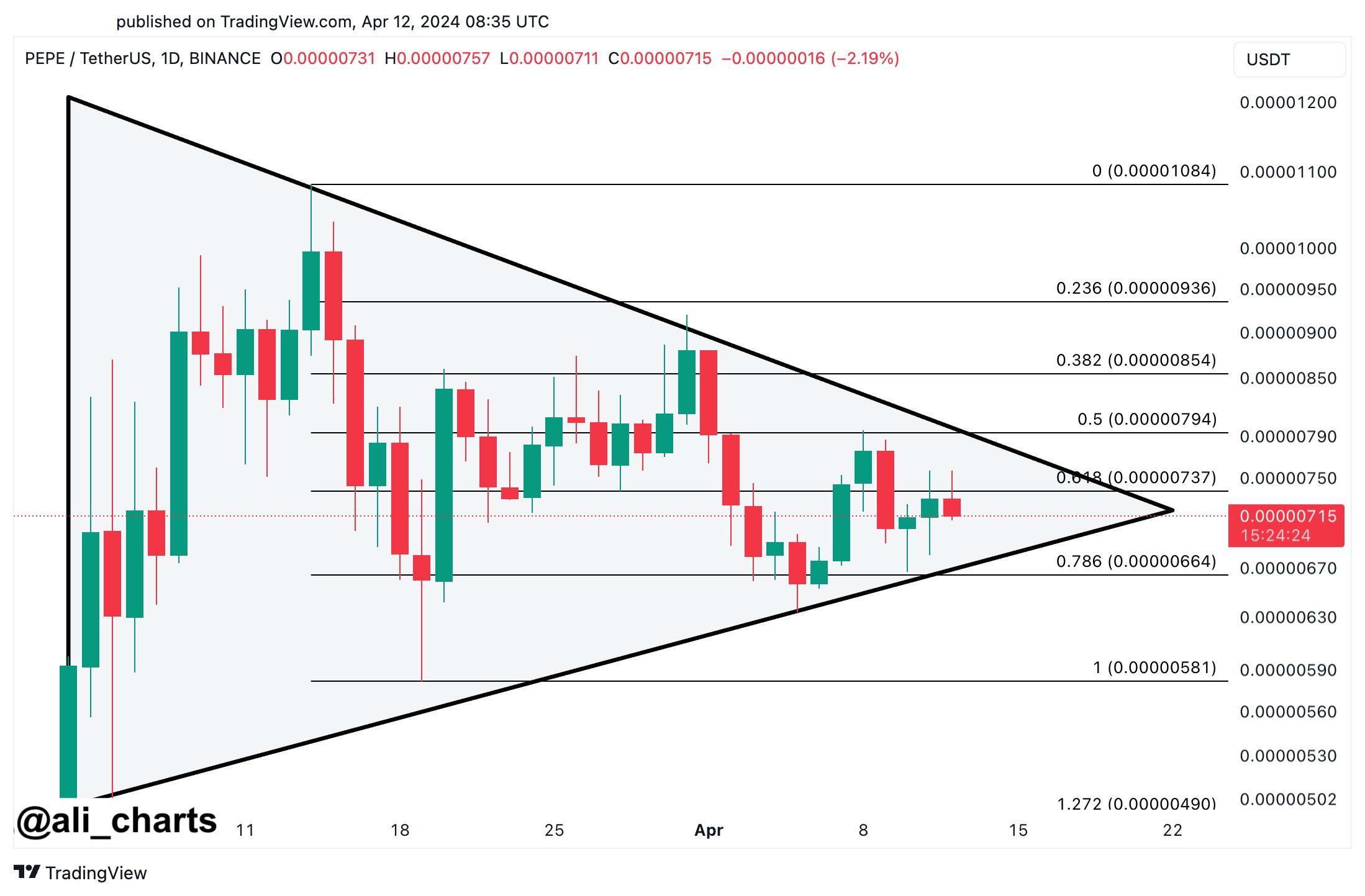
In a new post on X, analyst Ali discussed the recent trend forming in the PEPE price. According to the analyst, the memecoin is currently forming a symmetrical triangle pattern on its one-day chart.
The “symmetrical triangle” here refers to a pattern in technical analysis (TA) that, as its name suggests, looks like a triangle. In this pattern, there are two lines of interest between which the asset’s price consolidates for a period.
The upper line connects successive tops, while the lower one joins together bottoms. The main feature of the pattern is that these two lines approach each other at a roughly equal and opposite slope (hence the “symmetrical” in the name).
There are other triangle patterns in TA, but those have either differently angled lines (as is the case with wedges) or one line parallel to the time-axis (ascending and descending triangles).
Like other TA patterns that represent a consolidation phase, the lines of the symmetrical triangle also serve as a point of potential reversal for the price. The upper line usually offers resistance (meaning tops can occur), while the lower line may provide support (bottom formation).
When a break takes place from either of these lines, the price may likely see sustained momentum in that direction. This implies that a break above the triangle could be a bullish signal, while one below may be bearish.
The symmetrical triangle may be viewed as a phase of the market in which the bulls and bears are at a standstill, hence why the price is ranging sideways. During a break, one of these wins out, and price action follows in that direction.
Naturally, as the lines converge towards a center point in this pattern, a breakout becomes increasingly probable the closer to the apex of the triangle the asset’s price gets.
Now, here is the chart shared by Ali that highlights the symmetrical triangle pattern that PEPE has been trading inside recently:

Looks like the asset's price is getting closer to the converging point of the pattern | Source: @ali_charts on X
As is visible in the graph, the 1-day price of PEPE has been approaching the triangle’s apex recently, implying that a break in a direction may be coming for the memecoin.
“Watch out for a daily close outside of the $0.00000793 – $0.00000664 range, which could lead to a 54% move for PEPE,” explains the analyst. Given the pattern that has been forming, it now remains to be seen how the asset’s price will play out from here.
PEPE Price
At the time of writing, PEPE is trading around $0.000006868072, up 3% over the past week.
The price of the memecoin appears to have gone down recently | Source: PEPEUSD on TradingView
Featured image from Shutterstock.com, charts from TradingView.com
Disclaimer: The article is provided for educational purposes only. It does not represent the opinions of NewsBTC on whether to buy, sell or hold any investments and naturally investing carries risks. You are advised to conduct your own research before making any investment decisions. Use information provided on this website entirely at your own risk.
Tesla cuts price FSD premium driver assistance option by half in U.S.
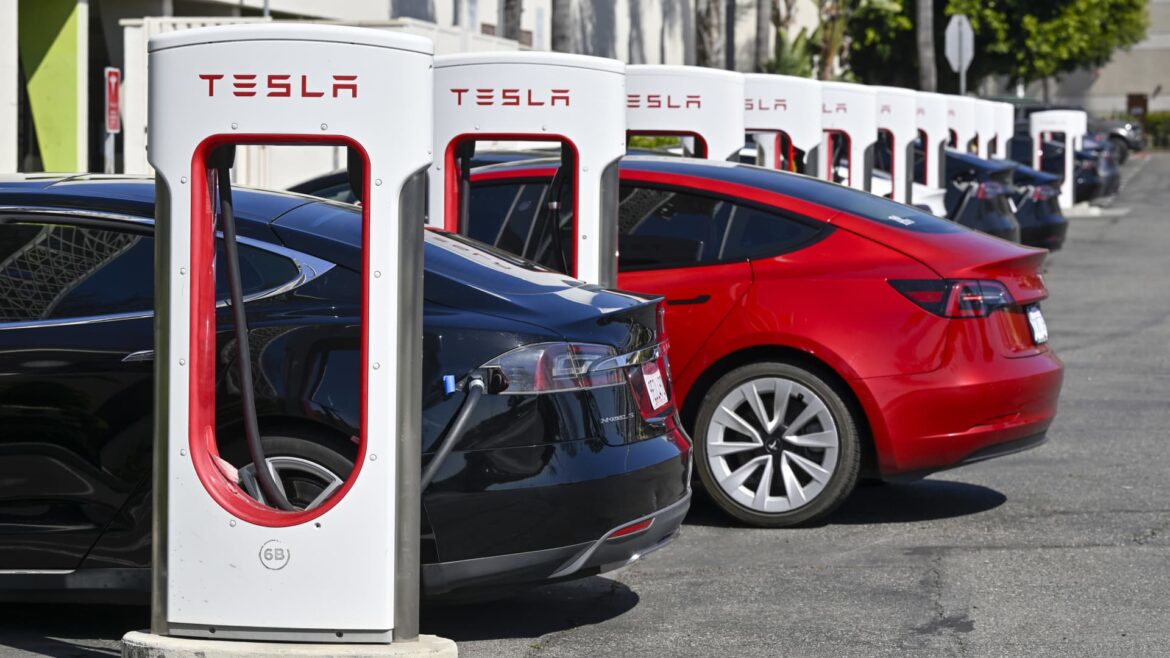
Drivers charge their Teslas in Fountain Valley, CA, on Wednesday, March 20, 2024.
Jeff Gritchen | Medianews Group | Getty Images
Tesla said on Friday that it’s cutting the subscription price of its premium driver assistance system for customers in the U.S.
Marketed as its Full Self-Driving, or FSD, package, Tesla customers will now pay $99 per month, down from $199 previously.
The price cut is at odds with previous promises from CEO Elon Musk, who has repeatedly said that the cost of FSD would only go up as Tesla adds features and functionality to the system.
“The FSD price will continue to rise as the software gets closer to full self-driving capability with regulatory approval,” Musk wrote on Twitter, now known as X, on May 18, 2020. He said at that point “the value of FSD is probably somewhere in excess of $100,000” per car.
Despite its brand name, the company’s FSD option today doesn’t make Tesla vehicles autonomous or functional as robotaxis.
Musk has promised shareholders and customers a robotaxi for years, and has said their existing vehicles would soon become self driving after an over-the-air software update.
He told investors on a call in 2019 that autonomous driving would transform Tesla into a company with a $500 billion market cap, up from around $42 billion at that time. (The company is worth over $500 billion today even without having developed an autonomous car.) Tesla raised over $2 billion through debt and equity after the call.
In a notice that’s now shown to some drivers through the touchscreen displays in their cars, Tesla says:
“Full Self-Driving (Supervised) can drive your Tesla almost anywhere. It will make lane changes, select forks to follow your navigation route, navigate around other vehicles and objects, and make left and right turns. It must be used with additional caution and an attentive driver. It does not make your vehicle autonomous. Do not become complacent.”
The company uses sensors in the steering wheel and cabin cameras, positioned above the rearview mirror, to determine if a driver is attentive or not, and will audibly alert drivers to keep their eyes on the road or hands on the wheel.
In 2022, the California Department of Motor Vehicles formally accused Tesla of engaging in deceptive practices around the marketing of its driver assistance systems, including its standard package Autopilot and FSD in the U.S., according to filings with a state administrative agency.
Meanwhile, Alphabet-owned Waymo is now operating commercial robotaxi services in several U.S. cities. The company also recently struck a partnership with Uber Eats for driverless food delivery. In China, Didi’s autonomous unit operates commercially in markets including Guangzhou. Companies including Bill Gates-backed Wayve in the U.K. and Amazon’s Zoox in the U.S. are testing robotaxis as well.
In a push for end-of-quarter sales last month, Musk mandated that all sales and service staff install and demo FSD for customers before handing over the keys. He wrote in an email to employees, “Almost no one actually realizes how well (supervised) FSD actually works. I know this will slow down the delivery process, but it is nonetheless a hard requirement.”
After that, Tesla also announced it would give away a one-month free trial of FSD to all customers in North America. Owners’ responses to the latest version of FSD have been mixed with some fans impressed, and many safety-conscious drivers switching off the free FSD trial, viewing it as inconsistent and unsafe.
Musk also recently promised to “unveil” a new dedicated robotaxi on Aug. 8. Tesla unveilings are marketing events, and don’t indicate a date for the start of production and deliveries. For example, Tesla unveiled a new version of the Roadster, and a fully electric heavy-duty truck called the Semi in 2017 and didn’t begin Semi deliveries until December 2022. It still hasn’t produced the new version of the Roadster.
Tesla didn’t respond to a request for more information, including whether the price cut announced Friday is permanent or temporary.
WATCH: Musk is trying to highlight the value that robotaxis could bring

Onchain data indicates that a single custodian now manages the coinbase addresses for at least nine prominent mining pools, which collectively account for 47% of Bitcoin’s total hashrate. The analysis shows that substantial miners’ rewards from pools like F2pool, Antpool, Binance Pool, and Braiins are being funneled to this particular custodian. Onchain Data Reveals Single […]
Source link

Bitcoin’s (BTC) value plummeted below $65,000 on April 12, a stark drop from its $71,000 peak earlier in the day, as a wave of selling hit the crypto and equities markets, causing some altcoins to fall more than 15% in a matter of minutes.
The decline mirrored a broader selloff across asset classes amid heightened global economic uncertainties and geopolitical risks.
Bitcoin has slightly recovered since the violent drawdown, trading at around $67,300 as of press time, based on CryptoSlate data.
Ethereum, the second-largest crypto by market capitalization, fell 12% to $3,100 before paring some losses to close 8% lower at $3244 as of press time.
Meanwhile, BNB and Solana (SOL) dropped almost 14% before recovering some losses. Both tokens were down roughly 12% over the past 24 hours as of press time — trading at $593 and $153, respectively.
Smaller cryptocurrencies faced even steeper declines, with tokens like Cardano (ADA), Avalanche (AVAX), and Bitcoin Cash (BCH) recording losses ranging from 15% to 20%.
The crypto market’s downturn triggered one of the largest leverage washouts of the month, erasing approximately $850 million in leveraged derivatives positions, with CoinGlass data indicating that $770 million of these were long positions expecting price increases.
Traditional stock markets also suffered losses as investors feared an escalation in Middle Eastern conflicts following warnings from US officials about potential aggressive actions by Iran against Israel.
This uncertainty drove investors toward safer assets, boosting Treasury bonds and the US dollar. Meanwhile, the S&P 500 and Nasdaq 100 each dropped about 1.7%. Gold prices briefly soared to an all-time high of over $2,400, and oil prices increased by 1%.
Ryze Labs commented on the day’s events, forecasting continued volatility for cryptocurrencies in the short term due to the upcoming tax season. Despite the immediate market jitters, the firm maintains a positive long-term view, anticipating that an easing monetary policy and a slowdown in quantitative tightening might stabilize and boost the crypto sector.
As global markets navigate through economic indicators and geopolitical tensions, the crypto sector remains particularly sensitive to such developments, preparing for possible further fluctuations as it approaches tax season and beyond.
The post Bitcoin’s crash to $64k causes meltdown for alts appeared first on CryptoSlate.
Recently, reports from IntoTheBlock revealed that the Litecoin (LTC) network has exceeded five million long-term holders. This achievement represents approximately 62.5% of all LTC addresses with a balance, underscoring Litecoin’s widespread adoption and long-term viability within the crypto community.
Rising Long-Term Holder Trend Signals Optimism
The surge in long-term holders has been particularly noticeable in recent months, underscoring a growing inclination towards holding LTC for quite a long time. In February’s closing days alone, the number of long-term holders soared by 170,000, signaling robust investor confidence in Litecoin’s long-term prospects.
In tandem with this surge in long-term holders, the number of individuals holding LTC for more than a year has steadily risen, now totaling 2.54 million addresses. Apart from the numerical growth, the profitability of holding LTC over the long term adds another dimension of interest.
Amazing milestone for Litecoin!
💎The network now counts over 5 million long-term holders of $LTC.
👉This figure represents 62.5% of all Litecoin addresses with a balance. pic.twitter.com/K5FHz3Ivjs— IntoTheBlock (@intotheblock) April 12, 2024
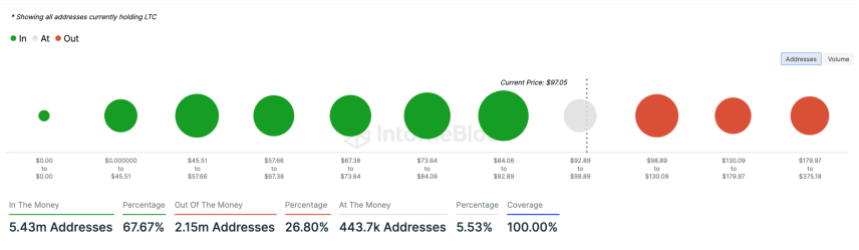
According to on-chain data, roughly 67.67% of all LTC addresses currently stand in profit, collectively holding 49.76 million LTC. In contrast, approximately 26.8% of LTC holders, totaling 2.15 million addresses, are currently at a loss.
Meanwhile, a smaller segment, constituting 5.53% of holders, is situated at breakeven, which means they are neither in a loss nor a profit.

Bullish Sentiment Surrounds Litecoin Amidst Rumors of ETF Approval
So far, Litecoin has seen relatively stable movement, experiencing a minor increase of 0.3% over the past week, followed by a slight downturn of 0.1% in the last 24 hours. As of the current writing, LTC is trading at $96.72.
Despite the altcoin’s current stability in price, analysts such as World of Charts anticipate a potential surge in the coming months, with projections suggesting a climb to $400. This bullish momentum is fuelled by growing institutional interest, particularly surrounding rumors of a potential LTC Exchange-Traded Fund (ETF).
Fox Business journalist Eleanor Terrett has hinted at institutional intrigue towards a Litecoin ETF, citing LTC’s functional similarities to Bitcoin as a potential factor in its approval by the US Securities and Exchange Commission (SEC).
🚨SCOOP (with fixed ticker) 🙂: Hearing rumblings on the institutional level about possible interest in a Litecoin ETF. The logic is that because of $LTC functional similarities to $BTC, the @SECGov may be more inclined to approve it, possibly even more so than $ETH.
— Eleanor Terrett (@EleanorTerrett) March 26, 2024
Additionally, Coinbase Derivatives’ recent launch of futures contracts for Litecoin further contributes to the buzz surrounding the cryptocurrency.
Renowned crypto analyst Luke Martin echoes this sentiment, suggesting that the approval of an Ethereum ETF could pave the way for other “old altcoins” like Litecoin to gain regulatory approval. Martin emphasizes that LTC and Dogecoin may have a stronger case for not being classified as securities, particularly in comparison to Ethereum.
Featured image from Unsplash, Chart from TradingView
Disclaimer: The article is provided for educational purposes only. It does not represent the opinions of NewsBTC on whether to buy, sell or hold any investments and naturally investing carries risks. You are advised to conduct your own research before making any investment decisions. Use information provided on this website entirely at your own risk.
In the last 12 days of April, the stablecoin sector expanded by $4.46 billion, reaching a current valuation of $155.86 billion. Additionally, the top five dollar-pegged cryptocurrencies experienced an increase in their supplies over the last 30 days. Top Dollar-Pegged Cryptos See Growth Amid April’s First 12 Days As of Friday, April 12, 2024, the […]

Source link
Bitcoin’s correction at the start of Q2 dragged down the Altcoins market, and a “gloomy” sentiment appears to surround investors despite Q1 2024 registering one of the best performances for the crypto market. As prices recover momentum, traders and analysts suggest a brighter future might be around the corner.
Altcoins Next Stop: Altseason?
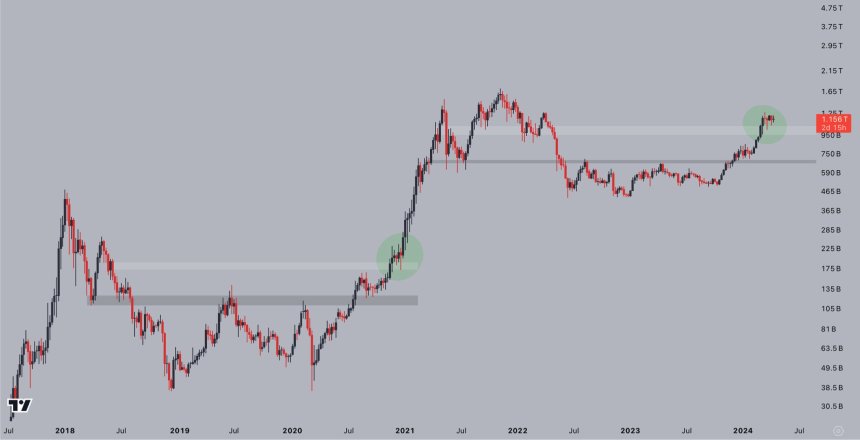
On Friday, some traders shared optimistic forecasts for altcoins. According to investor Crypto Jelle, the altcoin market cap chart “looks primed to go on a massive rally in the coming months.”
The investor highlights the similarities between the altcoin’s performance during the previous bull runs. Per the chart, after 2018’s all-time high (ATH) of $474.5 billion, the altcoin market consolidated under the resistance zone in “preparation” for the next bull run.

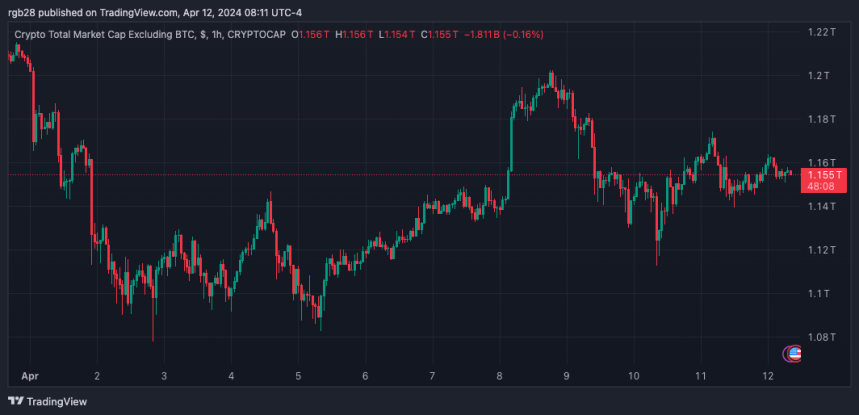
Altcoins market cap sitting at $1.15 trillion. Source: CryptoJelle on X
During the 2020-2021 bull market, altcoins’ market cap broke out and consolidated around a new support zone before continuing its upward trajectory to its last ATH of $1.7 trillion.
As the investor highlighted, altcoins’ performance looks like that of the previous bull run. They are seemingly consolidating after a breakout from the resistance zone. If history were to repeat itself, then altcoins could “remind everyone what they’re capable of.”
Another trader and analyst, Titan of Crypto, shared a similar prediction to Jelle’s. According to the analysts, he’s seen crypto community members believing that “there’ll never be another altseason.”
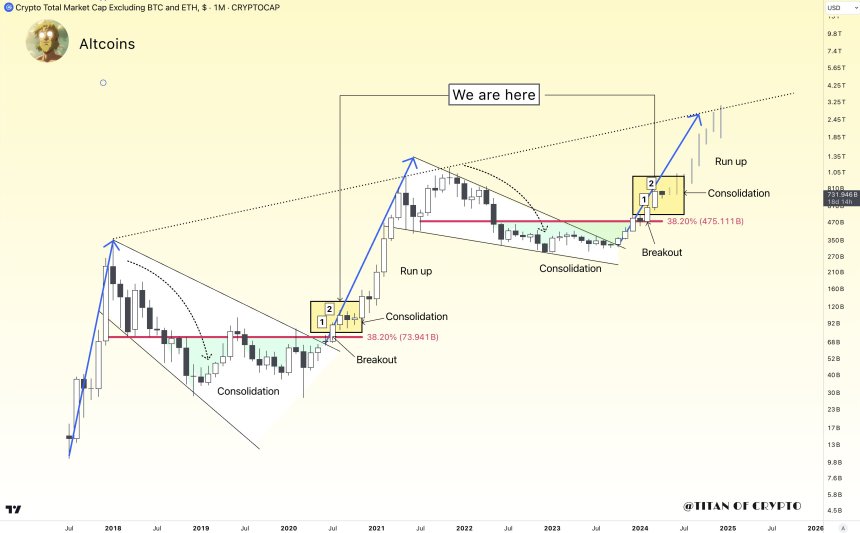
To those in doubt, the trader suggests they “zoom out” to get a broader perspective on where the market is in the cycle. Per his chart, which excludes Ether (ETH), altcoins are at the “2 bullish monthly candles followed by consolidation” phase.

Run up prediction for altcoins, excluding ETH. Source: Titan Of Crypto on X.
The chart also suggests that the subsequent run-up could surpass the $1.13 trillion ATH and soar to a market cap of $3.25 trillion in the coming months. To the analyst, the “#Altseason2024 is inevitable.”
Predictions Are Up, Why Is The Sentiment Down?
Across different platforms, the sentiment seems to lean towards “negative” despite the optimistic forecasts. Follis, content creator and founder of Chroma Trading shared his experience on X this Thursday.
According to the post, “sentiment at the moment is some of the worst” he’s seen during his years in the crypto community. Moreover, he considers “engagement is dead” as “everyone is quiet” across X, Discord, and Twitch.
Sentiment at the moment is some of the worst I’ve seen in my 3y in crypto
Twitter, twitch, discord – everyone is quiet, engagement is dead$BTC only -6% from ath but lots of alts down -40% or more. No real bid to be found for a month or more, except on random rotations &…
— フ ォ リ ス (@follis_) April 11, 2024
The post opened a discussion as to what could be the reason. Follis suggested a combination of “over-leveraged top longers” and “traders who expected price to go up indefinitely.”
Another user weighed in, suggesting traders lost significant money buying high and selling low on Solana and Base memecoins.
Top crypto trader Ansem joined the discussion, disagreeing with the “depressing” take on the current market. The trader pointed out that BTC was at $70,000 and ETH at $3,500 at the time of his post. These prices represent a 129.8% and 82.5% increase in the past year.
Similarly, he highlighted the performance of SOL compared to the bear market bottom and the remarkable performance of memecoins in the past six months. Many users agreed that drawdowns are usual during market cycles and ultimately suggested looking at the bigger picture.

Altcoins market cap is at $1.15 trillion. Source: TOTAL2 on Tradingview
Featured Image from Unsplash.com, Chart from TradingView.com
Disclaimer: The article is provided for educational purposes only. It does not represent the opinions of NewsBTC on whether to buy, sell or hold any investments and naturally investing carries risks. You are advised to conduct your own research before making any investment decisions. Use information provided on this website entirely at your own risk.