The stablecoin sector experienced a $3.26 billion expansion within the last eight days, climbing from $140.82 billion to $144.08 billion by Sunday, March 3, 2024. During February, increases in supply were observed in four of the top five stablecoins by market cap, with FDUSD’s supply growth leading amongst the five. Stablecoin Economy Rises 2.31% in […]
Source link

CoinNews
February job report, Powell’s visit to Capitol Hill are on investors’ radar this week

It is a crucial week for economists and investors as key economic data will be released, along with two days of testimony from Fed Chairman Jerome Powell before Congress.
Powell testifies before Congress
Wednesday, Thursday at 10:00 a.m. Eastern
Fed officials have been singing from the same songbook over the past few weeks, stressing patience about potential interest-rate cuts. Fed Gov. Christopher Waller, summed it up best when he recently asked “what’s the rush?”
Powell may not have appreciated that question. He is going to spend two days this week with lawmakers on Capitol Hill, many of whom are more than likely to have an answer prepared for Waller’s question.
Remember, Senate Democrats already wanted the first rate cut in January, saying that the Fed’s tight monetary policy was damaging the housing market. Talk of patience might not be welcomed.
Democrats are eager for the Fed to cut rates and potentially give the economy a jolt going into the November elections. Republicans will likely stress the need for the Fed to stay the course to combat still-high inflation. It is a political year and the Fed’s actions will be seen in that light, no matter how often it swears to be apolitical.
February job report
Friday at 8:30 a.m. Eastern
Economists expect the labor market to cool after two “fiery” job gains the past two months, said Douglas Porter, chief economist at BMO Capital Markets. In December and January, the economy added an average of 268,000 net new jobs per month.
Economists surveyed by the Wall Street Journal expect the economy to add 210,000 jobs in February. The unemployment rate is expected to remain steady at 3.7%., nearly as low as it has been in 50 years. Average hourly wages are expected to moderate to a 0.2% gain from the strong 0.6% rise in the prior month.
“Even though we believe job growth will cool in February, we still see a number of signs that the labor market remains strong, Feroli of JPMorgan said.
Q1 GDP tracking estimate
Data not officially released until end of April
Economists are ratcheting up their forecasts for first-quarter gross domestic product based on recent data.
Michael Feroli, chief U.S. economist at JP Morgan Chase, said he raised his estimate to a 2.25% rate in the January-March quarter, from his prior forecast of 1.7%.
Aichi Amemiya, senior economist for the U.S. at Nomura Securities, said he’s raised his tracking estimate to 2.2% from 2.1%.
The Atlanta Fed’s GDPNow estimate is 2.1%, down from 3% previously.
The government revised its estimate for fourth quarter growth to 3.2% from 3.3% previously. The official first-quarter GDP data won’t be released until April 25.
So the economy “is still in the soft landing zone,” said Scott Anderson, chief U.S. economist at BMO.
Cathie Wood’s Ark Invest Is Selling Nvidia Stock and Buying This Artificial Intelligence (AI) Stock

Cathie Wood is the founder and chief investment officer at Ark Invest, an asset management company focused on disruptive innovation. Ark manages several thematic index funds built around burgeoning technologies like artificial intelligence (AI), but the firm continued to sell down its position in Nvidia (NASDAQ: NVDA) throughout February.
That may strike readers as strange given that Nvidia graphics processing units are synonymous with AI infrastructure. But the stock has advanced 236% over the past year, so Ark is taking profits and reinvesting capital into other AI companies. For instance, the firm bought shares of Pinterest (NYSE: PINS) throughout February. The social media company now accounts for a little more than 1% of Ark’s $14 billion portfolio.
Here’s what investors should know.
Pinterest failed to impress with its fourth-quarter results
Pinterest reported mixed financial results for the fourth quarter. Global monthly active users (MAUs) increased 11% to 498 million and average revenue per user (ARPU) increased 2% to $2.00. Wall Street analysts anticipated slightly slower MAU growth, but slightly faster ARPU growth.
As a result, Pinterest missed top-line estimates. Revenue increased 12% to $981 million, but Wall Street was looking for $991 million. Despite that shortfall, the company beat bottom-line estimates due to effective expense management. GAAP net income reached $201 million in the fourth quarter, up from $17 million in the prior year.
Pinterest shares declined about 10% following the release of the report, and the stock is still 60% below the record high it reached in early 2021. But the company is executing on a sensible growth strategy by investing in artificial intelligence (AI) and partnering with third-party advertisers. Those moves could create value for patient shareholders in the years ahead.
Pinterest is executing on a sensible growth strategy
Pinterest operates a social media platform that lets users explore and curate visual content to discover new products and ideas. Its monthly user base trails that of Meta Platforms‘ Facebook and Instagram, ByteDance’s TikTok, and Snap‘s Snapchat, but Pinterest still ranks among the 15 largest ad tech companies in the world. That positioning is a product of its ability to collect consumer data and influence shopping decisions, and ongoing investments in AI help make that possible.
In the first quarter, Pinterest CEO Bill Ready said:
Nearly a year ago, we began moving to next-gen AI capabilities, enabling us to use recommender models that were 100x larger than before. We combined our first-party proprietary data with our AI-based computer vision and search technologies to improve perceived relevance for recommendations on related pins, driving perceived relevance up by nearly 10 points from a year ago to 94%.
In the fourth quarter, Pinterest added generative AI search guides to help users refine queries and take action (make purchases) more easily. It also debuted an AI-powered organization feature that automates content curation for users. Management says those innovations create a powerful flywheel. Specifically, Pinterest’s ability to make relevant recommendations improves as user engagement improves, simply because engagement creates data the company can feed into its machine learning models.
In addition to AI innovation, Pinterest has partnered with Amazon and Alphabet‘s Google to bring third-party advertising to its platform. Specifically, Amazon ads are live in the U.S. on Pinterest search and the home feed, and Google ads are live in international markets. Those partnerships let Pinterest tap advertising demand beyond its own ecosystem, and its partnership with Amazon in particular makes it easier for users to buy products they see on the platform.
Pinterest stock trades at a reasonable price
Going forward, digital ad spending is projected to grow at 15% annually through 2030, according to Grand View Research. How quickly Pinterest grows depends on its ability to generate demand among advertisers, which itself depends on its ability to engage users with relevant content and drive desirable outcomes for brands.
On that front, management is making sensible decisions that could lead to market share gains. Wall Street expects Pinterest to grow sales at 15% annually over the next five years, so that consensus estimate leaves room for upside if the company does indeed gain share. In either case, its current valuation of 8.2 times sales seem reasonable.
As a caveat, Pinterest faces tough competition from larger, more popular social networks that could siphon advertising dollars away from its platform. But unlike Pinterest, those competing platforms are not purpose-built for product discovery.
In other words, Pinterest is undoubtedly an underdog, but it also has unique strengths that could make it more effective in driving social commerce. If the company harnesses that potential, it could create substantial value for patient shareholders. Investors comfortable with that risk should consider buying a small position in Pinterest today. Personally, I like Ark’s decision to allocate about 1% of its portfolio to the stock.
Should you invest $1,000 in Pinterest right now?
Before you buy stock in Pinterest, consider this:
The Motley Fool Stock Advisor analyst team just identified what they believe are the 10 best stocks for investors to buy now… and Pinterest wasn’t one of them. The 10 stocks that made the cut could produce monster returns in the coming years.
Stock Advisor provides investors with an easy-to-follow blueprint for success, including guidance on building a portfolio, regular updates from analysts, and two new stock picks each month. The Stock Advisor service has more than tripled the return of S&P 500 since 2002*.
*Stock Advisor returns as of February 26, 2024
John Mackey, former CEO of Whole Foods Market, an Amazon subsidiary, is a member of The Motley Fool’s board of directors. Suzanne Frey, an executive at Alphabet, is a member of The Motley Fool’s board of directors. Randi Zuckerberg, a former director of market development and spokeswoman for Facebook and sister to Meta Platforms CEO Mark Zuckerberg, is a member of The Motley Fool’s board of directors. Trevor Jennewine has positions in Amazon, Nvidia, and Pinterest. The Motley Fool has positions in and recommends Alphabet, Amazon, Meta Platforms, Nvidia, and Pinterest. The Motley Fool has a disclosure policy.
Cathie Wood’s Ark Invest Is Selling Nvidia Stock and Buying This Artificial Intelligence (AI) Stock was originally published by The Motley Fool
My friend invited me to a concert — and then asked me to take him for dinner
Dear Quentin,
I have a good friend whom I like very much. He is one of those people I feel very comfortable around, as if I have known him for years. It’s hard to make friends in New York. People have so little time for friendship after work, the gym, kickboxing classes, therapy, checking their stock portfolio and, frankly, plotting their next move to climb up the corporate ladder. I grew up in the Midwest, so I expected people to have more time to develop friendships. This friend has put in the effort, meaning we meet once a week for dinner for about one and a half hours.
He called me this morning to invite me to a concert at Carnegie Hall. I am not a big classical-music buff (I usually fall asleep at operas) but I said I would go and would try to develop a taste for classical music. It beats sitting at home or sitting through all of those advertisements at the cinema. He said, “Great, I look forward to seeing you.” But before we hung up the phone, he added, “What would be nice is if you took me to dinner.” It was 8 a.m. — early to call anyone, but my point is that I was tired — so I said, “Sure!”
However, I was shocked and did not know what to say. I have invited him to the theater in the past and did not expect him to buy me dinner. In fact, the last time I brought him to the theater, I also brought another friend and ended up bringing that other friend for dinner! I didn’t mind, as I see it as “what goes around, comes around,” in a good way. I try not to keep an accounting of who is inviting whom, and assume that it all works out square and even in the wash. But now I’m faced with an evening with this friend where I feel obliged, or forced, to buy him dinner.
It takes the good out of the gesture if you have been instructed to take out your credit card. What would you do? Is this normal behavior?
Friend In Need
Related: ‘I felt humiliated’: She slipped the waiter her credit card on her way to the restroom. Is it emasculating for a woman to pay for dinner on a first date?
“Some people have certain social protocols to make life easier, especially in an expensive city like New York.”
MarketWatch illustration
Dear Friend,
What would be nice — to use your friend’s phrase — is if he had worded his question differently: “Would you like to see this concert at Carnegie Hall? I’ll get the tickets, and you can get dinner.” It’s not the most polished way of proffering an invitation, but at least it establishes the conditions up front. You wouldn’t like to accept a free ticket from a stranger on the street who then pointed at a nearby restaurant and added, “Now you have to buy me dinner!” Taking him to dinner seems fair, but being asked to do so after you accepted his theater invitation is a rug pull.
There is another, unspoken issue here. The invitation seems pointed, and if it seems pointed, it probably is pointed. You have your own social contract, which may be less transactional on the surface but may not work as consistently, leaving room for a missed dinner invitation here and a missed theater invitation there. That can leave people who have a different mode of behavior with a bee in their bonnet — “I paid the last time we went to Carnegie Hall, and he didn’t even buy me dinner!” — even if you feel like you returned the favor in other ways.
Some people have certain social protocols to make life easier, especially in an expensive city like New York. For example, if one person buys a $20 glass of wine, it’s polite for them to tell their dinner companion, “Let me leave the $20 tip, as I had a drink and I don’t think it’s fair that you should pay for my alcohol.” And the next time they meet and the same thing happens with the other friend, they can say, “I’ll get the tip.” That is, the protocol is understood. The problem here is that tickets to Carnegie Hall range from $81 to $224, so it’s not a cheap night out.
What do you do? You won’t enjoy the concert, especially as you’re only going because he had a spare ticket and you think you’re doing him a favor by trying not to sleep through a recital. And you certainly won’t enjoy your meal, knowing that you have been instructed to produce your credit card at the end of it. The beauty of offering an invitation is that it’s a gift, a gift with monetary value, sure, and also one that says your friend wants to spend time with you. So you won’t be doing him any favors by going now.
If you have, say, three days or more before the event, decline. Make a polite excuse, and the next time you meet for dinner, pick up the bill.
You can email The Moneyist with any financial and ethical questions at qfottrell@marketwatch.com, and follow Quentin Fottrell on X, the platform formerly known as Twitter.
The Moneyist regrets he cannot reply to questions individually.
Previous columns by Quentin Fottrell:
‘I don’t want my wife to lose everything’: I’ve been diagnosed with dementia — I suddenly could not spell or write legibly
‘Things have not been easy’: My sister is a hoarder and procrastinator. She is delaying probate of our parents’ estate. What can I do?
‘I gave up a job that I loved passionately’: My husband secretly set up a trust that includes our home and his investments. What should I do?
Check out the Moneyist private Facebook group, where we look for answers to life’s thorniest money issues. Post your questions, or weigh in on the latest Moneyist columns.
By emailing your questions to the Moneyist or posting your dilemmas on the Moneyist Facebook group, you agree to have them published anonymously on MarketWatch.
By submitting your story to Dow Jones & Co., the publisher of MarketWatch, you understand and agree that we may use your story, or versions of it, in all media and platforms, including via third parties.

Binance is in hot water in Nigeria in the aftermath of its settlement with the U.S. Department of Justice (DOJ). Nigeria’s House of Representatives Committee on Financial Crimes issued an ultimatum to Binance CEO Richard Teng on Friday, according to a local news report.
Ginger Onwusibe, the chairman of the committee, has asked Teng to appear before the committee by March 4. The summons was issued over its alleged involvement in financial crimes, including money laundering and terrorism financing.
Onwusibe warned that Teng’s failure to answer the summons would force the committee to invoke its constitutional powers and take appropriate steps.
In its U.S. plea deal, which received the judge’s approval last week, Binance pled guilty to money laundering and terrorism financing. The exchange also agreed to pay a historic fine of $4.3 billion and operate with monitoring as part of its settlement.
Binance has been uncooperative with the Nigerian committee
Shortly after Binance’s U.S. plea deal was announced, in a letter dated Dec. 12, the committee first asked Binance’s Managing Director to attend a hearing on Dec. 18. Binance was asked to brief the committee regarding Binance’s disregard for Nigeria’s laws.
The Nigerian Committee issued the ultimatum after Binance refused its invitation to address the committee in the past several times.
Onwusibe said:
“The constitution of the Federal Republic of Nigeria has empowered us to protect Nigerians from financial crimes, especially by foreign companies… The allegations of terrorism financing, money laundering, and tax evasion, amongst others levelled against Binance are damning enough.”
Onwusibe said the committee is resolved to fight financial crime and “block the leaks and channels to financing terror,” and “no distraction and manipulation can stop us.”
With Nigeria struggling with recession, the committee is also trying to collect as many tax dollars as possible.
According to Onwusibe, Binance caters to over 10 million Nigerians on its platform. However, the exchange does not pay any taxes in the country. Binance also does not have a physical presence in Nigeria where users can lodge complaints, Onwusibe said, adding:
“The era of exploitation is over and all culprits must be held accountable.”
Binance’s woes in Nigeria are escalating
Last week, the country’s telecom regulator, the Nigerian Communications Commission (NCC), ordered telecom companies to block access to websites of foreign crypto exchanges, including Binance, Coinbase, and Kraken.
On Feb. 26, Nigeria’s Department of State Security detained two Binance executives and confiscated their passports in connection with the investigation into Binance, according to a DLNews report.
A day later, Olayemi Cardoso, governor of the Central Bank of Nigeria, said that Binance Nigeria has witnessed “suspicious flows” of money in 2023. He stated:
“In the case of Binance, in the last one year alone, $26 billion has passed through Binance Nigeria from sources and users who we cannot adequately identify.”
On Friday, the BBC reported that the Nigerian government has ordered Binance to pay $10 billion in compensation. The report also noted that the government believes Binance and its executives manipulated foreign exchange rates through currency speculation and rate-fixing.
In a report on the same day by the Peoples Gazette Nigeria, a Binance spokesperson said that while the exchange was in talks with the government to “resolve issues,” it has not been informed of a $10 billion fine. In the same report, special advisor Bayo Onanuga said that his comments to the BBC were misinterpreted and that he never said the government had finalized the amount of the fine or that Binance was aware of it.
A young woman in her early 20s riding a chopper cycle.
Karan Kapoor | The Image Bank | Getty Images
Having a strong budget can help you build financial wellness.
“A budget is a picture of what your money is doing,” Tiffany Aliche, also known as The Budgetnista, told CNBC during a Women & Wealth livestream.
“It’s the foundation where you build your financial house. You have to understand what your money is doing,” said Aliche, a personal financial educator and author of “Get Good with Money.”
More from Women and Wealth:
Here’s a look at more coverage in CNBC’s Women & Wealth special report, where we explore ways women can increase income, save and make the most of opportunities.
By examining what you spend and setting a budget, you may find the cash to build other financial safeguards, such as an emergency savings fund and retirement contributions.
“You’re supposed to give each dollar a job,” said Sophia Bera Daigle, a certified financial planner and the founder of Gen Y Planning in Austin, Texas.
It might also be good to think of your budgets from an annual perspective. Taking on a new, big expense like a car or house, or even experiencing the occasional emergency, can affect your monthly spending, said Daigle, who’s also a CNBC Financial Advisor member.
Three steps to start a budget
1. Make a list of expenses: The first thing to do is write a list of all the things you spend money on within a given month, said Aliche. “That’s step one.” Consider expenses that are fixed, such as your rent or car payment, and those that are variable, such as groceries and utilities. It can also help to list out expenses you don’t pay every month, such as annual memberships or quarterly taxes.
2. Check your records: Next, see how those estimates match up to what you actually spend. Pull up your recent debit and credit card statements, and add up how much money you spent in a recent month.
3. Figure out how your spending matches with your income: Once you know how much you spend on a monthly basis, find the difference from how much you earn. Aliche calls this “the tears and tissues” step because many people realize they are overspending.
A lot of people hold onto the financial mistakes they made in their life, said Aliche. Don’t let the “tears and tissues” budgeting step derail you.
“Shame shields solutions,” she said.
To progress, lean on your community for emotional support and accountability. Figure out how to adjust your spending to bring your budget in line and give you room to meet your goals.
Also, “understand that money is a team sport,” said Aliche. You need a “board of directors” to help you reach your goals, such as an accountability partner, an accountant and a financial advisor.
SIGN UP: Join the free virtual CNBC’s Women & Wealth event on March 5 at 1 p.m. ET, where we’ll bring together top financial experts to help you build a better playbook, offer practical strategies to increase income, identify profitable investment opportunities and save for the future to set yourself up for a stronger 2024 and beyond.
Billionaire Bill Ackman Has 18% of His Pershing Square Portfolio Invested in 1 Unstoppable Stock
One way individual investors can find lucrative ideas is by following smart investment managers and note what stocks they own in their portfolios. Take Bill Ackman, the billionaire hedge fund manager of Pershing Square Capital Management. He runs a very concentrated book that focuses on what he believes are high-quality businesses with a long-term mindset.
Chipotle Mexican Grill (CMG) is one of Ackman’s top holdings, representing 18.2% of the portfolio as of Dec. 31. Ackman’s firm has owned the restaurant stock since the third quarter of 2016 at an initial cost basis of about $411 per share. From that price point, shares are up a whopping 545%.
Let’s take a closer look at Chipotle’s thriving business. Investors can then decide if the stock is a smart buy right now.
A comeback story
In the last five years, Chipotle’s revenue and diluted earnings per share have climbed at compound annual rates of 15.2% and 47.7%, respectively. These strong fundamental gains were undoubtedly the key ingredient for the stock’s impressive run.
The company performed extremely well during the COVID-19 pandemic. It leaned on its strong digital foundation and drive-through locations to serve hungry customers. And even in the last couple of years, a period of economic uncertainty, inflationary pressures, and recessionary fears, Chipotle continues posting stellar financial results.
In 2023’s fourth quarter, the business reported an 8.4% year-over-year, same-store sales jump driven by a 7.4% increase in transaction counts. This indicates that traffic isn’t letting up, and that consumers find tremendous value in Chipotle’s offering.
However, the business wasn’t always firing on all cylinders like it is now. When Ackman first purchased shares more than seven years ago, Chipotle was dealing with the fallout from the E. coli scare, which resulted in falling sales, waning trust, and a tarnished reputation. The famed hedge fund manager was greedy when others were fearful, as the great Warren Buffett emphasizes.
Lofty expectations
Investors looking to follow in Bill Ackman’s footsteps and take a big bite out of Chipotle stock right now are better off waiting patiently for a more attractive entry price. The market is fully aware of how wonderful this business is. On a forward basis, the current price-to-earnings ratio is about 50. That implies truly huge expectations for the company.
As a restaurant operator, Chipotle might be the furthest thing from the ongoing artificial intelligence boom, but it certainly has a lot of growth potential. This is likely what investors are most focused on, which is why shares are expensive.
There are currently 3,437 Chipotle locations that generate an average of $3 million in annual unit volume (AUV). Management believes there could be 7,000 stores open in North America one day that rake in $4 million of AUV. That means the long-term potential is to produce $28 billion in revenue, compared to 2023 sales of $9.9 billion.
The leadership team had originally targeted 6,000 stores as the ultimate goal. But seeing how well the restaurants were performing, they upped their outlook. It’s totally in the realm of possibilities that at some point in the future, they will raise the target again. However, that’s unpredictable, as we can’t read the CEO’s mind.
It’s worth pointing out the 7,000 stores target doesn’t include restaurants outside of North America. If Chipotle finds success in other parts of the world, there is even more upside. Based on the current valuation, though, I think this optimism is more than fully reflected in the stock price.
Neil Patel and his clients have no position in any of the stocks mentioned. The Motley Fool has positions in and recommends Chipotle Mexican Grill. The Motley Fool has a disclosure policy.
Alphabet (GOOGL -0.95%) (GOOG -1.22%) stock has run like wildfire over the past year, riding the recovery of tech stocks, the rebound of digital advertising, and the accelerating adoption of artificial intelligence (AI). Share prices of the search leader gained 52% during the past 12 months, nearly double the 27% gains of the S&P 500.
Investor confidence is on the upswing, fueled by the company’s improving financial results, which suggests that the advertising market — which represents the lion’s share of Alphabet’s revenue — will continue to gain ground.
Investors who sat out the recent rally are left asking themselves the quintessential investing question: Is a pullback coming, or should they buy Alphabet before the stock runs even higher? Let’s see what the evidence suggests.
Image source: Getty Images.
Multiple growth drivers on the horizon
Despite the bruising downturn of 2022 and the stock’s recent run higher, there are still reasons to be optimistic. Google remains the worldwide search leader, with more than 91% of the market, according to data compiled by web traffic analytics provider StatCounter. This is the funnel that drives the digital advertising that provides nearly all of Alphabet’s revenue. The company garnered an estimated 39% of worldwide digital ad revenue last year, according to online data provider Statista.
Furthermore, digital ad spending is expected to spike in 2024, increasing 13% year over year, according to data compiled by Insider Intelligence. As the global leader, Alphabet is best positioned to ride that secular tailwind higher.
The recovery in ad spending is already showing up in Alphabet’s results. In the fourth quarter, Alphabet’s revenue increased 13% year over year to $86.3 billion, accelerating from a 1% increase in the year-ago quarter. This suggests the advertising market is finally making a comeback, which could ultimately push Alphabet’s stock higher.
That’s not the only potential catalyst that could drive gains for the company.
The move to the cloud, a foundational part of the digital transformation, could also provide a boost. In the fourth quarter, Google Cloud remained the world’s third-largest cloud infrastructure provider, with 10% of the market, trailing Amazon Web Services and Microsoft Azure, which controlled 31% and 26%, respectively, according to market analytics company Canalys.
The role of cloud infrastructure services in providing generative AI to users has also been a hot topic, and Google Cloud is at the forefront of the conversation.
Its Vertex AI service offers everything users need to get AI up and running, including 130 prebuilt foundation models to choose from. Users can also accelerate the development process to “build, deploy, and scale AI-powered applications,” according to the company.
The most recent addition to its portfolio of products is Google Gemini, the company’s “largest and most capable AI model.” The system was designed to understand and incorporate information from a multitude of sources, including audio, video, text, images, and even computer code. Tests suggest its premiere model, Ultra, “exceeds current state-of-the-art results on 30 of the 32 widely used academic benchmarks” used to assess AI performance.
How to approach Alphabet stock now
Alphabet is currently selling for roughly 24 times trailing earnings, a discount compared to the price-to-earnings (P/E) ratio of nearly 28 for the S&P 500.
Furthermore, it’s difficult to quantify the impact of generative AI. As the opportunity continues to unfold, Alphabet could be among the principal beneficiaries of this secular tailwind.
As noted above, there are several growth drivers that could fuel an ongoing rally for Alphabet stock in the coming months and years. Given the opportunities ahead and its strong history of growth, I’d suggest now is the time to buy Alphabet stock while it’s still on sale.
Suzanne Frey, an executive at Alphabet, is a member of The Motley Fool’s board of directors. John Mackey, former CEO of Whole Foods Market, an Amazon subsidiary, is a member of The Motley Fool’s board of directors. Danny Vena has positions in Alphabet, Amazon, and Microsoft. The Motley Fool has positions in and recommends Alphabet, Amazon, and Microsoft. The Motley Fool recommends the following options: long January 2026 $395 calls on Microsoft and short January 2026 $405 calls on Microsoft. The Motley Fool has a disclosure policy.
Here’s the Average Social Security Benefit at Every Age From 62 to 70
The age at which you begin taking Social Security will affect your monthly income for the rest of your life, so it’s critical to make this decision carefully.
You can begin claiming at age 62 or anytime after that, and the longer you wait (up to age 70), the more you’ll receive each month. The age at which you file can affect your payments by hundreds of dollars per month, and if you’re going to be relying heavily on your benefits, this decision could make or break your retirement.
The age at which you should start taking benefits will depend largely on your situation, but it can be helpful to see the average payments at various ages. Here’s exactly how much the average retiree receives, as well as a few tips for deciding on the right age to make your claim.
Image source: Getty Images.
The average Social Security benefit by age
Your age is one of the most important factors influencing your benefit amount. To receive the full payments you’re entitled to based on your work history, you’ll need to wait until your full retirement age (FRA) to file. This age varies by birth year, but it’s 67 years old for everyone born in 1960 or later.
If you file before your FRA, your benefits will be reduced by up to 30%. By delaying past your FRA, you’ll earn your full benefit plus a bonus of between 24% and 32% per month. These adjustments are permanent, too, so the age at which you file will affect your income for the rest of your retirement.
The average retirement benefit varies widely by age. Here’s what those averages look like, according to the Social Security Administration’s most recent data released in December 2022:
| Age | Average Monthly Retirement Benefit |
|---|---|
| 62 | $1,275 |
| 63 | $1,365 |
| 64 | $1,412 |
| 65 | $1,505 |
| 66 | $1,720 |
| 67 | $1,845 |
| 68 | $1,848 |
| 69 | $1,819 |
| 70 | $1,963 |
Source: Social Security Administration. Table by author.
The average retiree at age 70 collects nearly $700 per month more than the average retiree at age 62. If your savings fall short or even run dry in retirement, those higher payments can go a long way.
There’s no one-size-fits-all approach as to when you should begin claiming Social Security. But to make the decision a little easier, there’s one question to ask yourself: What’s your biggest priority in retirement?
When it pays to delay Social Security
If maximizing your monthly income is your primary goal, delaying benefits until age 70 will help you achieve that. Because delaying benefits will result in larger checks for the rest of your life, this strategy can help you enjoy a more financially secure retirement — even if your savings eventually run out.
Waiting a few years to claim can also be a smart idea if you’re worried about benefit cuts. While Social Security isn’t going away, there could potentially be cuts within the next decade or so if Congress can’t fund a solution to the program’s cash shortfall. If that happens, having bigger checks to begin with can help cushion the blow.
When you might want to file early
That said, there are valid reasons to consider filing early, too. For example, if you’re battling health issues or have reason to believe you won’t live well into your 70s or beyond, it may not make sense to delay benefits. While you’ll still receive smaller monthly payments by claiming early, you could collect more over a lifetime than if you were to delay.
Finally, if you have a robust retirement fund and don’t necessarily need the extra cash from Social Security, filing early can make it easier to retire earlier. You don’t have to file for benefits as soon as you retire, but doing so can give you some extra income each month so you’re not relying entirely on your savings — and risking depleting your retirement fund too quickly.
There’s not necessarily a “best” time to take Social Security, as it will depend on your unique circumstances. But when you know how your age will affect your benefit amount, it can help make the decision a little easier.
The artificial intelligence (AI) market is full of hype and speculation, with early AI leaders like Nvidia or Microsoft trading at nosebleed valuations. Whether the AI market darlings deserve their rich valuations or not, three Fool.com contributors believe it’s time to look beyond the usual suspects.
They put their heads together to uncover existing tech giants like International Business Machines (IBM 1.71%), Cloudflare (NET 1.40%), and Salesforce (CRM 2.61%) — three great companies with deep AI expertise. This trio offers compelling value and potentially significant long-term returns from their AI initiatives.
Investing is a marathon. IBM, Salesforce, and Cloudflare have been running the AI race for years, and they won’t stop anytime soon.
IBM is the big, blue AI workhorse
Anders Bylund (IBM): Generative AI tools and flashy consumer tech often dominate the headlines. Meanwhile, good old tech titan IBM is quietly positioning itself as the backbone of enterprise-grade AI solutions.
The company’s hybrid cloud focus, emphasis on explainability and trackable data sources, and deep industry relationships might not seem as sexy as the latest ChatGPT upgrade, but these are the very elements that should make IBM an enduring force in the AI space.
IBM’s focus on long-term partnerships and sustainable solutions aligns with the needs of businesses wanting to use AI in an impactful yet responsible way. As concern grows around AI systems’ potential for harmful biases, misleading output, and black-box decision-making, IBM’s approach inspires a deeper trust.
The long-term contracts Big Blue signs with enterprise-class customers will depend on that professional-grade trust. “Hallucinations” and data mishaps are common themes in today’s large language models (LLMs), but IBM isn’t interested in playing that game. The likes of OpenAI, Microsoft, and Alphabet don’t seem ready to compete from the transparency and quality angle so far.
Critics might argue that IBM’s “slow and steady” approach is a disadvantage. But in the realm of enterprise solutions, patience and thoroughness should be seen as strengths. The slow and heavy vetting IBM’s prospective clients apply to the Watson AI systems today will result in lucrative, hard-to-replace, multiyear contracts.
“The early work for clients around data architecture, security, and governance is critical and hard, and we think consulting expertise is going to be crucial here,” CEO Arvind Krishna said in the recent fourth-quarter earnings call.
Moreover, IBM’s current valuation presents a potential value opportunity compared to some of the AI market’s highfliers. The stock trades at a modest 2.7 times sales and 13 times free cash flow, making even Alphabet look expensive in comparison with the same ratios clocking in at 5.6 and 25, respectively.
If the company can continue to prove that its AI solutions add tangible, measurable value to businesses, investors who focus on long-term potential may find IBM to be the unsung workhorse of the AI revolution. If nothing else, you’re looking at a generous dividend payer with torrential cash flows and a centennial business history.
IBM’s big AI bet is starting to pay off right now, but even if the business-grade AI strategy fizzles, it’s still a great income-generating stock to own in the long run. That’s a big “if,” though. AI and hybrid cloud computing have emerged as leading growth drivers for the ultra-experienced tech giant. I expect good things and big wins from Big Blue’s AI business in the coming years.
Could this edge computing play be an under-the-radar AI star?
Billy Duberstein (Cloudflare): The past 18 months in artificial intelligence have been all about training, which is the act of building extremely large language models out of billions of data parameters. But now the AI industry is moving to an “if you build it, they will come” phase. In layman’s terms, companies are now actually putting these models to work.
When a trained model is prompted and then goes to work on finding answers or completing a task, that’s called inferencing. And inferencing applications are about to take off.
To see how that shift is unfolding, look no further than Nvidia’s recent earnings report. CEO Jensen Huang said he estimates about 40% of Nvidia’s data center revenue over the past year was actually for inference, not training. That’s somewhat surprising, as Nvidia is thought to be the only game in town for training, whereas it’s possible inferencing could be done with some lower-power processors from competitors.
One company that could be an under-the-radar inference play is Cloudflare, which began as a software company that helped speed up websites, software applications, and content delivery.
But Cloudflare’s management was forward-thinking, taking the time and cost to build an integrated software stack from the beginning, whereby all of its new products and services can be run on the same type of commodity hardware. That has paid off in the form of an ever-increasing portfolio of products, including cybersecurity, network management, and developer platforms that run on its lightweight servers in internet service provider data centers close to customers at the edge.
Today, Cloudflare’s servers are in 310 cities in over 120 countries connecting 13,000 networks, with its network now within 50 milliseconds of 95% of the world’s population. And that makes Cloudflare a potentially ideal place for businesses to run their inference workloads. That’s because inference workloads are likely too computing-intense to run on end devices such as PCs or phones, but are likely “lightweight” enough so that they don’t have to be run all the way back in a large, cloud-based data center.
Management began to capitalize on this potential last September when Cloudflare released Workers AI, an inferencing-as-a-service platform for developers in Cloudflare’s servers, which could potentially put Cloudflare up against the big cloud computing players for inference workloads.
And the new offering is showing early signs of success, with Workers AI requests growing 9x between September and December, according to Cloudflare’s recent fourth-quarter conference call with analysts. And even though the new inference offering just came out and contributes little to revenues today, Cloudflare still saw a very healthy 32% revenue growth in the last quarter, driven by its core products. Of note, Cloudflare is really penetrating larger enterprise customers now, with the company recording its largest customer win, as well as its largest customer renewal ever last quarter.
With much-loved offerings across its core content delivery, network, and cybersecurity markets that are still growing strong, Cloudflare’s new inference products could bolster its already-strong growth rate for years to come.
A transition from growth to value
Nicholas Rossolillo (Salesforce): After a couple of years of unwinding out-of-control spending that cropped up during the pandemic, customer data and relationship management platform Salesforce (CRM 2.61%) is totally back. The software giant reported revenue growth of 11% this past year, despite a big slowdown in corporate spending as companies looked to tighten up as the economy slowed. Salesforce is predicting some of this soft spending among its users will continue, but is still nevertheless predicting revenue growth of about 9% for 2024 (fiscal year 2025 for Salesforce).
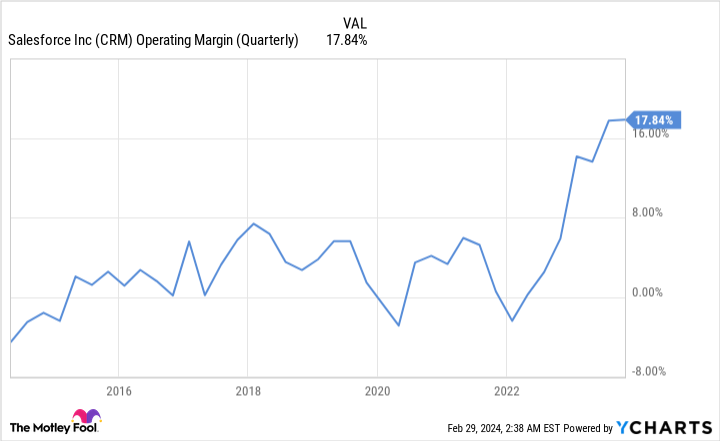
As the business has matured, Salesforce made a quick pivot from all-out growth (it had been putting up 20%-plus sales growth for the duration of its existence as a publicly traded stock over the last two decades) to a more value-generating business. CEO Marc Benioff and the top team ratcheted up generally accepted accounting principles (GAAP) operating profit margins this last year to 14.4%, and expects that figure to jump to 20.4% for full-year fiscal 2025.
Data by YCharts.
Along the way, Salesforce started repurchasing its own stock as part of a new strategy to begin returning cash to shareholders. And starting this year, Salesforce will also begin paying a quarterly dividend — which, as of this writing, is worth 0.5% in annualized yield. That’s not too exciting, but it nevertheless signals this data management software company’s successful evolution into a more mature business.
Of course, customer data is more important than ever in a new era of AI-fueled computing technology. Salesforce’s own development of AI throughout its platform isn’t translating into any pick-up in growth just yet. However, that tees up the possibility of management underpromising and overdelivering this year on financial guidance. Plus, Benioff and company said its own internal use of its AI tools should fuel the profit margin expansion story for years to come.
Salesforce stock now trades for about 45 times expected GAAP earnings per share (EPS), or about 30 times EPS on an adjusted basis (which corresponds a bit more closely to free cash flow). Shares have been on a hot run in the last year, but there are still years’ worth of profitable returns left in the tank for this cloud software leader. I’m happy to keep holding.