Gold advocate and vocal bitcoin critic Peter Schiff has warned of a bubble in bitcoin exchange-traded funds (ETFs) that will burst when gold rallies. Schiff argues that gold will “inevitably” break out, and the price of bitcoin will crash as investors withdraw from bitcoin ETFs. “Bitcoin has basically become a bet against gold,” he stressed. […]
Source link
CoinNews
Fisker seeks deal with another carmaker to remain afloat, shares plunge

Fisker Inc. shares fell 37% in extended trading Thursday after the EV maker said it was brokering a deal with an unnamed “large” carmaker as it seeks to remain in business, adding that there would be “substantial doubt” about its ability to do just so without a capital injection.
The deal could include an investment in Fisker
FSR,
a joint development of one or more electric-vehicle platforms and North American manufacturing, Fisker said.
Fisker has been dubbed the “Apple of autos,” having inked deals with manufacturers to produce its EVs and choosing to focus on the design side of the business.
The company also said that its current resources are insufficient to meet its needs over the next 12 months, and that it will need to seek additional equity or debt financing.
If there’s no financing or if financing terms are “less desirable” than expected, the company “may be forced to decrease its planned level of investment in product development, scale back its operations including further headcount reductions, and reduce production of the Fisker Ocean, which could have an adverse impact on the company’s business and financial prospects,” the EV maker said.
“As a result, the company expects to conclude there is substantial doubt about its ability to continue as a going concern when its annual financial statements for the year ended December 31, 2023, are filed with the SEC,” it warned.
Fisker said it would cut about 15% of its workforce, and that the reductions are mostly related to the change in its sales strategy from a direct-to-consumer model to a dealer-partner model. It was not immediately clear how many employees Fisker currently has, and the company did not return a request for information.
The company became a public through a merger with a blank-check company in July 2020.
It had an earlier life as privately held Fisker Automotive, which went bankrupt in 2013 after six years in business. The company’s assets were acquired by a Chinese auto-parts maker that also owned the company supplying batteries to Fisker, A123 Systems.
A123 Systems went bankrupt as well, hastening the demise of the old Fisker. The founder of Fisker Automotive, Danish designer Henrik Fisker, had resigned from the company’s amid board infighting just before the bankruptcy, but he retained some brand rights and went on to found Fisker Inc.
Last year was “challenging” for Fisker, including delays with suppliers and other issues that prevented the EV maker from delivering its Ocean SUVs “as quickly as we had expected,” Henrik Fisker said in the company’s statement.
“We also encountered unexpected headwinds in our efforts to establish a direct-to-consumer sales model in both North America and Europe at the same time,” plus “unanticipated challenges” such as rising interest rates and a tight labor market, he said.
Besides the layoffs, Fisker is also streamlining operations, including reducing its physical footprint and overall expenses.
Fisker reported fourth-quarter sales of $200 million, well bellow FactSet consensus for sales of $327.7 million for the quarter.
The EV maker lost $463.6 million, or $1.23 a share, in the quarter, compared with a loss of 34 cents a share in the fourth quarter of 2023. The analysts surveyed by FactSet expected a GAAP loss of 23 cents a share.
Fisker shares have lost 90% in the past 12 months, contrasting with gains of around 28% for the S&P 500 index
SPX.
I borrowed $20K from my mother, and repaid $5K. She has since died. What now?
When we sold our late mother’s house last year for $600,000, the equity was supposed to be divided equally by us four siblings (around $146,000 each). In 1996, I borrowed $20,000 from my mother interest-free to help buy my condo. I promised to pay her back in two years.
I managed to pay her back $5,000 in six months. But I made terrible decisions in my finances and I lost my high-paying job. My budget couldn’t afford to pay her back. I was terrified to tell her. She was extremely angry at that time, so she deducted $20,000 from my inheritance.
Long story short: I defaulted on mom’s loan. When mom made out her will, she produced my letter from 1996, which stated that I did not repay the loan. This is the only evidence of the transaction. I want to have the CPA redo the taxes to show that I paid part of the loan off.
When I called my sister, mom’s power of attorney, she was so upset. She said, “F— you, never talk to me again!” I was shocked! She has never talked to me this way in 75 years. I understand her anger because this is a mess and she’s a hero for doing such a wonderful job as a power of attorney.
I too am upset, but I need every cent of my inheritance. I live in a semi-expensive assisted living facility, and I’m not in good health. On top of that, Medicare only pays part of my health bills. Do you have any suggestions on how to fix this mess, without having to redo our taxes for 2022?
Cash-Strapped Son
Related: ‘Our American dream turned into a nightmare’: I sold my home, but rising interest rates and prices have locked me out of the market. What can I do?
“Your mother lent you this money almost 30 years ago, but did not record it on her tax return, and as such it is most likely considered a gift by the Internal Revenue Service.”
MarketWatch illustration
Dear Cash-Strapped,
You’re digging a dry well.
I’m sorry that you lost your job during your peak earning years. But given the timeline involved, it’s hard to accept that you could not have repaid your mother $15,000 over 28 years. It’s time to get real and acknowledge your part in this family drama. This loan should have been a priority for your budget. If you gave your mother $50 a month over that period, the loan would have been paid before she died.
Your mother lent you this money almost 30 years ago, but did not record it on her tax return, and as such it is most likely considered a gift by the Internal Revenue Service. In 1996, the annual gift tax exclusion was $10,000, so your mother effectively gifted you twice the eligible amount. Given that your mother passed away last year, it seems like that boat has sailed.
If you wish to amend your mother’s 2022 tax return, it’s years too late. And if you think that amending your mother’s return will restore your full $146,000 inheritance, you’re sadly mistaken. She appears to have left a will stating that she wanted $20,000 deducted from your inheritance. You can’t undo that by adjusting your or your mother’s tax returns.
Gift versus personal loan
From what you write in your letter, it seems like your mother effectively gifted you this money, at least in the eyes of the IRS. “When someone lends you money and doesn’t charge you interest, or charges a below-market rate compared to the IRS’s current applicable federal rate, the IRS might consider the loan a gift or require them to pay income taxes on imputed interest,” Experian
EXPGY,
says.
If this was an official loan, however, the IRS requires a bad-debt statement, explaining the details. “You must deduct a bad debt in the year it becomes worthless. If you realize you could have reported and taken a deduction for an unpaid debt years ago but didn’t, you generally have only three years to amend your return in order to claim it on your tax return,” according to TurboTax
INTU,
Even in that situation, your mother would likely not have been able to deduct a bad debt from your unpaid loan. “It’s a short-term capital loss, so you must first deduct it from any short-term capital gains you have before deducting it from long-term capital gains,” TurboTax adds. “You can deduct up to $3,000 of any remaining balance from other income.” But that’s all water under the bridge now.
A decade-long drama
Rather than think about what you are owed, look at it from your family’s perspective. You are the one who defaulted on a loan and a promise. That $20,000 would be equivalent to nearly $30,000 in purchasing power in 2024 — and that doesn’t account for the equity your mother “invested” in your home, which likely appreciated by the time you sold it. No one has done you a bad turn: not your sister and certainly not your mother.
Perhaps your sister is frustrated that years after this loan went unpaid, you are attempting to cause her more work by recording this $5,000. That amount is chump change in the larger scheme of your inheritance. Your mother helped you out financially when you were buying your condo. Don’t turn this good deed into a three decade-long drama. You know that you paid off part of the loan. You don’t need that recorded by the IRS.
Your sister is probably less annoyed by the fact that you did not repay the rest of the $20,000 loan, and more frustrated by the fact that you are trying to turn a bad debt dating back to 1996 into a payday in the wake of your mother’s death. It’s a hard story to sell that it’s not fair you missed out on $5,000 in your mother’s will when you failed to repay $15,000.
Focus on what you do have in your life, and make amends to your sister.
You can email The Moneyist with any financial and ethical questions at qfottrell@marketwatch.com, and follow Quentin Fottrell on X, the platform formerly known as Twitter.
The Moneyist regrets he cannot reply to questions individually.
Previous columns by Quentin Fottrell:
‘I don’t want my wife to lose everything’: I’ve been diagnosed with dementia — I suddenly could not spell or write legibly
‘Things have not been easy’: My sister is a hoarder and procrastinator. She is delaying probate of our parents’ estate. What can I do?
‘I gave up a job that I loved passionately’: My husband secretly set up a trust that includes our home and his investments. What should I do?
Check out the Moneyist private Facebook group, where we look for answers to life’s thorniest money issues. Post your questions, or weigh in on the latest Moneyist columns.
By emailing your questions to the Moneyist or posting your dilemmas on the Moneyist Facebook group, you agree to have them published anonymously on MarketWatch.
By submitting your story to Dow Jones & Co., the publisher of MarketWatch, you understand and agree that we may use your story, or versions of it, in all media and platforms, including via third parties.
Data shows the cryptocurrency futures market has seen liquidations amounting to $700 million in the past day as Bitcoin has gone through its volatility.
Bitcoin Has Seen Intense Price Action In Past 24 Hours
The past day has been a bit of a rollercoaster for Bitcoin, with the asset registering sharp price action in both directions but ultimately going up as the bulls win out.
The chart below shows what the price action for the cryptocurrency has looked like recently.
The price of the asset seems to have enjoyed sharp bullish momentum recently | Source: BTCUSD on TradingView
From the graph, it’s visible that Bitcoin initially witnessed some sharp bullish momentum, in which the coin not only broke above the $60,000 level, but went up to touch the $64,000 mark.
This high, which is the peak for the year so far, only lasted briefly, however, as BTC crashed down spectacularly to under the $59,000 mark. The asset has since recovered to higher levels, now floating around $62,700.
The rest of the cryptocurrency sector has also gone through its volatility, with prices fluctuating across the coins. As is usually the case with such sharp price action, the futures market has suffered many liquidations.
Crypto Futures Market Has Gone Through A Squeeze In The Past Day
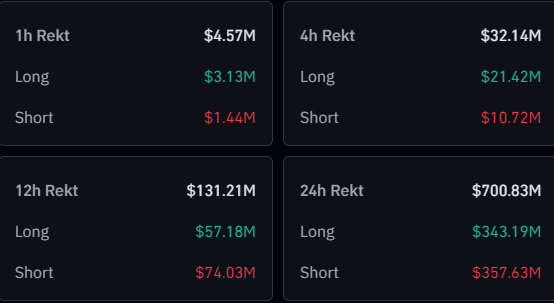
According to data from CoinGlass, the cryptocurrency futures market has witnessed the liquidation of contracts worth more than $700 million in the last 24 hours.
The table below displays the relevant information about the liquidations.

A massive amount of liquidations appear to have occurred in the past day | Source: CoinGlass
It would appear that only $131 million of the liquidations came within twelve hours, suggesting that most of the flush was situated inside the preceding half-day period. This makes sense, as Bitcoin was most volatile inside this window.
It also seems that the long-to-short ratio in this liquidation event has been quite balanced, even though the price has increased in the past day. This would suggest that some aggressive longing occurred as Bitcoin approached $64,000, and the subsequent pullback wiped these top buyers.
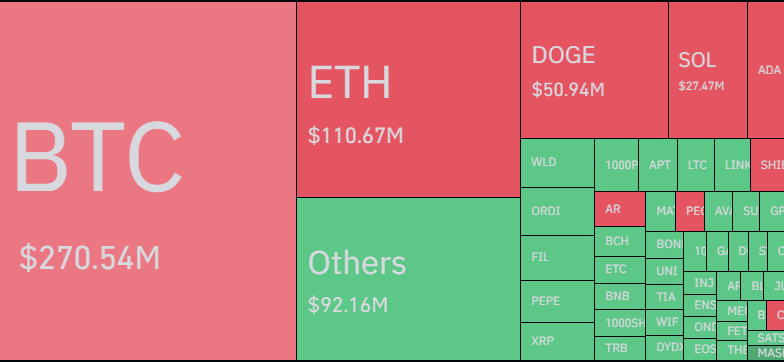
The table below shows how the distribution has looked for the various symbols.

Looks like BTC has topped the charts once more | Source: CoinGlass
As is generally the case, Bitcoin futures contracts have again been responsible for the largest portion of the total market liquidations, contributing around $270 million.
What’s different this time, however, is that this share, although the largest, isn’t even half the total liquidations. This could come down to the fact that speculators may now be playing around with altcoin positions after gaining confidence from the BTC price surge.
Dogecoin, the best performer among the top coins with its 34% jump, has occupied the largest share among the alts, with almost $51 million in liquidations.
Featured image from André François McKenzie on Unsplash.com, CoinGlass.com, chart from TradingView.com
Disclaimer: The article is provided for educational purposes only. It does not represent the opinions of NewsBTC on whether to buy, sell or hold any investments and naturally investing carries risks. You are advised to conduct your own research before making any investment decisions. Use information provided on this website entirely at your own risk.
Grayscale lobbying for regulatory approval of options for spot Bitcoin ETFs

Grayscale is lobbying for the US SEC to approve options on its spot Bitcoin exchange-traded fund (ETF), Reuters reported on Feb. 29.
Grayscale CEO Michael Sonnenshein said:
“It is vital to the interests of GBTC and all spot Bitcoin [exchange-traded product] investors to access exchange-listed options on GBTC and other spot Bitcoin ETPs.”
The SEC approved Grayscale’s spot Bitcoin ETF (GBTC) in January. Unlike most of the other newly approved spot Bitcoin ETFs, GBTC was converted to an ETF from an existing fund.
Options could enhance regulation
According to Sonnsenshein, the SEC’s rejection of options on GBTC would unfairly discriminate against shareholders because the regulator has approved options on Bitcoin futures ETFs.
He added that options could also support spot Bitcoin ETF investment more broadly as they could provide price discovery, assist market condition navigation, and support hedging and income generation.
Furthermore, options would bring BTC within the regulatory perimeter, allowing more market participants, including contract merchants and broker-dealers, to trade the funds.
Grayscale’s letter was reportedly prompted by the SEC’s decision to open comments on options for its ETF on Feb. 23. The regulator’s notice also opened comments on Bitwise’s equivalent ETF and other NYSE-listed trusts that hold Bitcoin.
Previously, in January, the SEC opened comments on options for BlackRock’s Nasdaq-listed spot Bitcoin ETF and various Cboe-listed spot Bitcoin ETFs.
Grayscale is a key ETF player
Grayscale’s communications with the SEC are critical because its past efforts have contributed to approvals. After the SEC dismissed Grayscale’s spot Bitcoin ETF application, the firm initiated a legal case against the regulator and won a victory that compelled the SEC to re-address the matter.
SEC chair Gary Gensler cited that outcome in his agency’s approval of spot Bitcoin ETFs, noting that the legal result made approval the “most sustainable path forward.”
The company and other asset managers have also applied for spot Ethereum ETFs. Grayscale’s application recently gained support from Coinbase on Feb. 21.
While Grayscale’s latest letter does not compel the SEC to act in any way, the company’s past significance means that its comment could influence future outcomes.
(Bloomberg) — Pig-butchering scammers have likely stolen more than $75 billion from victims around the world, far more than previously estimated, according to a new study.
Most Read from Bloomberg
John Griffin, a finance professor at the University of Texas at Austin, and graduate student Kevin Mei gathered crypto addresses from more than 4,000 victims of the fraud, which has exploded in popularity since the pandemic. With blockchain tracing tools, they tracked the flow of funds from victims to scammers, who are largely based in Southeast Asia.
Over four years, from January 2020 to February 2024, the criminal networks moved more than $75 billion to crypto exchanges, said Griffin, who has written about fraud in financial markets. Some of the total could represent proceeds from other criminal activities, he said.
“These are large criminal organized networks, and they’re operating largely unscathed,” Griffin said in an interview.
Pig butchering — a scam named after the practice of farmers fattening hogs before slaughter — often starts with what appears to be a wrong-number text message. People who respond are lured into crypto investments. But the investments are fake, and once victims send enough funds, the scammers disappear. As far-fetched as it sounds, victims routinely lose hundreds of thousands or even millions of dollars. One Kansas banker was charged this month with embezzling $47.1 million from his bank as part of a pig-butchering scam.
The people sending the messages are often themselves victims of human trafficking from across Southeast Asia. They’re lured to compounds in countries including Cambodia and Myanmar with offers of high-paying jobs, then trapped, forced to scam, and sometimes beaten and tortured. The United Nations has estimated more than 200,000 people are being held in scam compounds.
The study, “How Do Crypto Flows Finance Slavery? The Economics of Pig Butchering,” was released on Thursday. Griffin and Mei found that $15 billion had come from five exchanges, including Coinbase, typically used by victims in Western countries. The study said that once the scammers collected funds, they most often converted them into Tether, a popular stablecoin. Of the addresses touched by the criminals, 84% of the transaction volume was in Tether.
“In the old days, it would be extremely difficult to move that much cash through the financial system,” Griffin said. “You’d have to go through banks and follow ‘know-your-customer’ procedures. Or you’d have to put cash in bags.”
Paolo Ardoino, the chief executive officer of Tether, called the report false and misleading. “With Tether, every action is online, every action is traceable, every asset can be seized and every criminal can be caught,” Ardoino said in a statement. “We work with law enforcement to do exactly that.”
Tether has cooperated with authorities in some cases to freeze accounts tied to fraud. But often by the time the crime is reported, the scammers have already cashed out.
“Our paper shows they’re the currency of choice for criminal networks,” Griffin said.
Chainalysis Inc., a blockchain analysis firm, also said the study’s totals might be inflated. Just because a blockchain address receives some money from a pig-butchering scam doesn’t mean all the money received by that address comes from fraud. “Quantifying funds earned through pig-butchering scams is challenging given limited reporting,” said Maddie Kennedy, a spokesperson for Chainalysis. Tether is a one of the company’s customers.
Many of the fraud victims’ blockchain addresses were collected by Chainbrium, a Norwegian crypto investigations firm. Chainbrium also conducted its own analysis of the data and found that a large proportion of the funds flowed through a purportedly decentralized crypto exchange called Tokenlon. Scammers use the exchange to obscure the source of the funds, according to Chainbrium. Tokenlon didn’t respond to a request for comment.
“People in the US, their money is going straight to Southeast Asia, into this underground economy,” said Jan Santiago, a consultant to Chainbrium.
Eventually, the criminals would send the scam proceeds to centralized crypto exchanges to cash out for traditional money. Griffin said Binance was the most popular exchange, even after the company and its founder, Changpeng Zhao, pleaded guilty in November to criminal anti-money-laundering and sanctions charges and agreed to pay $4.3 billion to resolve a long-running investigation by prosecutors and regulators.
“Binance is the place where they can move large amounts of money out of the system,” Griffin said.
Like Tether, Binance has worked with law enforcement in some cases to freeze accounts tied to fraud and return money to victims. A spokesman for the company said it recently worked with authorities to seize $112 million in a pig-butchering case.
“Binance continues to work closely with law enforcement and regulators to raise more awareness of scams, including pig butchering cases,” the spokesman, Simon Matthews, said.
(Adds comments from Chainalysis in the 12th paragraph.)
Most Read from Bloomberg Businessweek
©2024 Bloomberg L.P.
Solana’s Memecoin BONK Reaches $1.6 Billion Market Cap, Witnesses Explosive 100% Price Rally
Solana (SOL) has reached a new 22-month high, demonstrating a remarkable 28% uptrend over the past month. However, the Solana-based meme coin, Bonk Inu (BONK), has captured investors’ attention with its explosive performance last month.
Bonk Inu Outperforms PEPE
According to CoinGecko data, BONK has achieved a staggering 102% price uptrend in the last 7 days and an impressive 103% increase in the past month, reaching a trading price of $0.00002510 and attaining a 3-month high.
In addition, the meme coin has experienced significant growth in market capitalization, reaching $1.6 billion and surpassing renowned tokens such as Pepe Coin (PEPE) to secure the 66th position among all cryptocurrencies, highlighting the growing interest in BONK as the cryptocurrency market experiences a resurgence of bullish sentiment fueled by Bitcoin’s (BTC) price uptrend.

Accumulating data from blockchain company Lookonchain shows the growing interest in Bonk Inu. In addition to the 50% increase in a single day, one wallet reportedly accumulated 98 billion BONK ($1.54 million) from the centralized crypto exchange (CEX) Binance just before the price increase.
According to Lookonchain, the SmartMoney wallet currently holds 319.44 billion BONK tokens worth approximately $7 million, enjoying a profit of $2.9 million, which could have further contributed to the price surge in the past 24 hours.
As of the latest update, the trading volume of Bonk Inu stands at $794,842,219 in the last 24 hours, demonstrating a substantial 74.30% increase compared to the previous day. This surge in trading volume indicates a recent rise in market activity surrounding the meme coin, reflecting growing investor participation and attention.
Potential Pullback Ahead?
As the token enjoys one of its best trading months since its launch, crypto analyst Altcoin Sherpa expressed positive sentiment towards Bonk Inu, highlighting its potential for further growth.
Altcoin Sherpa stated that Bonk Inu looks promising due to its relative underperformance compared to other meme coins, coupled with a notable uptrend pattern. The analyst wouldn’t be surprised to see Bonk Inu target previous highs and make further gains, although he suggested that a potential pullback may occur.
As the analyst suggests, the $0.00001940 price level may serve as a crucial support level for the BONK token in the event of a potential pullback or price correction. This level is significant as it would help maintain the current uptrend pattern observed on its daily chart.
However, suppose this support level fails to hold. In that case, it’s possible that BONK could see a further price decline towards the $0.00001500 level, which acts as the ultimate support before a potential drop to the $0.00001350 mark, key for the token’s prospects as it represents the last line of defense to prevent a fully formed downtrend in the cryptocurrency’s performance.
On the other hand, when analyzing the BONK/USD 1-W chart, it is important to note that there are no prominent resistance levels. The chart above shows thin lines known as “wicks” above the candlesticks of the token since its launch on December 15th.
This suggests that no significant obstacles prevent the token from reaching its all-time high of $0.0005487. The ability to maintain its current uptrend or potentially experience renewed bullish sentiment after a pullback will determine whether BONK can surpass this previous high.
Featured image from Shutterstock, chart from TradingView.com
Disclaimer: The article is provided for educational purposes only. It does not represent the opinions of NewsBTC on whether to buy, sell or hold any investments and naturally investing carries risks. You are advised to conduct your own research before making any investment decisions. Use information provided on this website entirely at your own risk.
Ten new U.S. spot bitcoin exchange-traded funds (ETFs) have shattered both inflow and trading volume records. The 10 funds took in $673.4 million, with Blackrock’s Ishares Bitcoin Trust (IBIT) accounting for $612.1 million of the total inflow. The 10 bitcoin ETFs also set a new record for total trading volume. Spot Bitcoin ETFs Set New […]
Source link
Why China, Japan and the Fed are shaking up the $26 trillion U.S. Treasury market
When investors think of the financial markets, the first thing that likely comes to mind is the stock market.
But there is a bigger, less-flashy counterpart to the equity market: the bond market. At the heart of the fixed income space lies U.S. Treasurys, one of the safest investments in the world.
“We have not paid attention to the Treasury market because it was a market for foreigners or for the Fed,” said Priya Misra, fixed income portfolio manager at J.P. Morgan Asset Management. “Now it’s a market for all of us, and it’s giving you better yield. So it’s something which we should not ignore.”
Buyers of U.S. Treasurys have been changing, with major players including China, Japan and the Federal Reserve seeing their respective holdings decline in recent years. The shift could have broad implications for the U.S. economy.
“What we’re observing is that [the new buyers] are a lot more price sensitive,” said Anders Persson, global fixed income chief investment officer at Nuveen. “They’re just not quite as sticky.”
Watch the video above to find out more about why major buyers are fleeing the U.S. Treasury market, the impact on yields and the economy at large, and how investors can best navigate the market going forward.
Timothee Chalamet stars as Paul Atreides in Denis Villeneuve’s “Dune: Part Two.”
Warner Bros. | Legendary Entertainment
LOS ANGELES — Movie theater operators are hoping that Warner Bros. and Legendary Entertainment’s “Dune: Part Two,” due out in theaters Friday, will be the much-needed oasis amid a drought of blockbuster content.
Since the start of the year, the domestic box office has tallied just $866.4 million in ticket sales through Sunday, a nearly 18% drop from the same period in 2023, according to data from Comscore. A boost at the beginning of the year could prove critical to a box office that’s still struggling to reclaim $10 billion in domestic annual ticket sales, a mark last seen before the Covid-19 pandemic.
“The arrival of ‘Dune: Part Two’ is coming at a point where the industry is looking for that momentum igniting blockbuster,” said Paul Dergarabedian, senior media analyst at Comscore.
So far in 2024, no film has generated more than $100 million in receipts. While surprise hits such as Sony’s “Anyone But You” alongside Paramount’s “Mean Girls” and “Bob Marley: One Love” have helped fill cinemas, the box office had few blockbuster holdovers from the holidays and limited new offerings in the new year.
Last year, the first quarter was buoyed by $263 million in ticket sales from Disney’s “Avatar: The Way of Water,” which hit theaters in December of the previous year. Similarly, 2022 had more than $200 million in residual sales from Sony and Marvel’s 2021 hit “Spider-Man: No Way Home.”
“We’re used to these peaks and valleys,” said Bill Barstow, who runs ACX Cinemas, a theater chain with six locations in five states. “And certainly, there’s no mystery to the last three years of the pandemic and then strikes and all the stuff that kind of kicks us. But then along comes something like ‘Dune.'”
Top 10 movies titles so far in 2024
- “Wonka” (Warner Bros.) — $81.3 million
- “Mean Girls” (Paramount) — $72.1 million
- “Bob Marley: One Love” (Paramount) — $71.1 million
- “Migration” (Universal) — $66.2 million
- “The Beekeeper” (Amazon MGM) — $63.1 million
- “Anyone But You” (Sony) — $62.1 million
- “Aquaman and the Lost Kingdom” (Warner Bros.) — $47.6 million
- “Argylle” (Universal) — $41.6 million
- “Madame Web” (Sony) — $35.3 million
- “Night Swim” (Universal) — $31.8 million
Source: Comscore
“It’s been a long slog of a winter at the box office, unsurprisingly so after numerous strike-induced delays crushed an already underwhelming studio slate in recent months,” said Shawn Robbins, chief analyst at BoxOffice.com. “‘Dune: Part Two’ represents the turn of the tide.”
While Warner Bros. is projecting a conservative $65 million debut for the much anticipated sci-fi sequel, box office analysts foresee a haul between $70 million and $80 million, especially as moviegoers are likely to gravitate toward premium large format screenings, which are pricier than regular tickets.
“We’ve had sold out ‘See It First’ showings in all of our IMAX locations and guest response is already extremely positive,” said Jeff Whipple, vice president of advertising, marketing and public relations at Larry H. Miller Megaplex Theatres, which operates 15 locations, predominately in Utah.
“Utah movie fans know that ‘Dune: Part Two’ is a big movie that needs to be experienced on the biggest screen possible,” he noted, adding that Megaplex locations are seeing strong advanced ticket sales for premium auditoriums such as IMAX, Dolby Atmos and D-Box motion screens.
The draw of these higher-priced tickets is leading some exhibitors to think the film could outperform projections.
“I think Warner Bros. has been conservative,” said Tim Handren, CEO at Santikos Entertainment, a regional cinema chain with 27 theaters in eight states. “Warner Bros. has done an absolute fantastic job marketing this movie.”
“They are geniuses in marketing,” ACX Cinemas’ Barstow echoed. “They just know how to build awareness.”
The film’s cast has been heavily promoting the film for weeks, participating in junkets, video interviews and appearing on late night shows. Even the stars’ premiere outfits have been making headlines, driving more awareness of the film’s release.
Timothée Chalamet and Zendaya attend the World Premiere of “Dune: Part Two” in Leicester Square in London, England, on Feb. 15, 2024.
Gareth Cattermole | Getty Images Entertainment | Getty Images
Alongside industry veterans such as Christopher Walken, Stellan Skarsgard, Javier Bardem, Josh Brolin and Dave Bautista, “Dune: Part Two” features four of the biggest young stars in Hollywood: Zendaya, Timothée Chalamet, Florence Pugh and Austin Butler.
Early ticket sales for the weekend are ahead of Universal’s “Oppenheimer,” which opened at $82.4 million, but below “Jurassic World Dominion,” which debuted at around $145 million, according to data from Fandango.
Cinema operators, while focused on the film’s opening weekend haul, are perhaps more interested in the longevity of “Dune: Part Two” at the box office.
While there are several new releases in March, which will help pad the overall domestic box office haul, “April is not nearly as strong,” Handren pointed out.
Highly anticipated film openings of 2024
March
- “Dune: Part Two” (March 1)
- “Imaginary” (March 8)
- “Kung Fu Panda 4” (March 8)
- “Ghostbusters: Frozen Empire” (March 29)
April
- “The First Omen” (April 5)
- “Godzilla x Kong: The New Empire” (April 12)
May
- “The Fall Guy” (May 3)
- “Kingdom of the Planet of the Apes” (May 10)
- “Imaginary Friends” (May 17)
- “Furiosa: A Mad Max Saga” (May 24)
- “The Garfield Movie” (May 24)
Titles like “Dune: Part Two,” which have a real shot at remaining in theaters with limited drops in ticket sales week after week, can help keep the box office afloat until the summer movie season begins in early May.
The film also offers exhibitors a chance to tease upcoming movies to audiences with those all-too-familiar previews before the film starts.
“I think ‘Dune’ opens up the entire world for us for summer,” Barstow said.
Disclosure: Comcast is the parent company of NBCUniversal and CNBC.
Don’t miss these stories from CNBC PRO: