JPMorgan Chase has discussed three main catalysts driving crypto prices over the coming months. The global investment bank’s analysts believe that the Bitcoin halving event and the next major upgrade of the Ethereum network are largely priced in. JPMorgan on Catalysts Affecting Crypto Prices Global investment bank JPMorgan Chase has provided its insights into three […]
Source link

CoinNews
Open interest, the total number of outstanding derivative contracts that have not been settled, is an important metric for gauging market health and sentiment. An increase in open interest means new money entering the market, showing heightened trading activity and interest in Bitcoin. Conversely, a decline suggests closing positions, potentially indicating a change in market sentiment or a consolidation phase. Monitoring these trends is important for understanding the liquidity, volatility, and future price expectations in the market.
In a bullish market, an increase in open interest often correlates with rising prices, suggesting that new money is betting on further price appreciation. This scenario typically reflects a strong market sentiment and investor confidence in Bitcoin’s upward trajectory. On the other hand, in a bearish context, growing open interest might indicate that investors are hedging against expected price declines, revealing a more cautious or negative market outlook.
Furthermore, the balance between call and put options within the open interest provides deeper insights into market sentiment. A predominance of calls suggests a bullish market sentiment, with many investors expecting price rises, whereas a majority of puts can indicate bearish expectations.
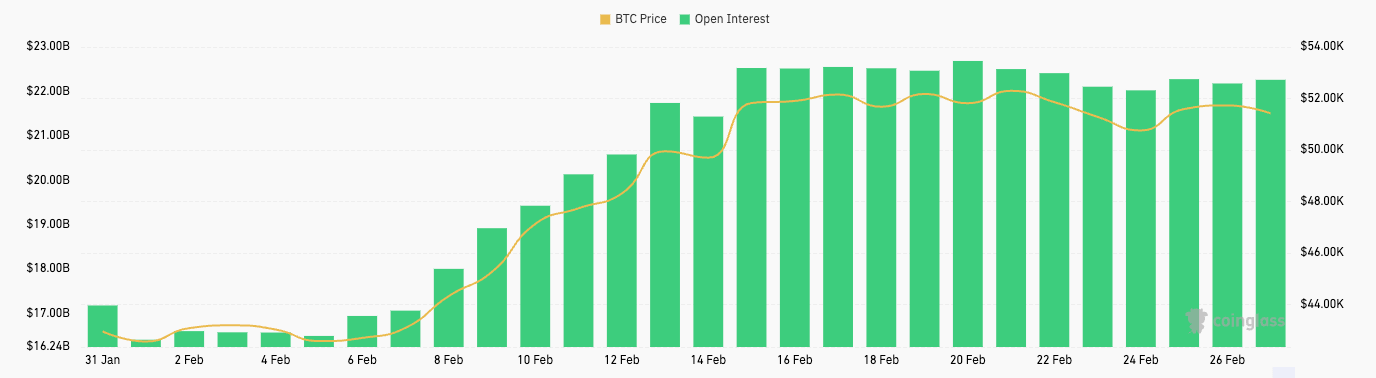
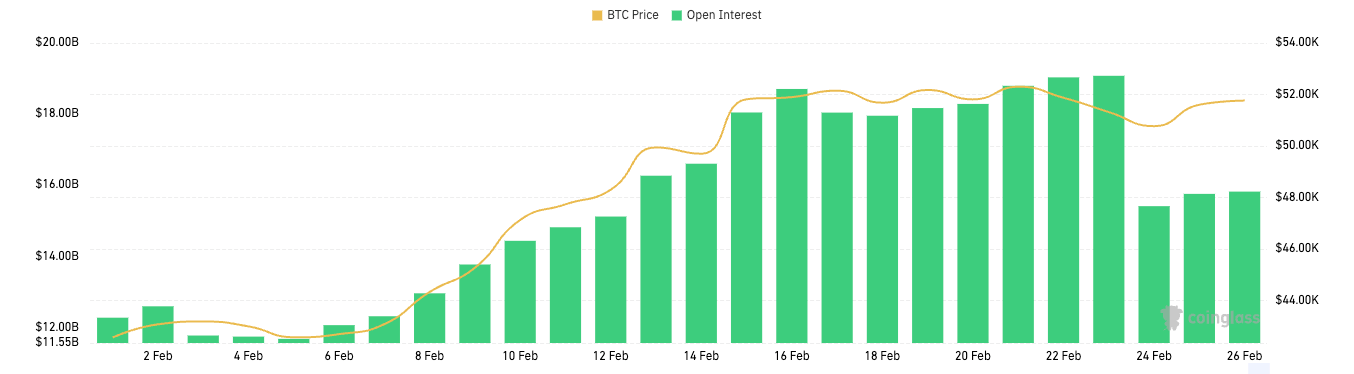
February saw a significant increase in open interest for Bitcoin futures and options.
From Feb. 1 to Feb. 20, Bitcoin futures open interest grew from $16.41 billion to $22.69 billion. This substantial rise suggests that traders were increasingly entering into futures contracts, anticipating higher volatility or making directional bets on Bitcoin’s price. Interestingly, this period aligns with a notable increase in Bitcoin’s price, from $42,560 to $52,303, suggesting a bullish sentiment among futures traders. The slight decrease in open interest by Feb.26 to $22.21 billion, alongside a marginal dip in Bitcoin’s price to $51,716, could indicate some traders taking profits or closing positions in anticipation of a consolidation phase or to reduce exposure ahead of potential volatility.

Similarly, Bitcoin options open interest saw a dramatic increase from $12.27 billion at the beginning of February to a peak of $19.08 billion by Feb.23 before dialing back to $15.82 billion towards the month’s end. Options provide the holder the right, but not the obligation, to buy (call option) or sell (put option) Bitcoin at a specified price, offering more complex strategies for traders to express bullish or bearish views or to hedge existing positions. The initial spike in options open interest reflects a robust engagement from investors, leveraging options for directional bets on Bitcoin’s price and protective measures against potential downturns.

The ratio between calls and puts for Bitcoin options provides a deeper insight into market sentiment and potential expectations for Bitcoin’s price direction. The distribution between calls and puts is a direct indicator of the market’s bullish or bearish inclinations, with calls representing bets on rising prices and puts on falling prices.
As of Feb. 26, the open interest in Bitcoin options was skewed towards calls, comprising 63.76% of the total, compared to 36.24% for puts. This distribution reinforces the bullish sentiment observed through the increase in options open interest earlier in the month. A predominance of calls in the open interest suggests that a significant portion of market participants were expecting Bitcoin’s price to continue rising or were utilizing calls to hedge against other positions.

However, the 24-hour volume tells a slightly different story, with calls accounting for 47.24% and puts for 52.76%. Compared to the overall open interest, this shift towards puts in the daily trading volume might indicate a short-term increase in caution among traders. It suggests that within the last 24 hours, there was a noticeable pick-up in defensive strategies or bearish bets.

The immediate implication for Bitcoin’s price is a potential increase in volatility. The bullish sentiment, as evidenced by the growing open interest and high proportion of calls, supports a continued positive outlook among many market participants. However, the recent uptick in puts volume may signal upcoming price fluctuations as traders adjust their positions in anticipation of or in response to new information or market trends.
Considering these, the market appears to be at a crossroads, with a strong bullish sentiment tempered by short-term caution. This scenario often precedes periods of heightened volatility as conflicting expectations play out through trading activities.

Shares of iRobot Corp. initially jumped 10% then cooled in after-hours trading Wednesday after the company posted quarterly results that topped analysts’ revenue and earnings estimates.
IRobot
IRBT,
reported a fiscal fourth-quarter net loss of $63.6 million, or $2.28 a share, compared with a net loss of $84.1 million, or $3.07 a share, in the same quarter a year ago. Adjusted earnings were a loss of $1.82 a share.
Revenue dropped to $307.5 million from $357.9 million in the year-ago quarter.
Analysts surveyed by FactSet had expected on average a net loss of $2.11 a share on revenue of $308 million.
The Roomba maker anticipates full-year 2024 revenue of between $825 million and $865 million, while FactSet analysts are forecasting $865 million.
After spiking in after-hours trading immediately following its earnings, shares lost their gains and ended the extended session flat. Shares of iRobot have plunged 71% over the past year, while the broader S&P 500 index
SPX
is up 27%.
Last month, Amazon.com Inc.
AMZN,
called off its planned acquisition of iRobot following opposition from the European Union. IRobot also said it would lay off 31% of its employees, or about 350 people, and that its chief executive, Colin Angle, had stepped down.
Fed is ‘not out of woods’ on inflation, new regional bank president says

The battle against rising prices is not over, one of the newest top Federal Reserve officials said Monday.
“When it comes to too-high inflation, I believe we are not out of the woods yet,” Kansas City Fed President Jeff Schmid said in his first public speech since joining the central bank six months ago.
Progress on inflation has been encouraging but has “largely” been driven by reductions in energy and goods prices, he said.
That might not last.
Residents of the Kansas City Fed district know that energy prices “are anything but stable,” Schmid said. And turmoil in the Middle East could put pressure on supply chains and affect the prices of goods.
That means further progress on inflation might have to come from lower prices for services, Schmid said. But the January CPI data showed that prices of services “continue to rise briskly amid still-tight labor markets and elevated wage growth,” he noted.
Schmid started his career as a Fed bank examiner in 1981 and went on to serve as CEO of several banks. He will be a voting member of the Fed’s interest-rate committee in 2025.
His caution about inflation fit with recent remarks from other top Fed officials.
“Recent Fedspeak has sent a clear signal that, although the policy rate has likely peaked and rate cuts are expected to commence this year, officials are not in a rush to lower rates,” said Matthew Luzzetti, chief U.S. economist at Deutsche Bank.
Luzzetti floated the idea that the Fed would cut in a “two-stage process,” with a few quarter-point cuts followed by a potentially lengthy pause.
Many economists think the Fed will delay their first cut until June. At the start of the year, the betting in financial markets had been that the first cut would come in March.
Stocks
DJIA
SPX
closed lower Monday and the yield of the 10-year Treasury note
BX:TMUBMUSD10Y
inched down to 4.281%.
Crypto analyst Rager recently provided valuable insights to Bitcoin and Ethereum investors ahead of the imminent bull run. As part of his statements, he revealed the best time to go all in on the two largest crypto tokens by market cap, Bitcoin and Ethereum.
“Last Great Opportunity For This Cycle”
Rager opined in an X (formerly Twitter) post that the “last great opportunity for this cycle” will come around the Bitcoin Halving. In line with this, he also stated that he was still holding spot in positions and waiting for the “BTC and ETH pullback”, which he explicitly predicts will happen between now and May.
Going by Rager’s opinion, this “nice dip” presents the perfect time for crypto investors to position themselves ahead of this cycle’s bull run. His statement also suggests that Bitcoin and Ethereum (and possibly other crypto tokens) will run massively after that pullback occurs. Interestingly, analysts have continued to identify this event as what will kickstart the next bull run.
BTC price recovers above $51,000 | Source: BTCUSD on Tradingview.com
Bitcoin Run To $60,000 Might Be Close
In a subsequent X post, Rager gave an idea of what price level Bitcoin could drop to when the crash occurred as he hinted that he wouldn’t invest until Bitcoin dropped to $48,000. He also provided an analysis of Bitcoin’s current price action, noting that it has been “composed of a few days of strong price action followed by a lot of chop and pullbacks.”
He added that Bitcoin and the broader crypto market “has a lot of upside opportunity.” However, he warned that there could likely be a short-term pullback, which he predicts could be the last great opportunity to invest. Rager also claimed that Bitcoin would break the $60,000 resistance for the first time since 2021 once this pullback is done.
ETH To $3,500 Is The Next Target
In another X post, Rager mentioned that the $3,500 price level is the target for the current bullish momentum in the market. He also believes this will likely happen “sooner rather than later” with the help of the Ethereum Spot ETF rumours. Industry experts have expressed confidence that these funds will be approved.
$3,500 is just Rager’s first target for Ethereum in this cycle’s bull run, noting that it isn’t the “peak high by any means.” Meanwhile, the analyst stated that the peak of this bull run is still far off. Using the crypto fundraising data as an indicator to determine when the market top is almost in, he noted that fundraising was still at lower levels compared to peak bull market activity.
Featured image from LAB51, chart from Tradingview.com
Disclaimer: The article is provided for educational purposes only. It does not represent the opinions of NewsBTC on whether to buy, sell or hold any investments and naturally investing carries risks. You are advised to conduct your own research before making any investment decisions. Use information provided on this website entirely at your own risk.
Motorola shows off concept smartphone that can wrap around your wrist
Motorola’s “adapative display concept” smartphone can wrap around a user’s wrist. The phone can generative a background to match what a user is wearing.
Arjun Kharpal | CNBC
BARCELONA, Spain — Motorola thinks we may be wearing our phones on our wrist in future.
The company, which is owned by Chinese tech giant Lenovo, showed off a bendable smartphone during the Mobile World Congress in Barcelona, Spain, after teasing it in a video last year.
It is just a concept product so it may never be released. But Motorola is keen to show the progress of display technology to stand out in the crowded smartphone market.
During a demonstration, a Motorola representative showed how the phone could bend in various ways to wrap around a wrist or stand up on a table.
When the phone is wrapped around the wrist, the way information is displayed changes. For example, the apps appear at the top of the screen.
The representative said the phone is “contextually aware” so adapts depending on how it has been bent.
The mechanism that allows the phone to bend was desecribed by the Motorola representative as similar to the way the human spine works.
Motorola’s “adaptive display concept” was on display at Mobile World Congress in Barcelona. The smartphone can bend in various ways.
Arjun Kharpal | CNBC
Bitcoin surges to prices last seen two years ago in painful crash days after ATH

Bitcoin (BTC) surged 6% on Feb. 26 to a new two-year high of $54,910 after US markets began trading, an indication of rising interest in the flagship crypto from retail and institutional investors.
Bitcoin was trading at roughly $54,650 as of press time, up 5.6% on a daily basis, with a market cap of $1.07 trillion, according to CryptoSlate data.
Start of winter
The last time Bitcoin was trading at these levels was in December 2021 — 21 days after it hit a new all-time high of $69,044 on Nov. 10, 2021.
On Dec. 3, 2021, Bitcoin was trading around $54,365 after giving up significant gains over the past three weeks following its rally to a new all-time high amid profit-taking and shifting market conditions.
However, the drawdown had only just begun, as the flagship crypto saw a severe dip over the next 24 hours that took Bitcoin to a painful low of $42,000 before recovering some of the almost $15,000 in losses before the day closed.
By the end of Dec. 4, 2021, Bitcoin was trading at $49,191, down 8.6% over a single day.
ETF performance, halving hype
Spot Bitcoin ETFs have continued their strong performance over February and experienced a significant spike in volume on Feb. 26 to set a new record of $2.4 billion in daily volume.
According to data shared by Bloomberg ETF analyst Eric Balchunas, BlackRock’s spot Bitcoin ETF IBIT posted a record trading volume of $1.3 billion as of press time, which brings it to the top 0.3% of all ETFs and the top 25 of all stocks for the day.
Meanwhile, spot Bitcoin ETF inflows for the past week stood at $583 million. The total is made up of more than $1 billion in inflows, which are offset by $436 million of Grayscale’s GBTC outflows.
Notably, GBTC outflows have slowed down significantly over the past couple of weeks, with the ETF recording only $44.2 million in outflows on Feb. 23.
Bitcoin Market Data
At the time of press 8:47 am UTC on Feb. 27, 2024, Bitcoin is ranked #1 by market cap and the price is up 10% over the past 24 hours. Bitcoin has a market capitalization of $1.11 trillion with a 24-hour trading volume of $48.69 billion. Learn more about Bitcoin ›
Crypto Market Summary
At the time of press 8:47 am UTC on Feb. 27, 2024, the total crypto market is valued at at $2.13 trillion with a 24-hour volume of $111.16 billion. Bitcoin dominance is currently at 51.96%. Learn more about the crypto market ›
Kyberswap Hack: Blockchain Security Firm Reports Movement of 800 ETH From Exploiter’s Address
Blockchain security firm Peckshield revealed on Feb. 26 that an exploiter labeled address associated with the Kyberswap hack had bridged approximately 800 ether tokens from Arbitrum to the Ethereum blockchain. On the same day, the Kyberswap team unveiled revised dates for reimbursing users impacted by the hacking. Kyberswap Hacker Starts Moving Funds Peckshield Alert, a […]

Source link
Warren Buffett says the stock market is increasingly ‘casino-like’—and young investors need to remember this ‘one fact of financial life’ to avoid the mess
Berkshire Hathaway CEO Warren Buffett shared a moving tribute to his fallen friend and right-hand man Charlie Munger in his annual shareholder letter over the weekend. The Oracle of Omaha lauded Munger as the “architect” of Berkshire’s success, eulogizing the “abominable no-man” by discussing some of his favorite whipping posts—including his comparison of the modern stock market to a casino.
“For whatever reasons, markets now exhibit far more casino-like behavior than they did when I was young,” Buffett wrote, adding that “though the stock market is massively larger than it was in our early years, today’s active participants are neither more emotionally stable nor better taught than when I was in school.”
Buffett’s words of caution were definitely a throwback to some of Munger’s favorite lines. Throughout his more than 75-year career, Munger argued that there were two types of people who buy shares in the stock market: investors and speculators. The investors—who are, above all, disciplined, hard-working, and thoughtful when buying assets—were always Munger’s people. But the speculators—those who seek nothing more than a quick buck without care for the intrinsic value of what they’re buying—well, Munger really didn’t like them much.
“They love gambling, and the trouble is, it’s like taking heroin,” he said in an April 2022 interview with Berkshire Hathaway investment officer Todd Combs. “A certain percentage of people when they start just overdo it. It’s that addictive. It’s absolutely crazy, it’s gone berserk. Civilization would have been a lot better without it.”
Like Munger, Buffett fears that too many modern investors have become entranced by speculative investing. Rather than digging into Securities and Exchange Commission (SEC) filings to find the best possible business to invest in, too many investors, particularly young investors, are simply buying stocks that are trendy, hoping someone else will pay more for them a few months, days, or even hours down the line. What or who does Buffett blame for this rise in “casino-like” behavior in the markets? Well, the democratization and gamification of trading is certainly not helping. As the billionaire put it: “The casino now resides in many homes and daily tempts the occupants.”
Becoming a stock market ‘casino’
Part of the reason the stock market is becoming increasingly “casino-like,” according to Buffett, is simply that buying and selling stock has never been easier—or more fun—due to the rise of online trading applications. The SEC is happy about the first part of that sentence, but not so much the second. Here’s how SEC Chair Gary Gensler put it in a statement in 2021 after launching an investigation into the gamification of trading applications:
“While these new technologies can bring us greater access and product choice, they also raise questions as to whether we as investors are appropriately protected when we trade and get financial advice…In many cases, these features may encourage investors to trade more often, invest in different products, or change their investment strategy.”
Like Gensler, Buffett is worried that the gamification of trading is leading to an increase in speculators in the market, and in this modern era of connectivity, the Berkshire CEO worries that could lead market “panics” to happen more rapidly.
“Speed of communication and the wonders of technology facilitate instant worldwide paralysis, and we have come a long way since smoke signals,” he warned. “Such instant panics won’t happen often—but they will happen.”
Remember this key ‘fact of financial life’—and you’ll avoid gambling in the market
For the speculators that are using the stock market like a casino, Buffett had one main tip: Remember who is really making money from your gambling—the House.
“One fact of financial life should never be forgotten,” he wrote. “Wall Street – to use the term in its figurative sense – would like its customers to make money, but what truly causes its denizens’ juices to flow is feverish activity.”
Modern brokerage firms, at times, entice investors into stocks or complicated derivatives with new and fancy features on their trading apps. But they aren’t doing it to help the average retail investor, they’re doing it because they make money from fees on every trade. That means the more trades, the better it is for the House, even if that’s not true for investors.
During periods where more of the general public gets interested in stocks, Buffett explained, “whatever foolishness can be marketed will be vigorously marketed – not by everyone but always by someone.”
The Berkshire CEO noted that when the scene then “turns ugly,” and speculators lose money during a market meltdown, they shouldn’t expect a helping hand—or justice—either.
“The politicians then become enraged; the most flagrant perpetrators of misdeeds slip away, rich and unpunished; and your friend next door becomes bewildered, poorer and sometimes vengeful,” he wrote. “Money, he learns, has trumped morality.”
This story was originally featured on Fortune.com
Technology stocks are riding high following Nvidia Corp.’s latest blockbuster earnings report, which helped push the Nasdaq-100 and the S&P 500 technology sector to fresh record highs last week.
But after looking past the index-level performance, there are signs that the momentum that has propelled the sector higher over the past year is starting to fade.
Unprofitable technology companies have started to roll over. Popular momentum gauges show the pace at which the average tech stock has outperformed the average S&P 500 stock has slackened. And the share of tech stocks trading above their medium-term averages has declined from its recent highs, although it remains well above 50%.
Meanwhile, valuations for the average technology stock have returned to their peak from November 2021, according to JC O’Hara, chief market technician at Roth MKM.
See: more stocks are joining the market’s rally — even as Big Tech still gets the most attention
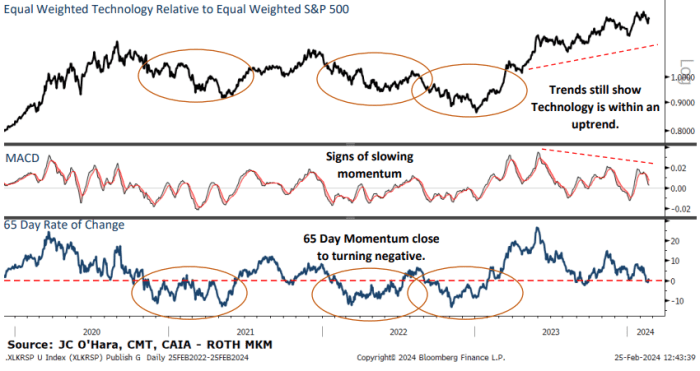
The average tech stocks’ relative momentum is starting to slow
While technology stocks remain firmly in an uptrend, their outperformance relative to the average S&P 500
SPX
stock has started to slow.
This is evidenced by a gauge of the average technology stocks’ outperformance compared with the average S&P 500 stock over the past 65 days, depicted in the chart below.
Such a shift has portended periods of underperformance for tech stocks in the past, not only in 2022, but in 2020 as well.
MKM ROTH
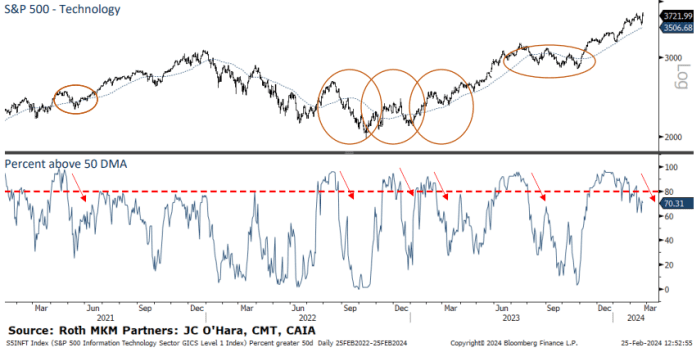
The share of technology stocks trading above their moving average is declining
Taken together, the S&P 500 technology sector is still trading well above its intermediate-term average. But more individual technology stocks have started to lag theirs.
By O’Hara’s count, roughly 70% of the tech sector’s 64 constituents are trading above their 50-day moving average as of Friday. By comparison, late last year, that number was 90%.
MKM ROTH
Valuations are looking stretched
Investors are paying a heavy premium for the average technology stock, evidenced by the trailing 12-month price-to-earnings ratio.
The ratio recently hit 35 times, a level that preceded the market peak from late 2021.
A version of the S&P 500 technology sector that assigns an equal weighting to each constituent stock only just took out those highs after more than two years. And during the interim, the gauge experienced a drawdown of more than 30%, according to O’Hara.
MKM ROTH
Options traders are getting greedy
Traders piled into bullish options ahead of Nvidia Corp.’s
NVDA,
earnings report last week. This pushed the 10-day put-call ratio, which measures demand for bullish options compared with demand for bearish options, firmly into greed territory.
However, history shows that options demand tends to mean revert, according to O’Hara. As of Friday, there was still plenty of room for options traders to shift from one side of the boat to the other.
MKM ROTH
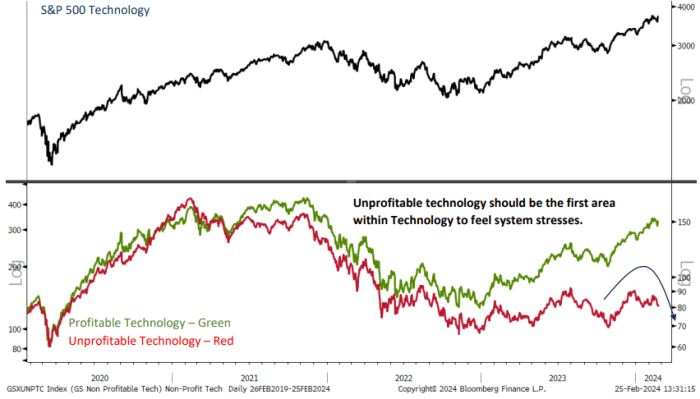
Unprofitable technology stocks are fading fast
Even technology companies that haven’t posted steady profits saw their shares rocket higher as the broader market rallied furiously in November and December. Some analysts described it as a “dash for trash.”
But since the beginning of 2024, many of these companies that have struggled to post steady profits have seen their shares lurch lower. Case in point: The ARK Innovation ETF
ARKK,
seen as a proxy for unprofitable technology companies, is down 5.3% since the start of the year following a gain of more than 48% between Nov. 1 and Jan. 1, FactSet data show.
In the past, these companies have acted as a canary in the coal mine, O’Hara said.
“When market stresses start to develop, the unprofitable companies are normally sold first, as they are extremely far out on the risk curve and have the largest downside potential,” he added.
MKM ROTH
To be clear, O’Hara isn’t recommending that his clients rush to dump their technology stocks.
“We are still very much overweight Technology in our sector rankings,” O’Hara said.
But a recent spike in inquiries from clients asking for investment ideas outside of the tech piqued his curiosity.
He now expects a modest pullback that could carry the sector back below its 50-day moving average. This would equate to a drop of more than 4% for the XLK, according to FactSet data. The ETF was recently trading at $206.35 a share on Monday.
With that in mind, investors might want to consider buying some downside protection for their portfolios, he said. The lopsided put-call ratio means investors can purchase portfolio insurance relatively cheaply.
The tech-heavy Nasdaq-100
NDX,
which has the heaviest weighting toward the biggest megacap technology stocks like Nvidia Corp., hit its latest record close of the year on Thursday, while the Nasdaq Composite
COMP
came within a hair of its first record close since Nov. 19, 2021.
Meanwhile the S&P 500 and Dow Jones Industrial Average
DJIA
finished last week with their 13th and 14th record closing levels of the year, respectively.
All three of the main indexes — the S&P 500, Dow and Nasdaq Composite — were trading in the red early Monday afternoon.