In the last week, 23 cryptocurrencies experienced notable gains against the U.S. dollar, with flare (FLR) and uniswap (UNI) leading the charge. Concurrently, dymension (DYM) and helium (HNT) saw significant declines over the same period. FLR and UNI Lead Gains in a Diverse Week for Cryptos, Despite DYM and HNT Setbacks As of now, the […]
Source link

CoinNews
Tornado Cash website, discord offline after community finds malicious code in protocol’s backend

Crypto mixer Tornado Cash has reportedly fallen victim to a significant backend exploit that has put user deposits and sensitive data at risk.
The security breach was revealed in a Medium post by Gas404, a community member, on Feb. 26.
The exploit represents a critical vulnerability for Tornado Cash, whose trading volume already suffered a dramatic decline following sanctions from the US Treasury Department’s Office of Foreign Asset Control (OFAC) in August 2022.
The sanctions, which were part of broader measures targeting the crypto sector, had significantly reduced the mixer’s operational scale even before the exploit.
Malicious code
According to the Medium post, malicious JavaScript code was discovered in the protocol’s backend. It was reported injected through a compromised governance proposal submitted by an individual posing as a Tornado Cash developer on Jan. 1.
The code surreptitiously redirects user deposit information to a server controlled by the attacker, posing a dual threat — the exposure of deposit data and the outright theft of the deposits themselves.
One such theft has been confirmed through transaction records on Etherscan, highlighting the exploit’s immediate impact.
The exploit’s technical details were discussed at length in the community post, illustrating the sophisticated nature of the attack.
Specifically, the malicious code was designed to encode and exfiltrate private deposit notes, effectively breaching the anonymity and security that Tornado Cash users depend on.
Proposed solution
In response to the crisis, Gas404 has proposed a solution to mitigate the damage: reverting Tornado Cash to a prior version of its IPFS deployment.
The move aims to secure the platform against the current vulnerability by utilizing a previously established and ostensibly secure infrastructure setup.
The proposed change emphasizes the urgency of addressing security flaws within decentralized platforms, where governance proposals can be manipulated for malicious purposes.
The Tornado Cash website and Discord channel were taken offline following the revelation and have yet to come back online — an indication of the exploit’s severity and the ongoing efforts to contain its repercussions.
Crypto analyst Egrag Crypto has put out an ultra-bullish price prediction for VeChain (VET), which the analyst predicts will achieve significant gains soon enough.
VeChain To See A 140x Gain
Egrag mentioned in an X (formerly Twitter) post that the VeChain token could see a 50x or 140x gain. He further highlighted how the crypto token could achieve any of this move to the upside. Analysing the chart, he stated that a 50x move could be in play if VET sees a similar percentage increase to the one that occurred around 2019.
Source: X
Back then, VET is said to have seen a 5,892% increase. Egrag predicts that the crypto token could rise to $0.9 if this move is indeed in play. Meanwhile, for the 140x gain, the analyst claimed that this move could be in play if the market eventually witnesses a similar percentage increase to the one around 2021 when VET’s price increased by 14,638%.
Related Reading: Pro-Ripple Lawyer Tags Poor XRP Price Performance As Unnatural, Rally Imminent?
That was when the crypto token hit its all-time high (ATH) of $0.27. Egrag predicts that VET could rise to as high as $2 if this is the move that ends up materializing. This prediction also means that VET will likely see a new ATH in the next bull run.
This is not the first time Egrag has offered a bullish price prediction for the VET token. Last year, the analyst predicted that VET could rise to $1.6 based on historical patterns. This prediction came after the crypto token made an impressive surge of 77%, hitting price levels unseen since May 2022.
Big Moves Still Lie Ahead For VET
IEgrag isn’t the only analyst who has recently laid out a bullish narrative for the VeChain token. Crypto analyst and YouTuber Crypto ZX also gave an analysis where he predicted that the crypto token could hit new ATHs if it succeeded in breaking certain resistance levels. One level he highlighted then was the $0.033 mark.
The analyst had also suggested that VET was currently in a period of consolidation as it gears up for another move to the upside. On the next leg up, Crypto ZX predicted that the crypto token was going to surge above the $0.033 resistance level. The analyst further revealed that a move above that level would be vital to unlocking new highs.
Interestingly, VeChain has since risen above that level. At the time of writing, the crypto token is trading at $0.0474, up over 5% in the last 24 hours, according to data from CoinMarketCap.
VET price at $0.048 | Source: VETUSDT on Tradingview.com
Featured image from Adaas Capital, chart from Tradingview.com
Disclaimer: The article is provided for educational purposes only. It does not represent the opinions of NewsBTC on whether to buy, sell or hold any investments and naturally investing carries risks. You are advised to conduct your own research before making any investment decisions. Use information provided on this website entirely at your own risk.
Vials move along a conveyor at the Novo Nordisk A/S production facilities in Hillerod, Denmark, on Monday, June 12, 2023. The success of Novo’s bestsellers Ozempic and Wegovy, drugs that help people lose significant amounts of weight, has created something of a gold rush in the pharma industry with about 40 companies developing products that will intensify competition.
Bloomberg | Bloomberg | Getty Images
Shares of Denmark’s Zealand Pharma rocketed higher, after the company posted strong results from a trial of a liver disease treatment that has been touted as a potential competitor in the booming weight loss drug market.
The Phase 2 trial of the survodutide drug showed 83% of adults saw positive results for a form of liver inflammation caused by excess fat cells known as “MASH,” the company said in an announcement Monday.
The drug has “demonstrated efficacy” in people with obesity and is currently undergoing five Phase 3 trials in a clinical program for people who are overweight or obese. It has received a fast-track designation from the U.S. Food and Drug Administration.
More CNBC health coverage
Analysts latched onto the drug’s possible efficacity in obesity research after the latest test results, which indicated the safety of the top dosage used in that trial.
Shares of Zealand Pharma provisionally closed 35% higher on Monday, amid enthusiasm for the company’s potential in the highly lucrative obesity market that propelled fellow Danish drugmaker Novo Nordisk to become Europe’s most valuable firm on its development of Ozempic and Wegovy.
Several other companies, including Eli Lilly, Roche and AstraZeneca, also seek to compete in the sector.

“Top-line results demonstrated an improvement in MASH, at all doses explored in the trial. Treatment with survodutide did not show unexpected safety or tolerability issues, including at the higher dose of 6.0 mg,” Michael Novod, head of bank Nordea’s health-care equity research team, said in a Monday note, hailing the latest Zealand Pharma results as an “unequivocal win for survodutide.”
“Importantly, the [Phase 2] MASH trial also tells us that the 6mg dose is safe, which is the top dose used in the ongoing [Phase 3] obesity trial too,” he added.
Analysts at Jefferies assessed that Zealand Pharma’s “position as a key player in next wave of obesity therapeutics is underappreciated,” noting the significance of the German co-inventor Boehringer Ingelheim’s announcement that the drug will advance as “quickly as possible” with treatment on liver diseases and related conditions.
Pharmaceutical firm Boehringer Ingelheim is funding and running clinical development of survodutide.

Quick Take
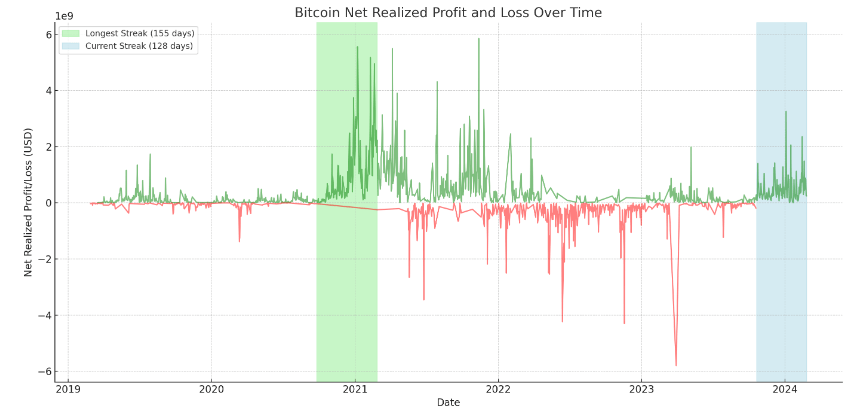
Net realized profit-taking for Bitcoin has witnessed an unbroken streak of 128 days, starting from Oct. 20, 2023, until Feb. 25, 2024. This period saw Bitcoin’s price catapult from below $30,000 to $50,000, providing lucrative opportunities for investors.
Defined by Glassnode, the net realized profit/loss represents the cumulative profit or loss from all coin transactions. It is calculated by deducting the realized loss from the realized profit.
This is not the first time such a trend has been noted. Looking back over the past five years, we find an even more extended period of consecutive net profit-taking: a staggering 155-day run from September 2020 to Feb. 26, 2021, during the significant bull run of 2021.

Interestingly, the frequency of profit-taking has dipped considerably in recent weeks as Bitcoin’s price has stabilized above $50,000. Notably, when Bitcoin’s price crossed significant milestones at $40,000 and $50,000, we noticed an intense surge in profit taking.

However, a contrast emerges when comparing the current trend with the 2021 bull run. The 2021 bull run witnessed multiple days where the profit-taking figures reached staggering heights of over $4 to $5 billion. In contrast, the highest profit-taking in 2024 peaked at $3.2 billion in a single day. This indicates a notably subdued level of profit-taking activities in the current year when compared to the intense trading during the 2021 bull run.
The post Bitcoin investors realize net profits for 128 consecutive days appeared first on CryptoSlate.
Opinion: We’re spending more on leisure and travel. These 11 stocks will soak it up.

Leisure stocks are likely to outperform this year as emboldened consumers kick back and relax. Here’s more on three economic trends supporting this trend and 11 stocks to consider, according to five money managers I check in with on this theme.
1. Consumer sentiment is surging. The University of Michigan consumer sentiment index added almost 10 points to 79 in January. Sentiment rose on improved outlooks for inflation and income. Consumer sentiment has surged 29% since November. That’s the biggest two-month increase since 1991.
2. Jobs are plentiful: Nonfarm payroll employment increased by 353,000 in January, and the count for the prior two months was revised upwards. Average hourly earnings rose by 4.5% over the prior year. The January jobs increase is even more impressive because payroll numbers typically shrink that month due to post-holiday layoffs, says Bank of America. The data confirm there is no recession on the horizon. Plentiful jobs and wage hikes make consumers more confident about leisure spending.
3. We’re in the midst of a productivity boom: Productivity growth was a robust 3.2% in the fourth quarter of 2023, following 4.9% and 3.5% gains in the prior two quarters. For perspective, growth has rarely come in above 4% over the past 20 years. Productivity growth supports pay hikes, and it reduces pressure on companies to raise prices. Both improve spending power. The boom also boosts economic growth. GDP growth is driven by a combination of labor force and productivity growth — both of which we have right now.
Here are 11 leisure stocks that will benefit from these trends:
Travel
When people feel more confident about their budgets, they hit the road. And there is still pent-up demand for travel post-Covid, says George Young, a portfolio manager with Villere & Co. in New Orleans. This is one reason his portfolio owns casino and hotel company Caesars Entertainment
CZR,
The stock may also benefit from continued efforts to reduce its high debt levels.
Matt Wittmer and Abby Roach at Allspring Global Investments favor Hilton Worldwide Holdings
HLT,
as a play on leisure travel spending. It’s also one of the major builders of hotels at a time when there’s a shortage of rooms. Hilton accounts for one in five rooms under construction, more than any other chain, Roach says. Meanwhile, independent operators continue to convert to the Hilton brand because it boosts business.
Next, consider airlines like Ryanair Holdings
RYAAY,
in Europe. The continent is in an economic slump, which hurts air travel. But it actually helps Ryanair. Since it has lower costs and a stronger balance sheet than competitors, Ryanair takes market share from struggling competitors in downturns, says Andrew Brown at Baillie Gifford, who specializes in finding companies that find ways to win throughout the economic cycle. The airline is still profitable even during this slump, and it is using profits to buy more landing slots at airports. The European economy may provide a tailwind this year as the central bank there eased monetary conditions, predicts Ed Yardeni, of Yardeni Research.
Also, consider two behind-the-scenes names in travel. Brown at Baillie Gifford singles out Amadeus IT Group
AMADY,
which provides software that runs booking systems for airlines and hotels, and in-house media systems at hospitality chains. Young, at Villere & Co., owns Euronet Worldwide
EEFT,
which has more than 50,000 ATMs in Europe, the Middle East, Asia and the U.S. That makes it a travel play.
Computer and mobile games
Consumers are spending less on games, but targeting their dollars on the most popular titles. This favors the large gaming software companies with the big hits, namely Take-Two Interactive Software
TTWO,
and Electronic Arts
EA,
says Alec Boccanfuso of Gabelli Funds.
Both will soon release updates of their biggest hits. Take-Two’s Grand Theft Auto VI will likely come out in 2025. But it’s not too early to position in the stock ahead of that release. Grand Theft Auto has not been refreshed since 2013 so there is probably a lot of pent-up demand for a new version. Take-Two also has a big position in mobile games, because of its purchase of Zynga. Electronic Arts should release an updated version of its Sports College Football series later this year. Now that college players are allowed to earn income from the use of their images it’ll feature popular college stars, another draw.
The great outdoors
Like a lot of retail chains that sell gear used in outdoor activities like camping, fishing and hunting ran big sales last year to blow out excess inventory. They got that job done, and now they’re ordering inventory again. “We are finally starting to see restocking,” says Boccanfuso at Gabelli Funds. “Retailers and manufacturers say the second half of this year will be better.” That would support growth at outdoor supply manufacturers.
Boccanfuso favors Vista Outdoor
VSTO,
which is selling its ammunition business to focus on products used in hiking, camping, cycling, golfing and fishing. It owns some of the biggest brands including Bell, Fox Racing and Giro in helmets, CamelBak in hydration packs, Bushnell and Foresight Sports in golfing, and Simms in fishing products. Another favorite is Johnson Outdoors
JOUT,
which makes fishing products like sonar, GPS systems and trolling motors. Among the retailers selling outdoor supplies, Boccanfuso singles out Sportsmans Warehouse Holdings
SPWH,
Though the pandemic-era outdoor activity craze died down, interest in the space remains above pre-pandemic levels. So, demand for outdoor products remains elevated.
Pool supplies
For many people, leisure means nothing more than lounging around the backyard pool. As consumers spend more time poolside, it will help Pool
POOL,
a wholesaler of pool maintenance products. This company also benefits from two trends, says Wittmer, at Allspring Global Investments. A lot of people put in pools during the pandemic. And there’s an ongoing migration to the Southeast, where people put in pools because of the warmer weather.
Michael Brush is a columnist for MarketWatch. At the time of publication, he owned CZR. Brush has suggested CZR and POOL in his stock newsletter, Brush Up on Stocks. Follow him on X @mbrushstocks.
More: George Soros’ fund bets on U.S. leisure travel, with fresh stakes in JetBlue, Spirit, Sun Country
Also read: The ‘cardboard-box’ recession is over. An out-of-the-box economic recovery is coming.

Thanks to strong corporate results, as well as the ongoing artificial intelligence (AI) boom, the so-called “Magnificent Seven” stocks are soaring to new heights. All of these companies have seen their share prices rise in the last 12 months, except for one.
Tesla (NASDAQ: TSLA) shares are down over 2% during that time frame. That’s a sign that the market has grown pessimistic about the business and its prospects.
Instead of the electric vehicle stock, the Magnificent Seven should include Netflix (NASDAQ: NFLX), the world’s dominant direct-to-consumer streaming service. Its shares have soared 77% in the past year. Here’s my case.
Tesla is an expensive automaker
After years of outsize growth and improving profitability, Tesla has hit a roadblock. Higher interest rates and intense competitive pressures have pumped the brakes on revenue gains, with sales up just 3% in the fourth quarter of last year. And in 2023, Tesla’s gross margin was 18.2%, down from 25.6% in the previous year.
If you want to view things from a positive angle, Tesla’s valuation has come down due to the stock’s 17% decline in the trailing-three-year period. Shares trade at a forward price-to-earnings (P/E) ratio of about 61 today.
However, this is still a very expensive price to pay for a struggling enterprise. I think the valuation still prices in the assumption that Tesla will get back to posting the monster growth it did in prior years, with margin expansion a sure thing.
I also view the valuation as reflecting investor optimism about Tesla being categorized as a tech company and not an automaker. To its credit, the business is truly innovative and disruptive, and there’s still the possibility of introducing full self-driving functionality at some point in the future. But as things stand right now, it’s still a car manufacturer.
Press play on Netflix
While Tesla struggles, Netflix is thriving. The leading streaming entertainment provider added 13.1 million net new subscribers last quarter, bringing the total to 260.3 million. This is a huge reversal from nearly two years ago, when Netflix lost 1.2 million customers in the first six months of 2022, and shareholders fled for the exits.
Last quarter, Netflix registered member growth in all its geographic regions, boosted by the successful launch of a cheaper, ad-supported tier, as well as efforts to crack down on password sharing. The company is dipping its toes in the live sports and entertainment space with its WWE partnership.
Netflix still has a huge opportunity to gain subscribers. According to CFO Spence Neumann, there are about 1 billion broadband-enabled households in the world (excluding China, where Netflix isn’t available). This gives the business a massive expansionary runway.
With Netflix’s first-mover advantage in the industry and a dominant market position with lots of growth potential, investors might not realize that the company is also booming from a profitability perspective. Netflix reported an operating margin of 21% in 2023, up from 18% in 2022. Executives believe this metric can continue expanding in the years ahead.
Plus, here’s something the bears never thought would happen: Positive free cash flow (FCF) production is a usual occurrence these days. Netflix is forecasting FCF of $6 billion this year, after raking in $6.9 billion in 2022. The leadership team will use this to repurchase shares.
I’m not sure if Netflix will replace Tesla in the Magnificent Seven anytime soon, but the latter certainly deserves to be placed in that category.
Should you invest $1,000 in Netflix right now?
Before you buy stock in Netflix, consider this:
The Motley Fool Stock Advisor analyst team just identified what they believe are the 10 best stocks for investors to buy now… and Netflix wasn’t one of them. The 10 stocks that made the cut could produce monster returns in the coming years.
Stock Advisor provides investors with an easy-to-follow blueprint for success, including guidance on building a portfolio, regular updates from analysts, and two new stock picks each month. The Stock Advisor service has more than tripled the return of S&P 500 since 2002*.
*Stock Advisor returns as of February 26, 2024
Neil Patel and his clients have no position in any of the stocks mentioned. The Motley Fool has positions in and recommends Netflix and Tesla. The Motley Fool has a disclosure policy.
Forget Tesla: I Think This Stock Should Replace It in the “Magnificent Seven” was originally published by The Motley Fool
The stock market has been kind to growth-hunting investors recently. The tech-heavy Nasdaq Composite (NASDAQINDEX: ^IXIC) market index has gained more than 32% over the last 12 months, thanks to an improving economy making stock buyers comfortable with potentially risky ideas again.
But some excellent growth stocks didn’t punch a ticket to that freight train. This creates an imbalance between fantastic long-term business prospects and modest share prices. In turn, savvy investors get a tempting buy-in opportunity.
Let me show you why I’m especially entranced by the wide-open buying windows I see for media-streaming platform expert Roku (ROKU -0.20%) and restaurant management tools provider Toast (TOST 1.19%) right now.
Toast’s share price has drifted lower for a long time, while Roku took a steep dive last week. Either way, I think it’s high time to invest in these great growth stocks before the market comes to its senses and sends their share prices skyward again.
Roku: down 3% in 12 months
Roku looks downright spring-loaded for robust gains. Meanwhile, bearish investors seem to insist on jumping aboard this future rocket after it takes off, adding more pressure to an already low stock price in the process.
That’s cool. I don’t mind buying more shares on the cheap, kicking the big payoff down the road again.
The bears often point to bustling competition in the smart TV market, led by longtime Roku customer Walmart agreeing to acquire Roku-less TV maker Vizio for $2.3 billion. They also complain about slow revenue growth and an unprofitable hardware business. In one example, analyst firm Oppenheimer says it is staying on the sidelines with a “neutral” rating until Roku can deliver sustained growth in device sales in the “high-teens” percentage range.
But strong competition is nothing new for Roku, which holds a dominant share of global connected TV sales despite challenges from Alphabet‘s Google TV and Chromecast, Amazon‘s Fire TV, the Apple TV line, and in-house software solutions from leading TV makers Samsung and LG Electronics. If that horde of highly competent and deep-pocketed rivals can’t compete effectively with Roku, I don’t see much of a threat from Walmart’s Vizio purchase, either. And regulators are not guaranteed to approve the deal, either.
The stalled top-line growth looks poised for a rebound in the second half of 2024 and an even stronger continuation next year. Most of Roku’s revenue comes from ad sales, and that restrained market has suffered from limited ad-buying budgets since the inflation crisis started in 2021. Now that budget dollars are trickling back into the picture, more than two years’ worth of underpromoted products and services are calling out for attention. That’s why I expect a sudden swing, not a slow crawl, back to healthy digital ad sales.
And those profit-sapping hardware sales should actually be seen as a marketing expense. Keeping prices low when everyone else plays along with the inflation trend by raising their software fees and device price tags has helped Roku grow its user base dramatically in recent years.
The company reported 60 million active accounts and 19.5 billion hours of streaming activity in the fourth quarter of 2021. Two years later, Roku sported 80 million accounts and 29.1 billion streaming hours. That’s 33% more users, engaging in 49% more streaming hours. That’s how you build a huge user base that should command higher ad rates in the long term.
So I see absolutely nothing wrong with Roku’s current and future results. Profits can wait while the company gets busy building a truly great business platform for the decades ahead. This stock is an absolute steal, and you don’t want to be left empty-handed when those double-digit growth rates come along to light a fuse under Roku’s shares.
Toast: up 7% in 12 months
Here’s another underappreciated growth story.
Toast sells a cloud-based software platform that helps restaurant owners, café managers, food truck vendors, and other food service businesses run and manage their operations. From processing payments and publishing menus to tracking ingredient inventory and designing data-based marketing campaigns, the system covers many functions normally handled by software from different vendors (or notes scribbled on the breakroom’s whiteboard).
If that sounds like a winning idea to you, we’re on the same page. Many restaurant owners agree, and Toast’s services are rolling out across the country like wildfire. Fourth-quarter revenue rose 35% year over year, bottom-line losses shrank from $99 million to $36 million, and free cash flow landed at $92 million. The company sports 106,000 customer locations, a 34% jump from the year-ago quarter.
And just like Roku, Toast uses low-priced hardware systems as a loss-leader marketing tactic. The idea is, once you try the management system, you’ll never want to leave. Just get a foot in the door. Those unprofitable credit card readers and order-taking tablets should pay off in the long run.
“We are well on our way to becoming the technology platform of choice for the entire restaurant industry,” CEO Aman Narang said on the earnings call with anaylsts. “Even in our most penetrated markets where we have over 30% market share, we are still gaining share at a healthy clip.”
Yet, Toast’s stock trades nearly 70% below the all-time high of 2021, and shares are valued at just 2.9 times sales. That would be a reasonable ratio for some of Toast’s clients, since restaurants tend to run with notoriously low margins and high growth is reserved for an elite group of newer names.
This is a software company on a high-octane growth run. Double-digit price-to-sales ratios are common in this category, even for companies with weak or nonexistent cash flows.
I’ll admit that Toast’s management has made a few unfortunate mistakes so far, such as introducing an unpopular fee for payment processing. But the company also canceled that fee quickly, showing an ability to stay flexible and listen to customer concerns.
So I understand if you’d rather watch Toast for a while to make sure the company isn’t forming a habit of problematic public relations moments. At the same time, I can’t take my eyes off the low share price and slim price-to-sales ratio — and the Toast name keeps popping up whenever I grab some takeout or take the family out to eat. Keep an eye out for Toast-branded credit card readers to see for yourself.
This growth rocket deserves better, and I highly recommend taking a chance on this innovator before the rocket ship takes off.
John Mackey, former CEO of Whole Foods Market, an Amazon subsidiary, is a member of The Motley Fool’s board of directors. Suzanne Frey, an executive at Alphabet, is a member of The Motley Fool’s board of directors. Anders Bylund has positions in Alphabet, Amazon, and Roku. The Motley Fool has positions in and recommends Alphabet, Amazon, Apple, Roku, Toast, and Walmart. The Motley Fool has a disclosure policy.
Regional banks were hammered in early 2023, thanks to troubles at a small number of banks. New York Community Bancorp (NYCB -2.43%) was actually one of the better performers through that difficult and uncertain period. But when the bank reported full-year 2024 earnings, it shocked investors by cutting the quarterly dividend from $0.17 per share to just $0.05. That’s a 70% decline in the dividend — and a warning sign that this may not be the right dividend stock for conservative investors.
What happened to New York Community Bancorp’s dividend?
In early 2023, fast-rising interest rates created a timing problem for some banks. They had bonds on their balance sheets that were intended to be held to maturity, but the value of those bonds had declined because of the swift change in rates. If the assets had been held to maturity, there would have been no problem, but for various reasons a small number of banks experienced a high level of customer withdrawals. That required these banks to sell the bonds that had fallen in value and, thus, they were suddenly not as well capitalized as investors thought.
Image source: Getty Images.
Basically, there was a bank run, and it caused a few banks to go out of business. One of those banks was Signature Bank. New York Community Bancorp stepped in and bought parts of Signature Bank. This increased the size of New York Community Bancorp and, in turn, subjected the company to more regulatory scrutiny. The key here is that larger banks are required to better safeguard customer deposits.
At the same time, New York Community Bancorp has experienced trouble with a couple of material loans. Highlighting the risk, in the fourth quarter, management increased the allowance for credit losses to $992 million from $619 million just three months earlier, a 60% jump in a single quarter. That’s a fairly large change in a very short period of time. The takeaway from all of this is that the risks here are material.
Thus, New York Community Bancorp cut the dividend. That frees up cash it can use to shore up its capital structure and appease its regulators.
Doing what needs to be done
From the perspective of New York Community Bancorp, it is acting quickly and decisively to solve a problem. In fact, cutting the dividend was probably the right decision for the bank to make. And it should help to speed up the process of muddling through this rough patch. A more aggressive long-term investor interested in turnaround situations might find that appealing. And, assuming the worst is behind the bank, such an investor could collect a 4.4% dividend yield while waiting for management to get the bank back on track.
That said, for conservative dividend investors, it might make more sense to stay on the sidelines until there are more substantial signs of improvement. Such signs might include the allowance for credit losses stabilizing (or falling) or, even better, the dividend being increased again, among other things. The problem is that, right now, the bank is still in crisis mode. The issues it faces are so worrying that the company shifted the executive reporting structure. It elevated a board member to executive chairman and, effectively, gave him the power to make major decisions. That’s what you would normally expect the CEO to be doing.
Of course, all this activity could lead to a brighter future. But right now the signs are worrying, and probably only the most aggressive investors should be looking at New York Community Bancorp. What’s going on isn’t the end of the world for the bank, but it biases the risk/reward profile more toward the risk side of the equation — and that’s just not appropriate for more conservative dividend investors. And mending the capital structure is unlikely to be a quick process.
Interesting stories don’t always make good investments
What’s been going on at New York Community Bancorp has been headline-grabbing news, and it is very interesting to see the drama unfold. But drama and dividends aren’t two things that most investors want going together if they are trying to live off the income their portfolios generate. If you are looking at New York Community Bancorp thinking that it won’t get any worse, you might be right. But you could also be wrong. Further deterioration would make things even more bleak for dividend investors. That won’t be worth the risk for most income seekers.
Reuben Brewer has no position in any of the stocks mentioned. The Motley Fool has no position in any of the stocks mentioned. The Motley Fool has a disclosure policy.
Alistair Berg | Digitalvision | Getty Images
A record 8.7% cost-of-living adjustment helped Social Security beneficiaries stave off the effects of inflation in 2023.
But as they file their federal returns this tax season, they may be surprised to find more of their benefit income has been taxed.
Capitol Hill lawmakers on both sides of the aisle have put forth proposals to eliminate those levies on benefit income altogether.
Rep. Angie Craig of Minnesota, who is championing a bill with fellow Democrats, calls the idea a “win-win.”
“It’s a tax cut for seniors and a way to ensure more Americans can depend on the Social Security benefits they’ve earned,” Craig said in a statement.
But experts say eliminating taxes on Social Security benefit income may be a tough ask as the program faces a funding shortfall.
COLAs go up, but tax thresholds stay the same
The 8.7% cost-of-living adjustment, or COLA, for 2023 — prompted by record high inflation — was the biggest annual increase in four decades. The Social Security Administration estimated it would put an extra $140 per month on average in beneficiaries’ monthly checks.
The year before — 2022 — the cost-of-living adjustment was 5.9%.
Both increases were substantially higher than the 2.6% average annual increase to benefits over the past 20 years due to record high increases in prices.
As inflation has started to subside, a 3.2% cost-of-living adjustment for 2024 has come closer to that average.
More from Smart Tax Planning:
Here’s a look at more tax-planning news.
But even as recent annual adjustments spiked, the thresholds at which Social Security benefits are taxed have stayed the same.
Up to 85% of Social Security benefit income may be taxed.
The levies are applied to combined income, or the sum of half your benefits and total adjusted gross income and nontaxable interest.
If your combined income as an individual tax filer is between $25,000 and $34,000 — or between $32,000 and $44,000 if married and filing jointly — you may pay taxes on up to 50% of your benefits.
If your combined income is more than $34,000 and you file individually — or if you’re married and file jointly and have more than $44,000 in combined income — up to 85% of your benefits may be taxed.
More may owe taxes on Social Security income
This year, some Social Security beneficiaries may see their benefits taxed for the first time, according to the Senior Citizens League. A 2023 survey from the nonpartisan senior group found 23% of respondents who had been receiving Social Security for three or more years paid taxes on their benefits for the first time that year.
That share may increase this tax season following the 8.7% cost-of-living increase in 2023, according to the group.
But just how much more beneficiaries will pay in taxes due to the “unusually large COLA” for 2023 depends on their personal circumstances, said Tim Steffen, a certified financial planner and the director of advanced planning at Baird.
“Whenever income is up, it’s reasonable to expect your tax liability to be as well, although that really depends on other income and deductions [you] might have between last year and this year, too,” Steffen said.
Over time, because Social Security’s combined income thresholds don’t change, more beneficiaries can expect to pay taxes on the money from their monthly checks.
“At a certain point in the future, essentially everyone will be paying taxes on their Social Security benefits,” said Emerson Sprick, associate director of economic policy at the Bipartisan Policy Center.
Proposals aim to eliminate ‘double tax’
Some lawmakers have decried a so-called “double tax” that those levies on benefits impose after beneficiaries paid into the system through payroll taxes.
“This is simply a way for Congress to obtain more revenue for the federal government at the expense of seniors who have already paid into Social Security,” Rep. Thomas Massie, R-Ky., who is sponsoring the Republican bill, said in a statement.
While both sides of the aisle have proposals to eliminate taxes on Social Security benefits, they differ on how to pay for it.
Craig’s proposal — called the You Earned It, You Keep It Act — would pay for the change with transfers from Treasury general funds and applying the Social Security payroll taxes to earnings over $250,000. Currently in 2024, the first $168,600 in employee wages is subject to the Social Security payroll tax.
The bill, which has seven Democratic co-sponsors, would help increase Social Security’s ability to make benefit payments on time and in full by 20 years, according to an analysis by the program’s chief actuary.
Massie’s proposal — called the Senior Citizens Tax Elimination Act — would pay for the cost of eliminating taxes on benefits through government fund transfers outside of the Social Security trust funds. The proposal, with 30 Republican co-sponsors, would not include any tax increases.
Not a ‘high probability of legislative success’
The idea of nixing taxes on Social Security benefits will likely be popular with the retirees who pay them. More than half of seniors — 58% — said the income thresholds for taxes on Social Security benefits should be updated to today’s dollars, according to a Senior Citizens League survey conducted last year.
But it may be tougher to get the change passed by lawmakers.
“They’re really popular messaging bills,” Sprick said. “But that doesn’t translate to a high probability of legislative success.”
Authorizing general fund transfers to shore up Social Security is “deeply unpopular” in Congress, Sprick said.
Social Security’s tax policies are already progressive, with just around 40% of beneficiaries owing levies on their benefit income, he noted.
Because of that, other changes to help the bottom 60% who do not owe taxes — such as providing higher income replacement for lower earners or a guaranteed level of minimum benefits — may better help those retirees, Sprick suggested.