Many have already pronounced the death of NFTs, and in part, they are correct. Amidst the fervor of the NFT hype cycle, we saw huge valuations and sales such as Beeple’s ‘The 5000 Days’ collection selling for a staggering $69.3 million. However, not substantiated by anything beyond the hype, the market came crashing down with […]
Source link

CoinNews
Ping Exchange’s hybrid cold storage redefines standards for crypto exchange custody

The launch of Ping Exchange signals a potential new stage in digital assets trading. The hybrid platform merges robust security protocols with user-focused asset control, setting a high bar for how exchanges should safeguard user assets. Ping’s standout feature is an unconventional model using a hybrid custodial cold storage to redefine crypto exchange security.
Ping leverages the unique CorePass ID application for streamlined user authentication. Traditional username and password vulnerabilities and cumbersome two-factor authentication (2FA) methods are gone. Instead, CorePass utilizes blockchain-secured identity information, rapid QR code scanning, and Core Blockchain encryption for secure, decentralized login and withdrawals.
Furthermore, while assets deposited onto the platform are placed into Ping’s custody, withdrawal of any assets remains tied to the user’s CorePass ID. Ping cannot withdraw deposited funds without authorization from the user, only allowing trading of assets within the exchange. This streamlined, self-custodial approach places an unprecedented level of access control into users’ hands, merging the benefits of DeFi and CeFi into a new opportunity for users.
So much exchange-focused content references the failures of FTX, Celsius, BlockFi, etc., while claiming to “do better” by offering more secure custody methodologies and promising not to comingle funds. Proof-of-reserve attestations are a fantastic first step; however, Ping’s model puts a flag in the ground in a different, much more substantial way.
With Ping, the CoDeTech team is offering a way to trade digital assets in an exchange environment without signing away the rights to your assets or your identity. Using CorePass, you, the user, remain in control of the data attached to your KYC verification and can revoke it from the exchange at any time. Further, the assets you deposit can be traded across any of the supported trading pairs with other users through a standard exchange order book. Yet, the exchange cannot withdraw your funds without your permission. While not impossible, an FTX scenario would be much more complex with Ping when compared to many traditional exchanges.
In order to facilitate trades Ping has the ability to swap assets between users. Ping also is required to retain the ability to freeze assets to be compliant with AML/KYC regulations. Like traditional exchanges, when it creates the deposit wallet it retains the associated private keys. However, these keys are then required to do anything with deposited funds not already approved by the user.
I’ve often touted that FTX wasn’t a crypto problem but a people problem. Many exchanges don’t rely enough on blockchain technology for their day-to-day operation. I’m so excited to see products like Ping come to market, which put blockchain verification and validation at its core.
Balancing Speed with Uncompromising Security
Moreover, Ping’s focus on cold storage is a cornerstone of its security framework. While many centralized exchanges rely on a less secure mix of hot and cold wallets, Ping’s air-gapped CorePass ID wallets isolate crypto holdings. CorePass ID allows for offline signing through QR codes, creating an air-gapped approach to custody. This strategy significantly reduces the surface area for hackers, minimizing the risk of costly breaches.
The meticulous offline transaction creation and signing process on these air-gapped devices demonstrates Ping’s commitment to safeguarding user funds. Moreover, integrating the ICAN standard with crypto wallets helps prevent sending and receiving errors while supporting various blockchains through network prefixes.
Despite this uncompromising stance on security, Ping also offers exceptional transaction speeds, particularly on the Core Blockchain, with confirmation times as low as a few seconds. This speed comes without sacrificing security. Additionally, near-instant withdrawal processing, typically achievable in under a minute, aligns with Ping Exchange’s pledge to enhance the user experience.
Innovation in Compliance
Ping’s technology also improves transaction security and compliance standards through its automated Know Your Customer (KYC) process. As mentioned in Core Corner Issue 1, CorePass ID allows users to complete a KYC process for their wallet and then essentially sell this data to any third parties, such as Ping, at a later date. This puts the power back in the hands of the user, giving them greater control over their data and who has access.
Ping aligns document submission with a tiered access system to streamline the process further, granting users personalized permissions appropriate to their verification level. This approach simplifies compliance with global regulations such as GDPR and CCPA, enhancing the overall security posture of the platform. Ping’s approach to compliance aims to be accepted as ‘best standard’ by regulators, according to people familiar with the matter.
More Than Just an Exchange
Beyond these novel custody methodologies, Ping Exchange offers real-time notifications, an AntiBot trading system, and multi-language support to cater to a wide spectrum of users, promoting broader inclusion.
While this innovative exchange showcases many groundbreaking features, it’s essential to exercise caution, as with any new platform. Time will ultimately determine its ability to deliver long-term stability and attract a significant user base. Nevertheless, with its innovative solutions to common exchange vulnerabilities, Ping Exchange warrants consideration from anyone seeking a new trading platform offering security and convenience.
In its first month of trading, it has processed volumes comparable to the top 200 DeFi platforms from CryptoSlate analysis. Further, thus far, it has done so without market makers adding liquidity. Instead, all trading through the platform has been peer-to-peer among the nascent Core Blockchain community.
Ping provides unparalleled access to these assets as the world’s first exchange to feature markets for Core Coin (XCB) and Core Token (CTN). Ping users enjoy unique trading opportunities while at the forefront of Core Blockchain developments. Other assets such as Ethereum, Bitcoin, Litecoin, and USDC are also actively tradeable.
The digital assets world is one of perpetual innovation. Ping Exchange’s novel approach to custody, compliance, and user experience could shape the future of exchanges and elevate the industry’s security standards.
Matterport (MTTR 0.95%) reported earnings this week, and the market didn’t like what it saw. Revenue isn’t growing as quickly as hoped, and the company is struggling to get to profitability.
But there’s upside for investors in Matterport — that’s what Travis Hoium highlights in this video.
*Stock prices used were end-of-day prices of Feb. 21, 2024. The video was published on Feb. 21, 2024.
Travis Hoium has positions in Airbnb, Apple, Matterport, and Zillow Group. The Motley Fool has positions in and recommends Airbnb, Apple, Matterport, and Zillow Group. The Motley Fool has a disclosure policy. Travis Hoium is an affiliate of The Motley Fool and may be compensated for promoting its services. If you choose to subscribe through their link they will earn some extra money that supports their channel. Their opinions remain their own and are unaffected by The Motley Fool.
Want $500 in Super Safe Annual Dividend Income? Invest $5,350 Into the Following 3 Ultra-Cheap, Ultra-High-Yield Stocks.
For more than a century, Wall Street has been a wealth-building machine. Despite dozens of stock market corrections and bear markets, the average annual return of stocks crushes the annualized long-term returns of Treasury bonds, gold, oil, and housing.
While there are lots of ways to make money in the stock market, buying and holding dividend stocks has consistently been one of the most successful strategies.
Last year, Hartford Funds released a report that, in collaboration with Ned Davis Research, examined the average annual returns of dividend stocks vs. non-payers over a five-decade stretch (1973-2022). What researchers found was an overwhelming outperformance for the income stocks. Dividend payers averaged a 9.18% annual return over 50 years, while non-payers delivered a more modest 3.95% average annual return.

What makes income stocks special is that they tend to be profitable on a recurring basis, time-tested, and can offer highly transparent long-term growth outlooks in many instances. Dividend stocks may not be highfliers like the “Magnificent Seven” but can generally increase in value over time and make their patient shareholders richer.
Although studies have shown that dividend stocks with really high yields can sometimes be more trouble than they’re worth, deals among ultra-high-yield stocks can be found. If you want to bring home $500 in super safe annual dividend income, simply invest $5,350 (split equally three ways) into the following three ultra-cheap and ultra-high-yield stocks, which sport an average yield of 9.35%!
Enterprise Products Partners: 7.33% yield
The first time-tested and exceptionally cheap income stock that can help you bring home $500 annually from a starting investment of $5,350 that’s split three ways is energy company Enterprise Products Partners (NYSE: EPD). Enterprise has raised its base annual distribution in each of the past 25 years.
Some investors are liable to be skittish about putting their money to work in the oil and gas industry, given what happened just four years ago. A historic demand drawdown caused by COVID-19 pandemic lockdowns crippled drilling companies and sent commodity prices markedly lower. However, Enterprise Products Partners’ operating performance was largely spared from this volatility.
What makes Enterprise such a safe investment is its role as an energy middleman. It’s a midstream company that operates more than 50,000 miles of pipeline and can store more than 260 million barrels of liquids.
Its secret sauce, if you will, is the structure of its contracts. Enterprise generates around three-quarters of its gross operating margin from long-term, fixed-fee contracts with upstream drilling companies. The fixed-fee aspect ensures that inflation and spot-price volatility for crude oil won’t adversely impact its operating cash flow. In other words, management has cash-flow visibility of at least a year into the future.
Visibility is important since it’s what guides management’s ability to grow the business. Having a transparent outlook gives Enterprise’s management team the confidence to make acquisitions and undertake more than $6 billion in major projects (mostly geared toward natural gas liquids).
Despite being a leading midstream energy company and benefiting from a higher spot price for crude oil, Enterprise Products Partners remains inexpensive. Shares can be purchased right now for less than 10 times forward-year earnings, which represents about a 10% discount to its five-year average.
PennantPark Floating Rate Capital: 10.99% yield
A second ultra-cheap (less than nine times forward earnings), ultra-high-yield dividend stock that can help you generate $500 in exceptionally safe yearly income from a beginning investment of $5,350 (split three ways) is little-known business development company (BDC) PennantPark Floating Rate Capital (NYSE: PFLT). PennantPark pays its dividend on a monthly basis and raised its payout twice in 2023.
BDCs are companies that invest in the debt or equity (common and preferred stock) of middle-market businesses (i.e,. generally small and unproven companies). While PennantPark has invested approximately $210 million in various equities as of the end of December, its $1.09 billion in debt securities held means it’s primarily a debt-focused BDC.
The answer to “Why focus on debt for unproven businesses?” comes down to yield. Since smaller businesses have limited options in traditional debt and credit markets, PennantPark is able to generate well-above-market yields on loans to middle-market companies. As of the end of 2023, the company’s debt-securities portfolio boasted a weighted average yield on debt investments of 12.5%.
But it’s not just the aggregate yield that’s impressive. The entirety of the company’s loan portfolio sports variable rates.
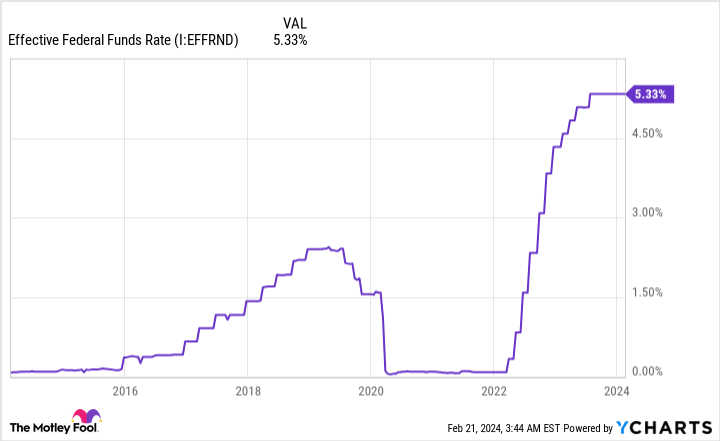
With the Federal Reserve undertaking the most aggressive rate-hiking cycle in four decades, PennantPark’s average weighted yield on its debt securities has catapulted higher by 510 basis points since Sept. 30, 2021 to the aforementioned 12.5%. As long as the nation’s central bank holds steady on above-average interest rates, PennantPark will be rolling in dough.
Another interesting aspect of PennantPark’s business is that it’s done an excellent job of preserving its investment capital and de-risking its aggregate $1.27 billion portfolio. Including common and preferred stock investments, it’s put its money to work in 141 companies. That’s an average investment size of only $9 million, which ensures that no single investment is critical to PennantPark’s success.
Furthermore, 99.99% of the company’s $1.09 billion loan portfolio is held in first-lien secured debt. First-lien secured debtholders are first in line for repayment in the event that a borrower seeks bankruptcy protection. The thing is, just one company in its entire portfolio is currently delinquent, representing just 0.1% of the value of its overall portfolio at its cost basis.

Altria Group: 9.73% yield
The third ultra-cheap, ultra-high-yield dividend stock that can produce $500 in super safe annual dividend income from an initial investment of $5,350 that’s split across three stocks is tobacco company Altria Group (NYSE: MO). Altria has raised its payout 58 times in 54 years and is yielding close to 10%.
The clearest headwind for tobacco companies is that consumers have wised up about the potential dangers of long-term tobacco use. Adult cigarette smoking rates in the U.S. have fallen from around 42% in 1965 to 11.5% in 2021, according to the Centers for Disease Control and Prevention. A shrinking pool of consumers is certainly a concern.
The good thing for Altria is that it sports strong pricing power. Tobacco products contain nicotine, which is an addictive chemical. Even with fewer consumers smoking cigarettes and shipments declining, Altria has been able to somewhat or fully offset sales declines by increasing the price on its products.
Altria accounted for nearly a 47% share of the cigarette market in the U.S. in 2023. The bulk of this comes from premium brand Marlboro, which represented 42.1% of the U.S. cigarette market. It’s easy to raise prices when you’re the undisputed leader.
However, Altria’s future rests on its ability to expand its operations beyond tobacco and into smokeless/alternative products. The company’s acquisition of electronic-vapor company NJOY Holdings in June 2023 is a perfect example.
While Altria flubbed badly with its large investment in e-vapor company Juul, it didn’t make the same mistake twice when it acquired NJOY. NJOY has received six marketing granted orders (MGOs) from the U.S. Food and Drug Administration, which serve as authorizations for those e-vapor products to be sold.
The vast majority of e-vapor products lack MGOs and could therefore be pulled from retail shelves at some point in the future. NJOY benefits from the safety of its positioning, as well as Altria’s decades of marketing and product-development expertise.
Lastly, the valuation makes sense. Though Altria is never going to be the growth story it was decades ago, it’s still capable of growing its annual earnings per share (EPS) by a low- to mid-single-digit pace. That makes its forward price-to-earnings ratio of less than 8 a bargain.
Should you invest $1,000 in Enterprise Products Partners right now?
Before you buy stock in Enterprise Products Partners, consider this:
The Motley Fool Stock Advisor analyst team just identified what they believe are the 10 best stocks for investors to buy now… and Enterprise Products Partners wasn’t one of them. The 10 stocks that made the cut could produce monster returns in the coming years.
Stock Advisor provides investors with an easy-to-follow blueprint for success, including guidance on building a portfolio, regular updates from analysts, and two new stock picks each month. The Stock Advisor service has more than tripled the return of S&P 500 since 2002*.
*Stock Advisor returns as of February 20, 2024
Sean Williams has positions in PennantPark Floating Rate Capital. The Motley Fool recommends Enterprise Products Partners. The Motley Fool has a disclosure policy.
Want $500 in Super Safe Annual Dividend Income? Invest $5,350 Into the Following 3 Ultra-Cheap, Ultra-High-Yield Stocks. was originally published by The Motley Fool
3 “Magnificent Seven” Stocks Billionaires Are Selling, and the 1 They Can’t Stop Buying
Since the beginning of 2023, investors have enjoyed a true running of the bulls on Wall Street. The iconic Dow Jones Industrial Average and broad-based S&P 500 galloped to fresh highs, while the growth-driven Nasdaq Composite ended the previous week a stone’s throw from eclipsing its November 2021 record-closing high.
While I’d love to tell you that this has been a broad-driven rally, the emergence of a new bull market is the result of outsized returns from the “Magnificent Seven.”

When I say Magnificent Seven, I’m referring to some of the largest, most influential businesses on Wall Street:
These are seven innovation-driven businesses that offer an abundance of competitive advantages. Examples include Alphabet’s virtual monopoly in internet search with Google; Microsoft’s continued dominance with its Windows operating system; Tesla’s position as North America’s leading electric vehicle manufacturer; Amazon’s dominant e-commerce marketplace; and Meta’s top social media assets, which attract nearly 4 billion active users each month.
While the outperformance of the Magnificent Seven isn’t lost on Wall Street, its most successful money managers have very different outlooks on these top-tier stocks, as evidenced by the latest round of 13F filings. A 13F allows investors to see what Wall Street’s brightest minds bought and sold in the latest quarter.
Based on 13Fs for the December-ended quarter, three Magnificent Seven stocks were given the heave-ho by billionaire investors, while another was aggressively purchased.
Magnificent Seven stock No. 1 billionaires are selling: Meta Platforms
The first Magnificent Seven stock that was sent to the chopping block in the fourth quarter is social media giant Meta Platforms. A half-dozen billionaire money managers lightened their respective fund’s stakes in the parent of Facebook, Instagram, and WhatsApp, including (total shares sold in parentheses):
-
Jeff Yass of Susquehanna International (3,037,082 shares)
-
Chase Coleman of Tiger Global Management (1,430,767 shares)
-
Philippe Laffont of Coatue Management (542,399 shares)
-
Steven Cohen of Point72 Asset Management (371,850 shares)
-
Israel Englander of Millennium Management (307,709 shares)
-
David Tepper of Appaloosa Management (100,000 shares)
The most logical reason for billionaires to be wary of Meta is the likelihood of a U.S. recession taking shape in 2024. Meta generates almost 98% of its revenue from advertising on its social media platforms, and it’s perfectly normal for advertisers to reduce their spending during periods of economic weakness. A recession would hurt Meta’s sales and its ad-pricing power in the short run.
The other potential concern for billionaires might be Meta’s valuation. Shares of the company have more than quintupled in value from their 2022 bear market low. Billionaires selling could represent simple profit-taking, or perhaps signal that top asset managers anticipate a short-term pullback in Meta stock.
However, the interesting thing about Meta is that it’s still historically cheap, even after its run-up. Shares of the company are valued at 12.6 times forecast cash flow in 2025, which represents a nearly 20% discount to its average price-to-cash-flow multiple over the trailing-five-year period.

Magnificent Seven stock No. 2 billionaires are selling: Alphabet
A second Magnificent Seven stock that got the boot from billionaire asset managers in the December-ended quarter is Alphabet. The parent of internet search engine Google, streaming platform YouTube, and cloud infrastructure service platform Google Cloud saw seven billionaires sell its stock, including (total shares sold in parentheses for Alphabet’s Class A shares, GOOGL):
-
Philippe Laffont of Coatue Management (3,302,342 shares)
-
Stephen Mandel of Lone Pine Capital (3,113,001 shares)
-
Chase Coleman of Tiger Global Management (1,278,300 shares)
-
Dan Loeb of Third Point (900,000 shares)
-
Ken Griffin of Citadel Advisors (806,651 shares)
-
Terry Smith of Fundsmith (571,317 shares)
-
Steven Cohen of Point72 Asset Management (236,969 shares)
Similar to Meta, the exodus among billionaires from Alphabet may have to do with concerns about the health of the U.S. economy. A few money-based metrics and predictive indicators have been blaring warnings that U.S. economic activity could weaken. Alphabet brought in about 76% of its net sales in 2023 from advertising on Google search, Google Network, and YouTube.
And just like Meta, the selling doesn’t seem to make much sense. In addition to periods of growth disproportionately outlasting recessions, Alphabet’s Google accounts for more than 91% of worldwide internet search share, as of January. In fact, you have to look back nearly nine years to find the last time a month went by where it didn’t account for at least 90% of global internet search. Alphabet’s ad-pricing power is practically unsurpassed.
Alphabet also completed its first year of operating profitability from its high-margin cloud infrastructure services segment. Google Cloud has gobbled up a 10% share of global cloud infrastructure service spending and shouldn’t have any trouble meaningfully increasing its cash flow in the years to come.
Magnificent Seven stock No. 3 billionaires are selling: Nvidia
The third Magnificent Seven stock that had billionaires willingly pressing the sell button during the fourth quarter is the infrastructure backbone of the artificial intelligence (AI) movement, Nvidia. All told, eight billionaires were sellers of the hottest megacap stock on Wall Street, including (total shares sold in parentheses):
-
Israel Englander of Millennium Management (1,689,322 shares)
-
Jeff Yass of Susquehanna International (1,170,611 shares)
-
Steven Cohen of Point72 Asset Management (1,088,821 shares)
-
David Tepper of Appaloosa Management (235,000 shares)
-
Philippe Laffont of Coatue Management (218,839 shares)
-
Chase Coleman of Tiger Global Management (142,900 shares)
-
David Siegel and John Overdeck of Two Sigma Investments (30,663 shares)
One of the prime reasons billionaire investors may have rushed for the exit is growing graphics processing unit (GPU) competition. Not only is Nvidia going to fend off increasing competition from external competitors like Advanced Micro Devices and Intel, but many of Nvidia’s top customers are developing their own AI chips, including Microsoft and Meta Platforms.
There’s also a real possibility that Nvidia could cannibalize its own gross margin as it expands its production of A100 and H100 AI-GPU chips. A modest increase in cost of revenue compared to an 86% jump in sales through the first nine months of fiscal 2024 (Nvidia’s fiscal year ended in late January) pretty clearly demonstrates how powerful Nvidia’s pricing power has been. Once this GPU scarcity wanes, its gross margin is liable to decline.
Lastly, every next-big-trend over the past three decades has worked its way through an early-stage bubble. History suggests that investors will overestimate the uptake of AI, just as they have with every previous next-big-thing trend for 30 years.
The Magnificent Seven stock billionaire money managers can’t stop buying: Amazon
There was, however, one Magnificent Seven stock that didn’t have billionaires abandoning ship. During the December-ended quarter, eight billionaires gobbled up shares of e-commerce company Amazon, including (total shares purchased in parentheses):
-
Ken Griffin of Citadel Advisors (4,321,477 shares)
-
Jim Simons of Renaissance Technologies (4,296,466 shares)
-
Chase Coleman of Tiger Global Management (947,440 shares)
-
Ken Fisher of Fisher Asset Management (888,369 shares)
-
David Siegel and John Overdeck of Two Sigma Investments (726,854 shares)
-
Steven Cohen of Point72 Asset Management (462,179 shares)
-
Israel Englander of Millennium Management (85,532 shares)
The lure of Amazon for billionaires is that its business isn’t as reliant on e-commerce as you might think. Although e-commerce accounts for a sizable percentage of Amazon’s sales, online retail sales are low margin. If the U.S. economy were to stumble and online retail sales tapered off, it won’t have much impact on Amazon’s cash flow.
By comparison, the company generates the lion’s share of its operating income from its cloud infrastructure services platform Amazon Web Services (AWS). AWS was responsible for close to a third of global cloud infrastructure service spending in the third quarter of 2023. As long as AWS continues to grow by a double-digit percentage, Amazon’s cash flow can motor substantially higher.
Despite a huge rally in its share price, Amazon remains inexpensive, relative to its cash flow. The reason I’m using cash flow, as opposed to the traditional price-to-earnings ratio, is because Amazon reinvests most of its operating cash flow back into its business. After ending every year of the 2010s at a multiple of between 23 and 37 times its cash flow, Amazon shares can be picked up right now for a little over 12 times forecast cash flow in 2025.
Should you invest $1,000 in Meta Platforms right now?
Before you buy stock in Meta Platforms, consider this:
The Motley Fool Stock Advisor analyst team just identified what they believe are the 10 best stocks for investors to buy now… and Meta Platforms wasn’t one of them. The 10 stocks that made the cut could produce monster returns in the coming years.
Stock Advisor provides investors with an easy-to-follow blueprint for success, including guidance on building a portfolio, regular updates from analysts, and two new stock picks each month. The Stock Advisor service has more than tripled the return of S&P 500 since 2002*.
*Stock Advisor returns as of February 20, 2024
Randi Zuckerberg, a former director of market development and spokeswoman for Facebook and sister to Meta Platforms CEO Mark Zuckerberg, is a member of The Motley Fool’s board of directors. John Mackey, former CEO of Whole Foods Market, an Amazon subsidiary, is a member of The Motley Fool’s board of directors. Suzanne Frey, an executive at Alphabet, is a member of The Motley Fool’s board of directors. Sean Williams has positions in Alphabet, Amazon, Intel, and Meta Platforms. The Motley Fool has positions in and recommends Advanced Micro Devices, Alphabet, Amazon, Apple, Meta Platforms, Microsoft, Nvidia, and Tesla. The Motley Fool recommends Intel and recommends the following options: long January 2023 $57.50 calls on Intel, long January 2025 $45 calls on Intel, long January 2026 $395 calls on Microsoft, short February 2024 $47 calls on Intel, and short January 2026 $405 calls on Microsoft. The Motley Fool has a disclosure policy.
3 “Magnificent Seven” Stocks Billionaires Are Selling, and the 1 They Can’t Stop Buying was originally published by The Motley Fool
As the Ethereum ecosystem braces for the much-anticipated Dencun upgrade, renowned crypto analyst Miles Deutscher provides an in-depth look at the altcoins poised for significant growth.
Scheduled for March 13, the Dencun upgrade is a critical hard fork aimed at enhancing Ethereum’s scalability, security, and usability. Deutscher’s insights reveal how specific Layer 2 (L2) solutions are uniquely positioned to benefit from the upgrade’s introduction of Proto-Danksharding and other key enhancements.
Deutscher explains, “The Dencun upgrade, especially with EIP-4844, represents a paradigm shift in how Ethereum will handle transactions. By drastically lowering gas fees and increasing throughput, we’re looking at a more accessible, efficient blockchain.” This upgrade is part of Ethereum’s broader roadmap, known as “The Surge,” focusing on scalability improvements.
Top-6 Altcoins To Watch Prior To Dencun
#1 Polygon (MATIC/POL): With its impending rebrand and investment in zk-technology, Polygon is at a pivotal juncture. Deutscher notes, “Polygon’s deep dive into zk-rollups could redefine its position in the L2 landscape, making MATIC an attractive asset for forward-looking investors.”
#2 Arbitrum (ARB): As the leading L2 by TVL and transaction volume, Arbitrum’s robustness is undisputed. “Arbitrum has cemented its position as a powerhouse in the L2 space, and the Dencun upgrade will only amplify its strengths,” Deutscher remarks.
#3 Optimism (OP): Positioned as a strong contender in the L2 space, Optimism’s ecosystem is set to expand. “The announcement of Optimism’s fourth airdrop is not just a reward for its community but a strategic move to bolster its ecosystem’s vibrancy,” says Deutscher.
#4 COTI Network (COTI): With the launch of V2 and its innovative ‘Garbled Circuits,’ COTI introduces a groundbreaking privacy solution. Deutscher observes, “COTI’s approach to privacy on the blockchain through ‘Garbled Circuits’ is a game-changer, potentially setting a new standard for private transactions.”
#5 Mantle (MNT): Highlighting Mantle’s rapid growth, Deutscher points out, “With $1.5 billion in ETH now staked as mETH, Mantle is not just growing; it’s thriving, supported by strategic airdrops that reward its community.”
#6 Metis (METIS): Identified as a potentially undervalued project, Metis’s upcoming initiatives are a beacon for investors. “Metis’s decentralized sequencer and the substantial METIS Ecosystem Fund are laying the groundwork for a robust, decentralized future, making it an intriguing prospect post-Dencun,” Deutscher explains.
Broader Implications For Ethereum
Deutscher also casts a spotlight on Manta Network, Starknet, zkSync, and Linea as projects to watch, emphasizing the widespread impact of the Dencun upgrade. He advises, “The ETH/L2 trade is increasingly compelling as we approach the Dencun upgrade. Shifting a significant portion of one’s portfolio into the Ethereum ecosystem seems prudent, given the transformative potential of the upcoming changes.”
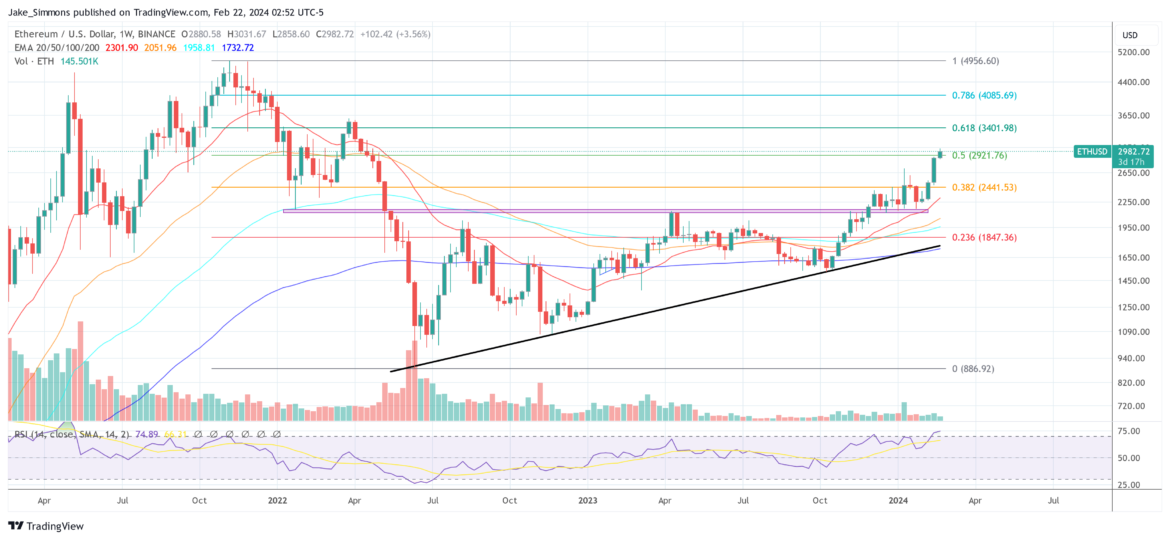
At press time, ETH still traded just below the $3,000 mark.

Featured image from Shutterstock chart from TradingView.com
Disclaimer: The article is provided for educational purposes only. It does not represent the opinions of NewsBTC on whether to buy, sell or hold any investments and naturally investing carries risks. You are advised to conduct your own research before making any investment decisions. Use information provided on this website entirely at your own risk.
Beyond Bitcoin: Ripple CEO Says Approval of Multiple Crypto ETFs ‘Inevitable’ — Embraces Idea of Spot XRP ETF
Ripple CEO Brad Garlinghouse believes that the U.S. Securities and Exchange Commission (SEC) will approve spot exchange-traded funds (ETFs) based on crypto tokens other than bitcoin. “I think it’s inevitable that there’ll be multiple ETFs around different tokens,” he stressed, noting that Ripple would welcome an XRP ETF. “In my opinion, it makes these markets […]
Source link
Opinion: Nvidia’s sheer dominance can be summed up by this one underrated number

Following a quarter when Nvidia Corp. grew data-center revenue and earnings each by more than 400%, another number illustrates the company’s dominance even more.
Among the record-setting elements of Nvidia’s
NVDA,
stunning fiscal fourth quarter was its 76% GAAP gross margin, which was up from 66% a year before. Nvidia forecasts that margin will remain around the same level for its ongoing quarter.
Nvidia’s gross margins appear to be the second highest in the semiconductor industry, behind only those of Arm Holdings PLC
ARM,
which licenses chip designs but doesn’t sell its own chips directly. Arm’s gross margins were roughly 93% in the December quarter.
Unlike Arm, Nvidia incurs expenses for things like inventory and supply-chain distribution, which helps explain why the company’s gross margin is lower. At the same time though, Nvidia’s margins stand out among those elsewhere in the chip sector. Intel Corp.
INTC,
reported a gross profit margin of 46% while Advanced Micro Devices Inc.
AMD,
reported a 40% margin in the fourth quarter, according to FactSet.
Admittedly, those companies have different business mixes. Intel and AMD make processor chips for PCs, among their other offerings, while Nvidia and AMD both have gaming-chip businesses. Plus, Intel manufactures its own semiconductors.
Leaving mix aside, however, Nvidia’s margins are so high in part because of the high prices the company is able to command for its products, due to their complex nature and their unstoppable demand. And Nvidia’s chips really are complex — not just a motherboard with a graphics processor unit (GPU).
“People think that the Nvidia GPU is just a chip, but the Nvidia Hopper GPU has 35,000 parts. It weighs 70 pounds,” Nvidia Chief Executive Jensen Huang said on the company’s earnings call Wednesday. “These are really complicated things we’ve built. People call it an AI supercomputer for good reason.”
The average cost of an H100 GPU is about $30,000.
Nvidia did note that its margins for the latest quarter and the current one could represent a peak due to favorable component costs in the supply chain in the past few months. But Chief Financial Officer Colette Kress said Nvidia had “visibility” into a mid-70% gross margin for the balance of this fiscal year, which would take margins back to where they were before this latest high-water mark.
In other words, even if Nvidia’s margins come down a bit from here, they’re still poised to sit above those from virtually every peer in the sector.
Nvidia will also be ramping up its next-generation GPU product, called Blackwell, but it is also currently supply-constrained. That could pressure Nvidia’s margins if it has to spend more on components that are in tight supply or if it cannot meet all the demand.
Read also: Wall Street keeps likening Nvidia to dot-com era Cisco. Is it justified?
Wall Street had been nervous about the demand for Nvidia’s products and investors have been on the lookout for any signs that the boom is ending. The company talked up years of growth potential ahead, but the margin figures add an understated element to the story of Nvidia’s prime positioning and help throw cold water on investors’ skepticism.
While Nvidia has had a near monopoly on the market for AI hardware so far, it will be facing more competition soon. Still, those record margins are clearly indicative that demand is continuing, and Nvidia should be able to command premium prices for its chips and accompanying systems due to the value they bring to customers.
Ethereum Whale Buys $187 Million ETH In 3-Day Spree, Anticipating Further Surge
In recent on-chain data from Spot On Chain, an Ethereum whale appears to have engaged in significant accumulation activity, sparking interest and speculation within the ETH community.
According to the platform, the whale address in question has purchased a total of 64,501 ETH in the past three days, amounting to roughly $187 million at current market prices,
Ethereum Whale Accumulation
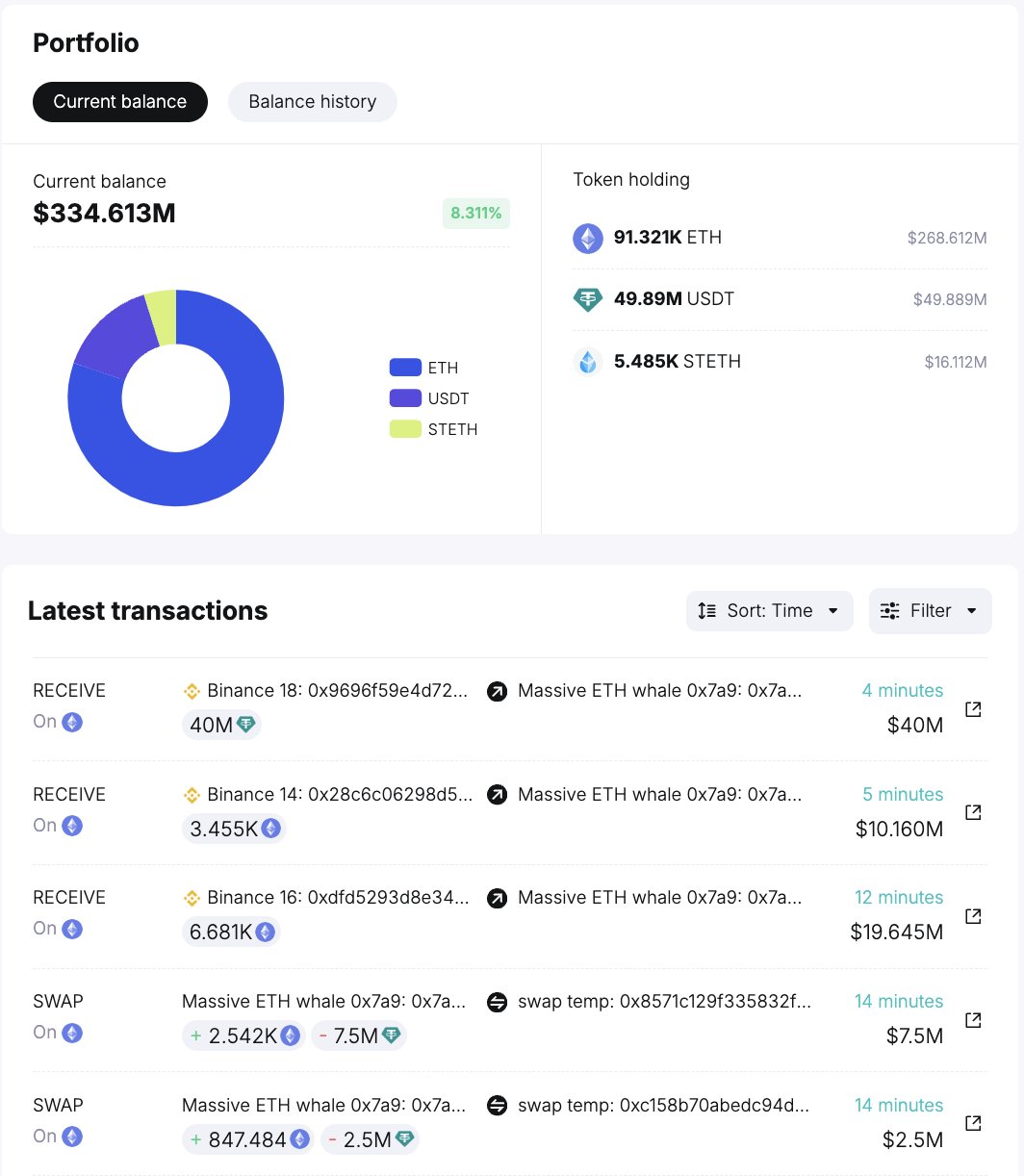
Spot On Chain reported that earlier today, the whale acquired approximately 13,526 ETH at an average price of $2,947 per ETH. This accumulation, valued at over $39 million, adds to the already substantial holdings of the whale, suggesting a bullish outlook on Ethereum’s future trajectory.
The platform’s data further reveals that the whale withdrew 10,136 ETH from Binance while purchasing 3,390 ETH from 1inch. These purchases have compounded the whale’s accumulation of ETH in the past three days to a total of 64,501 ETH.
Additionally, Spot On Chain highlights the withdrawal of an additional 40 million USDT from Binance, prompting speculation regarding its potential use for further Ethereum purchases.

According to the portfolio image above that Spot On Chain shared, the whale’s wallet holds a total of 91,321 ETH, in addition to approximately $49.8 million worth of USDT and 5,485 STETH. These assets, in total, are estimated to be $334 million.
Giant whale 0x7a9 allegedly bought 13,526 $ETH ($39.85M) at ~$2,947 again!
• withdrew 10,136 $ETH ($29.85M) from #Binance
• bought 3,390 $ETH with 10M $USDT #1inchOverall, the whale has bought 64,501 $ETH ($185.5M) in the past 3 days!
It also withdrew another 40M $USDT from… pic.twitter.com/ySbvIv2mux
— Spot On Chain (@spotonchain) February 21, 2024
Ethereum’s Price Action And Expert Sentiment
Ethereum has continued to showcase bullish momentum, trading up by nearly 6% over the past week. However, despite briefly surpassing the $3,000 mark, Ethereum has retraced slightly in the past 24 hours, trading around $2,900 at the time of writing.
This pullback has not dampened optimism within the crypto community, with many anticipating further upward movement. Industry experts have weighed in on Ethereum’s performance, with Stefan von Haenisch of OSL SG Pte in Singapore noting the cryptocurrency’s potential to outperform Bitcoin in the coming months.
Haenisch attributes this optimism partly to speculation surrounding the potential approval of spot Ethereum exchange-traded funds in the US. Michaël van de Poppe, CEO of MN Trading, echoes this sentiment, forecasting a potential surge for Ethereum to $3,800 to $4,500 shortly.
#Ethereum is on its way towards $3,800-4,500. pic.twitter.com/TfoBGloBsH
— Michaël van de Poppe (@CryptoMichNL) February 19, 2024
Featured image from Unsplash, Chart from TradingView
Disclaimer: The article is provided for educational purposes only. It does not represent the opinions of NewsBTC on whether to buy, sell or hold any investments and naturally investing carries risks. You are advised to conduct your own research before making any investment decisions. Use information provided on this website entirely at your own risk.

Royal Caribbean Group raised its earnings guidance for the year, thanks to “accelerating demand” and a strong start of the year for its cruises.
Royal Caribbean
RCL,
shares rose more than 5% in the extended session Wednesday after ending the regular trading day down 0.2%.
“The company continues to be very encouraged about the demand and pricing environment for 2024,” Royal Caribbean said. “Bookings have been significantly higher than during the same period last year.”
Don’t miss: Royal Caribbean stock jumps as strong start to ‘wave season’ sparks upbeat outlook
For 2024, all four quarters and all key products are booked ahead of the same time last year in both rate and volume, the company said. Consumer spending onboard also continues to exceed prior years “driven by greater participation at higher prices, indicating quality and healthy future demand.”
“Since our last earnings call, robust demand for our vacation experiences has significantly exceeded our initial expectations,” Chief Executive Jason Liberty said in a statement.
The company raised its 2024 adjusted EPS guidance by 40 cents to between $9.90 and $10.10.
About 15 cents of that full-year increase in adjusted EPS is driven by an improved revenue outlook for the first quarter of 2024, Royal Caribbean said.
Analysts expect the company to earn an adjusted $9.73 a share in the year.
Shares of Royal Caribbean have gained 60% in the past 12 months, compared with gains of around 25% for the S&P 500 index
SPX.
Related: Carnival’s stock is having a record year as cruise demand keeps increasing