This week, WLD token from the Worldcoin project soared by 142.7% against the U.S. dollar, topping the chart as the week’s most significant gainer. Hot on its heels was the digital currency bitget token (BGB), which saw an increase of just over 58% in the past week. Conversely, Astar (ASTR) experienced a decline of 6.4%, […]
Source link

CoinNews
NEAR has consistently followed the market trend since the start of the year. The latest market data shows the token is up nearly 30% bi-weekly. This is evidence that investors are still hyped by the recent growth featured within the broader market and the recent developments on the NEAR Protocol.
Account Aggregation: What’s The Gist?
NEAR is continuing its mission to be the one-all-be-all for entry-level and professional entities within Web 3. Account aggregation, or the consolidation of Web 3 and crypto accounts into one NEAR account, is their current focus.
Account aggregation is, according to their most recent blog post, a “critical pillar of advancing Chain Abstraction.”
It essentially groups every single account you have across the crypto world into a single access point: your NEAR Protocol account. The technology is still in development, but it seems to incite excitement in investors.
If NEAR can implement this innovation seamlessly within its ecosystem and beyond, it will cement itself to be a true innovator within the DeFi and Web 3 space.
NEARUSD currently trading at $3.529 on the daily chart: TradingView.com
According to a recent development overview done by Reflexivity Research, NEAR’s position allows it to be the bridge of all bridges within the crypto space.
Overview of @NEARProtocol‘s Q4 developments:
NEAR Protocol stands as a Layer-1 (L1) smart contract blockchain that couples a state-of-the-art sharded architecture with an emphasis on offering a user experience reminiscent of Web 2 platforms. While maintaining the security and… pic.twitter.com/LzKcMldJy7
— Reflexivity Research (@reflexivityres) February 16, 2024
“abstracting away different blockchains for a seamless Web3 experience has benefits beyond simply improving UX. It can potentially also reduce the liquidity fragmentation and tribalism associated with a fragmented crypto economy built around disparate, siloed blockchains.”
— NEAR Protocol (@NEARProtocol) February 16, 2024
In simple terms, NEAR’s recent development can unite the fragmented Web 3 space, onboarding new users and bringing new growth to the crypto world.
NEAR Approaching A Possible Ceiling

In its current situation, NEAR is following Bitcoin very closely in its price changes. Investors should then be careful of possible pitfalls within Bitcoin’s bullish market that may affect NEAR’s ability to climb.
If bearishness does take over the market, investors can rely on the $2.8 price level to slow down any bearish attempt in the short to medium term. However, investors and traders should try and consolidate on this line if NEAR follows any downward pressure from the broader market.
Featured image from Adobe Stock, chart from TradingView
Disclaimer: The article is provided for educational purposes only. It does not represent the opinions of NewsBTC on whether to buy, sell or hold any investments and naturally investing carries risks. You are advised to conduct your own research before making any investment decisions. Use information provided on this website entirely at your own risk.
Bitcoin euphoria phase far off, Coinbase data suggests more growth potential

What is CryptoSlate Alpha?
A web3 membership designed to empower you with cutting-edge insights and knowledge. Learn more ›
Connected to Alpha
Welcome! 👋 You are connected to CryptoSlate Alpha. To manage your wallet connection, click the button below.
Oops…you must lock a minimum of 20,000 ACS
If you don’t have enough, buy ACS on the following exchanges:
Connect via Access Protocol
Access Protocol is a web3 monetization paywall. When users stake ACS, they can access paywalled content. Learn more ›
Disclaimer: By choosing to lock your ACS tokens with CryptoSlate, you accept and recognize that you will be bound by the terms and conditions of your third-party digital wallet provider, as well as any applicable terms and conditions of the Access Foundation. CryptoSlate shall have no responsibility or liability with regard to the provision, access, use, locking, security, integrity, value, or legal status of your ACS Tokens or your digital wallet, including any losses associated with your ACS tokens. It is solely your responsibility to assume the risks associated with locking your ACS tokens with CryptoSlate. For more information, visit our terms page.
1 Wall Street Analyst Thinks Palo Alto Networks Stock Is Going to $425. Is It a Buy?
Shares of cybersecurity company Palo Alto Networks (PANW -0.13%) could soar to $425, according to analysts at BTIG, who recently raised their price target on the stock from $343 to $425 while maintaining a “buy” rating.
They cited their belief the company will report in-line results in the fiscal second quarter and maintain its fiscal 2024 guidance. Palo Alto is scheduled to report results after the market closes on Feb. 20.
Sluggish billings growth
Billings, the amount invoiced to customers in a given period, has been a weak spot for Palo Alto in recent quarters. This metric grew just 16% year over year in the quarter that ended on Oct. 31.
For the fiscal second quarter, Palo Alto expects to grow billings 15% to 18% with a tighter range of 16% to 17% expected for the full year. BTIG is confident the company can hit these targets, although it did point to one headwind: Prisma Cloud, the company’s cloud application security product, is facing increased competition, leading to a deceleration in growth.
Palo Alto CFO Dipak Golechha pointed to the “cost of money” as a key driver of the sluggish billings growth in the fiscal first quarter. A tough macroeconomic environment is putting a chill on demand, and the company doesn’t expect its results to improve much this year.
Is Palo Alto Networks stock a buy?
Palo Alto is a major player in the cybersecurity market with revenue expected to reach around $8.2 billion in fiscal 2024. While analysts are optimistic about the stock’s upward trajectory, the valuation should give investors some pause.
Management is expecting adjusted earnings per share between $5.40 and $5.53 in fiscal 2024. The midpoint of this range represents a price-to-earnings ratio of roughly 67 as of this writing. At BTIG’s new price target, the P/E ratio would jump to 77.
With billings and revenue growth stuck in a low double-digit range, this valuation is tough to swallow. Shares of Palo Alto have already gained about 24% in 2024, but investors may be getting ahead of themselves.
Timothy Green has no position in any of the stocks mentioned. The Motley Fool has positions in and recommends Palo Alto Networks. The Motley Fool has a disclosure policy.
Despite $7 billion GBTC outflow, Bitcoin ETFs net $4.9 billion since January
Quick Take
BitMEX’s data analysis presents a clear picture of the recent Bitcoin inflows and outflows into the ETFs. The Bitcoin ETFs experienced a significant inflow of $331 million on Feb. 16, contributing to a weekly net flow of $2.273 billion. This robust inflow marks a continued trend since Jan. 11, with the total net flow reaching a substantial $4.926 billion, according to BitMEX data.
BlackRock IBIT has been a core player leading these inflows, contributing $191 million on Feb. 16 and bringing its total inflows to a hefty $5.4 billion. Conversely, GBTC experienced outflows of $150 million, pushing its total outflows to $7 billion, according to BitMEX data.
In Bitcoin terms, BitMEX reports a net inflow of 6,376 BTC on Feb. 16, 44,865 BTC for the week of Feb 12. to Feb 16, and a total of 102,888 BTC since Jan. 11, 2024.
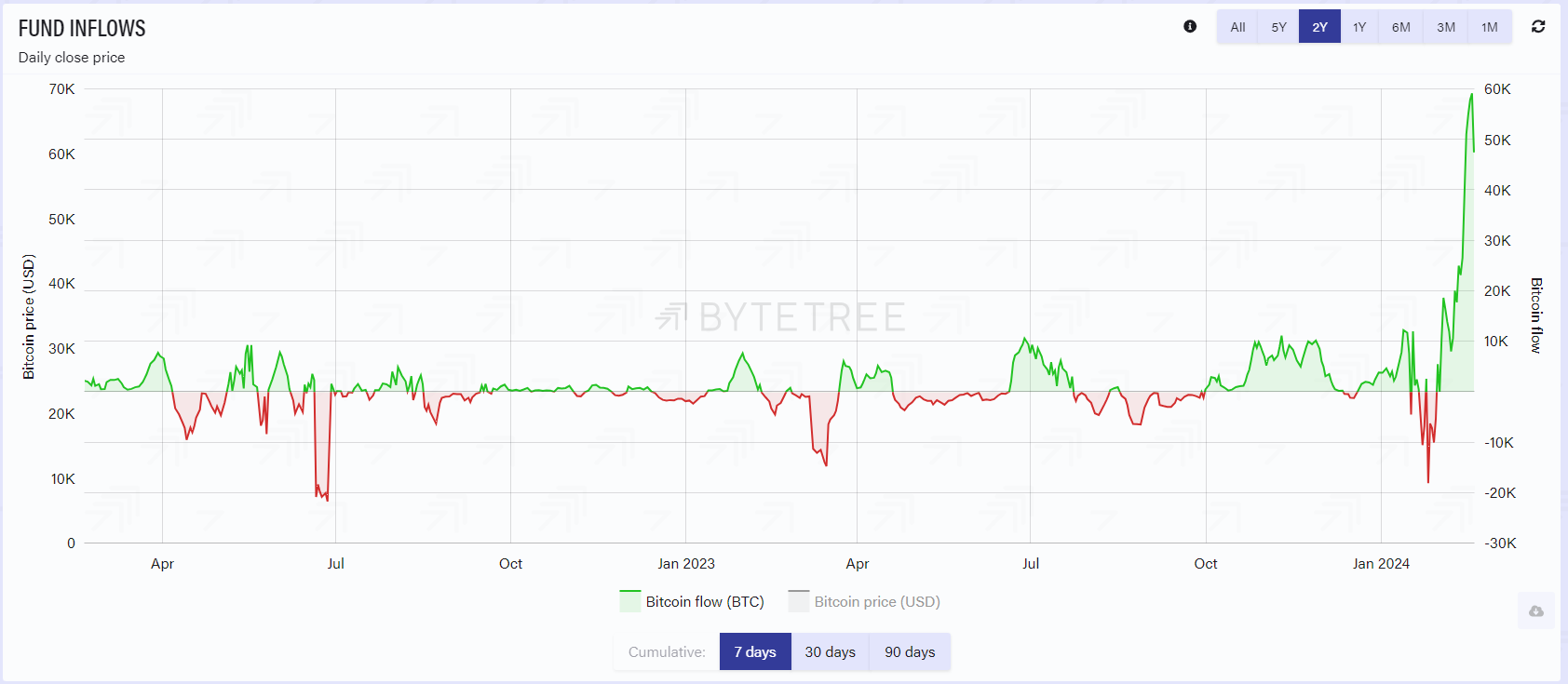
Meanwhile, according to Bytetree, the global ETPs hold approximately 947,000 BTC. Over the past seven days, ByteTree data indicates an addition of 47,500 BTC.

The post Despite $7 billion GBTC outflow, Bitcoin ETFs net $4.9 billion since January appeared first on CryptoSlate.
93% ghost interviews and 87% have not even shown up for their first day of work
Ghosting isn’t just for dating anymore. Now Gen Z are treating their would-be employers like bad dates and not showing up for job interviews or their first day on the job without as much as a phone call.
Employment website Indeed surveyed 1,500 businesses and 1,500 working people in the U.K. and found that job ghosting is rife, with 75% of workers saying they’ve ignored a prospective employer in the past year.
But the youngest generation of workers are by far the worst offenders.
A whopping 93% of Gen Zers told the global recruitment platform that they’ve flaked out of an interview.
Worse still, a staggering 87% managed to charm their way through interviews, secure the job, and sign the contract, only to leave their new boss stranded on the very first day.
Their reason for doing so? According to the survey, it makes them “feel in charge of their career”.
But it’s having the opposite effect on businesses left high and dry: More than half of businesses surveyed have said that ghosting has made hiring more difficult.
Businesses and millennials are at it too
Although Gen Z are the biggest culprits, baby boomers, Gen X, and millennials aren’t off the hook: Indeed’s data found that everyone is guilty of ghosting occasionally.
Almost half of those surveyed said they plan on pulling a disappearing act again, with a third deeming it acceptable to do so before an interview.
However, unlike Gen Z who feel emboldened by blanking bosses, older workers say they instantly regret it.
Millennials, for example, are most likely to feel anxious after ghosting and worried that ghosting will negatively impact future opportunities.
What’s more, while more than half of Gen Zers are repeat offenders, the researchers found that a candidate’s likelihood to ghost again decreases with age.
Even businesses are joining in: One in five workers complained that a prospective employer has failed to show up for a phone interview, while 23% have been provided with a verbal offer only to be left hanging.
It’s why workers today think that ghosting is fair game: More than half agree that since employers ghost job seekers, it’s okay to do it back.
And, perhaps surprisingly, over a third of companies agree that this sentiment is reasonable.
The data confirms suspicions—and offers a solution
For many employers, Indeed’s data will finally confirm their suspicions that Gen Z has commitment issues.
Towards the end of last year, an MIT interviewer and finance CEO was so fed up with young candidates not showing up for their interviews that she ranted about it on X—and the now-deleted post went viral.
“One no-showed after picking the time on my calendar,” Christina Qi, CEO of the financial services firm Databento and an MIT board member wrote. “Look, I know college isn’t for everyone, but this 1 meeting could affect where you go for these next 4 years of your life.”
Like MIT, Britain’s Office for National Statistics (ONS) similarly found that Gen Z is hard to pin down.
The government body was forced to scrap key employment data because young people didn’t bother responding to its telephone surveys.
If employers want to get a hold of Gen Z, Indeed’s data says they should sweeten the deal: When suggesting ways employers could prevent being ghosted, workers ranked higher pay first, followed by better benefits.
Indeed found that the cost-of-living crisis has exacerbated ghosting, with around 40% of those surveyed admitting that they’re more likely to ghost if they find a job offering better pay or a cheaper commute.
Ultimately, it’s not just about getting the job. For young workers, it’s also about being able to afford to accept the offer.
Gen Zers are being forced to turn down the roles because they can’t foot the bill for the expenses associated with starting a new job, like buying work-appropriate attire and a monthly train ticket.
“It’s clear that the financial offer is the biggest carrot for employers trying to attract talent, with pay, benefits and other factors that support the rise in cost-of-living likely to prevent a jobseeker from ghosting,” concluded Indeed’s U.K. head of talent intelligence, Danny Stacy.
“Of course, not all businesses will be in the position to increase their offer, but being transparent about the financial package from the outset is likely to prevent jobseekers from ghosting further along the hiring process.”
This story was originally featured on Fortune.com
Nearly 50% of Warren Buffett-Led Berkshire Hathaway’s $367 Billion Portfolio Is Invested in Only 1 Stock

I don’t think many people question that Warren Buffett is one of the greatest investors ever. He continues to prove this, as one of his biggest investments clearly demonstrates.
Berkshire Hathaway, the conglomerate Buffett heads up, first purchased shares in Apple (NASDAQ: AAPL) in the first quarter of 2016. And since the start of that year to Feb. 14 of this year, the top FAANG stock has skyrocketed 599%. This gain crushes the Nasdaq Composite.
Let’s try to figure out what exactly about Apple, which today represents just under 46% of Berkshire’s entire portfolio, first drew Buffett’s attention. Then investors can decide if the stock is still a smart buy today.
Traits of a winning investment
If you look through Berkshire’s numerous holdings, you’ll easily find businesses that have strong brands. But there might be no other company that has greater brand recognition than Apple. I’m sure this was the case eight years ago, too.
Apple sells some of the most in-demand hardware and software on the face of the planet. The beautiful designs and ease-of-use resonate with consumers. Buffett recognized this several years ago.
He probably also appreciated Apple’s proven pricing power. The Oracle of Omaha has even said that the top indicator of a quality business is its ability to raise its prices. Apple’s hardware devices are certainly at the premium end of the spectrum, but even with consistent price increases, consumer demand remains robust.
Investors would struggle to find companies that are in better financial shape than Apple. In fiscal 2015, the year right before Buffett first bought the stock, it reported an operating margin of 30% and generated $70 billion of free cash flow (FCF). Fast forward to fiscal 2023, and the operating margin has remained steady. Even better, the company produced $100 billion of FCF, and it currently sits on $65 billion of net cash.
It wasn’t as if Buffett was making a speculative bet on an unknown technology company. There were clear signs that Apple was a superior enterprise back then. Its market capitalization at the start of 2016 was around $580 billion. So, the business definitely wasn’t flying under the radar, either.
That’s why it’s a shocker that during the first quarter of 2016, Apple’s price-to-earnings (P/E) ratio averaged a ridiculously low 10.6. The market was presenting Buffett with a rare buying opportunity, one that he took full advantage of and that resulted in huge gains.
Should you buy Apple?
Apple has undoubtedly worked out as a fantastic investment, but is now a good time to buy the stock if you’ve been sitting on the sidelines? The characteristics I discussed above — namely the strong brand, pricing power, and incredible profitability — all hold true today. And I’m extremely confident that these factors will still be present a decade from now.
But there is one key difference between now and the time when Buffett first bought the stock. That’s the valuation. Apple shares currently trade at a P/E multiple of 28.7. This is 37% higher than the stock’s trailing-10-year average ratio, and it’s in the stratosphere when compared to the valuation Buffett paid.
I think investors need to be critical of the expensive valuation. It’s safe to say that Apple doesn’t have the same growth potential that it did when it was a much smaller company. In fact, revenue declined last fiscal year as many of its popular products reach a more mature stage of their lifecycles.
I would be surprised if over the next five years, Apple shares outperformed the broader market. The steep P/E ratio creates a major headwind to produce strong returns going forward. So, it’s best to wait for a better entry point.
Should you invest $1,000 in Apple right now?
Before you buy stock in Apple, consider this:
The Motley Fool Stock Advisor analyst team just identified what they believe are the 10 best stocks for investors to buy now… and Apple wasn’t one of them. The 10 stocks that made the cut could produce monster returns in the coming years.
Stock Advisor provides investors with an easy-to-follow blueprint for success, including guidance on building a portfolio, regular updates from analysts, and two new stock picks each month. The Stock Advisor service has more than tripled the return of S&P 500 since 2002*.
*Stock Advisor returns as of February 12, 2024
Neil Patel and his clients have no position in any of the stocks mentioned. The Motley Fool has positions in and recommends Apple and Berkshire Hathaway. The Motley Fool has a disclosure policy.
Nearly 50% of Warren Buffett-Led Berkshire Hathaway’s $367 Billion Portfolio Is Invested in Only 1 Stock was originally published by The Motley Fool
Billionaire David Tepper Has Invested Nearly $141 Million in This Ultra-High-Yield Dividend Stock — and It’s a Screaming Buy Right Now
What does David Tepper do when he’s not busy with his Carolina Panthers football team? We can put making lots of money near the top of the list.
Tepper ranks as one of the greatest hedge fund managers of the century. Thanks to the sizzling growth of Appaloosa Management, the fund he started in 1993, his net worth now stands at close to $20.6 billion.
This hefty total is the direct result of Tepper’s shrewd stock picks through the years. He’s still at it, with Appaloosa’s portfolio chock-full of winners. Tepper has invested nearly $141 million in this ultra-high-yield dividend stock — and it’s a screaming buy right now.
A midstream monster
The billionaire hedge fund CEO especially likes tech stocks. Appaloosa’s holdings include five of the “Magnificent Seven” stocks. But Tepper doesn’t limit himself to just one sector. His second-largest position that doesn’t have a technology connection is midstream energy leader Energy Transfer (ET 0.90%).
Energy Transfer operates more than 125,000 miles of pipeline. Its assets also include natural gas liquid (NGL) fractionaters, storage facilities, and terminals as well as other energy infrastructure facilities. The company has operations in all of the major U.S. oil and gas production basins.
Acquisitions have been a key source of Energy Transfer’s growth in recent years. For example, in November 2023 the company finalized its purchase of Crestwood Equity Partners LP for $7.1 billion.
Tepper owns close to 9.8 million shares of Energy Transfer. He first initiated a position in 2017. While he has bought and sold shares several times since then, Energy Transfer still makes up nearly 2.4% of his total portfolio.
Why Energy Transfer is a screaming buy
I think that Energy Transfer is a screaming buy right now, but not just because Tepper owns it. There are several reasons why I like the stock.
Let’s start with the company’s distributions. Energy Transfer’s distribution yield currently stands at 8.75%. Last month, the company increased the payout by 3.3%. It’s targeting annual distribution growth of between 3% and 5%.
Valuation is also an important factor. Energy Transfer’s forward earnings multiple is only 8.3x. Just how cheap is that? The overall S&P 500 energy sector trades at more than 11.8 times forward earnings.
I like it when the management teams of companies have plenty of skin in the game. It helps ensure that they’re well aligned with the interests of shareholders (or, in this case, unitholders). Energy Transfer’s management and independent board of directors members own roughly 11% of the company. That’s more than five times the insider ownership level of the midstream energy leader’s peers.
What about growth? I think that Energy Transfer looks pretty good on that front as well. Sure, the push to reduce carbon emissions will almost certainly boost the adoption of renewable energy sources. However, the demand for the NGLs, natural gas, and crude oil that Energy Transfer transports and stores should still increase over the coming decades.
The company is also positioning itself for the future. For example, Energy Transfer is working to capture carbon dioxide and transport it through its existing pipelines. It also operates eight renewable natural gas facilities.
What’s not to like?
Like any investment, Energy Transfer has some risks. The company’s long-term debt tops $51 billion. If interest rates remain high or increase in the future, Energy Transfer’s borrowing costs will rise and negatively impact profits.
The stock can also be volatile. Although Energy Transfer’s revenue and cash flow is well insulated from swings in oil and gas prices, its unit price isn’t.
Finally, Energy Transfer is a master limited partnership (MLP). Handling taxes related to investing in MLPs is more complicated than dealing with other stocks.
The good news is that these downsides shouldn’t outweigh the many positives that Energy Transfer offers investors. That definitely appears to be the case for David Tepper.
Keith Speights has no position in any of the stocks mentioned. The Motley Fool has no position in any of the stocks mentioned. The Motley Fool has a disclosure policy.
UPS (UPS 2.10%) stock received an analyst upgrade recently (from neutral to outperform) from a Baird analyst, buying into the view that the multinational shipping & receiving and supply chain management company’s prospects will improve in the second half of 2024. The analyst’s new price target of $170 (from $165 previously) represents a near 15% premium to the current price and is a vote of confidence in the stock.
UPS’s challenging year
Last year was far from vintage for UPS. If it wasn’t the slowing economy negatively impacting volumes, it was the threat of strike action during a protracted labor contract negotiation, causing customers to divert deliveries to other networks. If it wasn’t diverted deliveries, it was the increased costs associated with the agreed-upon employment contracts. The result of all of it was a 29% drop in adjusted operating profit for the full year.
An improving 2024
Management expects difficult conditions to persist through the first half of the year, with revenue expected to be flat to down 2% in the first half of 2024. However, management also expects a 4%-8% year-over-year improvement in revenue in the second half of the year. Moreover, UPS will lap the impact of the cost increases associated with the news contracts in the second half and start to see the cost benefits of the 12,000 job cuts planned for 2024.
Thinking longer term
UPS can grow by winning back lost volume and through an improvement in the economy. Also, the Baird analyst points out the longer-term potential for UPS’s strategic and cost initiatives to help improve its profit margins coming out of the slowdown.
The case for buying UPS is a compelling one, not least as its dividend currently yields 4.4%, and investors can look forward to the company’s Investor Day presentation in late March to hear more about how investments in technology (smart facilities, automation, etc.) that will enhance productivity in the future.
Lee Samaha has no position in any of the stocks mentioned. The Motley Fool recommends United Parcel Service. The Motley Fool has a disclosure policy.
Gold miner Polymetal looks to sell Russian operations for $3.69 billion amid nationalization fears

Gold miner Polymetal International on Monday said it had struck a deal to sell the entirety of its Russian mining business for $3.69 billion, with a view to fully exiting the Russian Federation due to the combined threats of Western sanctions and nationalization by Putin’s government.
If approved by shareholders, Polymetal will sell the business to Russian mining company JSC Mangazeya Plus, with a view to re-focusing its operations towards Kazakhstan where it currently runs two mines that account for around one-third of its total production.
The Anglo-Russian gold miner, which was founded in St Petersburg in 1998, said the sanctions-compliant agreement would see JSC Mangazeya Plus pay it $1.48 billion in cash and also agree to settle the Russian segment’s $2.21 billion debts.
Shares in Polymetal International fell 6% on Monday in Moscow, having lost 11% of their value over the past 12 months and 66% of their value since the start of the Russia’s invasion of Ukraine in early 2022.
In August 2023, the company abandoned its London listing and re-domiciled from Jersey to Kazakhstan’s capital Astana, with a view to avoiding Russia imposed rules that designated Jersey an “unfriendly jurisdiction” in response to Western sanctions.
Polymetal said it will let shareholders vote on the agreement at its upcoming annual general meeting on 7 March, as the company said the sell-off would help avoid risks including those posed by the operations being expropriated or nationalized by the Russian government.
In a statement, Polymetal said it believes a deal to sell its Russian operations “presents the most viable opportunity for the Group to restore shareholder value by removing or substantially mitigating critical political, legal, financial and operational risks.”
The striking of the deal marks the end of an arduous process faced by Polymetal in finding a sanctions-compliant buyer for its Russian operations, after it vowed to exit that country following the outbreak of war.
Polymetal’s push to divest from Russia was made more urgent by the U.S. Department of State’s decision to impose sanctions on its Russian subsidiary in May 2023, which blocked U.S. citizens from interacting with that unit.
The process of selling off its Russian assets has been more difficult due to stringent rules imposed by authorities in both Moscow and Washington on any company looking to exit Russia.
Polymetal said it had received confirmation from the U.S. Office of Foreign Assets Control (OFAC) that those involved in the sale to JSC Mangazeya would not be subject to sanctions, and made clear that any payment would be made via sanctions-compliant financial institutions.
JSC Mangazeya Plus is the mining subsidiary of the Mangazeya commodities conglomerate, which is controlled by Russian billionaire Sergey Yanchukov, who started his career as an oil trader in Ukraine.
If completed, the deal will see Polymetal retain its position as the second largest gold miner in Kazakhstan, in controlling two mines with an estimated 11.3 million ounces of gold.