
Stanley Druckenmiller, the legendary investor who was part of George Soros’ Quantum Fund, has dumped traditional tech stocks while putting funds into gold mining companies and artificial intelligence (AI) shares. According to filings, he sold Amazon, Alphabet (Google), and Broadcom stocks while acquiring shares of Barrick Gold and Newmont, two gold miners. Stanley Druckenmiller Sells […]
Source link
CoinNews
SHANGHAI/BEIJING (Reuters) – Chinese electric vehicle maker Xpeng said it would hire 4,000 this year and invest millions in artificial intelligence, as it seeks to survive what it describes as a “bloody sea” of competition in the world’s largest auto market.
The additional employees would represent a 25% expansion of the Volkswagen-backed EV maker’s workforce from the latest headcount of 15,829 at the end of 2022.
The expansion was announced in a letter from Chief Executive He Xiaopeng to employees on Sunday, the first working day after the Lunar New Year holiday.
The company will also invest 3.5 billion yuan ($486.36 million) in AI research and development for intelligent driving, He said, adding that Xpeng plans to release around 30 new products or revised models within three years.
“Facing the pessimistic macroeconomic situation, many business partners are drawing back and afraid to invest. I think this is an opportunity for our development,” He said, describing 2024 as the first year of the “knockout round” for Chinese auto brands. “In 2024, we will buck the trend and enter a high-speed positive cycle in the fourth quarter or earlier.”
Xpeng’s expansion plans contrast with rivals, which are racing to slash costs. Demand continues to falter in the world’s largest auto market despite renewed discounting led by Tesla.
Nio, another Chinese EV maker, said in November it would trim its workforce by 10% to improve efficiency amid growing competition.
Facing weaker demand at home, automakers in China have looked to exports as a driving force for growth. But China’s growing clout as a vehicle exporter is causing frictions abroad.
China’s commerce ministry said earlier this month that it would encourage the new energy vehicle industry to respond to foreign trade restrictions and cooperate with overseas firms, amid a European probe into Chinese subsidies for the sector.
Volkswagen said in July that it would invest around $700 million in Xpeng and purchase a 4.99% stake in the company.
“This year is Xpeng’s 10th year. Our performance must more than double,” He said.
($1 = 7.1963 Chinese yuan)
(Reporting by Zhang Yan, Sarah Wu, and Brenda Goh; Editing by Sam Holmes)
Ethereum price is gaining pace above the $2,800 support. ETH eyes more gains and might surge toward the $3,000 resistance zone.
- Ethereum is consolidating gains above the $2,820 support zone.
- The price is trading above $2,850 and the 100-hourly Simple Moving Average.
- There is a connecting bullish trend line forming with support at $2,850 on the hourly chart of ETH/USD (data feed via Kraken).
- The pair could continue to move up toward the $3,000 resistance zone.
Ethereum Price Eyes Upside Break
Ethereum price remained stable and slowly moved higher above the $2,800 pivot level. ETH even outperformed Bitcoin and climbed to a new weekly high above the $2,850 level.
A new multi-week high is formed near $2,894 and the price is now consolidating gains. Ether is stable above the 23.6% Fib retracement level of the recent move from the $2,722 swing low to the $2,894 high. There is also a connecting bullish trend line forming with support at $2,850 on the hourly chart of ETH/USD.
Ethereum is now trading above $2,850 and the 100-hourly Simple Moving Average. Immediate resistance on the upside is near the $2,895 level. The first major resistance is near the $2,920 level. The next major resistance is near $2,940, above which the price might rise and test the $3,000 resistance zone.

Source: ETHUSD on TradingView.com
If the bulls push the price above the $3,000 resistance, Ether could even rally toward the $3,120 resistance. In the stated case, the price could rise toward the $3,250 level in the near term. Any more gains might call for a test of $3,400.
Downside Correction In ETH?
If Ethereum fails to clear the $2,895 resistance, it could start a downside correction. Initial support on the downside is near the $2,850 level and the trend line zone.
The next key support could be the $2,800 zone or 50% Fib retracement level of the recent move from the $2,722 swing low to the $2,894 high. A clear move below the $2,800 support might send the price toward $2,780 or the 100-hourly Simple Moving Average. The main support could be $2,720. Any more losses might send the price toward the $2,640 level in the coming sessions.
Technical Indicators
Hourly MACD – The MACD for ETH/USD is gaining momentum in the bullish zone.
Hourly RSI – The RSI for ETH/USD is now above the 50 level.
Major Support Level – $2,780
Major Resistance Level – $2,895
Disclaimer: The article is provided for educational purposes only. It does not represent the opinions of NewsBTC on whether to buy, sell or hold any investments and naturally investing carries risks. You are advised to conduct your own research before making any investment decisions. Use information provided on this website entirely at your own risk.
Nintendo shares slide on report that Switch successor will be delayed until 2025

Shares of Nintendo Co. slumped in Tokyo trading Monday after Bloomberg News reported the company will delay its next-generation videogame console until 2025.
Bloomberg reported that Nintendo
7974,
told some of its game-publishing partners that the successor to the Switch console will not be released until March 2025, at the earliest. It had been expected in late 2024.
The delay likely means that Nintendo will also delay the launches of major new games until the new console comes out, Bloomberg reported. The Switch was launched in 2017.
Nintendo did not immediately respond to a request for comment.
Nintendo shares fell about 7% in Tokyo. The stock has rallied more than 50% over the past year, and hit an all time-high last week.
The videogame company reported earnings earlier this month, and said it now expects to sell 15.5 million Switch consoles through the year ending in March, up from a previous forecast of 15 million. However, revenue fell 6% year over year. Nintendo did not give a timeline on the Switch’s successor in its report or earnings call, but did say “It takes a long time and thorough planning to get ready for new hardware.”
Bitcoin Network Faces Downturn in Transactions and Fees as Halving Approaches
The volume of daily transactions on the Bitcoin network has seen a significant decline since Jan. 28, 2024, with numbers falling from peaks above 600,000 to below 300,000 transactions per day. This downturn is in sync with a decrease in the daily creation of Ordinal inscriptions, overall easing congestion and reducing onchain fees. Network Activity […]

Source link
EU regulators reportedly will fine Apple more than $500 million in antitrust probe

European regulators are reportedly set to slap Apple Inc. with a fine of more than $500 million, saying the tech giant unfairly hindered its music-streaming rivals.
The Financial Times and Bloomberg News reported Sunday that European Commission antitrust regulators are preparing to impose a roughly $500 million euro ($539 million) fine against Apple
AAPL,
after finding that it created an anticompetitive environment by failing to inform iPhone users that cheaper, alternative music-streaming apps were available outside its App Store.
The investigation was sparked by a complaint that Spotify SA
SPOT,
filed in 2019. While EU regulators have previously imposed large antitrust fines against Big Tech companies such as Google’s Alphabet
GOOGL,
GOOG,
and Microsoft Corp.
MSFT,
it has never imposed an antitrust fine against Apple.
The FT reported the fine is expected to be announced in early March.
Apple declined to comment Sunday, but referred to a previous statement, that said “The App Store has helped Spotify become the top music streaming service across Europe and we hope the European Commission will end its pursuit of a complaint that has no merit.”
Meanwhile, the FT and Bloomberg also reported that the European Commission is close to accepting a settlement from Apple in a separate antitrust case, over its Apple Pay system.
Retail investors are easing back into crypto while VC funding rises for first time in 1.5 years

Bitcoin prices climbed nearly 70% in the fourth quarter of 2023 and the crypto market has been rebounding, marking the re-entry of small retail investors. However, retail investors, who lost billions of dollars in the 2022 market crash, are moving in more slowly and cautiously this time, compared to the bull market in 2021, according to a Bloomberg report.
Venture capital funding in crypto and blockchain startups also recorded a 2.5% increase in Q4 2023 after constantly declining for six quarters, according to a Pitchbook report.
Retail traders want to be part of the bull market
Crypto exchange Coinbase has seen its net revenue from customer transactions rise 60% during the fourth quarter of 2023 compared to a year ago, according to the Bloomberg report. Compared to Q3 2023, the net revenue increased by 80%.
This is because the retail trading volume on Coinbase was up 164% in Q4 2023 compared to the previous quarter. The growth in retail trading volume outpaced that of institutional trading volume, which grew by 92% in Q4.
Retail trading on Coinbase also made up a larger chunk of the total trading volume — 19% in Q4 compared to 14% in Q3. However, it is still well below the 28-40% range recorded during the previous bull market.
Robinhood Markets reported a similar trend, with crypto notional volumes increasing by 242% in December compared to a year ago.
Retail investors are returning to the market with Bitcoin prices crossing the $50,000 mark for the first time in two years and the impending Bitcoin halving. Historically, Bitcoin halving, when mining rewards are slashed in half, leads to “more retail engagement and growth,” Coinbase CFO Alesia Haas told Bloomberg.
Alyssa Choo, crypto equities specialist at BitInvest, noted in a post on X:
“As the crypto market cap and trading volumes go up, retail trading goes up as well. Everyone wants to be a part of the bull market.”
Google searches for the term ‘Bitcoin,’ which indicates retail interest according to Wall Street analysts, increased in January when the Bitcoin exchange-traded funds (ETFs) were launched in the U.S. However, Google Trends show that the searches have slumped back to bear-market levels, indicating that retail investors are not diving headfirst into the market.
Kyle Doane, a trader at Arca, an institutional asset management firm, told Bloomberg:
“There are signs that the retail audience is starting to get back into the market, but not nearly to the extent of the last bull market yet.”
Things are starting to look up for crypto startups
Crypto and blockchain startups bagged $1.9 billion from 326 deals in Q4 2023, marking the first growth in crypto funding in a year and a half. Despite being only a “tiny percentage” increase, the Pitchbook report said it could mean it will become easier for startups to raise funds in the coming quarters.
Negative news surrounding large crypto exchanges like Binance and FTX and the bear market saw venture capital in crypto drying off significantly over the past year and a half. A series of bankruptcies, including that of FTX, and Binance’s historic $4.3 billion plea deal shook the market.
However, centralized exchanges still offer the lowest barrier to entry and a better user experience, which is why investors are still “optimistic” about them, the Pitchbook report noted.
Although the amount invested in the startups increased, deal volume decreased by 2.4% over the past quarter.
Crosschain bridging protocol Wormhole signed the biggest deal in Q4, securing $225 million in an early-stage round from Coinbase Ventures, Jump Trading, and ParaFi Capital.
Social Security Replaces Less of Your Income Now Than It Did Before. Here’s Why.
Social Security benefits help support you in retirement by replacing some of the income you were earning before you left the workforce. But they do not replace as much of your earnings as you might think — and the replacement rate has fallen over time.
Here’s what you need to know about how much of your pre-retirement income Social Security will actually replace when the time comes for you to start claiming.
Image source: Getty Images.
This is what Social Security’s replacement rate is
When the Social Security benefits program was first designed, retirees had a designated “full retirement age” (FRA) of 65 years old. This was the age when they could leave their job, claim Social Security, and get their “standard” benefit. The standard benefit for someone who claimed it at 65 was intended to replace around 40% of pre-retirement income
However, in 1983, Social Security was amended, and full retirement age has gradually been shifting later. For anyone born between 1943 and 1954, for example, FRA was moved to the age of 66. It then increases in two-month increments until 67, which is the FRA for anyone born in 1960 or later.
As FRA has changed, the replacement rate has also changed. In fact, according to the Center on Budget and Policy Priorities, a person who worked all their adult life, had average earnings, and retired at the age of 65 would see a replacement rate of about 37%.
That may not seem like a big drop from the original replacement rate of 40%, but with millions relying on Social Security as their primary source of income, even that small change can have a substantial impact on their retirement and financial security.
Your personal replacement rate depends on many factors
While the replacement rate for the average wage earner is about 37%, many factors affect how much of your personal income Social Security benefits will replace. Of course, one of the most important factors is how much you earned in your own career.
For example, if you retired at a full retirement age of 66 and 8 months in 2024, here’s what you can expect your replacement rate to be based on three scenarios:
- The replacement rate for someone with very low career earnings ($15,867 per year in 2022 dollars) would be about 78.9%.
- Someone with medium-average earnings ($63,469) would be able to replace about 42.6% of pre-retirement earnings.
- Someone with maximum average earnings ($156,274) would replace around 28% of pre-retirement earnings.
Higher earners replace less of their income because the Social Security benefits formula is progressive. Lower earners get back a higher percentage of their average wages when their benefit is calculated.
The reality, though, is that the change to full retirement age always means you’ll get less lifetime Social Security income because you either have to retire later (and pass up several months of benefits) to get your standard benefit or accept a reduction.
You should be prepared for the fact Social Security is unlikely to replace enough of your earnings that you can live on it without supplementary savings. That means socking money away in your 401(k), IRA, or other accounts as early as you can so you can be prepared in your later years.
With bitcoin’s value rising past the $51,000 mark, numerous long-dormant bitcoin hoards have begun to mobilize unspent transaction outputs (UTXOs) that have remained untouched for an extended period. Although instances involving ‘sleeping bitcoins’ from the years 2009, 2010, and 2011 are considerably scarce, there’s been a noticeable resurgence of older coin batches from 2012, 2013, […]

Source link
Nvidia’s earnings report could kill the momentum driving U.S. stocks higher
Wall Street is growing increasingly uneasy about an options-driven momentum trade that has helped push the S&P 500 index into record territory.
As demand for bullish call options surges to its highest level in years, some analysts have set their sights squarely on Nvidia Corp.’s
NVDA,
Wednesday earnings report, warning that it could be the catalyst that slams the brakes on this trade, potentially reversing a substantial amount of the market’s rally over the past four months.
Their reasoning is rooted in the fact that investors have gotten so bulled up on risky options bets, the mere fact that the earnings report has passed could be enough to sink the main U.S. stock-market indexes due to the internal dynamics of the options market — even if Nvidia’s results satisfy Wall Street’s expectations, according to several derivative-market experts who spoke with MarketWatch.
According to FactSet, analysts expect Nvidia to report earnings per share of $4.59, an increase of more than 700% from the same quarter last year.
See: Nvidia may shine again when it reports on Wednesday
Traders pile into bullish options at fastest pace since 2021 meme-stock frenzy
As stocks rallied over the past year, taking many on Wall Street by surprise, investors have increasingly relied on options to chase the market higher and boost returns.
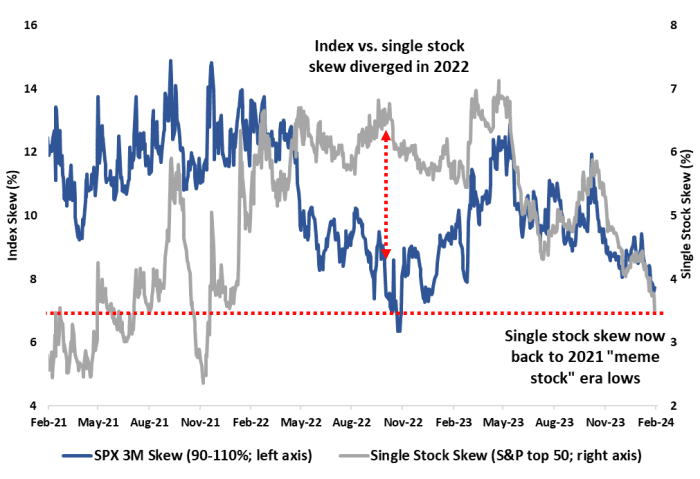
This has caused demand for bullish out-of-the-money calls on the largest U.S. stocks to approach the most skewed level since the meme-stock craze of 2021, according to data from Cboe Global Markets, one of the biggest options-exchange operators.
An option is said to be trading “out of the money” when the strike price of the option is above where the underlying stock or index is trading, in the case of calls, or below it, in the case of puts.
In the options market, “skew” typically measures demand for out-of-the-money calls compared with out-of-the-money puts, or demand for out-of-the-money puts or calls compared with their at-the-money counterparts. In this case, it is the former.
CBOE GLOBAL MARKETS
One key difference between the meme-stock era and the latest options-market frenzy is that this time around, more of the action is taking place in stocks that are heavily weighted in the main market indexes, said Michael Lebowitz, a portfolio manager at RIA Advisors.
“Option buyers are normally more insurance buyers. But now they’re more speculative traders, that’s what the skew is telling you,” he said during an interview with MarketWatch.
Michael Kramer, a longtime independent stock-market analyst and founder of Mott Capital, said Nvidia earnings could be a make-or-break moment for the market, but the odds are stacked against the chipmaker.
“The market in my opinion has placed a gigantic bet on one company,” Kramer said. “If Nvidia doesn’t guide up significantly, what is going to keep this thing going higher?”
With the stock already up nearly 50% this year, Nvidia has contributed roughly 25% of the S&P 500’s 4.9% advance since the start of 2024, Kramer said.
As of Thursday, the skew in Nvidia reached its highest level since June, according to data from SpotGamma, which provides data and analytics about the derivatives market.
Kramer said most of the stock’s advance over the past few months has been driven by aggressive call buying, which has forced options market makers to scoop up shares of the underlying stock to hedge their positions.
Rally poised to reverse after Nvidia earnings
While Nvidia has become the poster-child of the momentum trade, plenty of other stocks have gone along for the ride. That’s why Brent Kochuba, founder of SpotGamma, believes the broader market could decline next week, alongside Nvidia, as bullish call options tied to a swath of major U.S. companies are likely to cheapen after the chipmaker reports its earnings.
Once Nvidia’s earnings report has passed, implied volatility across the options market is likely to decline, Kochuba explained. This would be a typical reaction: implied volatility rises when investors see potentially market-moving events ahead that they want to hedge against, or speculate on. The opposite often happens when these events pass the market by.
As implied volatility falls, the options would get cheaper, while allowing the market makers that sold them to dump some of the stocks they accumulated to hedge their positions.
“Anything with a rich call skew could feel a bit more selling pressure” after Nvidia reports on Wednesday, Kochuba said in a note to clients shared with MarketWatch.
Options market makers typically buy stocks or index futures to hedge their positions since, if an option goes in the money, they could be on the hook to deliver the underlying stock.
Plenty of other technology names are seeing an extreme call option skew also, particularly semiconductor names like Advanced Micro Devices Inc.
AMD,
and Arm Holdings
ARM,
as well as other Big Tech giants like Microsoft Corp.
MSFT,
as traders bet that Nvidia’s rising tide could lift the broader information-technology sector.
Many on Wall Street, including Kramer, have been uneasy with the role the options market has played in driving the broader market higher since October, particularly as investors have reined in their expectations for the number of interest-rate cuts by the Federal Reserve this year, while earnings outside of a handful of megacap technology names have generally been lackluster, Kramer said.
The market’s torrid advance has left stocks to trade at their richest levels relative to their expected earnings in more than two years as major equity indexes like the S&P 500 and Nasdaq-100 have marched into record territory, while Wall Street analysts’ expectations for corporate earnings growth in 2024 have lessened.
The ratio of the S&P 500 relative to its expected full-year earnings recently topped 20 for the first time since early 2022, according to FactSet data, rising above its five-year and 10-year averages.
The forward price-to-earnings ratio for the Nasdaq-100
NDX
is even higher, and was trading north of 26 on Friday.
“Stocks aren’t trading on earnings momentum. They are trading on multiple expansion,” Mott Capital’s Kramer said.
Momentum begets momentum
To be sure, just because momentum has helped propel stocks higher, doesn’t mean traders can easily turn a profit by betting that the momentum will imminently reverse. As is often the case on Wall Street, momentum typically begets momentum.
“The pace of these rallies is not really sustainable — and in the case of something like Nvidia, it sets a pretty high bar to hurdle on earnings — but timing when the momentum fades is always the tough part,” said Bret Kenwell, U.S. options investment analyst at eToro.
U.S. stocks finished lower during the final trading session of the week, with the S&P 500
SPX
and Nasdaq Composite
COMP
snapping five-week winning streaks. The Dow Jones Industrial Average
DJIA,
on the other hand, managed to extend its winning streak to a sixth straight week.
Aside from Nvidia’s earnings, next week’s calendar of potentially market-moving events is looking pretty light, aside from the release of minutes from the Fed’s January meeting.