PRESS RELEASE. February 16, 2024 – I Am Hip Hop TV, a pioneering startup dedicated to revolutionizing digital media distribution, announces its strategic approach to enhancing brand visibility and driving engagement across major social media platforms. With a focus aon inciting meaningful user interaction that translates into increased awareness and sales conversions, the company has […]
Source link
CoinNews
MicroStrategy chair Saylor says Bitcoin represents the “digital transformation of capital”

In a recent interview with Fox Business, MicroStrategy Executive Chairman Michael Saylor delved into the transformative potential of Bitcoin, positioning it as a pivotal force in the shift from analog to digital capital.
Saylor’s insights come at a critical time when the flagship crypto is experiencing renewed interest and growth, highlighting its role in the evolving landscape of global finance.
According to Saylor:
“The conversion of analog capital to digital capital is not just a financial evolution; it’s a necessity for wealth preservation in the 21st century.”
With an estimated $900 trillion tied up in traditional assets like real estate, stocks, and bonds, he believes that Bitcoin offers unprecedented opportunities for capital preservation and appreciation.
“Economic energy”
Saylor began by addressing the fundamental question of what money truly represents, concluding that it acts as “economic energy” or the capital that underpins the wealth of the world.
Drawing on historical analogies, Saylor likened the digital transformation brought about by Bitcoin to the industrial revolutions of the past, where figures such as Rockefeller played pivotal roles in redefining energy consumption through oil.
He argued that just as earlier epochs saw the rise of civilizations through the management and channeling of physical forms of energy, the digital era could witness similar advancements through Bitcoin and its underlying network.
Saylor said:
“Civilizations have always advanced by mastering new forms of energy. In the digital age, Bitcoin is that new form of energy — a digital property powered by the most powerful computing network in the world.”
Saylor’s commentary extended to the broader implications of Bitcoin’s rise, suggesting it represents a new paradigm for protecting and enhancing wealth against traditional economic vulnerabilities like inflation, physical asset depreciation, and market volatility.
He said that Bitcoin is a secure digital space for capital, insulated from the geopolitical and environmental challenges that impact analog wealth. According to Saylor:
“Bitcoin offers a solution to the decay and depreciation of traditional forms of wealth. By moving wealth into cyberspace, we’re protecting it from the physical and economic challenges that have plagued assets for centuries.”
Shift in strategy
Saylor also discussed MicroStrategy’s strategic pivot towards becoming a Bitcoin development company. The company’s Bitcoin hoard now amounts to a little under 200,000 BTC, making it one of the largest whales in the industry.
With nearly $10 billion invested in Bitcoin, the company aims to leverage its assets and market presence to bolster the Bitcoin network. This involves issuing securities to acquire more Bitcoin for its shareholders. Saylor said:
“Our strategy is not just about holding Bitcoin. It’s about leveraging our assets to promote and expand the Bitcoin network”
Saylor said that the company’s long-term goal is to buy as much Bitcoin as possible and then “lock it up forever” while it focuses on developing the ecosystem around the flagship digital asset.
Erik Voorhees advises Apple to tap into Bitcoin to ‘make a billion dollars instantly”

Several crypto stakeholders have advised Apple, the iPhone maker, to invest in Bitcoin.
In a Feb. 16 post on the social media platform X (formerly Twitter), Shapeshift CEO and founder Erik Voorhees urged the technology company to quietly “buy several billion of BTC” and make the top crypto a payment method in its Apple Pay product.
He said this move would help the company “make a billion dollars instantly” and further drive the top crypto adoption.
Chen Fang, the chief operating officer of BitGo, suggested that integrating BTC into Apple Pay and Apple’s new Vision Pro headset would allow the company to “dominate metaverse payments.”
In 2021, Michael Saylor, the chairman of the largest corporate holder of BTC, MicroStrategy, said:
“If Apple were to add support for Bitcoin to the iPhone and convert their treasury to a Bitcoin Standard, it would be worth at least a trillion dollars to their shareholders.”
Over recent years, institutional enthusiasm for BTC has surged, culminating in the launch of numerous spot exchange-traded funds (ETFs). These ETFs represent a significant milestone, granting access to Bitcoin for a broader array of prominent financial institutions and funds.
Apple’s relationship with Bitcoin
Apple, the second-largest company by market capitalization, has a complex relationship with the emerging crypto sector.
The company previously hosted the Bitcoin whitepaper on its Mac computers for an extended duration. At the same time, Apple’s App Store has stringent policies regarding cryptocurrencies, resulting in the brief removals of various crypto-related applications like MetaMask, Coinbase Wallet, Trust Wallet, Damus, and others.
Despite these challenges, key figures within Apple have expressed positive sentiments towards crypto. Co-founder Steve Wozniak endorsed Bitcoin as a sound investment choice, revealing that he once made significant investments in the digital asset.
Similarly, Apple CEO Tim Cook mentioned his ownership of digital assets in 2021, emphasizing that it reflected his views rather than Apple’s official stance on cryptocurrencies.
We’re 56 With $1.2 Million in Investments and Savings. Can We Afford to Withdraw $60k-$80k Per Year in Retirement?

My wife and I are both 56. We have around $1.2 million saved – approximately $450,000 in company 401(k)s, $650,000 in a managed account, and approximately $70,000 in personal stocks. We also have approximately $22,000 in savings. Our home is worth $700,000 or more and we owe $197,000 with a 3.875% interest rate. Our advisor says we will be in good shape by 60. We will withdraw 5-8% from our investments and then take Social Security at 62. Do you think will we be able to withdraw between $60,000 and 80,000 annually and still be OK as long as our advisor makes us at least 5% to 8% per year?
– Jim
While it appears that you and your wife have done a good job of saving over the years, the strategy your advisor is proposing sounds risky to me. It certainly could work out for you, but there are two main reasons why I would consider a more conservative approach, which I’ll get into below. (And if you need additional help planning for retirement, consider speaking with a financial advisor today.)
Reason #1: Annual Returns Will Vary
While 5% to 8% is a reasonable expectation for the average long-term return of a low-cost, diversified investment portfolio, you cannot expect your advisor to produce those returns every year. Market returns can fluctuate widely from year to year. For example, the S&P 500 produced a positive return of 28.47% in 2021, only to lose 18.01% in 2022.
No matter how good your financial advisor is, your portfolio is going to be subject to these kinds of ups and downs. You can of course manage that risk through your asset allocation, but you will still have good years and bad years.
If your financial advisor is telling you that he or she can consistently produce returns between 5% and 8% or better, you need to be incredibly wary. Research shows that even professionals struggle to beat the market consistently, so the best you can hope for might be a portfolio that tracks market returns, in accordance with your asset allocation, with as little cost as possible.
The bottom line is that you cannot count on consistent 5% to 8% returns. Your withdrawal strategy needs to account for the fact that your returns will vary, as well as the possibility that the market will suffer a downturn in the early years of your retirement. The latter is known as sequence of returns risk and it can severely impact the long-term viability of your savings. (Talk to a financial advisor to build a retirement plan suitable for your circumstances.)
Reason #2: You’ve Proposed an Aggressive Withdrawal Rate

You may have heard of the 4% rule, which states that you can safely withdraw 4% from a balanced portfolio each year, adjusting upward for inflation, with little risk of running out of money over a 30-year timeline. A recent study by Morningstar does a good job of diving a little deeper, testing safe withdrawal rates that range up to 10% for various asset allocations and time horizons.
Your total investment portfolio balance is $1.17 million. Applying the 4% withdrawal rule to that balance, you could safely withdraw about $46,800 per year.
However, your plan is to withdraw between $60,000 and $80,000 per year, which equates to a withdrawal rate of 5.1% to 6.8%. According to the Morningstar study, those withdrawal rates could give you a 90% chance of making it 15 to 20 years, assuming just 40% of your assets were invested in equities. However, your success rate would go down as you extend your timeline out to 30 or 40 years.
In other words, you may be able to get away with withdrawing that much each year, especially if you are lucky and the stock market is up in the early years of your retirement. But it’s an aggressive strategy with lower odds of success than I would typically recommend. (A financial advisor can help you plan your withdrawals and build a retirement income plan.)
What Are Your Alternatives?

If I were your advisor, I would suggest a few alternatives to the plan you’ve presented.
One option is to reduce your expenses so that you can live on smaller withdrawals. If you can get your annual withdrawal closer to that $46,800 amount, you’ll increase the odds of your portfolio lasting you through your retirement.
Another option is to work longer. That will give you more time to save, more time to accumulate Social Security benefits and fewer years of retirement to support.
You can also consider how you claim your Social Security benefits. There are strategies you can use to maximize those benefits, which could reduce the amount you need to withdraw from your investment portfolio. (And if you need help optimizing your financial plan for retirement, consider speaking with a financial advisor.)
Bottom Line
Your advisor has much more insight into your situation than I do, so it’s certainly possible that I am missing something and that your plan is solid. But based on the information you’ve provided, you may want to proceed cautiously. If you are overaggressive with withdrawals, particularly in the early years of retirement, it could cause problems down the road.
Retirement Planning Tips
-
Your income needs typically fall in retirement, but by how much? T. Rowe Price recommends that you start by aiming to replace 75% of your pre-retirement income. You can then adjust that percentage up or down based on your savings rate during your working years and your expenses in retirement.
-
A financial advisor can help you save and plan for retirement. Finding a financial advisor doesn’t have to be hard. SmartAsset’s free tool matches you with up to three vetted financial advisors who serve your area, and you can have a free introductory call with your advisor matches to decide which one you feel is right for you. If you’re ready to find an advisor who can help you achieve your financial goals, get started now.
Photo credit: ©iStock.com/zamrznutitonovi, ©iStock.com/yongyuan
The post Ask an Advisor: We’re 56 With $1.2 Million in Investments and Savings. Can We Afford to Withdraw $60k-$80k Per Year in Retirement? appeared first on SmartReads by SmartAsset.
VeChain (VET), a blockchain platform focused on supply chain management and enterprise solutions, is experiencing a surge in price and trading volume, fueled by bullish predictions and anticipation of a major announcement related to environmental sustainability.
Over the past 24 hours, VET has jumped an impressive 12%, currently trading at $0.047. This follows a remarkable week where the altcoin gained a solid 67%, defying the recent lull in the broader cryptocurrency market. Notably, trading volume has skyrocketed by a staggering 155%, reaching over $135 million within the same period.

VET price action. Source: Coingecko
VeChain: Technical Breakout And Price Target
Crypto analyst Ali Martinez has garnered attention with his technical analysis, suggesting that VET is nearing the end of its consolidation phase. Martinez, referencing historical price patterns, predicts a breakout to the $0.05 region this week. If his prediction holds true, this would represent a further increase of 36% from the current price.
It feels like it will be a big week for #VeChain! If history repeats itself, $VET could be looking at a move to $0.054 this week, a brief correction until June, and then a bull run to $0.70 by November! pic.twitter.com/wTdPW34NNH
— Ali (@ali_charts) February 14, 2024
Martinez’s analysis draws parallels to VET’s 2021 bull run, preceded by a 595-day consolidation period. He posits that a similar trajectory could unfold this year, with a potential first target of $0.054, a level not seen since February 2022. This would translate to a remarkable 56% gain from the current price.
Impending Announcement Fuels Speculation
Adding to the bullish sentiment is the anticipation of a significant announcement from VeChain. Industry insiders hint at the company’s plans to unveil initiatives leveraging blockchain technology to address environmental challenges. The potential for blockchain to promote sustainable practices and create interconnected ecosystems that reward eco-conscious behavior is resonating with investors.
VeChain is joining the global tech community later this month, embarking on a tech-driven campaign to drive a sustainable future at #MWC2024.
— vechain (@vechainofficial) February 14, 2024
This strategic direction aligns with VeChain’s core values of sustainability and transparency, potentially attracting new investors and partnerships focused on environmental solutions. The announcement’s specifics remain undisclosed, but the buzz has undoubtedly contributed to the recent price surge.
VET market cap currently at $3.543 billion. Chart: TradingView.com
Community Anticipates Price Explosion, Analyst Cautions
VeChain’s strong community is particularly optimistic, with some predicting a price of $0.7 by November 2024. This ambitious target represents a staggering 1,921% increase from the current price. While the potential for growth is undeniable, it’s crucial to approach such predictions with caution.
Martinez acknowledges the bullish sentiment but warns of a potential short-term correction in June before the anticipated upward rally. He emphasizes the inherent volatility of the cryptocurrency market, reminding investors to conduct thorough research and adopt a risk-management approach before making any investment decisions.
Meanwhile, VeChain’s recent price surge and upcoming announcement have ignited excitement within the cryptocurrency community. While technical analysis suggests a potential breakout and ambitious price targets are circulating, it’s essential to remember the inherent volatility of the market and exercise caution.
Featured image from Adobe Stock, chart from TradingView
Disclaimer: The article is provided for educational purposes only. It does not represent the opinions of NewsBTC on whether to buy, sell or hold any investments and naturally investing carries risks. You are advised to conduct your own research before making any investment decisions. Use information provided on this website entirely at your own risk.
Surge in stablecoin supply ratio signals increased Bitcoin buying power
Quick Take
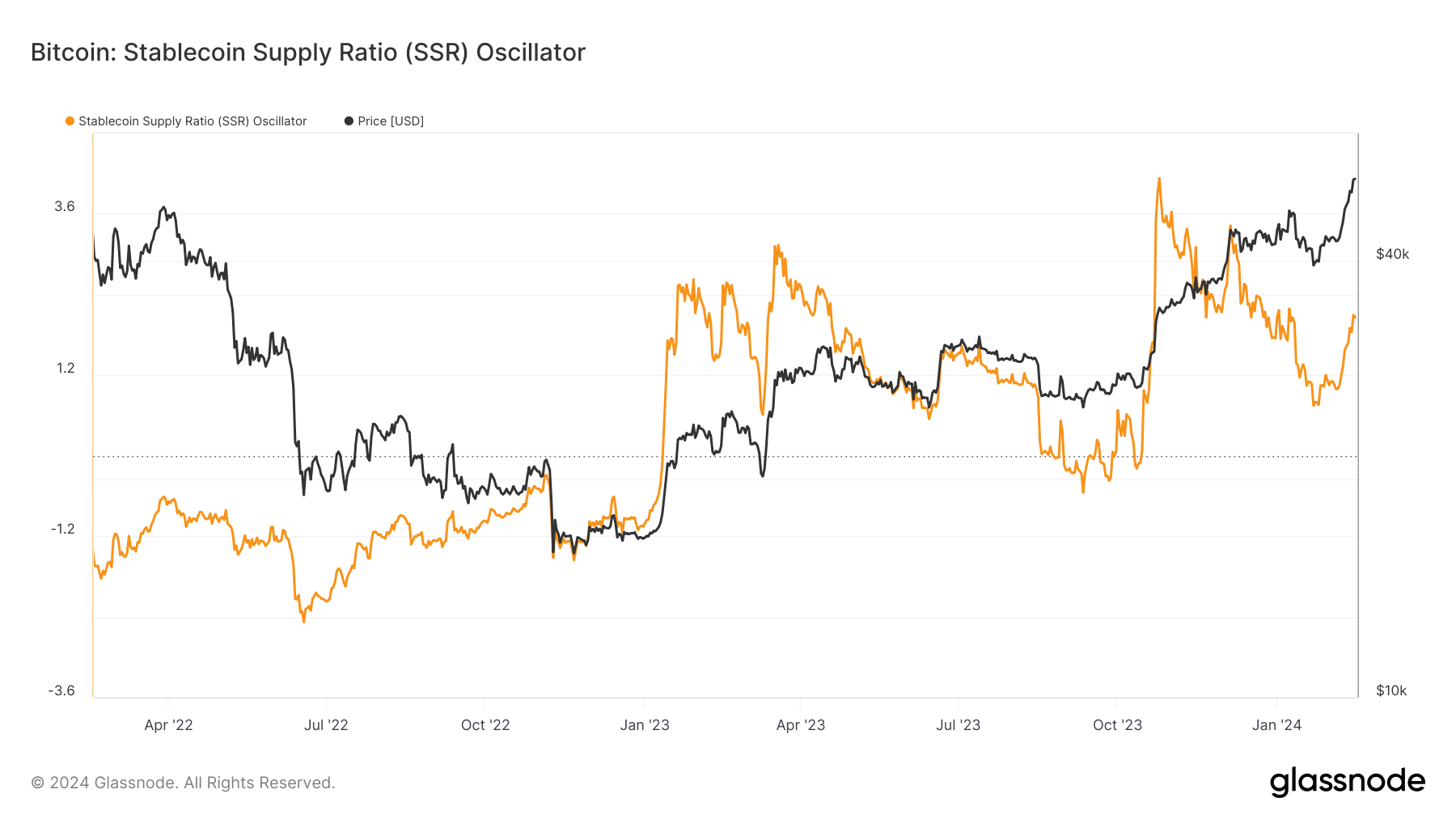
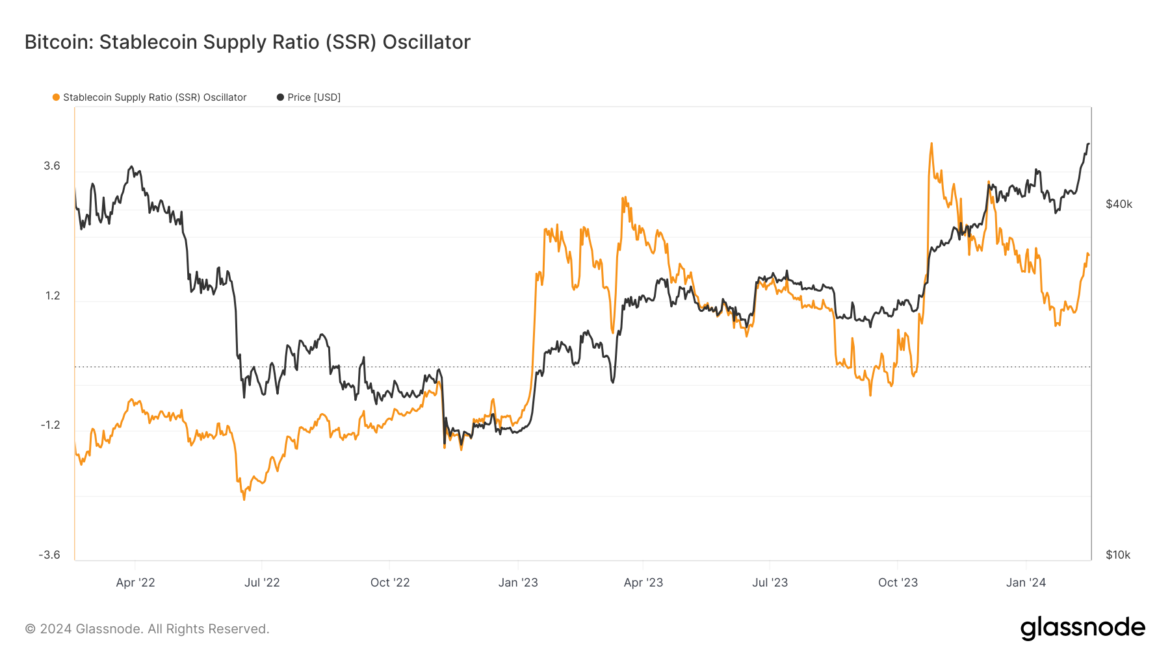
The Stablecoin Supply Ratio (SSR), a key metric that quantifies the supply forces between Bitcoin and various stablecoins, has been signaling increased “buying power” for Bitcoin in the past ten days.
Glassnode defines the SSR as the ratio of Bitcoin’s market cap to that of stablecoins denoted in Bitcoin, which serves as a proxy for the demand-supply mechanics of BTC versus USD. When the SSR dips, it implies a heightened buying power for the current stablecoin supply to purchase Bitcoin.

Three weeks ago, CryptoSlate observed a subtle upsurge in the SSR, from 0.74 to 1.04, corresponding to an increase in Bitcoin’s value to $42,000. Back then, the SSR was at 1.04, and it is now at 2.04. The upward movement started on Feb. 8 and coincided with the rise in Bitcoin price to $52,000.
This suggests that the demand for Bitcoin is driven by ETF interest and stablecoin liquidity entering the Bitcoin market.
The post Surge in stablecoin supply ratio signals increased Bitcoin buying power appeared first on CryptoSlate.
Shares of connected-TV platform company Roku (ROKU -23.81%) crashed on Friday after the company reported financial results for the fourth quarter of 2023. Many of the company’s numbers were better than anyone expected. But there was still enough concern that investors knocked Roku stock down by 20% as of 9:50 a.m. ET.
Good results weren’t good enough for the market
In Q4, Roku reached 80 million active accounts, a 14% year-over-year increase. This represented 10 million new accounts in 2023, its second-best year ever. And thanks to growth in active users, people streamed over 106 billion hours of content over Roku devices in 2023, up 21%.
From a user perspective, Roku’s growth was good — encouraging, considering how competitive the space is. Unfortunately, the company’s ability to monetize its audience worsened in 2023, which is likely why the market is unpleased today.
Roku’s average revenue per user (ARPU) was $39.92 in 2023, a 4% drop from 2022. What’s discouraging about this is that streaming per user was up, so one would have expected an ARPU increase, not a decrease. The company’s revenue was $984 million, up 14% year over year and ahead of expectations. But there was lower promotional spend for media and entertainment, which kept revenue from reaching its potential.
Roku is looking to the long term
Investors may also be concerned that Roku’s net loss of $710 million was its biggest ever. However, management isn’t concerned and is rather pointing out that it’s free-cash-flow positive and guiding for profits on an adjusted-profitability basis in 2024.
Roku’s management is more concerned with growth, even if it racks up losses. That does make Roku stock a riskier investment. But at least it’s paying off with user growth — adding 10 million new accounts in the past year was surprisingly strong. And it still expects double-digit top-line growth in the upcoming first quarter of 2024, which is nothing to sneeze at.
Much of Roku’s business is still trending in the right direction. That’s what’s important for long-term investors to remember today.
Shares of Blink Charging (BLNK -4.01%) skyrocketed this week, surging 29.7% at their highest point in trading through 10 a.m. ET Friday, according to data provided by S&P Global Market Intelligence. That’s a jaw-dropping one-week rally for a stock that lost 69% value in 2023.
Turns out, the electric vehicle (EV) charging equipment company is all set to report record-breaking revenues for its fourth-quarter and full-year 2023. And investors aren’t leaving any chances to bet on the languishing stock ahead of earnings.
Blink Charging’s revenue grew more than 100% in 2023
Blink Charging’s revenue has grown at a blistering pace in recent quarters. In its third quarter, the company reported 152% growth in revenue and 167% growth in gross profit, both year over year. A record quarter even encouraged Blink Charging to raise its full-year 2023 revenue guidance up to $128 million to $133 million from $110 million to $120 million.
Blink Charging, however, has surpassed even its upgraded guidance. This week, it announced its preliminary numbers and expects to report revenue above $42 million for Q4 and $140 million for 2023.
Now, those are big numbers, as they translate into at least 85% and 129% revenue growth for Q4 and 2023, respectively, at a time when the industry appears to be reeling. Blink Charging’s rival ChargePoint Holdings, for example, reported a 12% year-over-year drop in its revenue in the third quarter.
It’s no surprise, then, that Blink Charging stock shot higher this week.
Is it time to buy Blink Charging stock?
Blink Charging is yet to turn a profit but is already generating a positive gross profit, meaning it is generating enough sales to cover direct costs related to its EV charging equipment and services. In Q3, Blink Charging said it is targeting a positive gross margin of 30% or more for 2023. That’s a solid number, and a positive gross margin undeniably gives Blink Charging a lead over loss-making peers.
While that could make Blink Charging stock appealing, investors should also be aware of the risks. A prominent one is share dilution — Blink Charging has consistently issued stock to raise funds over the years.
Neha Chamaria has no position in any of the stocks mentioned. The Motley Fool has no position in any of the stocks mentioned. The Motley Fool has a disclosure policy.
4 Surprising Insights From The Coinbase Earnings Report, COIN Sees Bullish Surge
The foremost crypto exchange in the United States, Coinbase, released its earnings report on February 15th. As expected, there were major takeaways from the financial report, highlighting the crypto company’s performance in the fourth quarter of last year.
Coinbase’s Trading Volume Exceeds Expectations
Coinbase maximalist Coinbase Duck noted in an X (formerly Twitter) post how the crypto exchange defied expectations in the fourth quarter of 2023. Coinbase recorded $170.6 billion in spot trading volume, exceeding the estimated $168.
Specifically, a considerable influx of retail investors accounted for 18% of the total spot trading volume against the estimated 16% that the crypto exchange was projected to record. The return of these retail investors is believed to have been partly due to the resurgence that Bitcoin and the broader crypto market experienced towards the end of the year.
Meanwhile, consumer transaction revenue ($492.5 million) was way below the estimate of $570.9 million. However, Coinbase Duck noted that this wasn’t necessarily bad, as some investors started using advanced trading.
In a letter to its shareholders, the crypto exchange also revealed that some existing users traded significantly higher volumes, which could have necessitated the move to advanced trading.
Coinbase also recorded a total operating expense of $838 million, which happened to be below the projected estimate of $878 million. Specifically, the crypto exchange did a great job in its transaction expenses, recording an expense of $126 million compared to the estimate of $163 million.
However, the company’s sales and marketing expenses ($106 million) exceeded the estimate of $90 million. Coinbase revealed that this growth was “primarily driven by higher seasonal NBA spending, higher performance marketing spending due to strong market conditions, and increased USDC reward payouts due to growth in on-platform balances.”
Coinbase Had A Profitable Fourth Quarter
Coinbase recorded a net income of $273 million, beating the estimate of $104 million. Interestingly, going by figures from its Shareholder letter, the fourth quarter of 2023 was the only one in the year in which the crypto exchange didn’t record a loss for its net income. Meanwhile, the company also recorded its largest net revenue during that period.
Coinbase suggested that the excitement around the Spot Bitcoin ETFs and the expectations of more favorable market conditions in 2024 had contributed to its success in Q4 of 2023. Coinbase is a primary custodian for most Bitcoin ETFs, including BlackRock’s iShares Bitcoin Trust (IBIT).
Meanwhile, the crypto exchange earned $1.13 per share, beating the forecast of $0.43. This is without the crypto exchange accounting for the FASB change, which Coinbase Duck revealed could bring its earnings per Share (EPS) to $2.1.

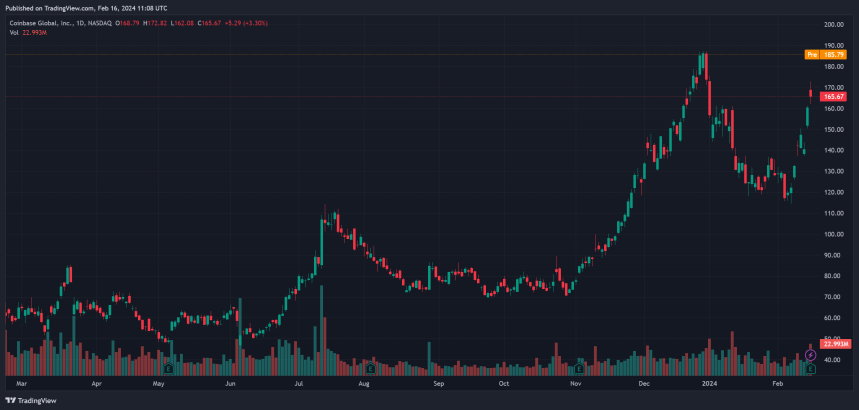
Chart from Tradingview
Disclaimer: The article is provided for educational purposes only. It does not represent the opinions of NewsBTC on whether to buy, sell or hold any investments and naturally investing carries risks. You are advised to conduct your own research before making any investment decisions. Use information provided on this website entirely at your own risk.
Microstrategy’s Bitcoin Investment Flourishes, Valued at Nearly $10 Billion
Based on the latest available data, the Nasdaq-traded Microstrategy possesses 190,000 bitcoins, acquired at a cost of $5.96 billion. Presently, the value of the company’s bitcoin holdings has swelled to $9.88 billion. This marks a 66% increase in the firm’s bitcoin portfolio, a stark contrast to its performance just eight months earlier. From Decline to […]
Source link