Bitcoin’s mining difficulty has hit an unprecedented peak, marking the most significant jump of 2024. On Thursday, at the milestone of block 830,592, the network experienced its fourth adjustment this year with a sharp 8.24% uptick. Bitcoin Mining Difficulty Skyrockets, Setting New Records in 2024 Mining bitcoin (BTC) has become considerably more challenging, following an […]
Source link

CoinNews
Crypto money laundering drops nearly 30% in 2023 as cyber criminals change tactics
Crypto money laundering experienced a significant decline of 29.5% in 2023 compared to the previous year, primarily due to a decrease in overall crypto transaction volume.
According to a Chainalysis report, illicit addresses moved approximately $22.2 billion in digital assets to various crypto services in 2023, marking a notable drop from the $31.5 billion transferred in 2022. This decline aligns with a 14.9% decrease in legitimate and illegal crypto transaction volumes.

Centralized exchanges remained the primary destination for funds from illicit addresses, although there was a noticeable increase in criminal fund movements toward gambling services and bridge protocols.
In detail, 109 exchange addresses received over $10 million each from illicit sources, totaling $3.4 billion in 2023, a significant rise from the $2 billion received by 40 addresses in 2022. Similarly, 1,425 exchange addresses received over $1 million each, amounting to approximately $6.7 billion in 2023, compared to $6.3 billion across 542 addresses in 2022.
Meanwhile, funds from illicit addresses to bridge protocols surged from $312.2 million in 2022 to $743.8 million in 2023.
‘Changing tactics’
Chainalysis noted that sophisticated crypto criminals with on-chain laundering skills, like the infamous North Korean-backed hackers Lazarus Group, are adapting their money laundering strategies and exploiting new services like crypto mixers and cross-chain bridges.
For context, the regulatory pressure on crypto mixing services like Sinbad and Tornado Cash, forced Lazarus Group to shift its money laundering strategy to YoMix, a new mixing service provider.

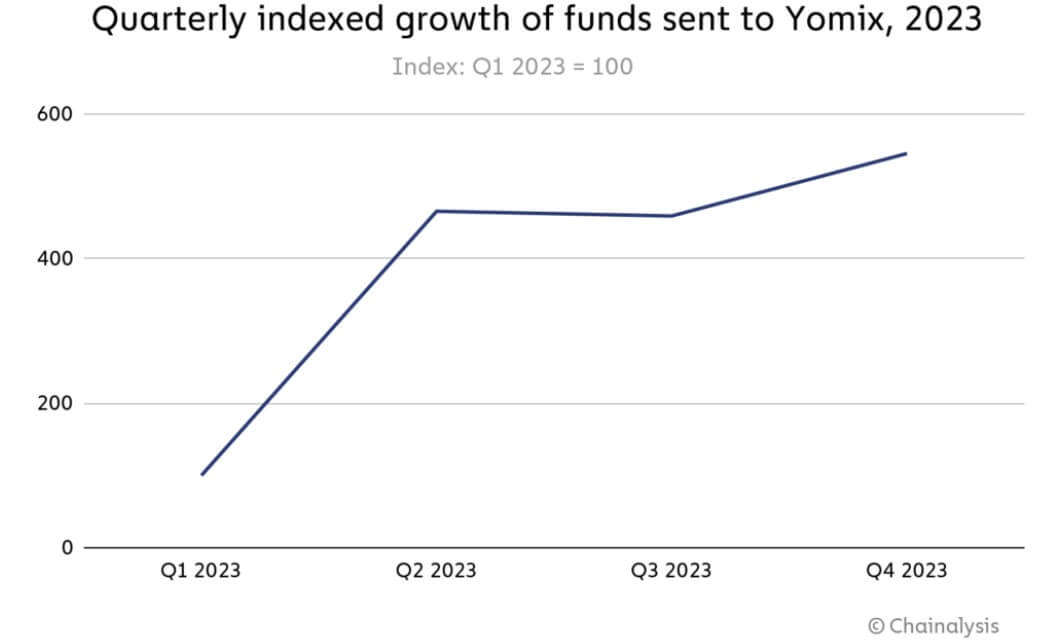
According to Chainalysis, this transition led to a notable increase in YoMix’s activity for last year, with its inflows rising more than fivefold. Additionally, nearly one-third of YoMix’s inflows can be traced back to wallets associated with crypto hacks.
“The growth of YoMix and its embrace by Lazarus Group is a prime example of sophisticated actors’ ability to adapt and find replacement obfuscation services when previously popular ones are shut down,” Chainalysis concluded.
In addition, North Korean-backed hacker groups were observed to be among the most common crypto criminals that utilized cross-chain bridges for money laundering activities.
PRESS RELEASE. February 15, 2024, London, UK — In a remarkable story one Bitcasino.io player has won a huge jackpot and another big win in the space of a few weeks, earning a massive $4.5 million dollars. Bets were placed in USDT cryptocurrency, with joy found in a Max Win, followed by a Big Win […]
Source link
Amid the XRP price unfavorable market sentiment, Changelly, a prominent global cryptocurrency exchange, has sparked new optimism by predicting a potential surge in the token’s price. The crypto exchange has projected new all-time highs for the cryptocurrency in the upcoming years.
XRP 2024 Price Prediction
On Wednesday, February, Changelly released a research report projecting XRP’s monthly prices for 2024. The crypto exchange emphasized XRP’s historical challenges, recounting significant declines that caused the cryptocurrency to trade well below its 2018 all-time high of $3.84.
Following an extensive analysis of XRP, Changelly has predicted a 23.71% increase in the price of XRP, surpassing current resistance levels at $0.5 and reaching $0.667 by February 16, 2024.

The crypto exchange noted that current technical indicators signal a 28% bearish bullish market sentiment on the token, alongside a Fear and Greed index reflecting high Greed at 74.
Changelly has also reported a positive seven-day upward trend for XRP, noting a $0.01 increase in the past 24 hours. The cryptocurrency platform foresees the average price of XRP reaching $0.617 by March, with a projected price range of $0.550 to $0.685.
Changelly forecasts that XRP will trade above the $0.50 mark in April and May, reaching average price values of $0.562 and $0.573, respectively. From June to September, the cryptocurrency is expected to gradually approach the $0.60 mark, with the average price values of XRP ranging from $0.55 to $0.59 during these months.
By November, the token is anticipated to break past resistance levels, maintaining an average price of $0.662, with a minimum and maximum value of $0.569 and $0.755, respectively. Meanwhile, Changelly has predicted a surge in the average XRP price to $0.695 for December, potentially reaching a peak value of $0.829.
Massive Price Surge In Upcoming Years
In its research report, Changelly provided a forecast of the token from 2025 to 2050. The crypto exchange platform anticipates big gains for the cryptocurrency, expecting its price to exceed $500 in the coming decades. Specifically for 2025 and 2026, Changelly projects XRP to surpass the $1 mark and trade at an average price of $1.18 and $1.72, respectively.
The cryptocurrency is expected to slowly increase over the years, surging past $2 mark in 2027 and surpassing its all-time high of 3.84 for the first time to reach an average price of $5.04 in 2028.
In the decade from 2030 to 2040, Changelly has predicted that XRP would trade at an average price of $7.39 in 2030, rapidly gaining more momentum over the years to reach a maximum level of $480.23 and a minimum of $413.15 in 2040.
By 2050, XRP is projected to surpass the $600 mark and trade at $625.74, with a maximum and minimum value of $690.55 and $595.36, respectively.
Chart from Tradingview
Disclaimer: The article is provided for educational purposes only. It does not represent the opinions of NewsBTC on whether to buy, sell or hold any investments and naturally investing carries risks. You are advised to conduct your own research before making any investment decisions. Use information provided on this website entirely at your own risk.
Tokenized real world assets (RWA) redefined as personal property in landmark Iowa digital asset bill

A seemingly progressive digital asset bill has been approved by the Judiciary Committee in Iowa, introducing significant amendments to the Uniform Commercial Code, explicitly aiming to integrate digital assets and electronic records into commercial transactions. The bill, House File 2519, is titled “An act relating to commercial transactions, including control and transmission of electronic records and digital assets.”
As reported by the Committee on Judiciary monitored with TrackBill on Feb. 15, this legislation seeks to address the complexities and opportunities presented by digital assets within the legal framework of commerce. By offering a nuanced approach to the control and transmission of electronic records, the bill promises to enhance legal clarity and security in digital transactions, catering to the needs of the evolving digital economy.
House File 2519 clarifies the legal standing of digital assets by providing comprehensive definitions for terms like “controllable electronic record,” “digital asset,” and “smart contract.” This precision aims to reduce ambiguities and foster a more secure environment for digital commerce. However, the potential for variations in such definitions across state, federal, and international jurisdictions adds potential complexity for digital asset service providers.
Recognizing digital assets as personal property
However, the new definitions are a key aspect of this bill. The bill recognizes the legality of smart contracts from Article 12 of the 2022 “Uniform Commercial Code Amendments,” stipulating that a contract cannot be denied legal effect or enforceability solely because it is executed through distributed ledger technology or a smart contract. This ensures that smart contracts, which automatically execute the terms of a contract when certain conditions are met, have the same legal standing as traditional contracts.
Further, the bill also references provisions that facilitate recording real estate through electronic means from the 2022 Act. Specifically, it highlights a county’s ability to record a real estate conveyance if the evidence of conveyance adheres to the general requirements outlined in state law and is in a format that conforms to standards set by the electronic services system. The bill specifies that this system enables counties and the Iowa County Recorders Association to collaborate in implementing the county land record information system.
Building on these aspects of the 2022 Act, House File 2519 aims to amend and add to the legal framework surrounding digital assets, focusing on adjusting the definition of “digital asset.” The bill amends the definition by eliminating exceptions previously recognized under the Uniform Commercial Code (UCC). This means that certain electronic records previously excluded from being considered digital assets, such as electronic records representing an interest in specific physical or tangible property (chattel) or a lease of such property, are no longer excluded.
For example, suppose a business takes out a loan to purchase a piece of equipment, and the loan agreement also grants the lender a security interest in that equipment as collateral. In that case, the document detailing this arrangement can be considered chattel paper. If this document is created, signed, and stored electronically, it’s an electronic record evidencing chattel paper. This digital form is increasingly common in today’s digital and financial transactions, offering a more secure and efficient way to electronically manage and transfer interests in real-world assets (RWA).
The amendment simplifies the classification of digital assets, treating them simply as personal property rather than specifically as intangible personal property. This is a shift from the possible previous categorization that might have considered digital assets more narrowly as intangible personal property. This broader classification could have implications for how digital assets are treated in various legal and commercial contexts, providing a more straightforward approach to their classification.
Intangible personal property historically referred to rights and licenses, whereas tokenized RWAs related to real estate may be more appropriately treated as personal property akin to physical property.
These provisions reflect House File 2519’s approach to further integrating digital assets into Iowa’s commercial and legal frameworks. By amending the definition of digital assets and clarifying their classification, the bill aims to simplify and modernize the regulatory environment for digital assets, making it more conducive to the evolving digital economy. Additionally, by defining terms such as “electronic services system,” the bill provides legal clarity for the operation of digital asset systems and services within the state.
Protections and recognition of digital assets
Interestingly, the legislation outlines no-action protection for qualifying purchasers of controllable electronic records, asserting that filing a financing statement under Article 9 does not constitute notice of a property right claim in a controllable electronic record.
This provision in the legislation means that individuals who purchase controllable electronic records (such as digital assets or tokens) receive legal protection against claims challenging their ownership based solely on the absence of a financing statement. Essentially, even if no financing statement is filed to declare a security interest in a digital asset publicly, the purchaser’s rights to the asset are protected. This aims to streamline transactions by simplifying the proof of ownership and reducing the administrative burden on parties engaging in digital transactions.
The state creates distance on CBDCs with neutral legislation without endorsement.
The bill also explicitly states that its provisions should not be interpreted to support, endorse, create, or implement a national digital currency. This stance ensures that the legislation remains neutral regarding a centrally issued digital currency (CBDC) by a national government or central bank, focusing instead on the regulatory framework for digital assets without promoting or facilitating the establishment of a national digital currency.
The potential implications of House File 2519 on digital asset service providers and users include heightened regulatory oversight, increased legal and operational complexities, and a need for technological adjustments to meet the legal standards for control over digital assets. These challenges highlight the bill’s comprehensive attempt to adapt Iowa’s legal framework to the digital age, balancing innovation with legal clarity and consumer protection.
Ultimately, House File 2519 represents a step towards integrating digital assets into the state’s legal landscape, aiming to provide a more secure and clarified legal framework for digital transactions. While the bill’s detailed approach introduces specific regulatory and operational challenges, it also offers opportunities for enhancing the legal infrastructure supporting the digital economy.
Meta Warns Of Zuckerberg’s Death-Defying Lifestyle — ‘There Could Be A Material Adverse Impact On Our Operations’

Meta Platforms Inc., under the leadership of CEO Mark Zuckerberg, flagged an unusual concern to its investors in its latest report filed with the Securities and Exchange Commission (SEC).
The company’s 10-K filing, an exhaustive review of its activities for 2023, for the first time listed the CEO’s penchant for high-adrenaline hobbies as a “risk factor,” hinting at the potential for “serious injury and death.”
Zuckerberg, 39, is known for his adventurous streak, engaging in activities like hydrofoiling and mixed martial arts — passions that come with risks.
Don’t Miss:
During the pandemic, Zuckerberg discovered a new hobby in Brazilian jiu-jitsu, frequently updating his social media with images of his training and toned physique. His efforts in the sport were recognized when he won gold and silver medals at a Brazilian jiu-jitsu tournament in May.
His dedication to these pursuits was underscored last November when he sustained a torn ACL during a mixed martial arts training session, a mishap he shared with his followers on Instagram. The post featured Zuckerberg in a hospital bed, his left leg wrapped and secured in a brace, evidence that his ventures often come at a price.
Zuckerberg’s enthusiasm extends to surfing, an activity that, despite his earnest participation, has drawn playful critique from online communities.
Trending:
Showcasing his zeal for pushing boundaries, Zuckerberg has ventured into aviation, pursuing a pilot’s license. Records from the Federal Aviation Administration reveal that he achieved his student pilot certificate last year, signaling progress in this often dangerous endeavor.
Meta’s recent SEC disclosure points out that Zuckerberg’s array of “high-risk activities,” including combat sports, extreme sports and recreational aviation, pose a unique challenge to the company.
The filing candidly addresses the potential repercussions on Meta’s operations should these pursuits lead to severe consequences for Zuckerberg, emphasizing the critical role he plays within the company. It notes that if the worst happens, “there could be a material adverse impact on our [Meta’s] operations.”
The filing added, “We currently depend on the continued services and performance of our key personnel, including Mark Zuckerberg.”
Meta hasn’t spoken about its decision to add this warning to its most recent 10-K. Just the same, there’s no word on whether Zuckerberg has plans to take a step back from his many thrill-seeking hobbies.
Read Next:
“ACTIVE INVESTORS’ SECRET WEAPON” Supercharge Your Stock Market Game with the #1 “news & everything else” trading tool: Benzinga Pro – Click here to start Your 14-Day Trial Now!
Get the latest stock analysis from Benzinga?
This article Meta Warns Of Zuckerberg’s Death-Defying Lifestyle — ‘There Could Be A Material Adverse Impact On Our Operations’ originally appeared on Benzinga.com
© 2024 Benzinga.com. Benzinga does not provide investment advice. All rights reserved.
In this podcast, Motley Fool host Mary Long caught up with Motley Fool analyst Jason Moser for a conversation about the publicly traded companies associated with the Super Bowl to dig into whether any are worth an investor’s attention.
Mary also interviewed Dave Schwartz, ombuds at the University of Nevada, Las Vegas, and a student of gambling history.
To catch full episodes of all The Motley Fool’s free podcasts, check out our podcast center. To get started investing, check out our quick-start guide to investing in stocks. A full transcript follows the video.
10 stocks we like better than Walmart
When our analyst team has an investing tip, it can pay to listen. After all, the newsletter they have run for over a decade, Motley Fool Stock Advisor, has tripled the market.*
They just revealed what they believe are the ten best stocks for investors to buy right now… and Walmart wasn’t one of them! That’s right — they think these 10 stocks are even better buys.
See the 10 stocks
*Stock Advisor returns as of 2/12/2024
This video was recorded on Feb. 10, 2024.
Dave Schwartz: Traditionally, the NFL thought that gambling was terrible, Las Vegas was even worse at gambling. Even now that reason because we’re having gambling scandals, and cheating scandals in the past in football and baseball and other sports, professional amateur so it makes sense if people want [inaudible]. But they continue to have this policy long after gambling had become more mainstream within the United States. Long after we have casinos all across the country, they continue to have this. It’s interesting that as the national prohibition on the spread of sports gambling fell, the league’s policy changed.
Mary Long: I’m Mary Long, and that’s Dave Schwartz. Ombuds at the University of Nevada, Las Vegas, and a student of gambling history. I caught up with Schwartz for a look at the history of sports betting and what it means today. But first, I talk with Jason Moser about four publicly traded companies with ties to the Super Bowl to see if any of them are worth investors attention. Tomorrow at the Kansas City Chiefs face off against the San Francisco 49ers in Las Vegas, Nevada. It’s a Super Bowl and you know what they say, if you can’t go to the Super Bowl, make your own Super Bowl so that’s what we’ve done. Jason, excited to be here with you.
Jason Moser: Happy to be here, Mary. Thanks for the invite.
Mary Long: We’ve got four stocks, each representing a different element of Sunday’s Super Bowl game. We’re going to talk through each of these teams, and at the end, I’ll ask you, which stock is the winner in your mind. Let the games begin. In one corner, we’re repping the San Francisco 49ers we’ve got United Airlines. United is the presenting sponsor of the 49ers. It’s also the official airline for both teams. But for our purposes, we’re going to put United solely with San Francisco. The airline industry uses some metrics that might be unfamiliar to investors who are newer to the industry or just exploring it. How do you grade airline stocks and where on that scale would you put United?
Jason Moser: Well, so in grading airline stocks, I will say first and foremost, I’ve just never been an investor in airlines personally. To me, it’s not the most attractive long term type holding. The capital requirements, the constant fuel hedging, it’s certainly an industry where size does matter. But whenever I hear about investing in airlines, it just takes me back to that Warren Buffett quote from 2007. He wrote in the Berkshire Letter. He said, ”If a far sighted capitalist had been present at Kitty Hawk, he would have done his successors a huge favor by shooting Orval down.” Obviously, he’s kidding and he even had a little bit of a turnaround there and tried some airline investments as well. It didn’t work out so great. But when you look at the data from this industry, the data I found, and compiled by airlines for America, since 1978, there’s been over 100 bankruptcy filings in the airlines industry. They’ve not all resulted in liquidation, but this is just an industry rife with bankruptcies and that’s obviously, not a good thing. But like I said, size does matter. You look really too I think, the big players in the space as the ones that probably stand the best chance. United absolutely stands out in that way. As far as metrics, I think one that stands out to mean the load factor, that’s something that ultimately measures the percentage of available seating capacity that’s been filled with passengers. Higher means that an airline has sold most of its available seats, and so I think that can give you an idea, at least to the health and consistency of any given airline. But it’s absolutely a difficult space to invest in.
Mary Long: There’s a difficult aspect of the space because the bankruptcy like you mentioned, just massive upfront costs. But also more recently we’ve seen shorter-term issues also plague the industry. I feel you can’t talk about airlines today without talking about many issues, not least of which is Boeing‘s chaos that’s happening. How is that in particular affecting United’s operations?
Jason Moser: Well, with United, the short answer is it’s a big deal. United has plenty of exposure to this particular plane. If you go back to the earnings call recently, they noted as of Saturday January 6, the MAX 9 aircraft had been grounded, and they noted a call. They’re the largest operator of the Boeing MAX 9 and that represents approximately 8% of their capacity from the first quarter. Clearly, that’s something that matters a lot for United. That speaks to I think, one of the short term challenges that they’ve been witnessing. It’s absolutely playing out in their guidance looking toward 2024. They’re spending in particular, they’re expecting reduction in orders and deliveries from Boeing all the way out into 2025. That ultimately requires them to go in there and rework their fleet plan and exactly how they’re going to manage this. One of those near term headwinds that is absolutely going to impact United more so than others, something investors definitely want to keep in mind.
Mary Long: Playing on behalf of Kansas City, we’ve got the official soup sponsor of the Chiefs none other than the Campbell Soup Company, Ticker CPB. Despite the name, it’s not just soup that Campbell sells. They also own Pepperidge Farm of Goldfish Fame, Pop Secret popcorn, Cape Cod potato chips, lots of snacks basically. Campbell’s breaks down their revenue into two different segments, meals and beverages as one and then snacks as another. That snack segment has accounted for an operating profit of 640 million in fiscal 2023. That’s 42% of its total profits, even in the age of Ozempic are snacks big business?
Jason Moser: Absolutely, they’re a big business. We love snacks. We all love our snacks. Whether it’s sweet, salty, a mix of the two, snacks are very big business and it’s absolutely been a driver for Campbell. If you look at the data, at their statistic data actually, says that revenue for the US snack food market is set to hit $114 billion here in 2024. It’s expected to grow annually, close to 4% through 2028. That’s not mind bending growth, but it is pretty reliable and pretty steady. Then when you look at another, I think shining snack example out there in the market, like Pepsi. Pepsi I think is a great example of a company that has benefited through the years by building out their snack side. Just to put that in context, their free to lay business went from $15.8 billion in revenue in 2017 to $23.3 billion in 2022. Talking about going to the numbers because they tell the tale, Mary. I think those numbers tell us a lot.
Mary Long: Over the past 10 years, you look at Campbell’s stock price and it hasn’t moved too much. There’s ups and downs, but it’s leveled out over time. Neither has its operating income. What needs to happen for Campbell to not just beat its competitors in this fool bowl that we’re playing today, but in the market?
Jason Moser: It’s going to be difficult I think that what we’re seeing with Campbell is that they are trying to really hone their portfolio of offerings for where the future of food is going ultimately. Part of that is in packaged foods. I think part of that is we’re going to see some acquisitions from this company going forward as well though, they just acquired Sovos Brands which gives them Rao’s. I think that’s how you pronounce it Rao’s, the pasta sauce in a number of other ancillary brands and prepared meals. That’s where they see a lot of opportunity there. But you’re right, the growth, this company’s lobbed up, it’s nothing to write home about. It’s not been a winning stock for investors just based on returns. Ultimately, when organic growth runs dry, when the company has trouble just growing on its own, then they start leaning on some of those acquisitions in that consolidation. I understand that strategy, but acquisitions do come with their share of risk.
Jason Moser: It’s going to take a number of different efforts I think for this to ultimately be a market beating stock going forward.
Mary Long: Growth is not the story here but Campbell has a decent defensive line we might say. Stock pays a 3.44% dividend. That dividend has been around for several decades and with few exceptions has increased relatively regularly. Does that make this a more compelling case for a portfolio?
Jason Moser: I think it certainly makes for a better argument in holding the stock. I think anytime you’re getting a 3% or better yield on a dividend-paying stock, that’s a good thing. That’s a healthy yield and we like to see that. Now if we look at the total return for this company over time, over the last 10 years a total return for Campbell shareholders has been close to 50% versus the markets 180% or so. This is clearly a company that has lagged the market significantly. Again I think dividends are great. I want them, I’m getting older and I’m moving more of my portfolio over toward income bearing investments there but this doesn’t really look like the best income idea out there. It’s not a dividend aristocrat, it’s not a dividend king, it’s not to say it can’t be one day but those are the companies I think we want to look more toward when we’re looking for really reliable dividend payers. Those companies that have grown their dividends annually for at least 25 consecutive years or if you’re a king status and that 50 years, that really tells you that dividend is a priority and once those companies achieve that status they really do everything in their power to not relinquish it because investors really do care about it.
Mary Long: Playing on behalf of Las Vegas and Allegiant Stadium we’ve got Allegiant Travel which is not your typical airline it seeks to be an integrated travel company. In addition to running Allegiant Airlines, the company officially opened Sunseeker Resort in Florida in mid December of last year. They’ve also acquired a golf course management software company called Teesnap. They’re looking to launch a family gaming center that has laser tag, go carts, bowling, you name it. We talked about airlines already. Seems like that’s a hectic enough, expensive enough business to be a part of. Why take on even more? Is that something that differentiates Allegiant or does it diversify it?
Jason Moser: It could be maybe a little bit of both. I think it absolutely differentiates it. Because you and I were talking before we started recording and that was one of the things with Allegiant that makes it stand out, it’s not just one of those discount airlines, it’s more, and that could potentially be a good thing. Now it absolutely could run that risk of diversification. Just trying to do too many things and not really doing anything well. But I think it’s compelling. It makes me want to look at Allegiant a little bit more closely because when you consider the size of the travel and experience market, all together they really are focusing on not just the travel but the experience and entertainment side of it as well. That can be very powerful assuming that they do it well. The company IPO back in 2006, it’s still a true small cap; one-and-a-half billion dollar market capitalization. It is not a company that has grown by leaps and bounds but it does seem like they’re taking these steps in order to try to be able to grow here in the coming years. Time will tell whether that actually works or not but listen, I respect the effort.
Mary Long: Allegiant has pulled a bit of a Disney in the past year. Former CEO Maury Gallagher is now CEO once more. He replaced John Redmond this past fall after Redmond had been in the spot for less than a year. Redmond resigned. We don’t really know why, but Gallagher had been with the company for a while. He’s been a majority owner and board member of Allegiant since 2001. Basically brought Allegiant from being one plane to a fleet of over 100. He’s played a role in several low-cost airlines. Unlike other airlines, Allegiant’s stock peaked mid-pandemic in 2021 but today it’s still off about 70% from those highs. Is Gallagher’s returned the beginning of a turnaround story?
Jason Moser: Well, I hope. It seems like that’s the guy that could probably make it happen given his track record. Bringing an airline out of bankruptcy and obviously, we talked about that earlier with United. Bankruptcy was just a common word in this space. But that also can present opportunities and it seems like Mr. Gallagher is certainly trying to take advantage of that opportunity. Looking through their most recent earnings call, they seem very optimistic with the strategy. They are getting some headwinds in regard to pilot negotiation issues behind them and I think that’ll be a load off of the business. Right now today, 75% of their roots don’t have any direct competition at all so they do stand out a little bit in that way. I think that’s one of the things that’s most interesting about this company is they know what they are and what they’re trying to be. They’re not out there trying to compete in those big cities and networks where all of the money is. They’re really trying to do their own thing. They said in the call I thought this was a pretty interesting way to put it. He said, “We’ve created our own private swim lane and are proud to be in it.” They really are a company focused on their identity doing things their way and focusing on that particular market opportunity. Hey, listen, I like that.
Mary Long: If you’re not at Allegiant Stadium to watch the game, you’re probably watching the Super Bowl on a screen in which case you’ve got Paramount Plus to thank. The streaming business is not awesome if you’re not Netflix, where does Paramount Plus fit into that picture?
Jason Moser: Well, if you look back at their earnings call in November of last year Paramount Plus the streaming offering crossed 63 million subscribers. I was actually surprised to see that number that high. This is not a company that I have followed very closely because like you said streaming sucks unless you’re Netflix. [laughs] I think that really speaks to a lot of things Netflix did right early on in their efforts there. But Paramount Plus 63 million subscribers they deliver 38% direct to consumer revenue growth. They were able to increase prices a little bit. That’s all very encouraging. Now it all does come at a cost. That content just continues to get more and more expensive. To me I think this is just a space that is going to witness a lot of consolidation in the coming quarters in years. If I’m a betting man, I think that Paramount probably ends up being a part of something bigger there but there’s no doubt they have a portfolio of content that a lot of viewers really place a lot of value in because 63 million subscribers, that has nothing to seize that.
Mary Long: Consolidation seems like that will be a likely story for Paramount moving forward or even earlier this week news broke that media mogul, Byron Allen, who owns the Weather channel among other local TV stations made a $14.3 billion offer to acquire Paramount Global. Allen’s deal offers shareholders a 50% premium on the current share price. If you are a shareholder, are you praying that the deal goes through or are you holding out and hoping for a realistic larger growth story beyond being bought?
Jason Moser: I personally would be hoping for an acquisition just get out of this thing and go for. Now I don’t own Paramount shares and I don’t think that I will. But for me again just streaming in particular, it is just a very difficult space in speaking to that consolidation theme, I mean, it is. We’re just seeing it all over the place. Paramount Plus even recently, they incorporated showtime into that offering so like with the price points there you had you could do Paramount Plus essential which is just six dollars a month or if you want to do Paramount Plus plus Showtime that’s essentially double the cost. But even just there’s a little consolidation going on even in their own universe. Then we saw also this recent announcement just the other day ESPN, Fox and Warner Brothers Discovery teaming up for a new sports streaming service and Disney trying to figure out exactly how to move forward with that ESPN strategy. To me Netflix has taught us a lot. They taught us that the economics of streaming are really difficult and that being early to the game for them made a really big difference. Now it feels when a new streaming service is announced people get a little bit more fed up with the whole thing. Remember we’ve talked about Zoom exhaustion before. That’s totally a thing and I think there’s a similar dynamic that’s now playing out with all of these streaming services so they have to be very thoughtful in the new services they announce and how exactly how much they’re going to be charging for them because consumers are getting close to having had enough.
Mary Long: Jason, we’ve talked airlines, we’ve talked soup and snacks. We’ve talked integrated travel and streaming. Which of these teams has your bet to win Fool Bowl 2024?
Jason Moser: Well, if you look at the track record of all four, none of these four has really lit the world on fire so to speak. Let’s assume Paramount is going to ultimately be acquired. I think that that’s more than likely a given. Even if it weren’t going to be acquired, to me I think actually I’d like to learn a little bit more about Allegiant. I still don’t have much of a desire to invest in a pure play airline but to me with Allegiant, this is more a travel company and entertainment company which could be a little bit more compelling. I like that they know their customer, they seem to be laser-focused on that particular opportunity as opposed to doing other things that they may not really be able to compete so effectively on. I don’t know, I’m going to be keeping my eye on Allegiant here.
Mary Long: Unlike the Super Bowl we won’t know who wins out tonight or tomorrow but well, we’ll keep our eyes posted on what happens in the long term.
Jason Moser: But we’ll revisit it next Super Bowl.
Mary Long: Bingo. For Fool Bowl 2024. That’s hard to say. I did not do myself a favor with that one.
Mary Long: Up next is my conversation with Dave Schwartz, Ombuds at the University of Nevada, Las Vegas, and a student of gambling history. I wanted to talk to you because our relationship with the nation as gambling has changed a lot in recent years. Before the ’80s, you could really only bet in two places, Nevada and Atlantic City. Today, sports betting is legal in 38 states plus DC, and we all walk around with virtual casinos in our pockets. How did gambling go from being mostly illegal and mostly stigmatized to mostly everywhere?
Dave Schwartz: It has been an interesting process and a lot of it was driven by money. I guess not surprising because it’s gambling. Basically casino style gambling for many years was only legal in Nevada, New Jersey, rolled the dice in it, legalized it in ’76. It started in ’78 and other states and the federal government saw this be used to make some money that could help. Atlantic City, it was for urban redevelopment. Tribal gaming, of course, was also recognized and came along in the ’80s and ’90s and a lot of states legalized gambling. Most of the idea was, look, people are going to be doing this anyway, but if we legalize it, we can gain some benefit from it.
Mary Long: I want to hone in on one organization’s role in this changing relationship with gambling in particular, Super Bowl Sunday is coming up. The NFL used to pretty strongly oppose not just sports betting, but Las Vegas in particular. In 2003, the Las Vegas Convention and Visitors Authority attempted to buy air time for a Super Bowl commercial. They were flat out denied. There’s been like this firewall of sorts between the league and Las Vegas this year. The Super Bowl is in Las Vegas. How did the NFL in particular come to embrace Sin City?
Dave Schwartz: I have a feeling that three quarters of a billion dollars in public funding really helped change that relationship. That, of course, is what was guaranteed for the stadium, it was built for the Raiders when they moved here. Traditionally, the NFL thought that gambling was terrible. Las Vegas was even worse than gambling. Not without reason, because there had been gambling scandals and cheating scandals in the past in football and baseball and other sports, professional and amateur so makes sense. They wanted to keep it a arm’s length. But they continue to have this policy long after gambling had become more mainstream in the United States. Long after we casinos all across the country, they continue to have this. It’s interesting that as the national prohibition on the spread of sports gambling fell, the league’s policy changed and they seem to be much more gambling friendly.
Mary Long: How did the NFL’s relationship with sports betting and their embrace of that compared to the pace at which other sports leagues embraced it?
Dave Schwartz: NFL seemed to be a little bit behind you had MBA was probably one of the more proactive ones, but in general, most of the other sports started to embrace it once after 2018, when the Supreme Court struck down the Professional Amateur Sports Protection Act. More states started to legalize it. It became more mainstream in the other sports. I want to say jump on the bandwagon, but became a lot friendlier toward it.
Mary Long: In 2018, Americans wagered 4.6 billion dollar on sports betting. 2023 they bet $104 billion. How much of that growth comes from previously illegal wagering that’s now been brought into the public light or is that just all new money coming into this?
Dave Schwartz: That’s a really good question and you’ve got to imagine that a lot of it was the previously illegal gambling they came in. You also have as there’s advertising for it and it’s more mainstream and it’s more accessible, it becomes less stigmatized, so it’s easier for people to bet, so they’ll get into it a little bit more. I think it’s probably a combination of both, where they’re maybe taking some of the business away from the illegal gambling, but also maybe people are learning more about it for the first time.
Mary Long: It seems safe to bet too that that number of dollars wagered each year will only grow more in the future. As we enter into an era when gambling maybe becomes a larger part of everyday life. We talked about like mini casinos in your pocket. Are there lessons from history that we as a society should keep in mind?
Dave Schwartz: There’s certainly some lessons. I think number one, people have gambled throughout all of human history. Some societies have been a little bit more on the prohibition aside, where they don’t allow legal gambling. But pretty much if you look at the history of humanity, somebody was gambling somewhere. It seems like that’s a universal impulse. What makes it interesting is the way people gamble change. We’re no longer betting, back in Egyptian times, people betting a game that was a lot like Backgammon. That’s not such a big deal. Now we’ve got craps and Blackjack and especially slot machines. Slot machines is another great thing. If we went back to 1850 and said people are going to be gambling in machines, they would say, how could that be? That’s a big deal now. Basically, gambling tends to evolve as the technology evolves. It’s interesting if you look back, going all the way back to history, you have the shift to groundstone technology from flakes stone technology, back in the stone age, you start seeing cubicle dice which are polished instead of the animal bone dice. You have the rise of block printing and you see the proliferation of playing cards. In the 19th century you have the telegraph being used and what’s one of the things that people use it for, to gamble by sending horse racing results across the country. If you look at every technological change, it seems like people have found a way to make it about gambling. I’m not surprised we’re still doing that.
Mary Long: There are a lot of threads, I think, between this trend, the rise of sports betting, and social media and like this need for constant stimulation, but also maybe an inclination, particularly among young people, toward financial nihilism. You want to shoot your shot, you want to get rich quick, you want to beat the house. I think that, that fascination with chance is like very natural and very human. But in your research, do we tend to see increased interest in gambling at times of social, cultural, economic discontent? Or is it just a constant throughout any type of period in history?
Dave Schwartz: It definitely ebbs and flows. For example, in Western Europe, you saw a real boom in gambling from about 1,500, 1,600 to about 1,800 as there was a lot of changes going on. You had a lot more cash and money economies developing things like that. You also have the rise of things like insurance, which originally was considered a form of gambling. Basically, you take out insurance on a ship. You’re betting that your ship is going to sink. That was one of the first areas of insurance. You also have the rise of joint stock companies splitting the risk, things like that. You also have the rise of the theory of probability, where you can even do that. We see that boom. Then in the 19th century, it declines. That’s when you have a rising middle class. You’ve got what the historians call the market economy misses Max Weber’s Protestant work ethic where he work hard, save money. Gambling is subversive to that because you can go from rich to poor overnight. There’s a crackdown against gambling and pretty much United States, at least, which is where I studied most of my history. There’s a shift from a more subsistence style economy to more market style economy. More people are getting pulled into that. There’s a lot more speculation and a lot more importance for discipline people working hard, saving their money. You see a turn against gamble. Then getting into the 20th century, people are still gambling and there’s the idea that hey, wait, we can actually use this to fund some stuff for the government which means we don’t have to raise taxes and that’s one thing. I don’t know if any politicians are ever, ever yet popular for raising taxes that ever gets maybe I don’t know. It’s very popular because hey, we can raise money without raising taxes and let people that. I think that’s how that’s played out in the past.
Mary Long: As always, people in the program may have interest in the stocks you talk about and the Motley Fool may have formal recommendations for or against. So don’t buy or sell stocks based solely on what you hear. I’m Mary Long. Thanks for listening. Enjoy the game tomorrow if you’re watching and whether you are or not, we’ll still have an episode here for you. See you then.
Harvard remains the nation’s richest school as college endowments keep growing
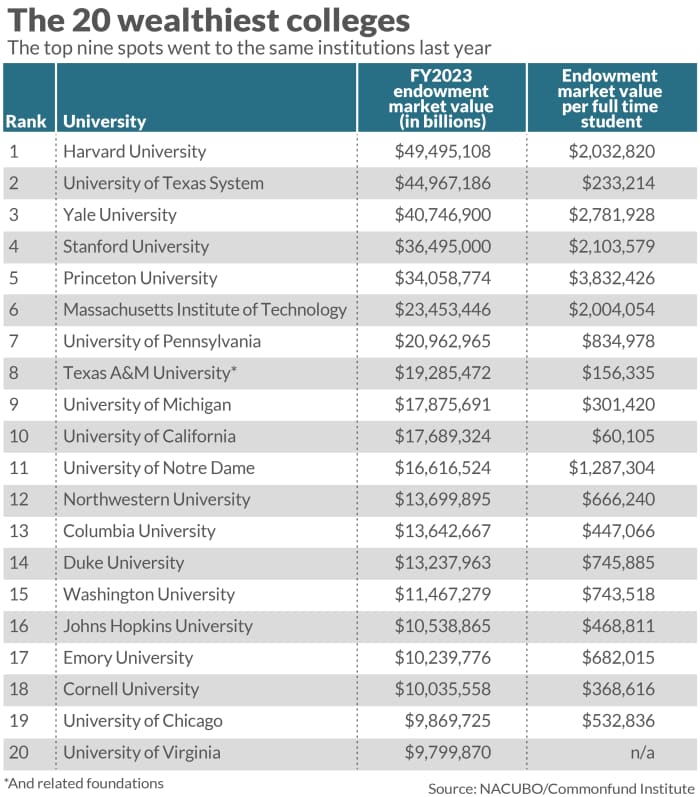
Harvard University’s endowment grew to more than $49.5 billion last year, making it once again the nation’s wealthiest college.
The University of Texas System wasn’t far behind with an endowment value of nearly $45 billion, while Yale University remained the third-richest school even as its endowment market value dropped slightly from last year.
The ranking of the nation’s largest college endowments is the result of a study of the financial assets of nearly 700 academic institutions, published Thursday by the National Association of College and University Business Officers and the Commonfund Institute.
Some institutions, like the University of California system, saw their fortunes swing over the last year. UC’s market value jumped 14.7% to nearly $17.7 billion, allowing the system to have the 10th-largest endowment and bumping the University of Notre Dame out of the No. 10 spot. The top nine university endowments by market value were unchanged from 2022. The average college endowment saw a 7.7% return in the last fiscal year ending June 30, 2023, according to the report.
The study showcased the significant wealth that some colleges have at their disposal. Harvard’s endowment, for example, is worth more than the annual gross domestic product of countries like Jordan, Bolivia and Paraguay.
The findings come amid continued debate over whether wealthy, tax-advantaged universities should receive more scrutiny. Following clashes on campuses across the country over topics like diversity, equity and inclusion and the Israel-Hamas war, conservative lawmakers have looked to target the endowments of rich, name-brand schools. In the past, college-access organizations and others have also questioned whether schools with large endowments should be spending more on making college financially viable for a larger swath of students.
“Whether the criticism is coming from the left or the right, there’s not a lot of people to stand up and defend the leaders of Ivy League institutions, and I think that’s in part because they’re not using their endowments to serve most Americans,” said Charlie Eaton, author of “Bankers in the Ivory Tower, The Troubling Rise of Financiers in U.S. Higher Education.”
The bulk of the money that universities drew down from their endowments last year was spent on financial aid. Schools used nearly 48% of their distributions, on average, for that purpose, according to the report. But there is an opportunity to do more, according to critics like Jennifer Bird-Pollan, associate dean of academic affairs at the University of Kentucky’s J. David Rosenberg College of Law.
“Where’s the growth going? What does that mean for the university? Or do you just sort of pat yourself on the back and say we had another banner year for the endowment?” she said.
Private foundations are required to spend at least 5% of their assets on charitable functions each year. Universities had an average endowment-spending rate of 4.7% last year, according to the survey. At universities with endowments over $1 billion, the average rate was 4.5%.
‘We don’t ever ask, how much is enough?’
Universities counter that endowments aren’t just piggy banks, but are rather meant to shore up the long-term future of the college. Additionally, schools are limited in the ways they can spend their endowment money because donors flag it for specific uses, colleges say. And institutions do use them to fund operations; on average, schools use their endowments to pay for 11% of their annual operating budgets, the study found. Schools with larger endowments said they funded 17% or more of their budgets.
Still, to Bird-Pollan, the focus on endowments’ growth and value highlights how disconnected they can be from universities’ priorities overall.
“We don’t ever ask, how much is enough? We just say more is always better,” she said. “I think it’s worth asking if that’s really true. What did the donors have in mind when they gave this huge amount of money to the university? Did they have in mind that it was going to go to some hotshot investment bank and not really be used for the functioning of the university?”
Part of that growth mindset is a result of the influence that the broader financial world’s strategies have had on endowment management over the past several years, Bird-Pollan said. Indeed, between fiscal years 1988 and 2023, the share of endowment assets allocated to alternative investments, like private equity and venture capital, went from less than 10% to more than 50%, the study found.
Typically, larger endowments perform better than smaller endowments — but that wasn’t the case last year. Schools with endowments valued at less than $50 million saw a 9.8% return, compared with 2.8% for schools with endowments over $5 billion and a 5.9% return for schools with endowments valued between $1 and $5 billion, per the study.
That’s because smaller endowments were more exposed to public equities, which performed better than these alternatives last year, Commonfund Institute Chief Executive Mark Anson told reporters on a conference call.
Still, the ability of larger endowments to withstand the kind of risk associated with alternative investments will probably allow them to fare better in the long term, said Eaton, an associate professor of sociology at the University of California, Merced. Smaller endowments may not be able to afford to subject themselves to the kind of short-term volatility associated with these kinds of assets, he noted.
That some schools’ endowments can weather swings in their investment performance indicates how disconnected the funds may be from some universities, Eaton said.
“When you’re endowment grows to be $50 billion a year, and it’s so large that it doesn’t really matter for the extent to which you can subsidize your university operations if you have a bad year, that’s kind of a sign that the old logic about endowments doesn’t really hold,” he said. That “old logic” is the idea that the endowment is there to ensure that each generation of students receive the same educational experience as their predecessors.
It’s not just the economic environment that can impact university endowments; the political environment may play a role, too. The survey indicated that culture-war politics may be having an influence on the approach of colleges’ investment managers.
About 35% of the universities featured in the study said they use some kind of responsible investing strategy, including ESG. That figure represents a “leveling off” after seeing growth in previous years, said George Suttles, executive director of the Commonfund Institute.
The “fraught” political climate may have caused some schools that were considering a responsible investing strategy to take pause, Suttles said.
For the third year in a row, the survey asked colleges about the share of gifts to their endowments that were tagged for diversity, equity and inclusion, or DEI. About two-thirds of schools said they received DEI-related gifts, a level similar to previous years. Overall, about 6.4% of gifts to colleges in fiscal year 2023 had a DEI purpose, according to the study.
But that may change. The period the survey covers ended just as the Supreme Court issued an opinion banning affirmative action at colleges — a ruling that some experts have said could impact gifts and financial aid. In addition, the reporting period ended before the recent donor backlash toward colleges’ approach to diversity, antisemitism and other issues.
NACUBO Chief Executive Kara Freeman called the issue of DEI “extremely important, as it gets to core mission,”
“Institutions of higher education must reflect both the students they serve and the communities that surround them,” she said in an email. “At the end of the day, our endowments must help leverage and enhance our teaching, research and service capabilities.”
Solana Mobile Processed Over $20 Million in Payments Using USDC With No Processing Fees
Solana Mobile, Solana Labs’ smartphone subsidiary, processed over $20 million in payments in alliance with Shopify and USDC, the second-largest dollar-pegged stablecoin. Anatoly Yakovenko, a co-founder of Solana Labs, explained that 51% of Chapter 2’s payments were completed using USDC, with no payment processing fees associated. Solana Mobile Processed Over $20 Million in USDC Payments […]

Source link
Many people make it a New Year’s resolution to start investing — a laudable goal. The good news is that doing so doesn’t require millions of dollars in the bank. Even with $500, a relatively modest sum, new and seasoned investors alike can get their hands on solid companies with excellent growth prospects.
In fact, let’s consider two examples: Sarepta Therapeutics (SRPT 0.06%) and Veeva Systems (VEEV 0.99%). A single share of either of these costs well below $500, and both are worth investing in. Let’s dig deeper.
1. Sarepta Therapeutics
Sarepta Therapeutics develops medicines for rare diseases, particularly one known as Duchenne muscular dystrophy (DMD), an inherited condition that causes progressive muscle waste. The biotech’s lineup features four therapies for DMD. Its latest approved treatment, Elevidys, was the most important yet. It is a gene therapy that addresses DMD’s underlying causes and serves as a one-time treatment for eligible patients.
Thanks to the continued adoption of Sarepta’s medicines, the company’s top line is growing at a good clip. The drugmaker expects revenue of $1.145 billion for the full fiscal 2023 period, which would equal an increase of 22.7% compared to the previous fiscal year. That’s partly thanks to Elevidys, which was only approved in mid-2023 and will end the year with $200.4 million in revenue. Developing medicines for DMD has proved difficult, so the fact that Sarepta has four of them on the market is impressive.
The company isn’t stopping there. It will seek label expansions for Elevidys. The biotech also has a pipeline with over 40 programs, many still targeting DMD. Elsewhere, Sarepta recently started a phase 3 study for one of its clinical compounds as a potential treatment for limb-girdle muscular dystrophy, a group of muscle-related diseases. Sarepta Therapeutics’ innovative qualities and deep pipeline should allow it to deliver solid returns.
The company’s shares are changing hands for just under $128 apiece, making $500 good for three of them, with change to spare.
2. Veeva Systems
Veeva Systems provides cloud-based software solutions for the life science industry. The company’s focus has made it popular among many of the largest drugmakers in the world, including Novo Nordisk, AbbVie, Pfizer, Novartis, and many more. Veeva’s strategy is simple. Its cloud-based platform helps address some of the biggest pain points its clients face in developing and testing medical products and eventually marketing them.
Some of these pain points include a labyrinth of regulatory guidelines, the need to safely and accurately record data, and the fact that the process can be slow. The value of the services Veeva provides has generally led to consistent revenue growth, even though it experienced a bit of a slowdown last year. During its latest reporting period — the third quarter of fiscal 2024 ended on Oct. 31 — Veeva’s revenue increased 12% year over year to $616.5 million.
VEEV Revenue (Quarterly YoY Growth) data by YCharts
Veeva Systems’ lower revenue growth rates since mid-2021 are due to a slump in the cloud market, but that shouldn’t matter too much to long-term investors. The company estimates it has a total addressable market of more than $20 billion, of which it has a 12% share. In other words: Veeva has a massive runway for growth ahead. And while there is plenty of competition in the broader cloud industry, it is the leader in this small niche that targets life science companies.
Furthermore, it benefits from switching costs because its clients depend on its services for critical day-to-day activities, making it hard to jump ship without risking data loss, business disruptions, and the possibility of failing to comply with some regulations — a potentially catastrophic event for drugmakers. Veeva Systems’ moat means it should retain a strong position in its industry for a long time while delivering consistently solid financial results and stock market performance.
At a price of almost $219 as of this writing, investors can buy two shares of the company.
Prosper Junior Bakiny has no position in any of the stocks mentioned. The Motley Fool has positions in and recommends Pfizer and Veeva Systems. The Motley Fool recommends Novo Nordisk. The Motley Fool has a disclosure policy.