A database with the personal information of over 5 million Salvadorans was recently leaked in a data breach forum. The database, which has been around since August and has recently been linked to Chivo, El Salvador’s national cryptocurrency wallet, has 144GB of data, including the full name, unique identity number, date of birth, address, and […]
Source link

CoinNews
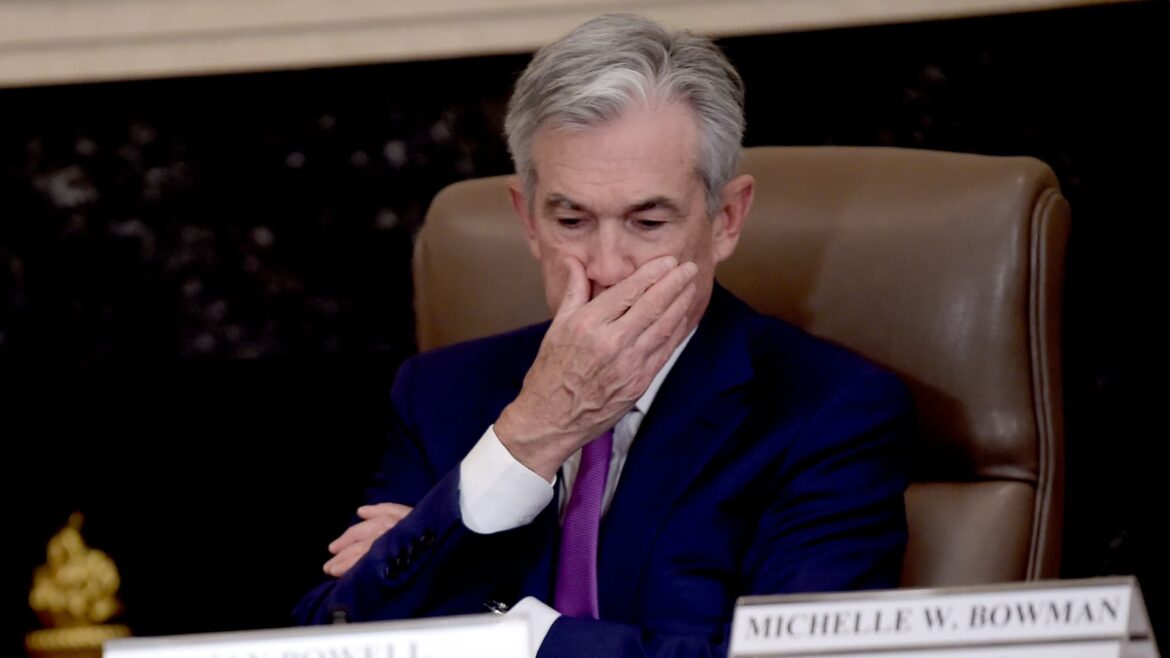
US Federal Reserve Chair Jerome Powell attends a “Fed Listens” event in Washington, DC, on October 4, 2019.
Eric Baradat | AFP | Getty Images
A hotter-than-expected consumer price index report rattled Wall Street Wednesday, but markets are buzzing about an even more specific prices gauge contained within the data — the so-called supercore inflation reading.
Along with the overall inflation measure, economists also look at the core CPI, which excludes volatile food and energy prices, to find the true trend. The supercore gauge, which also excludes shelter and rent costs from its services reading, takes it even a step further. Fed officials say it is useful in the current climate as they see elevated housing inflation as a temporary problem and not as good a measure of underlying prices.
Supercore accelerated to a 4.8% pace year over year in March, the highest in 11 months.
Tom Fitzpatrick, managing director of global market insights at R.J. O’Brien & Associates, said if you take the readings of the last three months and annualize them, you’re looking at a supercore inflation rate of more than 8%, far from the Federal Reserve’s 2% goal.
“As we sit here today, I think they’re probably pulling their hair out,” Fitzpatrick said.
An ongoing problem
CPI increased 3.5% year over year last month, above the Dow Jones estimate that called for 3.4%. The data pressured equities and sent Treasury yields higher on Wednesday, and pushed futures market traders to extend out expectations for the central bank’s first rate cut to September from June, according to the CME Group’s FedWatch tool.
“At the end of the day, they don’t really care as long as they get to 2%, but the reality is you’re not going to get to a sustained 2% if you don’t get a key cooling in services prices, [and] at this point we’re not seeing it,” said Stephen Stanley, chief economist at Santander U.S.
Wall Street has been keenly aware of the trend coming from supercore inflation from the beginning of the year. A move higher in the metric from January’s CPI print was enough to hinder the market’s “perception the Fed was winning the battle with inflation [and] this will remain an open question for months to come,” according to BMO Capital Markets head of U.S. rates strategy Ian Lyngen.
Another problem for the Fed, Fitzpatrick says, lies in the differing macroeconomic backdrop of demand-driven inflation and robust stimulus payments that equipped consumers to beef up discretionary spending in 2021 and 2022 while also stoking record inflation levels.
Today, he added, the picture is more complicated because some of the most stubborn components of services inflation are household necessities like car and housing insurance as well as property taxes.
“They are so scared by what happened in 2021 and 2022 that we’re not starting from the same point as we have on other occasions,” Fitzpatrick added. “The problem is, if you look at all of this [together] these are not discretionary spending items, [and] it puts them between a rock and a hard place.”
Sticky inflation problem
Further complicating the backdrop is a dwindling consumer savings rate and higher borrowing costs which make the central bank more likely to keep monetary policy restrictive “until something breaks,” Fitzpatrick said.
The Fed will have a hard time bringing down inflation with more rate hikes because the current drivers are stickier and not as sensitive to tighter monetary policy, he cautioned. Fitzpatrick said the recent upward moves in inflation are more closely analogous to tax increases.
While Stanley opines that the Fed is still far removed from hiking interest rates further, doing so will remain a possibility so long as inflation remains elevated above the 2% target.
“I think by and large inflation will come down and they’ll cut rates later than we thought,” Stanley said. “The question becomes are we looking at something that’s become entrenched here? At some point, I imagine the possibility of rate hikes comes back into focus.”
Don’t miss these exclusives from CNBC PRO
Even with $300, many Buffett investments are within reach of the average investor.
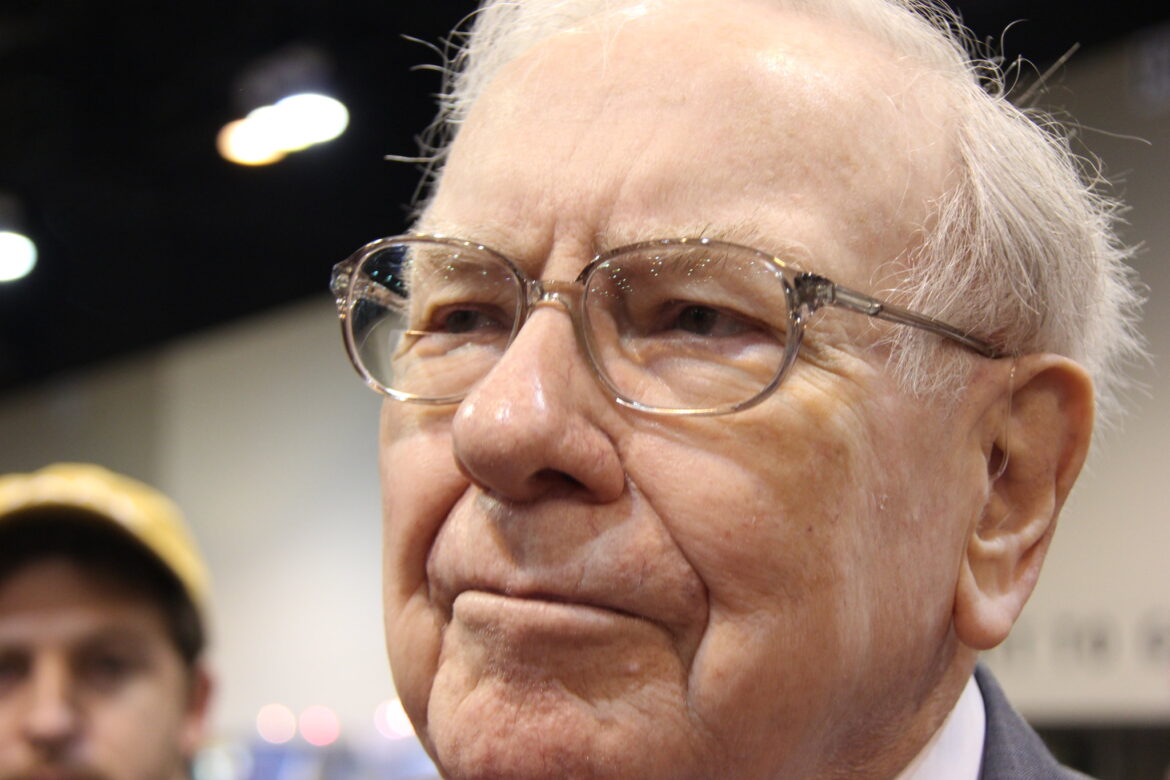
Warren Buffett became one of the world’s best-known investors through his long track record of consistency. Since 1965, his portfolio has earned an average yearly gain of 20%, approximately double that of the S&P 500.
However, with Buffett now in his 90s, many investment decisions are in the hands of his lieutenants, Todd Combs and Ted Weschler. This has changed the philosophy of Berkshire Hathaway a bit, and to that end, it incorporates more growth stocks.
Consequently, investors — even with a modest budget of $300 — can find some intriguing growth stocks in the Berkshire portfolio that could deliver market-beating returns over time.
Amazon
Berkshire did not buy Amazon (AMZN 1.67%) until 2019. As to why it took so long to buy, Buffett said he was “too dumb” to buy Amazon earlier. He was long skeptical of tech stocks but, in time, came to realize the staying power of such businesses.
Now, Amazon is the world’s second-largest retailer, according to the National Retail Federation. Moreover, it pioneered the cloud computing business through Amazon Web Services (AWS), a segment that now accounts for most of the company’s operating income.
Additionally, it operates fast-growth businesses such as digital advertising, online seller services, and its subscription service, known to the public as Amazon Prime. They helped generate revenue of $575 billion in 2023, a 12% increase from last year. This made it a highly diversified business that investors can buy for around $185 per share right now.
Admittedly, Amazon’s forward price-to-earnings (P/E) ratio of 44 may appear expensive, considering that investors often associate Buffett with finding bargains. Still, investors should remember that Amazon has always sold at a high multiple, and the portfolio has sought more expensive stocks since Buffett handed off some investment decisions to others.
Ultimately, with a comparatively reasonable valuation and its diverse business lines, it should remain a stock that serves Buffett and other investors well.
Nu Holdings
NuBank parent Nu Holdings (NU -0.17%) is one of the world’s largest online banks, but since it only operates in Brazil, Mexico, and Colombia, it is likely not on the radar of most investors. Nonetheless, it probably should be, and not just because Berkshire was an early investor in this business.
Nu presents a unique opportunity since just a few institutions had previously dominated banking in this region. For that reason, a large percentage of the population did not have a bank account or credit card. Nu has changed this by issuing the first credit card to millions of Brazilians. Now, 53% of all adult Brazilians (88 million of Nu’s 94 million customers) have at least one account with Nu.
Additionally, the company is now repeating this formula in Mexico and Colombia, meaning its rapid growth can continue. So fast is this growth that the company’s $8 billion in revenue for 2023 grew 68% over the previous year.
Moreover, with the stock at around $12 per share, investors can not only buy a few shares with a $300 budget but also buy at levels just above its IPO price from late 2021. Furthermore, at a forward P/E ratio of 31, the shares are priced reasonably when considering the outsized revenue growth of this fintech stock.
DaVita
DaVita (DVA -0.50%) is probably not a company most investors think of as a growth stock. It offers kidney dialysis to more than 200,000 patients in the U.S. and 10 other countries.
However, the need for such services never disappears, making it the type of business that has always drawn Buffett’s attention. Additionally, approximately 10,000 baby boomers age into Medicare every day, and chronic kidney disease affects about 34% of U.S. adults aged 65 or older. While that may serve as a warning to watch one’s kidney health, it also means a growing customer base for DaVita as kidney disease rises.
Admittedly, considering that its 2023 revenue of $12 billion grew by only 5%, it may not look like much of a “growth” business. Nonetheless, the stock has been in a state of recovery as excess deaths (due to COVID-19) and missed appointments weighed on its performance for most of 2022, and rising labor costs have remained an ongoing challenge.
Moreover, analysts expect its cost-cutting to boost net income by 21% in 2024. Thus, considering its P/E ratio is around 18, the stock is arguably a bargain. Also, with the stock trading at about $135 per share as of the time of this writing, investors with a $300 budget can afford its shares. Investors who follow Buffett’s lead will likely continue to profit from this healthcare stock.
John Mackey, former CEO of Whole Foods Market, an Amazon subsidiary, is a member of The Motley Fool’s board of directors. Will Healy has positions in Berkshire Hathaway and Nu Holdings. The Motley Fool has positions in and recommends Amazon and Berkshire Hathaway. The Motley Fool recommends Nu Holdings. The Motley Fool has a disclosure policy.
Billionaire Bill Ackman Owns $1.9 Billion Worth of This Artificial Intelligence (AI) Stock Instead
Nvidia (NASDAQ: NVDA) is arguably the world’s most popular artificial intelligence (AI) stock, as evidenced by its 215% gain in the past year alone. It’s not a claim without merit, because the company’s revenue more than doubled in fiscal 2024 (which ended Jan. 28) on the back of its industry-leading AI data center chips.
But if investors want to know where the AI industry is headed next, it can be helpful to know where billionaires are putting their money. Bill Ackman, for example, manages a $10 billion stock portfolio for his hedge fund, Pershing Square Capital Management, and he doesn’t own Nvidia at all.
Instead, Ackman owns a $1.9 billion position in Google parent Alphabet (NASDAQ: GOOG)(NASDAQ: GOOGL). Not only has he made solid gains on that investment already, but the stock is also still cheap and could be poised for further upside thanks to the company’s AI initiatives.
Here’s why it’s not too late for investors to follow Ackman’s lead.

Microsoft created an opportunity for Ackman to buy Alphabet
It’s no coincidence Bill Ackman bought Alphabet stock in the first quarter of 2023 when Microsoft (NASDAQ: MSFT) announced its $10 billion investment in leading AI startup OpenAI. Microsoft quickly integrated OpenAI’s ChatGPT technology into its Bing search engine, in an attempt to disrupt Google’s 91% market share in the internet search industry.
Traditional search engines like Google typically make the user sift through web pages for the information they need, whereas Bing’s new chatbot interface can instantly provide a direct answer to almost any question. It’s a far more convenient experience. Alphabet stock plunged because investors feared the company fell way behind Microsoft on the AI front, but Ackman viewed that as a buying opportunity.
In a recent interview with David Rubenstein, Ackman said Alphabet’s valuation had fallen so much that he was getting a great deal on the company’s existing businesses, like search and YouTube, while getting its AI initiatives basically for free.
It’s interesting to note that Ackman felt Alphabet’s AI technology was neck-and-neck with OpenAI’s when he made the investment, even though Alphabet hadn’t launched its own AI chatbot yet.
Alphabet’s Gemini now outperforms OpenAI’s latest GPT-4 models
Shortly after Microsoft announced its OpenAI investment, Alphabet reminded investors it had been working on AI for years. After all, Google acquired AI startup DeepMind way back in 2014. That’s why it took only a few months to launch Google Bard, a chatbot designed to compete directly with ChatGPT.
The quality of a generative AI application comes down to the quality of the developer’s data, and since Google has been the window to the internet for decades, it arguably has more useful information with which to build AI applications than any other company.
Bard paved the way for Alphabet’s latest and greatest family of AI models called Gemini, which were launched in December. According to Alphabet, Gemini outperforms OpenAI’s most advanced GPT-4 models across most multimodal benchmarks. In other words, it’s capable of interpreting and generating text content, images, videos, and computer code more accurately.
Alphabet announced the release of Gemini 1.5, which is even more advanced, in February. The company says it’s far better at “in-context learning,” meaning it can learn new skills from users’ prompts without needing additional fine-tuning from developers. In one test, Alphabet gave Gemini 1.5 a grammar manual for a rare language called Kalamang — which has fewer than 200 speakers worldwide — and it could translate it at a similar level to human subjects who used the same learning material.
Gemini is now available as a standalone chatbot, but its technology is also woven into the traditional Google Search engine to feed users text-based responses in their search results. That reduces the amount of time users have to spend clicking through to third-party web pages for the information they need, striking a balance between traditional search and the chatbot experience.
Ackman is sitting on big gains, but Alphabet stock can still go higher
Ackman bought the bulk of Pershing Square’s Alphabet position in the first quarter of 2023, at an estimated average price of $96.56. That implies he’s sitting on a 60% gain based on the stock’s current price of $154.85. Ackman added to his holdings in the second and third quarters of 2023, and he’s sitting on a profit on those positions, too. But it isn’t too late for investors to follow his lead, because the stock is still relatively cheap.
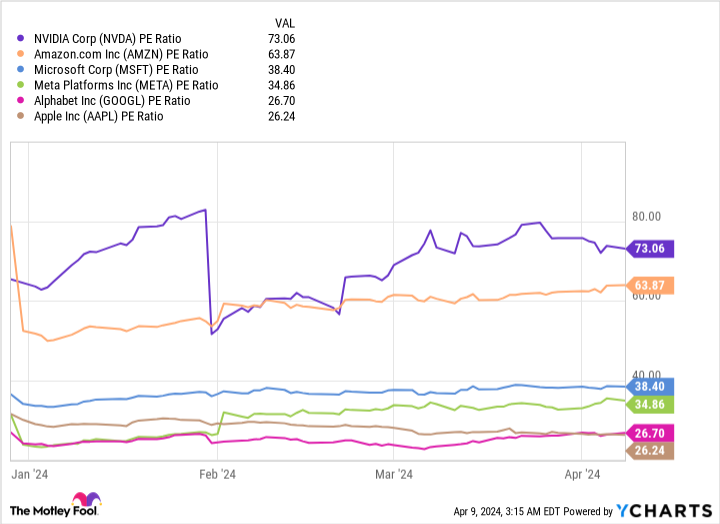
Alphabet generated a record $307.4 billion in revenue in 2023, with $5.80 in earnings per share (that is, profit). The latter places Alphabet stock at a price-to-earnings (P/E) ratio of 26.7. That means Alphabet is the second-cheapest stock among the six U.S. tech giants valued at $1 trillion or more:
The advertising dollars generated by Google Search still account for most of Alphabet’s revenue. However, Google Cloud is the company’s fastest-growing segment thanks to its growing portfolio of AI services. Businesses and developers can access the latest data center infrastructure and ready-made large language models, including Gemini, on Google Cloud to build their own AI applications.
Alphabet is also weaving Gemini into its other products, such as Google Docs and Gmail, offering a productivity boost to customers who can now use AI to rapidly craft content in those applications. Longer-term, Alphabet is reportedly negotiating with Apple to make Gemini the default AI chatbot on that company’s devices, including the iPhone. Details are scarce, but it could be an incredible opportunity, considering Apple has an installed base of more than 2.2 billion devices worldwide.
I think Ackman made a spectacular bet on Alphabet, and his $1.9 billion position is likely to continue to grow in value.
Should you invest $1,000 in Alphabet right now?
Before you buy stock in Alphabet, consider this:
The Motley Fool Stock Advisor analyst team just identified what they believe are the 10 best stocks for investors to buy now… and Alphabet wasn’t one of them. The 10 stocks that made the cut could produce monster returns in the coming years.
Consider when Nvidia made this list on April 15, 2005… if you invested $1,000 at the time of our recommendation, you’d have $522,969!*
Stock Advisor provides investors with an easy-to-follow blueprint for success, including guidance on building a portfolio, regular updates from analysts, and two new stock picks each month. The Stock Advisor service has more than quadrupled the return of S&P 500 since 2002*.
*Stock Advisor returns as of April 8, 2024
Suzanne Frey, an executive at Alphabet, is a member of The Motley Fool’s board of directors. Randi Zuckerberg, a former director of market development and spokeswoman for Facebook and sister to Meta Platforms CEO Mark Zuckerberg, is a member of The Motley Fool’s board of directors. John Mackey, former CEO of Whole Foods Market, an Amazon subsidiary, is a member of The Motley Fool’s board of directors. Anthony Di Pizio has no position in any of the stocks mentioned. The Motley Fool has positions in and recommends Alphabet, Amazon, Apple, Meta Platforms, Microsoft, and Nvidia. The Motley Fool recommends the following options: long January 2026 $395 calls on Microsoft and short January 2026 $405 calls on Microsoft. The Motley Fool has a disclosure policy.
Forget Nvidia: Billionaire Bill Ackman Owns $1.9 Billion Worth of This Artificial Intelligence (AI) Stock Instead was originally published by The Motley Fool
Should Investors Buy Super Micro Computer Stock Instead of Dell Stock?
Dell Technologies is a much larger company than Super Micro Computer, but that doesn’t automatically make it a better investment.
Fool.com contributor Parkev Tatevosian compares Dell Technologies (DELL -0.29%) and Super Micro Computer (SMCI 0.48%) to answer which is the better buy for investors looking to capitalize on the artificial intelligence (AI) trend.
*Stock prices used were the afternoon prices of April 8, 2024. The video was published on April 10, 2024.
Parkev Tatevosian, CFA has no position in any of the stocks mentioned. The Motley Fool has no position in any of the stocks mentioned. The Motley Fool has a disclosure policy.
Parkev Tatevosian is an affiliate of The Motley Fool and may be compensated for promoting its services. If you choose to subscribe through his link, he will earn some extra money that supports his channel. His opinions remain his own and are unaffected by The Motley Fool.
Quick Take
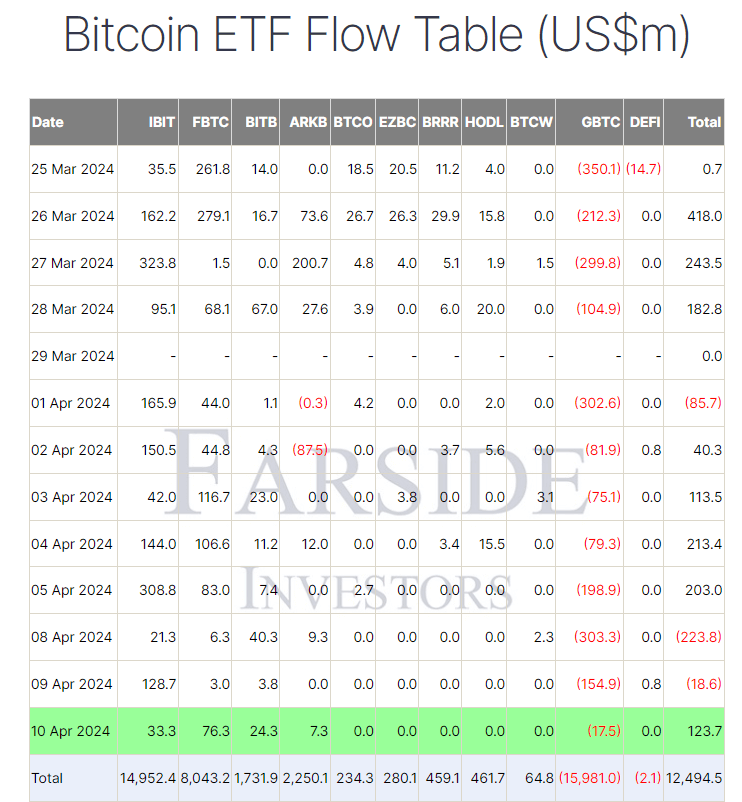
Farside data indicates that Bitcoin (BTC) Exchange-Traded Funds (ETFs) experienced a significant inflow of $123.7 million on Apr. 10, following a period of consecutive outflows. Notably, the Grayscale GBTC ETF saw its lowest outflow at just $17.5 million since launch. However, its total outflows reached $15,981.0 billion.

Farside data highlights that among the BTC ETFs, including BlackRock IBIT, Fidelity FBTC, ARK’s ARKB, and Bitwise BITB, which have seen the most significant inflows, only these four registered positive inflows on Apr. 10. Leading the group was FBTC, with an inflow of $76.3 million, its largest since Apr. 5, pushing its total inflows to $8,043.2 billion. The total net inflows to Bitcoin ETFs now stand at $12,494.5 billion.
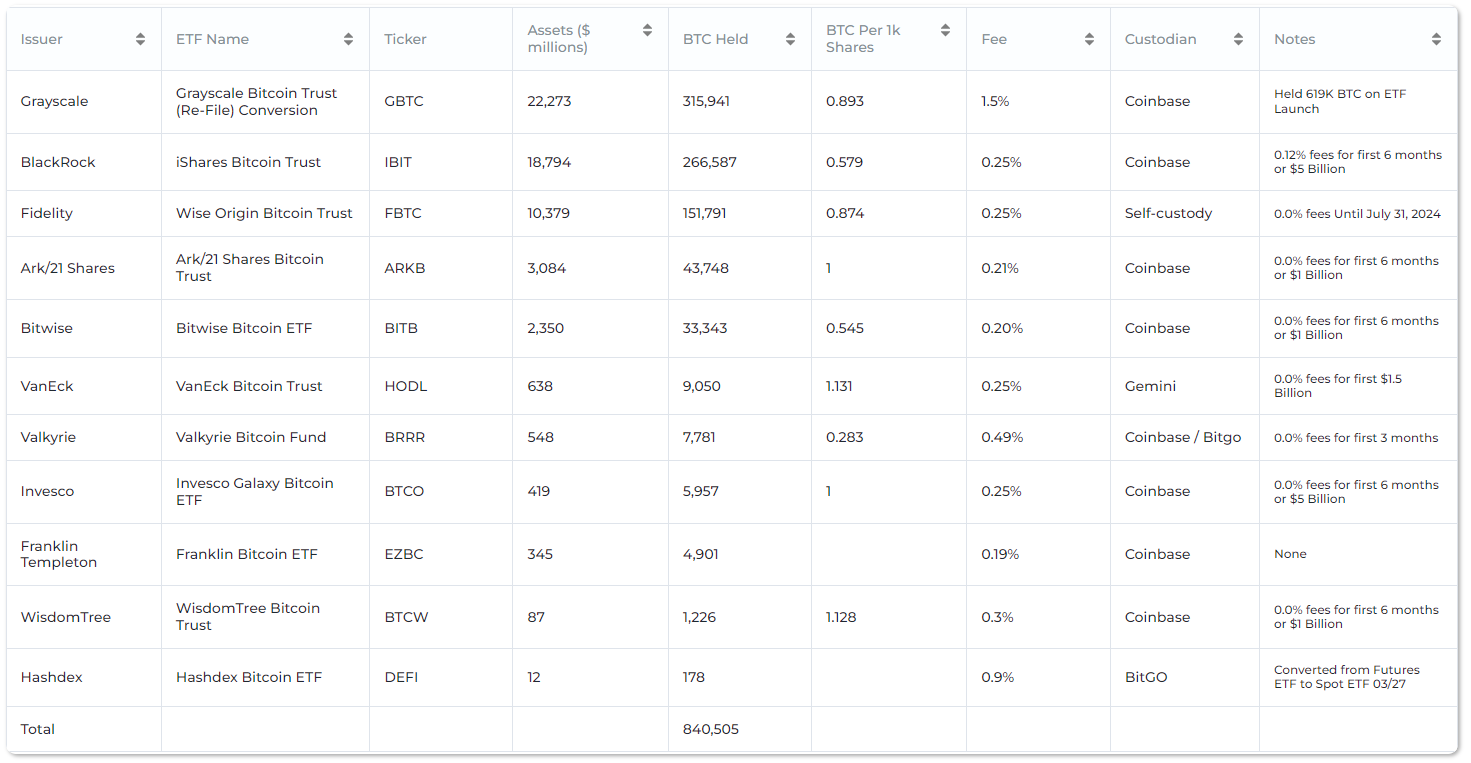
According to Heyappollo data, the eleven US spot BTC ETFs collectively hold 840,505 BTC.

The post GBTC ETF records lowest outflow since launch: $17.5 Million appeared first on CryptoSlate.
In a recent analysis, Stanislas Bernard, the founder of Sinz 21st.Capital, delved into the complexities surrounding Hong Kong’s consideration to approve spot Bitcoin ETFs against the backdrop of China’s escalating economic crisis. With the nation grappling with a record debt-to-GDP ratio of 288% in 2023, and witnessing one of the most severe housing market collapses in three decades, the financial instability has triggered an unprecedented capital flight towards overseas markets.
The Perfect Timing For A Spot Bitcoin ETF?
Amidst these turbulent economic times, Hong Kong’s potential approval of spot Bitcoin ETFs stands out as a pivotal development that could not only be a safe haven for Chinese investors but also significantly influence Bitcoin’s valuation, potentially catapulting it to the elusive $100,000 mark.
China’s economic woes have been intensifying, marked by a towering debt ratio and a plummeting housing sector that has investors scrambling for alternatives. “China currently faces a significant economic downturn, exacerbated by soaring debt and malinvestments in real estate. The crisis, becoming well-known in 2021 with the default of Evergrande Group, has now spread, causing a ripple effect that will likely slow down the Chinese economy for years to come,” Bernard pointed out.
This backdrop of economic instability has incited a significant shift in investor behavior, notably among Chinese investors who, faced with stringent capital controls, have sought refuge in ETFs that offer exposure to foreign markets. Yet, this avenue has been fraught with its own challenges.
“Investors are paying premiums as high as 43% on certain US-focused ETFs due to quota limitations, which speaks volumes about the desperation to find safer investment harbors,” Bernard notes. Such premiums underscore the pervasive fear and uncertainty that have gripped the Chinese market, driving investors towards seemingly any available exit from the volatility of the domestic market.
The Role Of Hong Kong
Bernard believes that not only Hong Kongers but also Chinese mainlanders will flock to Bitcoin ETFs. “They are pretty integrated. Mainland is HK’s largest trading partner. Would not be possible to approve a spot ETF and then close it to mainland. They will enforce transaction limits instead,” the expert said.
In the midst of these developments, Hong Kong’ Securities and Futures Commission (SFC) is reportedly considering the approval of spot Bitcoin ETFs already by the end of April, as reported yesterday. This move is viewed as a strategic effort to capture a portion of the capital flowing into Bitcoin, especially in the wake of the SEC’s approval of similar ETFs in the US, which saw a meteoric rise with $12 billion of net flow.
“Hong Kong is scrambling for a change. The approval of spot Bitcoin ETFs could unlock a vast reservoir of stranded Chinese capital into Bitcoin, providing a much-needed life raft for investors,” Bernard explained.
The anticipated approval of spot Bitcoin ETFs by Hong Kong authorities has been met with significant enthusiasm within the crypto community. Influential figures such as Bitcoin Munger and Stack Hodler have been vocal about the potential impact of this development on Bitcoin’s price.
“Hong Kong ETFs approval have accelerated to next week. Most accounts on CT weren’t making a big deal about them, but they are a big deal. They are going to take us to $100k+ in due time. Tick tock!” stated popular Bitcoin analyst Bitcoin Munger (@bitcoinmunger). He refers to the regional yearly year-over-year supply change from West to East.

Stack Hodler (@stackhodler) further emphasized the urgency among Chinese investors to find secure investment avenues outside the traditional system, “Chinese investors were panic-buying a Gold fund at a 30% premium this month as they attempt to get their wealth into something outside the Chinese system. The approval of Hong Kong spot ETFs could be the turning point, offering a sanctioned avenue for wealth preservation amidst the crumbling real estate market.”
Overall, the potential approval of spot Bitcoin ETFs in Hong Kong is poised to be a landmark development, not just for the region but for the global market. By offering a secure and regulated channel for investment, it could serve as a catalyst for significant capital inflow into Bitcoin, reinforcing its status as a viable store of value.
“As we stand at the cusp of this historic development, the implications for Bitcoin and the broader cryptocurrency market could be profound. The approval of spot Bitcoin ETFs in Hong Kong could indeed be the harbinger of a new era, potentially driving Bitcoin’s value to new heights,” concluded Bernard.
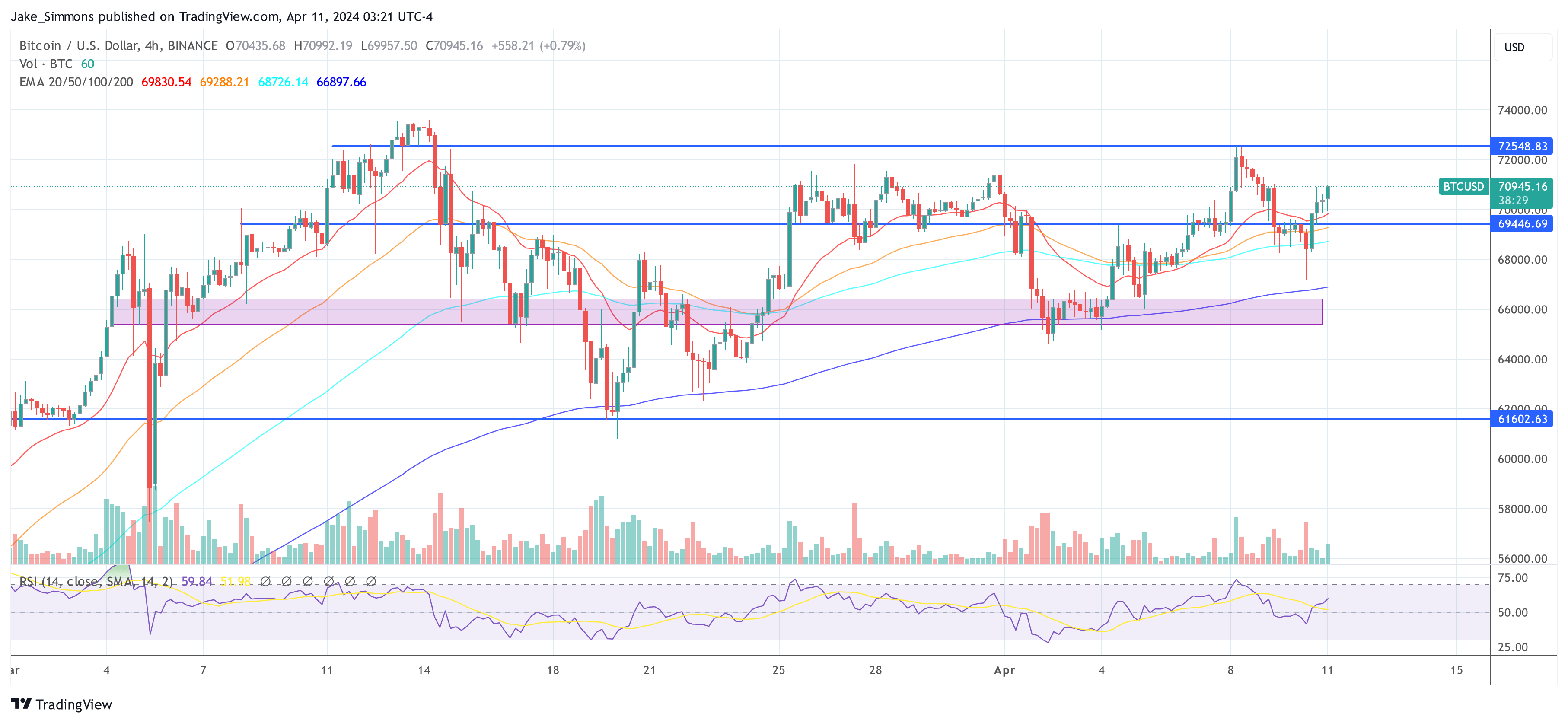
At press time, BTC traded at $70,945.

Featured image created with DALL·E, chart from TradingView.com
Disclaimer: The article is provided for educational purposes only. It does not represent the opinions of NewsBTC on whether to buy, sell or hold any investments and naturally investing carries risks. You are advised to conduct your own research before making any investment decisions. Use information provided on this website entirely at your own risk.
Russian Central Bank Chief: Mass Adoption of Digital Ruble Expected in 5 to 7 Years
Elvira Nabiullina, head of the Russian central bank, has stated that the mass launch of the digital ruble will take five to seven years. This appears to contradict recent suggestions by the chairman of the State Duma Committee on the Financial Market that the launch will begin next year. No Decision Before 2025 Elvira Nabiullina, […]
Source link
Bitcoin Tumbles on Hot CPI Data, But This Analyst Stays Ultra Bullish: Here’s Why
The better-than-expected United States Consumer Price Index (CPI) released on April 10 is already sending shock waves through the financial market. Bitcoin and most crypto assets are trading lower, extending losses recorded on April 9, weighing negatively against optimists.
United States CPI Data Came In Hot
According to Trading Economics data on April 10, CPI, a key economic metric for gauging inflation, rose 0.4% in March, pushing the annual inflation rate to 3.5%. Notably, this surpassed economist predictions and, most importantly, dashed hopes for the United States Federal Reserve (Fed) to slash rates aggressively this year.

However, amidst the market jitters, Matt Hougan, the CIO of Bitwise Asset Management, offered a contrarian perspective as fear permeated the Bitcoin and crypto market. In a post on X, Hougan downplayed the influence of the CPI data on Bitcoin’s long-term trajectory.
The executive argues that investors and traders should track other market factors like spot Bitcoin exchange-traded fund (ETF) inflows and rising government deficits. In Hougan’s assessment, these can strongly influence price, even lifting Bitcoin higher since they are currently aligned.
Time To Buy The Bitcoin Dip?
As such, even with the fall in BTC, the drop could offer potential buying opportunities for long-term holders. Some supporters believe the “hot” CPI data only exposes the vulnerabilities of fiat currencies. This would potentially drive investors to use Bitcoin as a hedge.
Moreover, this upbeat sentiment is backed by solid demand for gold, a store of value asset preferred by traditional finance investors. Analysts anticipate Bitcoin will follow a similar path as investors seek to protect value amid rising inflation.
Further bolstering the bullish sentiment is the possibility of a spot Bitcoin ETF launch in Hong Kong before the end of April.
The Hong Kong Securities and Futures Commission (SFC) has been assessing various applications. Leading Chinese asset managers have submitted some. If the product is approved, it could further channel more capital to BTC, boosting inflows from the United States.
When writing, BTC is steady but under pressure. April 9’s losses have been confirmed. The coin might track lower if bulls fail to push prices above all-time highs of around $74,000.
Bitcoin remains in a broader bullish formation, technically moving inside a rising wedge. This bullish outlook will only be invalidated if prices tank below $61,500 in the sessions ahead.
Feature image from DALLE, chart from TradingView
Disclaimer: The article is provided for educational purposes only. It does not represent the opinions of NewsBTC on whether to buy, sell or hold any investments and naturally investing carries risks. You are advised to conduct your own research before making any investment decisions. Use information provided on this website entirely at your own risk.
Binance CEO Discusses Company’s Plan After Settlement With US Authorities
Binance’s chief executive has shared his company’s future direction and areas of focus following its settlement with U.S. authorities, including the Department of Justice (DOJ). “We have moved past that as the company move into greater maturity,” he insisted, adding that the crypto firm is focusing on “sustainability.” ‘The Direction of Travel Is Very Clear’ […]
Source link