The Ethiopian state electricity company has reportedly signed power supply agreements with 21 mainly Chinese bitcoin miners. The African country’s pursuit of foreign exchange has seemingly taken precedence over the concerns often raised by climate change advocates. Ethiopia Set to Become the Preferred Destination for Chinese Bitcoin Miners Ethiopia’s state power company has entered into […]
Source link

CoinNews
Dogecoin (DOGE), the meme-driven cryptocurrency, remains confined within a narrow trading range of $0.075-$0.088 since the beginning of 2024, leaving investors grappling with its future trajectory. While activity has dwindled compared to early 2023, a significant portion of DOGE addresses remain profitable, fueling cautious optimism.
Profitable Addresses Offer Glimmer Of Hope
Approximately 60% of DOGE addresses, totaling roughly 1.34 million, currently hold their tokens at a profit, implying they bought at lower prices. This data, gathered by blockchain analytics firm IntoTheBlock, suggests underlying bullish sentiment despite declining market engagement.
Technical Support And Resistance Levels
Analysts highlight key support levels around $0.077-$0.079, where a large number of investors entered the market. This zone could act as a buying floor, preventing further price depreciation.
However, breaching this support could trigger a dip to $0.07, offering potential entry points for bargain-seeking investors. Conversely, overcoming the $0.088 resistance level could pave the way for a price climb towards $0.094.
BTCUSD trading at $50,093 on the daily chart: TradingView.com
Dwindling Activity Raises Concerns
A closer look at network activity paints a less rosy picture. Both transaction volume and whale activity, signifying large-scale investments, have decreased significantly, indicating reduced trading interest. This lack of enthusiasm could hamper Dogecoin’s upward momentum.
#Dogecoin is experiencing a decrease in transaction volume and whale transaction count, which typically indicates lower trading activity. This could be a sign that fewer people are buying, selling, or transferring #DOGE, possibly due to reduced interest or confidence in it! pic.twitter.com/SiKNxx4FhN
— Ali (@ali_charts) February 12, 2024
Technical analysis reveals a stalemate between the 50-day Exponential Moving Average (EMA) acting as support and a falling trendline acting as resistance. This pattern signals a lack of clear direction in the near term. Flipping the trendline to support could be a positive indicator, but achieving that requires renewed buying pressure.

Valentine’s Day Prediction Offers Modest Hope
Crypto exchange Changelly offers a moderate prediction for Valentine’s Day, forecasting a 1.12% price increase to $0.082591. While this could bring temporary cheer to DOGE holders, it also underlines the currency’s sensitivity to market sentiment and overall volatility.
Dogecoin: Long-Term Concerns Linger
Meanwhile, Dogecoin’s recent fall from the top 10 cryptocurrency rankings raises concerns about its long-term viability. Unlike competitors offering real-world applications, DOGE primarily relies on celebrity endorsements and internet trends. This raises questions about its ability to compete in the rapidly evolving crypto landscape.
The future of Dogecoin remains uncertain. While a short-term price rise is possible, concerns about its utility and competitive edge compared to other projects persist. Investors should approach DOGE with caution and conduct thorough research before making any investment decisions. Remember, price predictions are merely educated guesses, and the cryptocurrency market remains inherently unpredictable.
Featured image from Pexels, chart from TradingView
Disclaimer: The article is provided for educational purposes only. It does not represent the opinions of NewsBTC on whether to buy, sell or hold any investments and naturally investing carries risks. You are advised to conduct your own research before making any investment decisions. Use information provided on this website entirely at your own risk.
Crypto Community Fires Back at Hillary Clinton’s Criticism of Bitcoin Undermining US Dollar as Reserve Currency
The crypto industry has responded to criticism from Hillary Clinton, who said that cryptocurrency can undermine the role of the U.S. dollar as the world’s reserve currency. Galaxy Digital CEO Mike Novogratz argued that the only thing that can undermine the U.S. dollar as a reserve currency is reckless spending by both U.S. political parties. […]
Source link
The crypto market is currently abuzz with discussions on Bitcoin (BTC), as it teeters on the brink of reaching the $50,000 threshold. This is fueled by the fast-approaching halving as well as a “bullish divergence” observed over the past week, with Bitcoin breaking past the $48,000 mark.
Analyst Analysis On Bitcoin
Michaël van de Poppe, a prominent figure in the realm of crypto analysis, recently shared insights on the bullish divergence. Van de Poppe pointed out the notable weekly candle that propelled Bitcoin’s value beyond $48,000, signaling a potential challenge at the $50,000 resistance level in the near term.
#Bitcoin looking at the resistance.
Massive weekly candle, through which Bitcoin is back above $48,000.
I’m personally interested what price will do around $50,000 in the upcoming 1-2 weeks. pic.twitter.com/6I927U20pg
— Michaël van de Poppe (@CryptoMichNL) February 12, 2024
Further echoing this challenge, IntoTheBlock highlighted a key obstacle Bitcoin faces on its path to $50,000 in the latest post. The firm identified a crucial resistance level, noting that over 800,000 addresses have purchased nearly 270,000 BTC at an average price of $48,491.
Currently, at a loss, these holders may exert selling pressure as Bitcoin approaches its break-even point, potentially impacting its ascent to the coveted $50,000 mark.
Bitcoin has set its sights on $50k!
To get there, there is one important resistance level left. Over 800k addresses acquired nearly 270k $BTC at an average price of $48,491. These addresses are currently in the red and might provide sell pressure as they break even on their… pic.twitter.com/nEw4tP8wUc— IntoTheBlock (@intotheblock) February 12, 2024
Over the past week alone, Bitcoin’s value has increased by more than 10%, igniting discussions among crypto enthusiasts and experts regarding its future trajectory. This bullish momentum and the impending halving event reinforce optimistic stances within the crypto sphere about Bitcoin’s value proposition.
Bullish Outlook On BTC And Market Sentiment
Amid this bullish phase, several crypto analysts and market observers have put forward their forecasts regarding Bitcoin’s potential price movement shortly. Crypto Rover, another analyst with a significant following, suggested that surpassing the $48,500 resistance and reaching the 0.618 Fibonacci level could set Bitcoin on a path to the “official trend reversal to a bull market.”
Once #Bitcoin breaks the $48,500 mark, better said, the 0.618 Fibonacci level,
that will mark the official trend reversal to a bull market. I’m keeping a close eye on this level! pic.twitter.com/ne2SvugHRp
— Crypto Rover (@rovercrc) February 10, 2024
Furthermore, data from IntoTheBlock indicates a positive trend regarding Bitcoin address profitability. Currently, 91% of Bitcoin addresses are profitable, with the total number of addresses in profit at 46.87 million, accounting for 90.53% of all addresses.
This is contrasted with 3.44 million addresses that are still at a loss. IntoTheBlock’s analysis also reveals that most addresses that purchased BTC within the $40,919.92 to $55,413.77 range are now profitable, underscoring a bullish sentiment among Bitcoin holders.
Featured image from Unsplash, Chart from TradingView
Disclaimer: The article is provided for educational purposes only. It does not represent the opinions of NewsBTC on whether to buy, sell or hold any investments and naturally investing carries risks. You are advised to conduct your own research before making any investment decisions. Use information provided on this website entirely at your own risk.
The stock market is looking a lot like it did before the dot-com and ’08 crashes, top economist says

-
The stock market looks similar to the periods that preceded the dot-com and 2008 market events.
-
David Rosenberg pointed to the exuberance for AI, which has sparked a “raging bull market.”
-
The “speculative mania” carrying the stock market could soon end, he warned.
The stock market is flashing the same warning signs of “speculative mania” that preceded the crashes of 2008 and 2000, according to economist David Rosenberg.
The Rosenberg Research president — who called the 2008 recession and who’s been a vocal bear on Wall Street amid the latest market rally — pointed to the “raging bull market” that’s taken off in stocks, with the S&P 500 surpassing the 5,000 mark for the first time ever last week.
The benchmark index has soared around 22% from its low in October last year, clearing the official threshold for a bull market. The index has also gained for the last five weeks and has been up for 14 of the last 15 weeks — a winning streak that hasn’t been seen since the early 1970s.
But the stellar gains are a double-edged sword for investors, as the market looks dangerously similar to the environment prior to the dot-com and 2008 crashes, Rosenberg wrote in a note on Monday.
“With each passing day, this has the feel of being a cross between 1999 and 2007. It is a gigantic speculative price bubble across most risk assets, and while AI is real, so was the Internet, and so were the high-flying stocks that populated the Nifty Fifty era,” he said, referring to the group of 50 large-cap stocks that dominated the stock market in the 60s and 70s, before falling by around 60%
Other Wall Street strategists have warned of the parallels between today’s market and similar stock booms in the past. The hype for artificial intelligence pushed the Magnificent Seven stocks to dominate most of the S&P 500’s gains last year, and a major price correction is on the way as valuations soar to unsustainable levels, Richard Bernstein Advisors said in an October 2023 note.
“This is the problem when a group of mega cap ‘concept’ stocks trade at double the multiple of the rest of the market. The lesson is that (i) the higher they are, the harder they fall, and (ii) there are dangers when too much growth gets priced in,” Rosenberg said. “Being real in an economic sense does not mean we have not entered a realm of excessive exuberance when it comes to the financial markets,” he added, referring to the hype surrounding AI.
The outlook for stocks is also shadowed by an uncertain economic picture. Geopolitical risks, recession risk, and the risk that the Fed will disappoint investors hoping for rate cuts aren’t being priced into markets at the moment, Rosenberg added.
“I don’t find speculative manias a turn-on and in my personal finances, I avoid them like the plague. Not everyone likes to hear that, especially since I missed so much of this rally but that’s how I roll,” he said.
Rosenberg has warned investors to tread carefully before, given the slew of risks he sees ahead for markets. Previously, he said that the S&P 500 looked “eerily similar” to 2022, the year the index plunged 20%. That’s partly because a recession that “few see and few are positioned for” is coming for the economy, he wrote in a post on LinkedIn last month.
Read the original article on Business Insider

Shares of AMC Entertainment Holdings Inc. ended Monday’s trading up 4.1% as the stock extended its winning streak to three days — its longest-such run since a four-day streak that ended on Dec. 28, 2023.
The stock is up four of the past five days, and short interest as a percentage of AMC’s
AMC,
public float of shares was 10.91% on Monday.
Related: AMC’s stock rallies more than 10% for biggest gain since August
The movie-theater chain and original meme stock has hit a series of record lows recently but rallied last week. On Feb. 6, the stock ended the session up 10.9%, registering its biggest single-day percentage gain since Aug. 30, 2023.
AMC shares hit a record-low close of $3.67 on Feb. 5 — a far cry from the heady days of the meme-stock frenzy, during which the stock surged to an all-time closing high of $339.05 on June 2, 2021, according to Dow Jones Market Data.
Related: AMC’s bonds find buyers while original meme stock slides
Last month, AMC Chief Executive Adam Aron described the recent decline in the company’s share price as “so frustrating.”
AMC shares have fallen 89% in the last 52 weeks, compared with the S&P 500 index’s
SPX
gain of 21.4%.
Markets count on consumer-price index to fall below 3% for first time since 2021

Tuesday has the potential to bring investors something they haven’t seen in almost three years: A U.S. inflation rate based on the consumer-price index that looks more like 2%.
In the run-up to January’s CPI data, stocks finished near a record close, with the S&P 500 index
SPX
ending above 5,000 on Monday — helped by growing confidence that inflation is improving. Treasury yields ended little changed, following a steep climb over the past few weeks that’s been driven by stronger-than-expected U.S. economic data.
Economists now expect an annual headline CPI rate of 2.9% for January, which would be the lowest level since March 2021 and down from 3.4% in December. Any upside surprise in Tuesday’s report that shows inflation remaining unexpectedly sticky, however, is likely to shake up the bond market the most, according to analysts.
Read: The first big inflation report of 2024 is coming out. Here’s what the CPI is likely to show.
Tuesday’s data is likely to “just confirm what the market already knows: that inflation is falling,” said Adam Turnquist, chief technical strategist for LPL Financial in Green Bay, Wis. “Anything outside of that is going to lead to some volatility on a short-term basis, but it’s also not going to detract from investors’ confidence on inflation.”
“Stocks should do well if inflation is in line or below expectations and, in the event that it isn’t, investors might be willing to withhold judgment by focusing on individual components of the report that are expected to fall, like shelter,” Turnquist said via phone. “Fixed income will be moving the most if inflation comes in hotter than expected, following a string of upside surprises to the economy. If you throw in a high inflation print, that’s going to add to the upside we’ve seen in terms of yields. And the dollar is highly correlated to the 10-year rate.”
On Monday, 2 –
BX:TMUBMUSD02Y
and 10-year Treasury rates
BX:TMUBMUSD10Y
settled not far from their highest levels since mid-December. Yields had finished Friday with their biggest weekly advances since the period that ended on Jan. 19, after minor revisions were made to past CPI reports.
The ICE U.S. Dollar Index
DXY
has advanced roughly 1.9% for the year. Meanwhile, stocks ended mixed, with the S&P 500 losing an earlier gain to finish lower at 5,021.84 while the Dow Jones Industrial Average closed up by 125.69 points, or 0.3%.
“Stocks are pricing in a baseline expectation that inflation is largely improving, and it’s now more about monetary policy and when — not if — the Fed is going to cut rates and by how much,” Turnquist said. “The inflation hysteria around these prints has deteriorated.”
The annual headline rate of CPI reached a peak of 9.1% in June 2022 and has since steadily fallen, holding around 3% for seven straight months. While Federal Reserve policymakers prefer to rely on another gauge known as the PCE and the core readings that exclude food and energy, officials also pay attention to annual headline CPI because of its ability to affect household expectations.
See also: Why Americans Are So Down on a Strong Economy
“Anything under 3% offers some sort of assurance,” said strategist Will Compernolle at FHN Financial in New York. “But I think tomorrow won’t give as much as definitive clarity on inflation as the markets hope for.”
“January was full of disruptions, with weather and illness. Consumer spending patterns changed and companies couldn’t operate at full capacity. How those two ingredients combine, I’m not sure,” Compernolle said via phone. “But with lower demand, inflation could look cooler, on net, and January’s data may not be representative of the longer-term trajectory on inflation.”
The report “will probably be seen as ‘good enough,’ and might provide a sense of relief that inflation is not moving any faster,” he said on Monday.
Surprisingly, the newly introduced Ethereum (ETH) token standard, ERC-404, made an impressive debut in the crypto market, outperforming many other digital assets.
However, as Bitcoin (BTC), the dominant cryptocurrency, began to rally, investors swiftly shifted their focus to the king of crypto. Consequently, this shift led to notable price drops and market capitalization declines across the ERC-404 ecosystem and its associated tokens.
From Skyrocketing Surges To Sharp Corrections
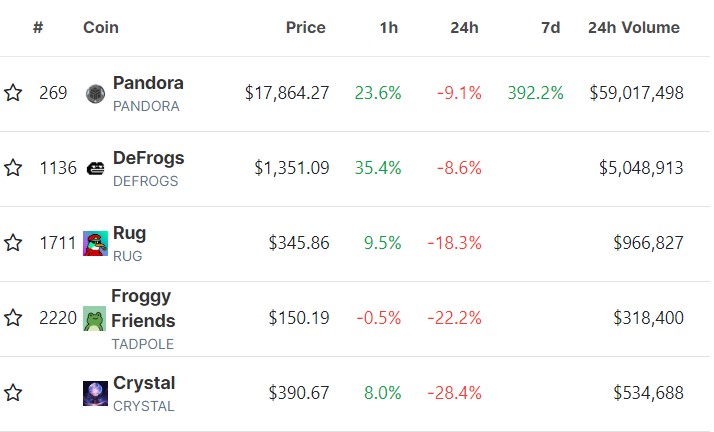
According to data from CoinGecko, the ERC-404 sector has experienced a significant decline, with an overall market capitalization drop of 29% in the past 24 hours.
Key tokens within this sector, including PANDORA, DeFrogs, RUG, Froggy Friends, and Crystal, have all witnessed substantial price decreases. PANDORA, which had garnered attention and speculation, surged by a staggering 12,000% within a week.
Opening at $250 on February 3, 2024, its value skyrocketed to over $34,000 per token by February 9, 2024. However, it dropped by 38% from its all-time high (ATH) in just 24 hours.

On the other hand, Crystal suffered the most significant losses, with its price plummeting by 28.4% and trading volume declining by over 35%. These figures indicate a stark decline in market activity for the token. Currently, Crystal is down more than 51% from its ATH of $792.74, exemplifying the inherent volatility of the ERC-404 sector.
Following closely behind, Froggy Friends experienced a 16% drop in trading volume and an 81% decrease in price from its peak of $823. CoinGecko data reveals that Froggy Friends currently trades at $150 per token.
But what are the ERC-404 token standards? And what is causing the price and market capitalization to drop?
Navigating The ERC-404 Ecosystem
Ethereum, known for its smart contract platform, has been a breeding ground for various token standards. While ERC-20 and ERC-721 gained widespread adoption for fungible and non-fungible tokens (NFTs), a new contender emerged: ERC-404.
Named after the popular website error code “404,” ERC-404 introduces the concept of “semi-fungibility” to Ethereum. It combines the divisibility of ERC-20 tokens with the uniqueness of ERC-721 tokens, bridging the gap between these two types.
ERC-404 tokens are associated with specific NFTs, allowing fractional transfers of linked NFTs. Full ownership results in minting the linked NFT to the holder’s wallet, while fractional transfers trigger the burning of the associated NFT. New NFTs are automatically minted when sufficient fractions are accumulated to form a complete token.
DN-404 Prepares To Challenge ERC-404’s Dominance?
According to a recent report by The Block, transaction fees increased as ERC-404 tokens gained traction, prompting developers to work on an alternative implementation called Divisible NFT (DN-404).
This new standard aims to optimize code and reduce transaction fees, addressing the rising costs associated with ERC-404 tokens. The DN-404 implementation is set to be released soon, potentially alleviating network congestion caused by the influx of ERC-404 tokens.
While there were initial discussions between the Pandora team, the creators of ERC-404, and the developers working on DN-404, the two groups did not reach an agreement and are not collaborating, according to the report.
This introduces uncertainty for traders and investors who navigate between supporting the original ERC-404 or the upcoming DN-404 implementation.
Overall, the introduction of ERC-404 brought excitement and volatility to the crypto market. While semi-fungibility and fractional transfers of linked NFTs hold promise, challenges such as rising transaction fees and the emergence of DN-404 have impacted the ERC-404 ecosystem.
Traders and investors now face the dilemma of choosing between the original implementation and the upcoming alternative. As the market evolves, it will be interesting to see how the ERC-404 sector adapts and whether it can regain stability and investor confidence.
Featured image from Shutterstock, chart from TradingView.com
Disclaimer: The article is provided for educational purposes only. It does not represent the opinions of NewsBTC on whether to buy, sell or hold any investments and naturally investing carries risks. You are advised to conduct your own research before making any investment decisions. Use information provided on this website entirely at your own risk.
Bitcoin Halving 2024 — Grayscale Study Reveals Unprecedented Market Evolution
According to the latest data, the countdown to the Bitcoin network’s halving event shows fewer than 10,000 blocks from becoming a reality. Further analysis suggests that the halving is anticipated to take place between April 19 and April 21, 2024, reducing the block rewards from the existing rate of 6.25 bitcoins per block to 3.125 […]

Source link
The countdown to Bitcoin’s highly anticipated halving event is on, with fewer than 10,000 blocks left as of Feb. 12.
According to the Bitcoin Halving Clock, approximately 9,843 blocks remain before the event, which is estimated to occur by April 17.
The halving event is significant for the crypto industry because it enhances Bitcoin’s scarcity by reducing miner rewards. CryptoSlate Insight reported that the event would slash the number of BTC produced daily by miners to 450 BTC from 900 BTC.
Historically, BTC halving has usually been followed by an increased difficulty in mining the top crypto asset and a bullish price movement.
Bitcoin upcoming halving is ‘different’
Crypto asset management firm Grayscale said the impending halving event carries distinct implications compared to its predecessors due to the notable surge in BTC’s utility over the past year.
“Despite miner revenue challenges in the short term, fundamental onchain activity and positive market structure updates make this halving different on a fundamental level,” Grayscale wrote.

According to the firm, the recent introduction of Bitcoin Exchange-Traded Funds (ETFs) presents a stable demand outlet that could counteract the downward pressure from mining issuance.
It said:
“ETFs, in general, create access to Bitcoin exposure to a greater network of investors, financial advisors, and capital market allocators, which in time could lead to an increase in mainstream adoption.”
Furthermore, Grayscale highlighted the significance of Non-Fungible tokens (NFTs)-like ordinal inscriptions in the BTC ecosystem. The firm said these assets “present a new path toward sustaining network security through increased transaction fees.”
Beyond that, the emergence of ordinal inscriptions has invigorated on-chain activity, yielding over $200 million in transaction fees for miners as of February 2024. This trend is anticipated to endure, buoyed by renewed developer engagement and ongoing innovations within the blockchain.
In addition, Grayscale noted that miners have been proactively preparing for the halving’s financial implications by liquidating their BTC since late 2023. This proactive stance positions them favorably ahead of the halving event.
Even if some miners were to exit the network, Grayscale said the subsequent decrease in hash rate would prompt an adjustment in mining difficulty, safeguarding network stability.
“While [BTC] has long been heralded as digital gold, recent developments suggest that [it] is evolving into something even more significant,” Grayscale concluded.
At the time of press, Bitcoin is ranked #1 by market cap and the BTC price is up 3.52% over the past 24 hours. BTC has a market capitalization of $980.27 billion with a 24-hour trading volume of $30.81 billion. Learn more about BTC ›
Market summary
At the time of press, the global cryptocurrency market is valued at at $1.86 trillion with a 24-hour volume of $62.28 billion. Bitcoin dominance is currently at 52.66%. Learn more ›