According to the latest figures, Metaplanet, a company listed on the Japanese stock exchange, witnessed its share price soar by nearly 90% in just one day. This significant jump came on the heels of the company’s announcement regarding its intention to incorporate 1 billion yen in bitcoin into its balance sheet. Metaplanet Joins Forces With […]
Source link

CoinNews
Zeta Markets launches governance token to steer Solana-based DEX toward community rule

Zeta Markets, a decentralized exchange (DEX) built on Solana, will launch its governance Z token today, according to a statement shared with CryptoSlate.
The DEX revealed that the token’s debut aligns with its commitment to “becoming a fully community-centric protocol” and empowers its community members to influence its decisions.
Zeta has enjoyed considerable interest and adoption from the crypto community thanks to the rising popularity of the Solana ecosystem. The DEX stated that its monthly trading volumes crossed a new all-time high (ATH) of over $1.2 billion, traded by more than 71,000 monthly active users in March.
Data from DeFillama shows that the total value of assets locked on the platform has soared to a new high of over $21 million as of press time.
Z token supply
Z token has a total supply capped at 1 billion. Zeta Markets plans to allocate 10% of the tokens through airdrops, with 5% earmarked for Zeta traders and community members based on their Z-Score.
The platform revealed that 1% of the airdrop would be reserved for other Zeta users affiliated with strategic communities within the Solana ecosystem. In comparison, the remaining 4% will be allocated to Z stakers.
Upon launch, approximately 30% of the token supply will be allocated to incentivize maker and taker trading activities, acknowledging their pivotal role in maintaining liquidity on the exchange.
Zeta roadmap
Tristan Frizza, the founder of Zeta Markets, stated that the token launch is part of the protocol’s long-term vision. This vision includes pioneering a novel vote escrow model on Solana and incorporating a staking mechanism that enables holders to earn additional rewards.
Additionally, Zeta plans to introduce the first layer-2 rollup on the Solana network before the end of this year.
According to Frizza:
“With a platform that has already stood the test of time and facilitated billions in volume for tens of thousands of traders, we’re excited to launch $Z, the governance token of Zeta, to closely align the long-term interests of users with the protocol. This will empower the community to shape the future trajectory of the protocol and weigh in on important decisions as we collectively strive to deliver the ultimate DEX experience.”
The post Zeta Markets launches governance token to steer Solana-based DEX toward community rule appeared first on CryptoSlate.
Planet Fitness Has Been ‘Pretty Much Destroyed,’ Says Company Founder Amid Speculation On Boycott Cancellations

Planet Fitness Inc. (NYSE:PLNT) Founder and CEO Mike Grondahl detailed a history of rampant abuse at the company and alleged it misrepresented its financials during a recent interview with controversial right-wing X user Libs of TikTok.
This comes after weeks of calls for boycotts of the brand after the company canceled the membership of a Planet Fitness gym goer after speaking out about a biological male in the women’s locker room.
Planet Fitness’s policy allows gym members to use the locker room associated with their gender identity. But this policy has led to a few high-profile cases of women feeling uncomfortable in Planet Fitness women’s locker rooms, and some women and children have reported abuse and sexual harassment at the facilities. Many of these incidents resulted in the women losing their membership, but an arrest was made in at least one instance, as previously reported by Benzinga.
Don’t Miss:
In the 15-minute interview, Grondahl outlined the history of the company and the reason behind its founding. Grondahl started the gym, noting the Judgement Free Zone was meant to be a welcoming signal to novice gymgoers looking for a place to start. But when speaking about the company today, Grondahl says it’s “devastating” what it’s become.
“Planet Fitness was like another child for me. And I put my heart and soul into building that company and it’s been pretty much destroyed in, ya know, it’s lost all respect within the country within the last couple weeks,” he said. “There’s no common sense standing behind this.”
Grondahl told Libs of TikTok he didn’t approve of the policies or the response to them in recent weeks. Grondahl sold the company to private equity in November 2012 and lost control. Following the sale, he remained CEO until he was ousted after he reported that the chief administrative officer (CAO) and general counsel hired by the private equity firm had been found guilty of multiple charges over several years and abused minors on several occasions. In two instances, he was a teacher and was found guilty of abusing his students. The CAO left Planet Fitness in 2017.
Trending: Long overdue disruption in the moving industry is underway. Here’s how to invest in it with just $100.
“When we went public, the majority of the board knew that this lead attorney was a pedophile. It’s in the culture.” Grondahl said during the TikTok interview.
The Planet Fitness “culture” includes accusations of widespread abuse at the company.
“It started at the corporate office, this attorney started abusing employees, then he’s abusing them sexually, now the culture leads into the people doing the right thing are being thrown out of Planet Fitness,” Grondahl said.
While it’s clear Grondahl is not a fan of the policies and politics going on at Planet Fitness at any level, he went on to detail some more claims that might end up further hurting their stock price. Grondahl said, “Their numbers are very suspect,” referring to Planet Fitness’s financials. Grondahl, having founded and led the company for over a decade, has a deep understanding of the interworking and economics needed to open a Planet Fitness location.
“I hope those people are buying in short because the way that they report their same-store sales and the amount of units that they can say that they can put in America is complete bullsh*t,” Grondahl said.
Read About Startup Investing:
About 60,000 people must live in an area to maintain a 10,000-member Planet Fitness club.
According to the 2020 U.S. Census, there are currently 650 cities in the U.S. with more than 60,000 members and only 806 with more than 50,000 people.
Planet Fitness has 18.7 million members across 2,575 gyms around the world. It would likely require tens of thousands of members or more to begin to make a dent in its bottom line. While this is possible, it’s notoriously difficult to cancel a Planet Fitness membership unless you’re one of the people speaking out against the company. One short report from the “Bear Cave” in January 2023 dubbed Planet Fitness an “illegal billing operation with gyms on the side.” Planet Fitness is down 23% since that report came out.
That doesn’t mean members aren’t trying. According to Google Trends, there’s been a 2,800% surge in inquiries such as “how to cancel Planet Fitness membership on app.” Google marked “How do I cancel my Planet Fitness membership” as a “breakout” trend, noting a recent rise in search results for this query.
Near the end of the video, Libs of TikTok account owner Chaya Raichik said there have been “mass cancellations” although nothing has been confirmed or substantiated.
Benzinga reached out to Planet Fitness for comment and will update the story accordingly.
“ACTIVE INVESTORS’ SECRET WEAPON” Supercharge Your Stock Market Game with the #1 “news & everything else” trading tool: Benzinga Pro – Click here to start Your 14-Day Trial Now!
Get the latest stock analysis from Benzinga?
This article Planet Fitness Has Been ‘Pretty Much Destroyed,’ Says Company Founder Amid Speculation On Boycott Cancellations originally appeared on Benzinga.com
© 2024 Benzinga.com. Benzinga does not provide investment advice. All rights reserved.
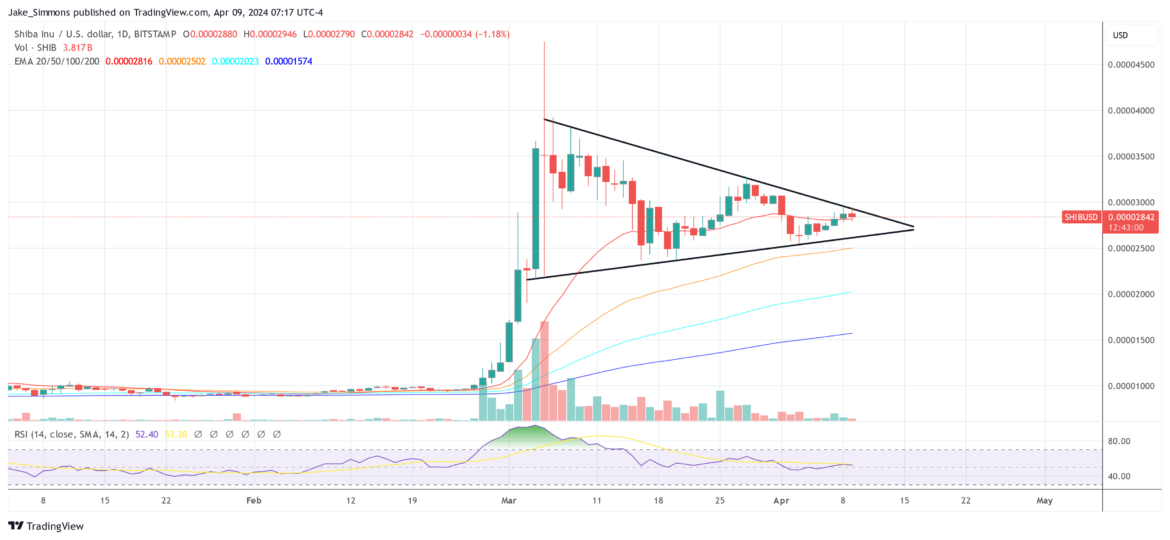
Since reaching its peak for the year at $0.00004749 over a month ago, on March 5, the price of Shiba Inu (SHIB) has fallen by approximately 40%. Nonetheless, there may be brighter days ahead. Following a meteoric rise of 390% in just eight days from the end of February till the beginning of March, a period of consolidation was inevitable for the SHIB price. However, this phase could be drawing to a close.
Shiba Inu Price About To Surge 65%?
On the daily chart, the meme coin is exhibiting a critical chart pattern that suggests a significant price movement may be imminent. The analysis of the daily SHIB/USD chart reveals the emergence of a symmetrical triangle pattern. This classic chart pattern is generally considered a continuation pattern, typically heralding an uptick in volatility. Given that SHIB has been on a notably strong uptrend, the momentum could swing back in favor of the bulls.

Over the past five weeks, the price of SHIB has been making a series of lower highs and higher lows, which is evident from the converging trend lines that are containing the price action. The apex of the triangle is fast approaching, suggesting that a breakout is imminent. This type of consolidation suggests market indecision, and as the pattern reaches its conclusion, we can expect a significant move in either direction.
The current price at the time of the analysis is $0.00002842. Notably, the volume has been declining as the pattern developed, which is typical during the formation of a symmetrical triangle and further validates the pattern.
Exponential Moving Averages (EMAs) also paint a crucial picture. The 20-day EMA is flatlining, suggesting a neutral short-term trend, while the 50, 100, and 200-day EMAs are all trending upward, providing strong support levels. Particularly, the price is currently above the 20-day EMA, which is positioned at approximately $0.00002817, and this level could act as a strong support in the near term.
The Relative Strength Index (RSI) is hovering near the 52.40 level, which is slightly above the midpoint of 50 that separates bullish momentum from bearish momentum. The RSI level indicates a neutral stance in the market momentum but leaves room for an upward push should the market sentiment sway positively.
In terms of deriving price targets from this pattern, technical analysts typically measure the height of the triangle at its widest part and project that distance from the point of breakout.
If SHIB breaks above the triangle, the price could surge, targeting the height of the triangle, which could be in the region of the yearly high at approximately $0.000048, considering the widest part of the pattern. This would translate into a 65% price rally from the current price. Conversely, a downward breakout could send the price to test the $0.00001500 level, which would be the equivalent target on the downside.
It is important to mention that while symmetrical triangles can lead to a substantial breakout, the direction is not certain until a clear breakout occurs with an accompanying increase in volume. Traders and investors need to watch for a daily close outside of the triangle’s boundaries, with increased volume, to confirm the direction of the breakout.
Featured image created with DALL·E, chart from TradingView.com
Disclaimer: The article is provided for educational purposes only. It does not represent the opinions of NewsBTC on whether to buy, sell or hold any investments and naturally investing carries risks. You are advised to conduct your own research before making any investment decisions. Use information provided on this website entirely at your own risk.
A competitor gave a positive update on end market conditions.
Shares in Johnson Controls (JCI 1.25%), a building products and heating, ventilation, air conditioning, and refrigeration (HVAC) company, rose 10.2% in March, according to data provided by S&P Global Market Intelligence. The move comes after two pieces of newsflow, which could be construed as plusses for the company.
A competitor updates
Siemens Smart Infrastructure, part of Siemens AG, is named a large competitor of Johnson Controls in the latter’s Securities and Exchange Commission (SEC) filings. As such, it’s always interesting when its management comments on trading conditions, as it did in March during the Bank of America Industrials Conference.
Siemens CFO Ralf Thomas noted weakness in its automation business. Still, he said that the smart infrastructure business was tracking toward the high end of management’s expectations in the quarter — a good indication for Johnson Controls’ end market prospects.
Restructuring Johnson Controls
According to Reuters, the company is working with advisors over a potential sale of some of its residential and light commercial HVAC businesses, with Robert Bosch, Samsung, and Lennox International discussed as possible suitors for assets worth more than $6 billion.
Such a deal would see Johnson Controls refocusing on its core commercial HVAC and fire and security products.
Image source: Getty Images.
Why a sale would make sense
Investors would welcome a sale because the main attraction of buying the stock is its exposure to the theme of commercial building owners retrofitting their HVAC and building systems to improve efficiency and meet their net-zero emissions targets. The company’s suite of artificial intelligence (AI)-driven digital applications on its OpenBlue platform can significantly improve building efficiency and save costs.
Given that the residential and light commercial HVAC businesses only contributed 10% of sales in 2023, and are not a core part of the long-term growth drivers discussed, a deal would make sense and enhance the stock’s investment proposition.
Turning to more immediate matters, Johnson Controls is evaluating the impact of a cyber attack on its operations that restricted its growth in the first quarter of 2024. In addition, its global product sales are going through a weak patch as dealers work through inventory built up during the supply chain crisis. For reference, dealers rushed to build inventory as lead times (the time it takes an order to be delivered) were extended, and they wanted to ensure they had products available for customers.
Now that lead times have normalized, dealers are running down inventory, meaning Johnson Controls is temporarily weak. Management believes its sales growth will notably increase in its financial second half — something to look out for when the company releases its second-quarter earnings results.
Lee Samaha has no position in any of the stocks mentioned. The Motley Fool has no position in any of the stocks mentioned. The Motley Fool has a disclosure policy.
FDIC bank deposit rules just changed. Here’s what savers need to know
If you have more than $250,000 in deposits at a bank, you may want to check that all of your money is insured by the federal government.
The Federal Insurance Deposit Corporation, or FDIC, implemented new requirements for deposit insurance for trust accounts starting April 1.
While the FDIC’s move is intended to make insurance coverage rules for trust accounts simpler, it may push some depositors over FDIC limits, according to Ken Tumin, founder of DepositAccounts and senior industry analyst at LendingTree.
As part of its National Financial Literacy Month efforts, CNBC will be featuring stories throughout the month dedicated to helping people manage, grow and protect their money so they can truly live ambitiously.
The FDIC is an independent government agency that was created by Congress following the Great Depression to help restore confidence in U.S. banks.
FDIC insurance generally covers $250,000 per depositor, per bank, in each account ownership category.
If you have $250,000 or less deposited in a bank, the new changes will not affect you.
How FDIC coverage of trust accounts has changed
Under the new rules, trust deposits are now limited to $1.25 million in FDIC coverage per trust owner per insured depository institution.
Each beneficiary of the trust may have a $250,000 insurance limit for up to five beneficiaries. However, if there are more than five beneficiaries, the FDIC coverage limit for the trust account remains $1.25 million.
“For those who do go above $1.25 million under the old system, they definitely should be aware that changed,” Tumin said.

That may cause coverage reductions for certain investments that were established before these changes. For example, investors with certificates of deposit that are over the coverage limit may be locked into their investment if they do not want to pay a penalty for an early withdrawal.
“If you’re in that kind of shoes, you have to work with the bank, because you might not be able to close the account or change the account until it matures,” Tumin said.
The FDIC is also now combining two kinds of trusts — revocable and irrevocable — into one category.
Consequently, investors with $250,000 in a revocable trust and $250,000 in an irrevocable trust at the same bank may have their FDIC coverage reduced from $500,000 to $250,000, according to Tumin.
“That has the potential of causing loss of coverage, too,” Tumin said.
The agency is also revising requirements for informal revocable trusts, also known as payable on death accounts. Previously, those accounts had to be titled with a phrase such as “payable on death,” to access trust coverage limits. Now, the FDIC will no longer have that requirement and instead just require bank records to identify beneficiaries to be considered informal trusts.
“The bank no longer has to have POD in the account title or in their records as long as the beneficiaries are listed somewhere in the bank records,” Tumin said.
To amplify FDIC coverage beyond $250,000, depositors have several other options in addition to trust accounts.
That includes opening accounts at multiple FDIC-insured banks; opening a joint account for two people, which would bring the total coverage to $500,000; or opening accounts with different ownership categories, such as a single account and joint account.
Don’t miss these stories from CNBC PRO:
FTSE 100’s illusion of growth unmasked by currency and inflation adjustments
Quick Take
When assessing the performance of assets or currencies, it is essential to consider both nominal and real returns, the latter of which accounts for inflation. Inflation can be gauged through different metrics, such as the consumer price index (CPI) or indicators related to the money supply (e.g., M2). While the money supply is not a direct measure of inflation, it can play a role in shaping it. However, when evaluating an asset’s performance in a local currency, such as the British Pound (GBP), it is often useful to benchmark it against the US Dollar.

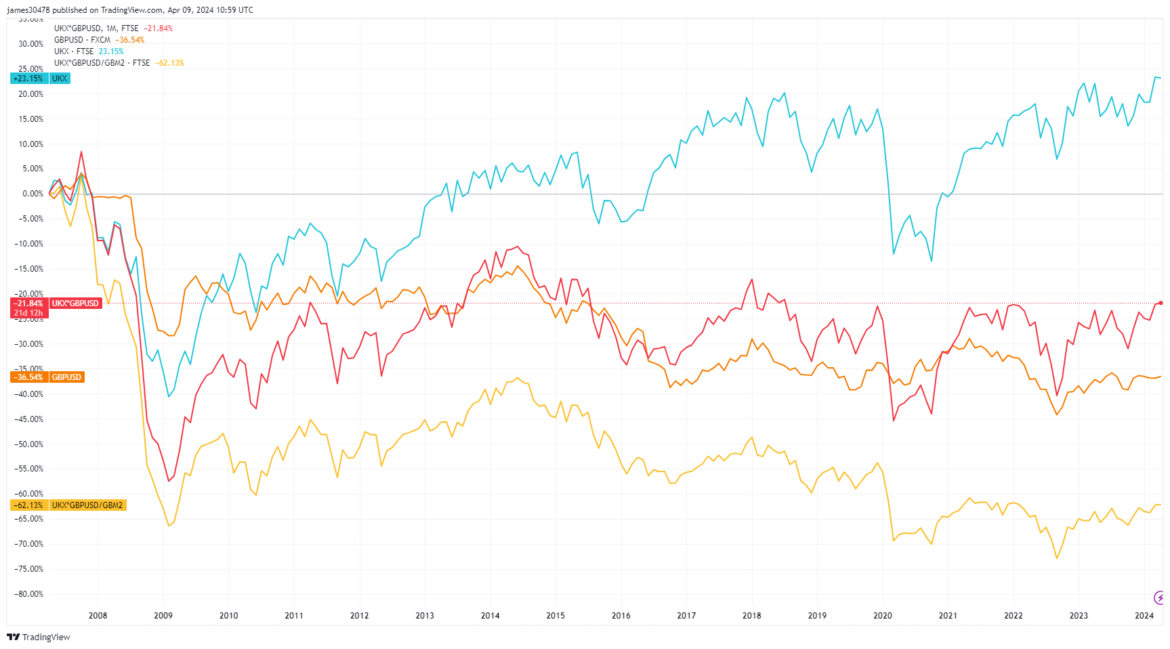
A prime example is the FTSE 100, which has risen approximately 23% since 2007 and recently achieved an all-time high, surpassing 8,000 in GBP terms. At first glance, this may appear impressive. However, when converted to US Dollars, the FTSE 100 has actually declined by 22% over the same period, while the GBP has fallen 37% against the Dollar. The situation becomes even more alarming when measured against the UK’s M2 money supply, revealing a staggering 62% decrease.
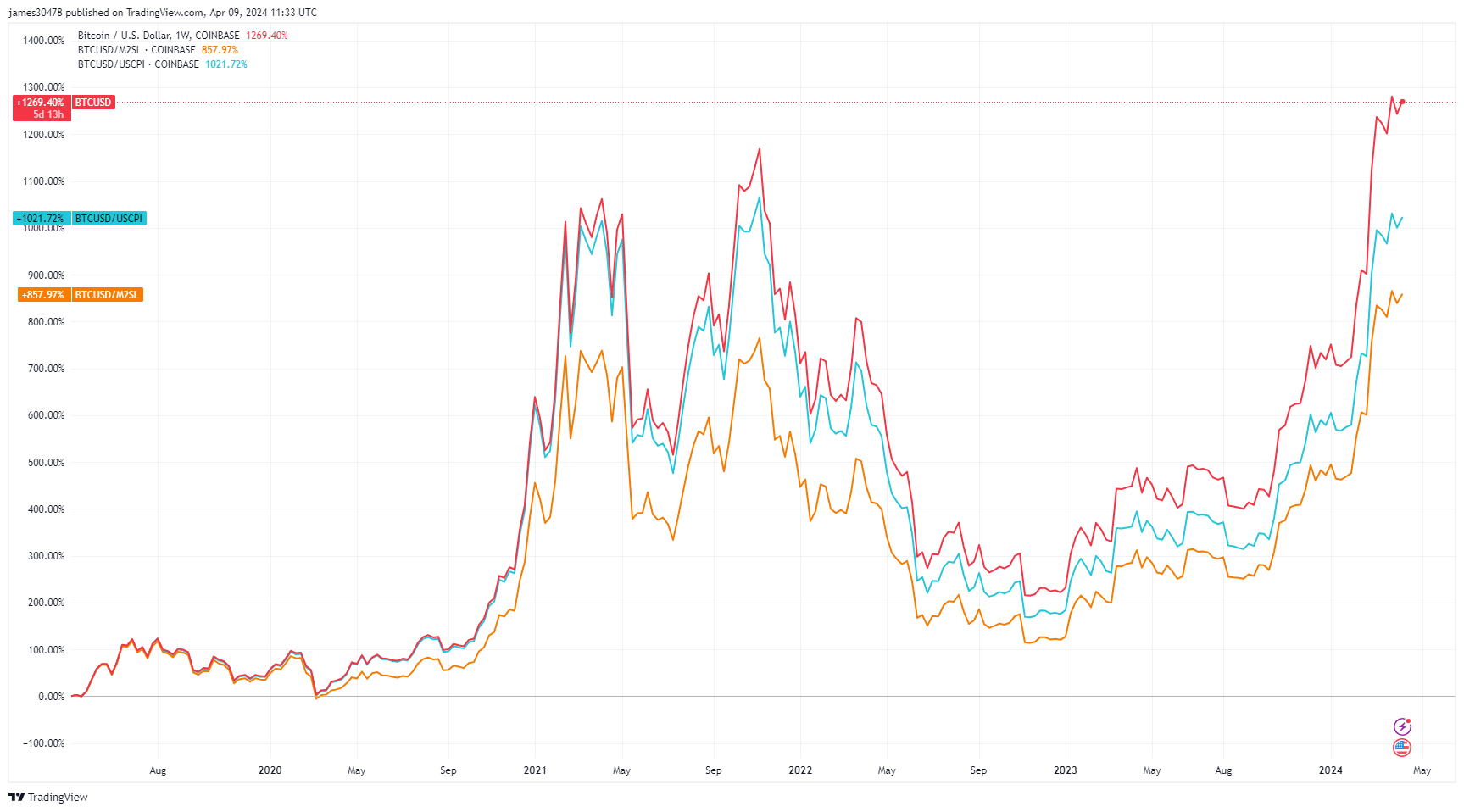
Bitcoin, over its historical trajectory benchmarked in USD, has consistently surged to new highs with each cycle, surpassing a remarkable 1200% increase in the past five years. Furthermore, it has demonstrated the capacity to outperform the M2 money supply and is nearing record highs relative to the US Consumer Price Index (CPI).

To gain a comprehensive understanding of an asset’s true performance, I believe it should first be converted into US Dollars (if measured in a local currency) and then adjusted for local CPI inflation and money supply changes. This approach provides a more accurate and holistic view of the asset’s real value and performance over time.
The post FTSE 100’s illusion of growth unmasked by currency and inflation adjustments appeared first on CryptoSlate.
‘Garbled Circuits’ Enable Transactional Confidentiality, Encourage Enterprise Web3 Adoption — COTI Co-Founder
According to Shahaf Bar-Geffen, CEO of the privacy-centric Layer 2 network COTI, enterprises and mainstream organizations are not yet fully convinced of the benefits of complete privacy or true anonymity in any system. Bar-Geffen said the primary reason for this is that such systems often get exploited by individuals with dishonest intentions. Regulators’ Perceptions of […]

Source link
Saving $1 million in your 401(k) is no easy accomplishment. Most people never make it to that milestone.
Only the top 3.3% of retirement savers had accumulated over $1 million across their accounts as of the end of the last decade, according to estimates from the Employee Benefit Research Institute, based on the latest Federal Reserve Survey of Consumer Finances. But if you know what those 401(k) millionaires know, you could join this elite group.
They don’t have any insider information. And most didn’t get lucky by vesting company stock in their 401(k) before the price went parabolic. They just understand how to make the most of their 401(k) plan.
Here are three secrets of 401(k) millionaires.
Image source: Getty Images.
1. They always get their full company match
If there’s one thing you must do to make the most of your 401(k), it’s to get the full company match. If you aren’t contributing enough to get it, you’re practically leaving free money on the table.
Every 401(k) plan will have a different matching policy, but the basics are the same for most companies. If you contribute up to a certain percentage of your salary, your company will also contribute an amount up to 100% of your contribution. Some common 401(k) matching contributions are $0.50 per dollar up to 6% of your pay or a dollar-for-dollar match on the first 3% and $0.50 per dollar on the next 2%.
It’s worth pointing out that unless you’re earning a very high income, you can usually get your full company match with contributions well below the limit for a 401(k). For 2024, the 401(k) deductible contribution limit is $23,000, or $30,500 for workers age 50 or older. So it’s not like you need to be some super saver to set yourself up for a $1 million 401(k).
Getting your full company match will typically put your savings rate close to 10% of your salary per year. Even with an average salary of just $60,000 per year, you’ll end up contributing $6,000 per year. If you can consistently do that for a full 40-year career, you’re very likely to end up with $1 million in your 401(k).
2. They always minimize their fees
For all the benefits of a 401(k) plan, they typically come with one major drawback: The fees can be a significant drag on your investment returns. But if you know what the 401(k) millionaires know, you can minimize the impact of fees on your account.
There are three types of 401(k) fees: administrative, service, and investment fees. Unfortunately, you’re stuck paying whatever administrative fees your company plan dictates. But when it comes to service and investment fees, you can exercise a lot more control.
Service fees are the one-time charges you might pay for using some of the features of your 401(k) plan. For example, you might have to pay a service fee to take out a 401(k) loan or use a participant-directed account. Those services are totally optional, so you won’t pay anything if you don’t use them, but the fee could be worth it in some instances.
The bigger cost for most retirement savers are the investment fees. These are charged by funds offered by your 401(k). Finding funds with a low expense ratio will have a massive impact on your overall returns. And the good news is that funds with low expense ratios are usually broad-based index funds, which have historically outperformed actively managed mutual funds, which you might also find in your 401(k) plan.
If you can stick to the lowest-cost funds and avoid unnecessary service fees, you’ll be well on your way to joining the 401(k) millionaires.
3. They never interrupt their investments unnecessarily
The biggest secret of 401(k) millionaires is that they’ve been investing for a long time. What’s more, they haven’t stopped or withdrawn funds until they need to in retirement.
That means they invested in good times and bad. When stocks looked expensive, they still contributed to their 401(k). When the stock market was crashing and everyone was running for the hills, they still contributed to their 401(k). The discipline of consistently contributing and letting compound earnings work for them is what truly separates 401(k) millionaires from the average retirement saver.
If you want to become a 401(k) millionaire, you have to understand the power of compounding. It might not seem like much that first year you contribute 10% of your salary to your 401(k). It might not even feel like much after the fifth year.
But eventually, you’ll see your account growing quicker than you ever imagined as it pushes toward $1 million. That only happens, though, if you keep your money invested and never disrupt it unnecessarily.
If you can manage to consistently invest throughout your career, you should find yourself joining the small group of 401(k) millionaires by the time you’re ready to retire.