There are a handful of signals that point to the strong US consumer finally slowing down.
Macquarie strategist Thierry Wizman, foresees the US economy slipping into a consumer-led slowdown.
He said a downturn could hit sometime between now and the end of the first quarter of 2024.
American consumers are finally showing signs of slowing as they blow through their savings, and there are a handful of warning signs that the economy could soon tip into a spending recession.
Thierry Wizman, a strategist at Macquarie Global, foresees the US economy slipping into a consumer-led slowdown sometime between now and the end of the first quarter in 2024. A major pullback in consumer spending could force GDP growth to grind to halt, he told Insider, pushing the overall economy into borderline recession territory.
Wizman’s downbeat forecast is counter to what other commentators have said, as consumers have kept up their spending spree over the third quarter in a row this year. Retail sales, jumped 0.7% during the month of September, more than double what economists were expecting.
But the resilient spending is itself the problem: spending has been so strong, it’s bound to whiplash in the other direction as savings run dry and Americans financial situations change, Wizman said.
“There were reasons why Q3 was very strong. Getting through all the revenge travel … the concert tours,” Wizman said. “The problem, of course, is that it’s usually followed by a hangover.”
“Like all hangovers, this one will happen soon after the binge,” he added in a note this week.
The economy is now flashing a handful of warning signs that the US consumer is running out of steam. Here are five signals of weakness that point to a spending recession on the way.
1. Credit card delinquencies are rising
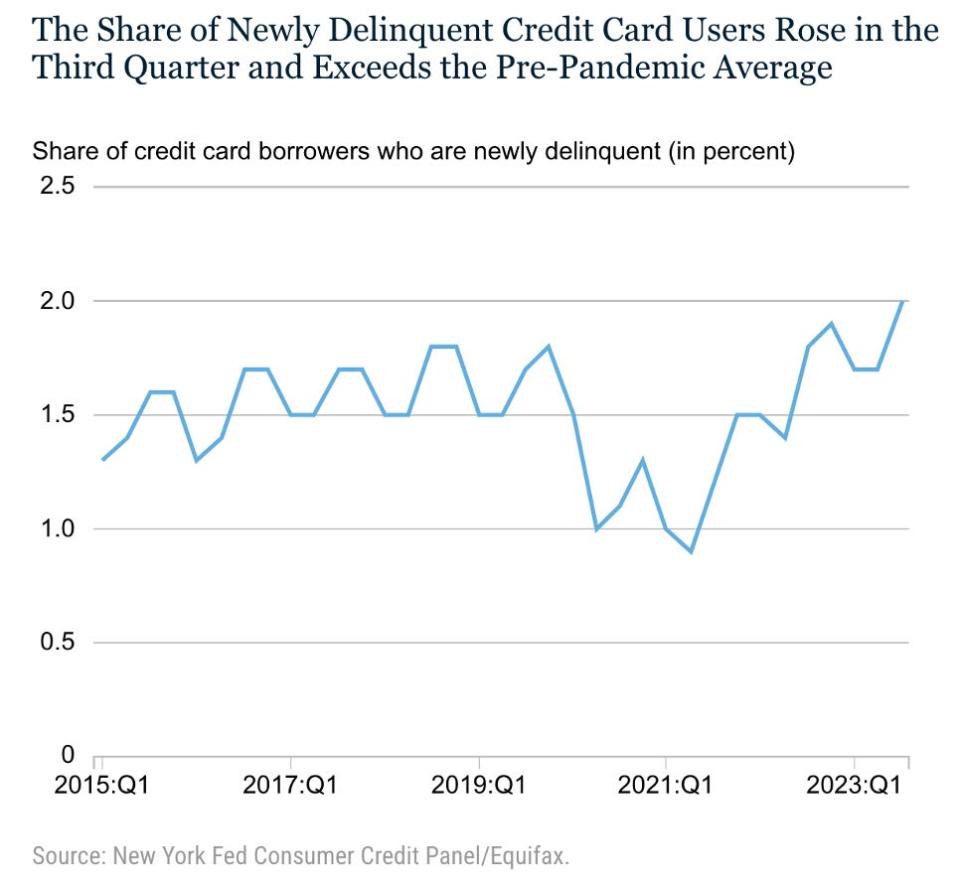
Newly delinquent credit card users are rising.New York Fed/Equifax
Credit card holders that became newly delinquent rose to 2% the last quarter, about double the rate recorded in the first quarter of 2021. Meanwhile, Americans who were seriously late in paying their credit card balances – by at least 90 days – rose to nearly 6% the last quarter, according to the New York Fed’s latest Household Debt and Credit report.
Credit card delinquencies also saw a particularly high jump for those who already had auto and student loan debt, the report added. That’s a sign financial stress is growing, Wizman said, which is likely to lead people to pull back on spending.
2. Americans are saving less
The personal savings rate slumped to 3.4% in September.Federal Reserve/Bureau of Economic Analysis
The personal savings rate slumped further last month. Americans saved an average 3.4% of their disposable personal income in September, down from 4% in August, according to the Bureau of Economic Analysis. That’s well-below the pre-pandemic savings rate, when Americans were stashing away around 7% of their disposable personal income.
“That’s actually very, very low compared to historic norms,” Wizman said of the current savings rate. “So there has to be at some point an adjustment.”
3. Consumer confidence has fallen three months in a row
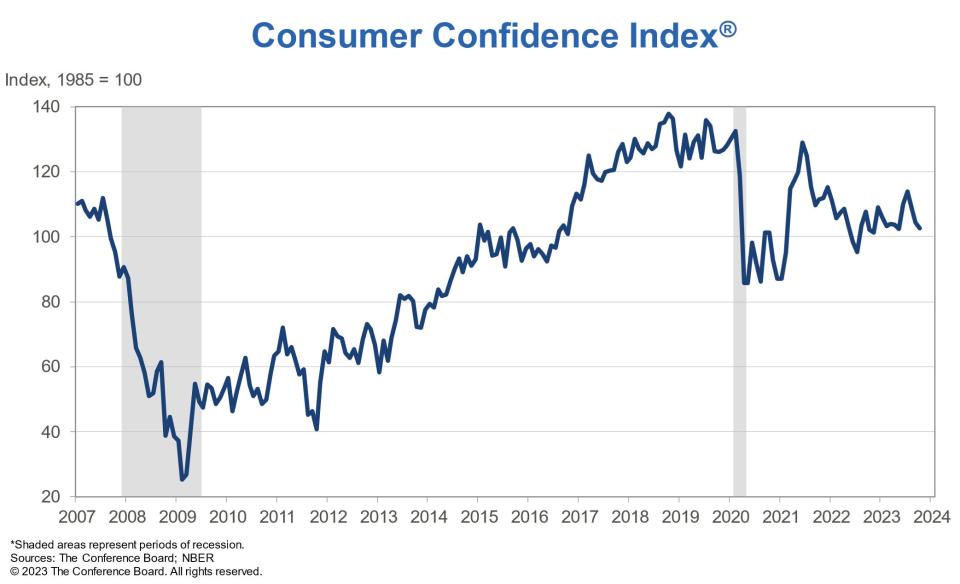
Consumer confidence slipped further in October to a reading of 102.6Conference Board
Consumer confidence slipped to 102.6 in October, down from a reading of 104.3 the prior month, according to the Conference Board. That marks the third month in a row that consumers’ attitudes have soured, based on factors like inflation, stock prices, and interest rates.
Meanwhile, the Conference Board’s Expectations Index, which reflects consumers’ short-term economic outlooks, slipped to 75.6 in October. It remains slightly below a key threshold of 80, which has traditionally signaled a recession coming within the next 12 months.
“Consumer fears of an impending recession remain elevated, consistent with the short and shallow economic contraction we anticipate for the first half of 2024,” the Conference Board said in a statement.
4. Consumers aren’t planning to splurge this holiday season
Americans are less likely to splurge this holiday season than last year.McKinsey & Company
Americans are looking less likely to splurge, even as they head into the holiday season. A McKinsey survey of 1,000 US consumers found that just 35% say they plan to spend big this year, lower than the 39% of people who said they were willing to splurge ahead of the holidays in 2022.
A separate Morgan Stanley survey found that 69% of people are waiting for retailers to offer discounts before they start shopping. On average, consumers are looking for a discount of around 30%, strategists said.
5. Retailers aren’t hiring as much ahead of the holidays
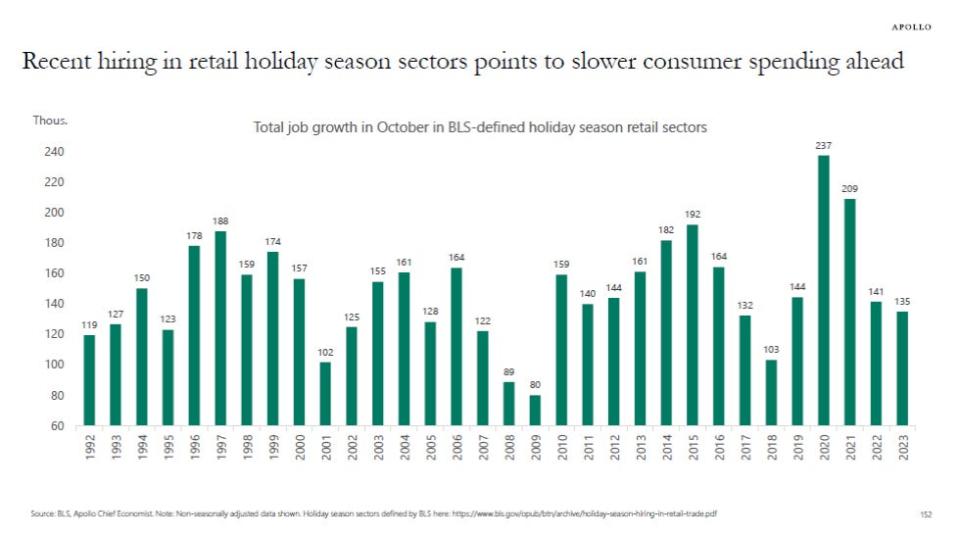
Holiday hiring slumped to the lowest level in five years.Apollo/Bureau of Labor Statistics
Holiday hiring among retailers slumped to 135,000, the lowest level in about five years, according to data from the Bureau of Labor Statistics.
“Hiring for the holiday season is generally done in October, and adding up new jobs created in the BLS-defined holiday season retail sectors in the latest employment report shows that retailers expect a weaker holiday season,” Apollo chief economist Torsten Slok said in a note on Tuesday.
Dear Harry, My mother has a home (value approximately $300,000) and no money in savings. She is using many state-funded benefits (food stamps, energy assistance, Medicaid) to supplement what her Social Security does not cover on a monthly basis. My brother and I are trying to determine if selling her home and moving her to a smaller, less expensive home would help but we realize that once the house sells she may lose some or all of these benefits because she would then have money in the bank. Is the right thing to do to move her home in our names (but then we would have to pay capital gains once it sells) or to a trust before selling it so that it is out of her name? She won’t be able to survive without these state benefits, regardless of an increase in her savings.
Dear reader, Your mother is subject to the miserliness of public benefits in our country. Many programs are only available for individuals who keep their savings below $2,000, a threshold that has not changed since 1984.
There are a lot of factors for your mother to consider in deciding whether to sell her home or to transfer it or some of the proceeds of its sale to you and your brother or into trust.
First, you are right. If the house is transferred to you and your brother and then you sell it, you will have to pay taxes on any capital gain. If your mother keeps the house and sells it herself, she can exclude the first $250,000 of gain from taxation. So, it probably does not make sense to transfer the house to you and your brother if the plan is to sell it.
Second, there are other possible drawbacks to such a transfer. The house or the proceeds of its sale would be subject to claim if either you or your brother were sued and potentially if you entered divorce proceedings. Further, your mother would lose some autonomy since she would be dependent on you for her home and possible access to her cash.
Third, such a transfer could make your mother ineligible for benefits for a period of time. To make things complicated, each program has its own rules, and sometimes the rules differ depending on the circumstances. For instance, some state Medicaid programs do not impose a transfer penalty as long as a beneficiary is living in the community but do if they move to a nursing home.
Fourth, a trust may make sense, but the typical trust used to protect homes must be irrevocable and it must bar distributions to the person creating it. So, if your mother transferred her home to a trust and then it was exchanged for a less expensive house, she would not have access to cash that would be generated. This is an argument for transferring the house or the excess proceeds directly to you and your brother to hold for your mother despite the drawbacks described above.
Finally, if your mother is disabled she may be eligible for one of two “safe harbor” trusts that permit her to shelter assets and still benefit from them. For one of these trusts, she must be under age 65. The other, a so-called (d)(4)(C) or “pooled disability” trusts, she may be eligible after age 65, but that depends on state options. As you can see, these issues are very complicated and the best plan depends on a mixture of your mother’s situation, the specific benefits she receives, and how various laws are applied in your state.
To determine the best approach it makes sense to consult with a local elder law attorney.
Chief Executive Officer of Binance, Changpeng “CZ” Zhao, has shared a report in which the exchange intervened in the theft of millions of dollars worth of crypto assets. Through a fast response operation, the Binance Global Head stated they were able to prevent the bad actors from making away with over 90% of the stolen loot.
Binance Confiscates $11.8 Million In Assets Belonging To Kidnapped Clients
In a Friday post on X, CZ stated that executives from one of Binance’s client companies were deceived into going on a business trip to Montenegro, during which they were kidnapped and forced to forfeit all assets in their crypto wallets.
Executives from a client were lured on a ‘business trip’ to Montenegro, where they were abducted and forced to empty their wallets. Total loss ~$12.5m.
We investigated the on chain activities and reached out to our partners earlier today to have the wallet frozen, as all of the…
In total, the Binance CEO stated that the bad actors were able to obtain approximately $12.5 million dollars worth of digital assets from their victims, which were all converted to USDT and moved to a TRON wallet.
However, Binance was able to quickly intervene in the matter, alerting their partners to the situation, who were then able to freeze the wallet. In doing so, Binance foiled the kidnapper’s access to $11.8 million of the $12.5 million loot.
The incident recounted by CZ is not a new occurrence in the crypto space, as sometimes bad actors resort to such brazen methods to steal crypto assets from investors.
In 2020, Le Duc Nguyen, a Vietnamese investor, was kidnapped and robbed of about VND 35 billion ($1.5 million) worth of crypto assets by another Vietnamese man named Ho Ngoc Tai with the help of 15 gang members.
Tai claimed that he lost 1,000 Bitcoins valued at VND 100 billion by investing in other tokens based on financial advice. The crypto investor felt cheated and proceeded to obtain a “refund” via forceful means.
Albeit, Tai and his hired hands were eventually apprehended by the police and faced trial in May 2023, during which 14 of the 16 culprits were given sentences ranging from 9 to 19 imprisonments.
CZ Faces Questions On Crypto’s Decentralization
Following Zhao’s account of the successful crypto asset recovery, some crypto enthusiasts raised concerns over Binance’s ability to freeze users’ assets at will, a feature synonymous with the fiat banking system.
I really condemn this loss and happy coz most of the money is safe but I have a question @cz_binance In fiat banks, everyone say that those guys can freeze money at any time without any reason How crypto is better if someone can still freeze our personal wallet??
However, the Binance boss stated that crypto users have a choice to avoid such occurrences, as assets can only be frozen on centralized exchanges (CEX). Using other forms of storage, such as non-custodial wallets, users’ assets are bound to remain inaccessible to any third party.
I’m 35 and have been dating a man 20 years older than me; he is 55. I have a 5-year-old child. Things were going well until we started having conversations about the relationship being serious and possibly merging our assets.
He shared his home with his ex-wife after being married for 20 years. He recently took out a second mortgage on that home. He also has adult children in their late 20s, and they seem to still be heavily dependent on him for financial support.
He is repaying his own student loans, and also those for his children. I own my home free and clear. My student loans will be paid off within the next two years, and I made a few good investments so I have quite a bit of funds in savings and a good retirement account.
A standoff over the future
When we discussed taking steps to move the relationship forward and discussed marriage, I expressed that I would be willing to sell my current home, purchase a new home and asked that he do the same so we can build a life together. He was completely opposed to this plan.
His ideal plan: I move into his current house that he shared with his ex-wife until he can pay it off, which would be in 10 to 15 years and then we could purchase a new home together. He also said that I could help him pay off his house to move the process along quicker.
If we decide to go with his plan, his adult children will inherit that home. He’s not willing to compromise in this area, and it has created a roadblock in the relationship. I do not want to move into his home, and he says I’m being selfish and unrealistic.
What should I do?
Anonymous
“Divorce can trigger a financial setback of 15 or 20 years, particularly when paying off a mortgage is concerned.”
MarketWatch illustration
Dear Anonymous,
He is the ultimate speed dater.
By moving in, assuming he pays his mortgage in full and adds your contribution to the pot, he will effectively halve the term of his mortgage. Put another way: You will effectively halve the term of his mortgage. You would be helping him build equity in his home. Nice work, if you can get it.
Divorce is economically devastating for many couples, many of whom end up splitting their assets 50/50, especially if they both started off in their 20s, had children and built a life together. It can trigger a financial setback of 15 or 20 years, particularly when paying off a mortgage is concerned.
It sounds like your boyfriend kept the house and refinanced in order to pay off his ex-wife. That, plus the burden of these student loans has left him in a pickle. If you move in, rent out your home and pay him rent for the next 15 years, he’ll be free and clear by the time he’s 70.
That sounds like a very nifty plan. He’s proposing the “detergent and fabric softener in one bottle” answer to his post-divorce money problems: he gets a relationship with a woman who has all her budgetary ducks in a row and a tenant in a 2-for-1 deal.
His plan is non-negotiable
His plan is more likely to succeed if he makes it non-negotiable, so now we have five problems. 1: The original proposal. 2: The lack of compromise. 3: His many student-debt obligations. 4: His response that you are selfish and unrealistic. 5: The 20-year age difference.
The last one is only a challenge because you are at different stages of your life. You are a young mother; his children are grown. You are on the road to fiscal freedom; he is climbing back into the black after a divorce. You have hearts in your eyes; he has dollar signs in his.
There’s one thing I do like about this suggestion: you both remain financially independent. Whatever you decide, make sure this is a core tenet of any plan. You have your own home and a 5-year-old child to raise, so I caution you against buying a home with him.
Paying off your boyfriend’s mortgage should not be part of your retirement plan.
You can email The Moneyist with any financial and ethical questions at qfottrell@marketwatch.com, and follow Quentin Fottrell on X, the platform formerly known as Twitter.
Check out the Moneyist private Facebookgroup, where we look for answers to life’s thorniest money issues. Post your questions, tell me what you want to know more about, or weigh in on the latest Moneyist columns.
The Moneyist regrets he cannot reply to questions individually.
Previous columns by Quentin Fottrell:
‘I’ve been living inside a silent divorce’: I want a ‘kitchen-table’ separation from my husband without lawyers. Is that a good idea?
‘I cashed in my retirement account to buy our home’: My husband left me and our two kids and won’t pay the mortgage. What now?
My wife and I bought a beautiful lakeside home for $700,000. It’s now worth $1.2 million. Do we sell now to avoid capital gains?
The greatest wealth transfer in American history is looming as baby boomers prepare to shift trillions of dollars to the next generations, but how do you broach that often taboo money topic with mom and dad?
The answer: Carefully, or you may regret it.
Nearly four in five wealthy families have had unplanned discussions about money, with 26% of people later regretting it, according to a new study by the Merrill Center for Family Wealth, a part of Merrill Private Wealth Management.
“When fear is driving it, it can go badly,” said Valerie Galinskaya, head of the Merrill Center for Family Wealth.
From parents’ perspective, the concerns include that sharing financial information can lead to entitlement among heirs or power struggles within the family. Members of younger generations, meanwhile, can be concerned about overstepping their place in the family. They might also feel anxious about what kind of inheritance may or may not be coming to them or worried about equitable sharing among siblings, financial advisers said.
Talk early and often
“We have seen people think of this as a binary choice — either share or not share. But it’s not a light switch that is either on or off. It should be a dimmer switch, where you share more and more as you’re comfortable,” Galinskaya said.
“Talk about the money, about the purpose of the money, then talk about the actual amount over time,” she said.
“Some people have ‘verbal vomit’ and share too much. It’s not a one-time thing. It’s a process with multiple conversations,” Galinskaya said. “Having a one-on-one conversation or two-on-one talk, rather than over the Thanksgiving table, tends to go more smoothly. It’s a really uncomfortable conversation for a lot of people.”
For higher-net-worth clients, there can be additional complexity. Having an unbiased individual in the room, such as a financial adviser, can be helpful, Galinskaya said.
James Sahagian, managing director of Ramapo Wealth Advisors at Steward Partners, said having a family meeting with an adviser who can act as a facilitator — or a buffer — can be very helpful.
“The formality of it and the formal setting can really help communicate what the older generation wants to convey,” Sahagian said. “No one wants to talk about their own mortality, but they want to address any concerns that the assets will not be managed appropriately or spent wisely.”
Morgan Hill, chief executive and owner of Hill & Hill Financial, cautioned that getting too specific about the dollar figures that may be passed down can be a mistake. Just explain the general division of assets, Hill said.
“Don’t talk about the exact money. Everyone wants their kids to get the same slice of cake. Just say ‘I love everyone equally and my documents reflect that,’” Hill said. “Kids don’t need to know anything about a specific number. There may be nothing left, because the parent isn’t done living yet.”
Hill also said every family should be clear about who is the executor of the will, and there should be clear instructions in the event of an emergency about contact information for lawyers and financial advisers.
“You don’t want everyone fighting with each other in the middle of a crisis,” Hill said.
And not every family has great wealth. Sometimes the conversation reveals financial shortfalls that adult children may need to help their parents with or seek advice about, Galinskaya said.
“It’s not always a rosy situation, but take the steps to have a proactive conversation so you can determine if there are some hard choices that have to be made,” Galinskaya said.
Why it matters
When families aren’t able to talk about and plan effectively for wealth and the transfers of wealth, it has repercussions: 70% of family wealth is lost by the end of the second generation, and 90% is gone by the end of the third generation, according to Merrill.
Most of the dissipation of wealth is due not to the economy or markets but to factors within the family, such as limited communication and heirs who lack the necessary skill sets to manage wealth, Merrill found, according to the survey of more than 270 individuals from families with assets of $50 million or more.
“Wealth remains a taboo topic in most circles. This curtain of silence leaves many wealthy families and individuals feeling isolated and ill-equipped to manage the responsibilities that come with wealth,” according to Merrill.
A separate study by Northwestern Mutual found the average American thinks 17 is the right age for kids to have their first conversations about family finances with their parents or guardians.
“Talking about money with your family used to be taboo in society, but today, young people are changing the conversation,” said Aditi Javeri Gokhale, chief strategy officer, president of retail investments and head of institutional investments at Northwestern Mutual. “Meaningful wealth discussions between generations are now happening earlier in life and more frequently.”
According to the Northwestern Mutual study, 29% of U.S. adults have talked to their parents or guardians about an inheritance, will provisions and other matters related to their estates.
Younger generations said these talks should be happening earlier. Millennials said the big talks should happen at age 45, while baby boomers and members of older generations said they should happen at 55.
“The most successful family situations tend to start at a young age with their children. They want financially aware children who have a general knowledge of the source of wealth and what it took to amass it,” Sahagian said. “The biggest problems are when the kids don’t appreciate what it took to create the wealth.”
A senior couple reviewing tax consequences for missing a required minimum distribution.
As you age, the rules for withdrawing money from your IRA change. For many years, retirees had to start withdrawing money after age 70 1/2. Under new rules, you must start taking required minimum distributions (RMDs) every year after age 73, or face steep IRS penalties. While the specifics can get complicated, the basics boil down to taking your RMD by the deadline and paying ordinary income taxes on the money. A financial advisor can help create a tailored IRA withdrawal strategy optimized for your situation.
IRA Withdrawal Rule Changes
The rules for cashing your IRA have gone through some significant modifications in recent years. The good news is that, generally speaking, they have become more liberal and loosened rather than tightened controls over withdrawals.
In particular, the SECURE Act 2.0 raised the RMD age from 72 to 73 for those who turn 72 in 2023. It had previously been raised from 70 1/2 to 72. This means now you can wait until April 1 of the year after which you turn 73 in 2023 to take your initial RMD.
Figuring Out How Much to Withdraw
Once you hit RMD age, you must start taking annual withdrawals from your traditional, SEP and SIMPLE IRAs by December 31 every year. The amount you must withdraw is based on your age, account balance and life expectancy factors set by the IRS in their Uniform Lifetime Table.
To calculate your RMD, you divide your prior year-end IRA balance by your life expectancy factor from the table. For example, if you are 73, your life expectancy factor is 26 1/2 years. To get the RMD, divide the balance in your IRA at the end of the previous year by 26 1/2 and be sure to withdraw at least this month by the end of the current year.
RMD Exceptions and Taxes
Rules vary depending on the type of retirement account and specific circumstances. For instance, Roth IRAs are exempt from RMD rules, so you can leave your account untouched if you wish no matter what your age.
There are also different rules for inherited IRAs, including both traditional and Roth types. Beneficiaries who inherit IRAs have varying RMD requirements based on their relationship to the original account holder.
Taxation of IRA withdrawals after retirement is more straightforward. The IRS taxes all pre-tax money withdrawn from traditional IRAs as ordinary income based on your federal income tax rate. Roth IRA withdrawals represent exceptions. They are tax-free if taken after age 59 1/2 and the account has been open for at least five years.
Reasons to Follow IRA Withdrawal Rules
A senior woman worried about missing withdrawal rules for her retirement accounts.
There are some solid motives for make sure you withdraw money from your IRA in accordance with the rules. In particular, skipping or skimping on RMDs can be an expensive mistake. That’s because if you fail to withdraw the full RMD amount you calculated, the IRS levies a 50% tax on whatever portion you missed.
Beyond financial penalties, not following the RMD rules could leave you cash-strapped. Sticking to RMDs ensures you have income to cover expenses now while preserving assets for future needs.
IRA Withdrawals in Action
To get an idea of how this works in practice, consider a retiree who turns 73 this year and has a $132,500 IRA balance. Their life expectancy factor per the IRS Uniform Lifetime Table is 26 1/2 years. Dividing their $132,500 balance by the 26 1/2-year distribution period gives them an RMD of $5,000 for the year.
This retiree only withdraws $3,000 that year, however, exposing themselves to the required 50% penalty on the shortfall. In this case, the penalty would be 50% of $2,000 or $1,000. They still have to withdraw the $5,000, but they only receive $4,000 and still owe regular income taxes on that.
Making a Plan
To avoid costly penalties, make sure you understand the RMD rules. Carefully consult the IRS Uniform Lifetime Table annually to calculate what you must withdraw and make a plan.
You might also consider taking more than the minimum in low-earning years. For larger accounts, spreading withdrawals over the year prevents big swings in income.
Bottom Line
A senior woman estimating how much she will need to withdraw from her retirement accounts.
The money in your IRA is yours to spend as you like, but you’re not allowed to leave it in a tax-advantaged shelter forever. With traditional IRAs as well as some other retirement account types, required minimum distributions from IRAs must begin at age 73. To ensure compliance, the law provides for steep financial penalties if you don’t withdraw the minimums. Following IRS rules prevents losing money, while smart planning help can minimize taxes and maximize your retirement income.
Retirement Planning Tips
Speaking with a financial advisor can ensure you take RMDs properly to avoid expensive IRS penalties. SmartAsset’s free tool matches you with up to three vetted financial advisors who serve your area, and you can have a free introductory call with your advisor matches to decide which one you feel is right for you. If you’re ready to find an advisor who can help you achieve your financial goals, get started now.
Kaspa (KAS) has emerged as a notable altcoin, drawing considerable interest from investors. Notably, the cryptocurrency has achieved its all-time high, experiencing an impressive 66% increase over the previous week.
Examining the monthly performance charts reveals an even more substantial upward trajectory, with KAS exhibiting a remarkable surge of over 90%. Zooming out to a year-long perspective, the altcoin has witnessed an astonishing increase of over 2,000%, showcasing its significant growth over this extended period.
Investors are closely monitoring Kaspa as it continues to showcase strong bullish momentum, reflecting the cryptocurrency market’s dynamic nature. The rapid and substantial increases in both short-term and long-term intervals underscore the token’s potential for high returns.
Kaspa Shows Mettle, Pulls Off Its Own Rally
With Bitcoin surpassing the $36,800 threshold and Ethereum exceeding $2,000, the native token of Kaspa pulled off its own ascent, rising from approximately $0.070986 to reach an unprecedented peak of $0.092917.
Based on the aforementioned data, it can be observed that Kaspa is one of the limited number of tokens now experiencing their highest recorded values. Many cryptocurrencies registered a significant decline from their historical peak values following the occurrence of a market downturn commonly referred to as the “crypto winter.” This period witnessed the collapse of prominent crypto entities such as Terra Luna and FTX crypto exchange.
Based on the data provided by CoinMarketCap, it can be observed that the trading volume of Kaspa’s (KAS) has experienced a significant surge of more than 95%.
Source: CoinMarketCap
Additionally, the market capitalization of KAS has exhibited a notable gain of nearly 20%. Furthermore, there has been a significant increase in trading volume, with a jump of around 380% compared to the preceding week. The current market capitalization of the project stands just above $1.8 billion.
This increase in value positions Kaspa as a compelling investment option, capturing the attention of those seeking opportunities in the ever-evolving landscape of digital assets. As the altcoin landscape continues to evolve, Kaspa’s impressive performance highlights its resilience and appeal, making it a noteworthy player in the cryptocurrency market.
KASUSDT trading at $0.089 on the weekend chart: TradingView.com
The inclusion of Kaspa on Coinone’s platform is its initial foray into the cryptocurrency market in South Korea, granting it significant visibility among a group of investors who are very interested in blockchain initiatives and digital assets. The unique GHOSTDAG protocol, authored by Kaspa, garnered the interest of Korean traders.
Kaspa Makes Foray Into South Korea
The latest indication of Kaspa’s growing popularity among cryptocurrency traders and investors is its successful entry into the South Korean market. As Kaspa develops and realizes its lofty vision of scalability, security, and practical application, it appears ready for more expansion.
KAS’s future trajectory remains uncertain, with the potential for further rally or a correction. Reaching $1 would signify a remarkable 1062% growth, though it seems unlikely currently. The possibility of a correction looms, despite community members maintaining a target of at least $0.10.
The recent surge in Bitcoin (BTC) to a yearly high of over $36k may have influenced KAS’s all-time high, suggesting that KAS and other altcoins could follow BTC’s lead if it continues to rally.
(This site’s content should not be construed as investment advice. Investing involves risk. When you invest, your capital is subject to risk).
When it comes to managing your taxes, where you fall in one of the seven progressive tax brackets is the key to understanding how much you’re going to end up paying when you file your return.
The Internal Revenue Service announced new inflation-adjusted brackets for 2024 on tax rates that go from 10% to 37%. The dollar amounts of income separating the bands run from as little as $11,600 to more than $365,000, for those filing single, with similar ratios for those married filing jointly.
You can pay no attention to this at all, and just let your tax preparer or software figure out the math for you. Or you can delve into the details and potentially reduce the amount you owe.
A progressive tax system means you don’t pay the top rate on your whole income. Instead, you pay the rates for each band in a row as you go up the income ladder. If your taxable income as a single filer is $11,600 in 2024, you’ll pay 10% on the entire amount. Anything above that, and you pay the 10% tax on that first chunk, and then add each additional band on top of it.
Next year, for instance, if you have taxable income of more than $609,350, that puts you in the 37% bracket. You’ll pay $183,647.25 — the stacked combination of the 10%, 12%, 22%, 24%, 32% and 35% brackets — plus 37% of the excess over $609,350.
To figure out where you fall on the spectrum, you just need to estimate your 2024 taxable income or extrapolate from your previous tax returns. You can see the full tax-bracket charts here.
This may seem like just a curiosity for those with straightforward income, but you’ll need to pay close attention if you’re planning any atypical financial moves, such as a retirement, a conversion from a 401(k) to a Roth IRA or the sale of a business or significant piece of property.
“Everyone seems to care about tax brackets,” says Sri Reddy, the senior vice president of retirement and income solutions at Principal Financial Group. “But I wouldn’t tell you to worry about it. You should make as much money as you want, because you get to keep some portion of it. I’d just rather have you have an awareness of what it might mean to you.”
Here’s where tax-bracket management matters most:
Retirement savings
You can know your tax bracket now, but you don’t know what it will be in the future. Your retirement savings are stuck in the middle.
Should you pay tax on your retirement savings now and save in a Roth IRA or Roth 401(k), so the growth is tax-free after you’re 59½? Or should you save in tax-deferred accounts and pay tax down the road when you spend the money — or are forced to withdraw it yearly for required minimum distributions? And if you do this, at some point do you want to convert some of those funds to Roth, pay the tax and then let the funds grow tax-free into the future?
“If you’re in a high tax bracket now, doing a Roth contribution to your 401(k) makes no fiscal sense,” says Chris Chen, a Boston-based certified financial planner who runs Insight Financial Strategists.
Chen recently advised a couple in their 50s who wanted to shift all of their 401(k) contributions from tax-deferred accounts to Roth to save the hassle of converting the funds later. The challenge is they are currently in the 35% tax bracket, and must also pay Massachusetts’ 5% state income tax. They plan to retire early, at which point they’ll probably drop to the 12% bracket.
“So putting money in Roth now does not make sense from a tax standpoint,” says Chen. “They got persuaded to continue putting money into a traditional 401(k), and they deferred the Roth idea to later.”
Roth conversions
When you do come to the Roth conversion stage, you’ll need to look even closer at your tax bracket so that you can see how much income you can add without pushing into the next level. It’s a particularly steep increase from the 12% bracket to the 22% bracket, and then from the 24% bracket to the 32% bracket.
“You have to see at what point is it too painful to pay the tax,” says Ryan Losi, a CPA and executive vice president at PIASCIK, based in Glen Allen, Va. “We don’t want to go up to 32% or 35%, because that’s too big a payment.”
For example, if your taxable income for 2024 is going to be $80,000 as a married couple, you’d be in the 12% bracket. If you plan to convert $20,000 from your 401(k) or IRA to Roth, that pushes you over the $94,300 limit, and $5,700 would be taxable at 22%, to the tune of $1,254. So perhaps you’d want to only convert $14,000 instead, and by controlling the size of the conversion, you can minimize your tax liability.
You can do some of this tax-bracket management on the income side as well, Reddy says. You can employ a bunching strategy, meaning you make all your stock sales that would cause capital gains in one year and avoid transactions the following year. Or you might be due a lump-sum payment for disability or severance or from an annuity, and you can spread it out instead. “This is where awareness is important,” says Reddy.
Charitable giving
Bunching strategies also are helpful with charitable giving. Losi’s high-income clients are big users of donor-advised funds, which are charitable accounts that allow donors to take a deduction the year they deposit the funds and then distribute them later. “Clients will call and ask me, ‘What do I need to contribute this year to get me out of the 37% bracket?’” Losi says.
This works with the lower brackets, too, not just among the rich. If you’re in a high-tax state or paying a mortgage, it might benefit you to see where you are in your tax bracket. If you make a charitable donation of even a few hundred dollars, it could make sense for you to itemize instead of taking the standard deduction, and that extra amount could push you into a lower bracket.
Business owners and QBI
Business owners and sole practitioners are the ones who pay the most attention to their tax brackets, Losi says, especially because of the qualified business income deduction that can reduce taxes on business income by up to 20%. The rules are complicated, and it takes a lot to manage not only where you fall in the brackets, but also the phase-outs for specific trades.
For these taxpayers, it may make sense to try to get paid less by clients in a certain calendar year, and pay themselves more.
“You can invoice, but tell clients to hold off on payment,” Losi says. “You can accelerate deductions. You can deduct 100% of capital spent for automobiles, desks, chairs — everything [a business] needs to run.”
Losi also encourages business owners to pay themselves a healthy salary, which can reduce business income, and then set up solo qualified plans and cash-balance pension plans to put that money away pretax. “Heck yeah, cash-balance pension plans,” Losi says. “I’m the trustee of ours.”
When Alan Jope took over as CEO of Unilever(UL -0.21%), the company was on the cusp of big changes. Jope did an admirable job, and also had to contend with the coronavirus pandemic along the way, but he has now stepped aside. New CEO Hein Schumacher has gotten to know the consumer staples titan and he’s presented investors with a business plan.
Wall Street analysts were unimpressed, but that doesn’t mean it’s a bad plan. Here’s why you might want to own Unilever despite what analysts think.
Unilever is a different company today
When Jope took the helm of consumer staples giant Unilever in early 2019, the company was set for a series of shifts. Notably, it was moving from an unusual dual-listing structure to being based entirely out of the United Kingdom. That was completed in late 2020. Also in the works over that span was the sale of slower-growing businesses like teas, a division sold in mid-2022. Along the way, the company was adding faster-growing brands via bolt-on acquisitions, such as the purchase of Liquid IV in a deal announced in late 2020.
Image source: Getty Images.
During that time period, Jope also had to deal with an activist investor in the form of Nelson Peltz. He was eventually added to the company’s board of directors. Unilever chose not to get into a big battle with the investor, who had previously had a very public fight with competitor Procter & Gamble. And, of course, the larger global backdrop through much of Jope’s tenure includes the coronavirus pandemic and the impact it has had on consumer demand, supply chains, and inflation.
Simply put, Jope had to carry a heavy load. It wasn’t a perfect run, but he saw the company through a transition period and it is now positioned very differently than it was in 2019. This is where Schumacher comes in. He has inherited a business that is more streamlined and shifting in the direction of growth.
Unilever underwhelms Wall Street
Schumacher just held his second earnings conference call. On the first call, he basically introduced himself, explained he was excited to be the CEO and that he’d take some time to figure out what he wanted to do as the new boss. It was a completely reasonable approach and investors were happy to wait for details. That Q3 update came with a long strategic presentation.
Generally speaking, the questions from Wall Street analysts made it very clear that Schumacher’s plan wasn’t enough to impress them. The big takeaway seemed to be that very little about Unilever’s long-term road map was going to change. It boils down to cutting costs, focusing more on the biggest and best brands, pushing product innovation, and streaming line management (including tying pay more closely to performance). As one analyst noted, however, these things sound like business basics.
Indeed, a rapid upturn in performance seems unlikely. But from a long-term investor’s point of view, getting the basics right should probably be a good thing after a period of business upheaval that has significantly altered the company’s operations. Furthermore, Unilever’s blueprint is very similar to the one that Nelson Peltz pushed at Procter & Gamble. That plan proved to be quite beneficial for the company, which has been performing better than peers for several years.
Unilever is a different company (it has more emerging market exposure and sells both food and consumer products), but there’s no reason to think that the steps which helped Procter & Gamble turn its business around would be a mistake here. In fact, after the changes that have already recently taken place, you could argue that slow and steady is the more advisable choice.
No reason to avoid Unilever
Unilever is a giant in the consumer staples space, with a global portfolio of well-known and much-loved brands. The dividend yield is an attractive 3.9%, which is toward the higher side of the company’s historical yield range. While Unilever hasn’t performed as well as some peers like P&G, a lot of change has occurred in a short period of time.
With the new CEO largely sticking with the long-term plan, which Peltz most likely influenced, investors shouldn’t expect a quick change in performance. But you can still collect that historically high yield from an industry leader while you wait for the slow-and-steady approach being taken to play out. For income investors who think in decades, that’s probably a good outcome.
A “Now Hiring” sign is posted in the drive thru of a McDonald’s restaurant on July 07, 2021 in San Rafael, California.
Justin Sullivan | Getty Images
More wage hikes are coming across U.S. states in 2024 and many Main Street businesses may feel the pinch.
Not only are wages generally up from year-ago figures given the hot labor market, but minimum wage rates are rising in many states as a result of new laws. These can be a double-whammy to small businesses already dealing with inflationary pressures. At the same time, businesses know they need to pay more to attract top talent.
“It’s a very precarious situation that small businesses find themselves in,” said Steve Hall, vice president of economic development lending at the Local Initiatives Support Corporation, a community development financial institution.
Here are some of the biggest wage hikes set to impact Main Street in the coming year:
California fast-food workers
Beginning on April 1, 2024, California’s minimum wage for the state’s 500,000 fast-food workers will increase to $20 per hour. By comparison, the average hourly wage for fast-food workers in 2022 was $16.21, according to a state release announcing the change, which cites a 2022 research brief from The Shift Project think tank.
Companies like McDonald’s and Chipotle have already said they are likely to raise prices to counteract the impact of the new law.
Chipotle chief financial officer, Jack Hartung, told analysts on a company earnings call that the chain will likely raise prices in California by a “mid-to-high single-digit” percentage. And McDonald’s chief executive Chris Kempczinski told analysts he couldn’t pinpoint the exact amount, but price hikes were likely to ensue.
This targeted food sector increase is separate from California’s hike to its minimum wage, which is rising to $16 in 2024 from $15.50, a 3.2% climb. Some cities and counties in California have higher local minimums.
Other states where minimum wages are going up in 2024
Other states are raising the minimum wage, in part to attract workers to those areas of the country, Hall said.
Currently, 30 states and Washington, D.C., have minimum wages above the federal minimum wage of $7.25 per hour, according to the National Conference of State Legislatures. Even so, there’s a big disparity between minimum wage rates across the country, based on factors such as local cost of living.
Some states have set the bar significantly higher than the federal rate, and in many cases, levels are slated to rise in 2024 and beyond. Hawaii, for example, is set to raise its minimum wage to $14 in January, up 16.7% from the current $12 rate. Last year, the state set a plan for its minimum wage through 2028 when it will be $18 per hour. The state hiked its rate in 2022 for the first time since 2018 when the minimum wage rate was set at $10.10 per hour.
Maryland’s rate, for companies with 15 or more employees, will increase to $15 from $13.25, a 13% jump.
Delaware’s minimum wage is rising to $13.25 in 2024, up from its current level of $11.75, a 12.8% jump.
Wage growth cools, but gains above pre-pandemic levels
Wage growth in the U.S. labor market has started to slow as the Federal Reserve’s interest rate increases cool off the economy. But wages, generally, are still increasing, which has an impact on small businesses’ ability to attract and retain top talent. Job-stayers reported a 5.7 percent year-over-year pay increase in October, according to ADP data, which analyzes the wages and salaries of nearly 10 million employees over a 12-month period. Pay growth for job-changers was 8.4 percent, ADP said.
In the most recent government nonfarm payroll report for October, average hourly earnings increased 0.2% for the month, less than the 0.3% forecast, while the 4.1% year-over-year gain was 0.1 percentage point above expectations. As growth has slowed somewhat, pay gains are still higher than before the pre-pandemic levels of roughly 2% to 3% growth, according to ADP.
Meanwhile, some of the largest companies in the nation continue to put pressure on the hiring competition, such as Bank of America, which last moth raised its minimum wage to $23 an hour and targets a minimum wage of $25 by 2025.
Where employers will look for the money
Employers want to treat their workers fairly, but they also need to figure out where the money to increase wages is coming from, said Molly Day, vice president of public affairs at the National Small Business Association. Some may pare back on benefits, hire fewer workers or like the big fast-food companies, raise prices for consumers. But those moves can have implications on the broader business. “It’s a really hard position that small businesses are in, especially when it’s such a big jump,” Day said.
The impact could be even higher for low profit-margin businesses. Instead of hiring three high school students for the summer, maybe they’ll decide to hire one or two. “I think that’s a choice that many small business owners will have to make,” Day said.
Indeed, business owners will have to weigh the pros and cons of efforts they can take to manage the wage increases.
“The last thing we want to do is make changes in the ways we do business that’s going to negatively affect our employees and make them feel not valued,” said Zachary Davis, co-founder and chief executive at The Glass Jar, a farm-to-table restaurant group in Santa Cruz, Calif.
However, customers don’t like when you raise prices, so communicating with them about the reason for the increase is critical. “We’re not out to try to take more from our customers than they can afford, but we have to adapt to accommodate wage increases,” Davis said.
The long-term implications of higher pay
Certainly, employees value competitive wages. Twenty-four percent of respondents said having competitive wages was the most important factor in deciding where to work, according to a recent survey from small business HR vendor Homebase.
Higher wages generally translate into happier employees, less turnover and higher productivity, said Leo Carr, executive president of The Elite Group, a professional development and training organization in Southfield, Mich.
However, small businesses still have to consider what wage growth over time could do to the bottom line. It may be sustainable now, but “down the road it may not be,” Carr said.
Even so, many business owners are resigned to the idea of paying more for workers, given that they can’t otherwise find good employees. “They’ve given up on the idea that paying more for a workforce is a bad thing,” Hall said. “Now they’re just saying, ‘Give me a workforce.'”
















 Source: