Charles
Schwab’s unrealized losses in a key part of its large bond portfolio widened in the third quarter to $19.4 billion as interest rates rose. Investors should pay attention.



Charles
Schwab’s unrealized losses in a key part of its large bond portfolio widened in the third quarter to $19.4 billion as interest rates rose. Investors should pay attention.

Algorand (ALGO), a smart contract platform employing the Proof-of-Stake (PoS) consensus mechanism, has showcased notable progress in the third quarter (Q3) of the year, as reported by Messari.
Despite facing some challenges, the platform has seen remarkable growth in its ecosystem and significant developments in various aspects of its platform.
Per the report, the non-fungible token (NFT) Rewards program implemented by Algorand garnered notable success, leading to a significant increase of 321% in NFT-related transactions compared to the previous quarter.
This program, initiated through a governance vote in Q2, allocated 500,000 ALGO in rewards to NFT marketplace users to stimulate activity.
Furthermore, during Q3, Algorand experienced a surge in user adoption, adding 1.1 million new addresses and witnessing a 2% increase in total daily average transactions compared to the previous quarter.
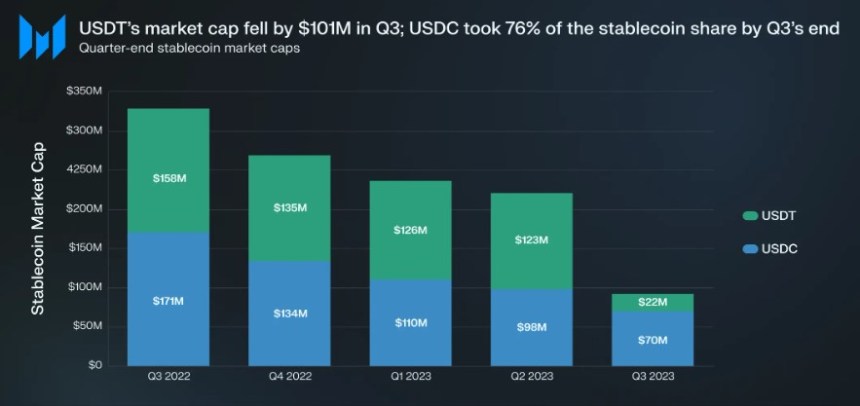
However, Algorand’s total stablecoin market cap faced a decline of 58% in Q3, largely attributed to the decreasing market caps of stablecoins on the platform. Despite this, USDC (USD Coin) surpassed USDT (Tether), accounting for 76% of the stablecoin market cap.
In the decentralized finance (DeFi) space, Algofi, Algorand’s largest DeFi protocol by Total Value Locked (TVL), began winding down operations in July.
As a result, Folks Finance emerged as the dominant DeFi protocol on Algorand, capturing 55% of the DeFi TVL in Q3. Algorand’s quarterly revenue, including fees collected by the protocol, grew by 25% in ALGO terms; however, it declined by 23% in USD terms due to the daily average ALGO price.
Algorand’s governance participation experienced a decline of 8% in Q3, accounting for 30% of the circulating supply. The platform’s network upgrade in Q3 allowed for increased throughput, lower blocktime, and support for quantum-secure interoperability via State Proofs.
Looking ahead, Algorand has announced plans to launch AlgoKit 2.0, a developer-focused tooling that aims to simplify the developer experience. It also intends to shift its network topology to a peer-to-peer design and transition to an incentivized consensus economic model in 2024.
Regarding price action, ALGO, currently ranked 53rd among the largest cryptocurrencies in the market, has faced challenges amid the recent bullish surge in most cryptocurrencies.
The token is currently trading at $0.1217, experiencing a decline of over 7% in the past 24 hours. Despite this retracement, ALGO has shown impressive gains across other time frames.
Over 7 and 14 days, ALGO has recorded significant gains of 10% and 21%, respectively. The best performance was seen in the 30 days, with a surge of 28%.

However, ALGO has faced a year-to-date decline of over 62%, in contrast to most of the crypto market, where major cryptocurrencies have nearly doubled in value since the end of the crypto winter.
Moreover, ALGO has struggled to surpass its 200-day moving average (MA), a significant resistance level. This has resulted in the recent pullback, preventing the token from reaching levels not seen since July, where it reached $0.1364.
The future trajectory of ALGO remains uncertain. It will depend on continued developments and growth in its ecosystem to propel the token towards its yearly high of $0.2898, reached in February. Alternatively, ALGO may consolidate below its moving averages.
Featured image from Shutterstock, chart from TradingView.com


Singapore-based Hodlnaut filed a wind-up order with the court on Nov. 10 as it prepares for a full liquidation of its remaining assets, according to court documents.
The winding-up process will be carried out under the provisions of the Insolvency, Restructuring, and Dissolution Act of 2018 and is expected to begin in the coming weeks.
The move comes after more than 17,000 creditors chose to vote against a restructuring plan for the company in January, opting for liquidation instead. Under the plan, the directors who were leading the company when it collapsed would have been in charge of the restructuring.
In a circular addressed to the stakeholders, the company’s former interim judicial managers, Aaron Lee and Angela Ee, revealed that they had been discharged as interim judicial managers and subsequently appointed as joint and several liquidators by the High Court of Singapore.
The liquidators emphasized the challenges posed by the substantial volume of creditors, including the extensive Hodlnaut user base. They assured creditors that efforts would be made to consolidate responses to individual queries and provide regular updates.
However, the liquidators also clarified in their communication that the liquidation proceedings do not constitute an admission of any outstanding sums owed by the company to its creditors.
Hodlnaut, which provided cryptocurrency lending services, faced financial turmoil in August 2022 and was forced to apply for creditor protection after incurring losses of approximately $189 million, primarily due to its exposure to the Terra ecosystem.
TerraLUNA collapsed in May 2022 and caused billions in losses for investors worldwide, including companies like Hodlnaut.
The crypto lender also suffered a setback of $13.3 million in crypto assets that were frozen on FTX when withdrawals were halted before the exchange filed for bankruptcy in November 2022.
The post Hodlnaut files wind up order in preparation for liquidation appeared first on CryptoSlate.

The Federal Reserve’s balance sheet has undergone a recent update, revealing a quantifiable decrease in its total. As of Nov. 8th, the balance sheet reveals a total of $7.861T, indicating the continuation of the Federal Reserve’s quantitative tightening strategy. Notably, the balance sheet has seen a reduction of about $6B in the last week.

This reduction, however slight, is essential to note as it is one of the slightest week-over-week changes effected by the Federal Reserve. To put it into perspective, it ranks as the fifth smallest reduction in a span of the past 20 weeks. This information is crucial as it illustrates the Federal Reserve’s consistent, albeit slow, progress towards a tightened balance sheet. The implications of these changes, while not immediate, will be significant for financial markets in the long run as they reflect the Federal Reserve’s monetary policy adjustments.

The post Fed’s balance sheet signals cautious but consistent quantitative tightening appeared first on CryptoSlate.

(Bloomberg) — T. Rowe Price Group Inc. said clients will likely withdraw more than $26.3 billion in the fourth quarter, extending a streak of redemptions by investors ditching actively managed mutual funds for cheaper products or cash money-market holdings.
Most Read from Bloomberg
The asset manager reported $6.3 billion in preliminary net outflows in October and expects investors to pull more than $20 billion total in November and December, the firm said Friday in a statement.
The Baltimore-based firm, with $1.3 trillion in client assets at the end of October, attributed the elevated outflows in part to a few large client withdrawals.
T. Rowe had already suggested that it anticipated a high level of outflows for the fourth quarter, Keefe, Bruyette & Woods analysts Michael Brown and Aidan Hall wrote in a new note. “But clearly the magnitude was not fully appreciated by us and the Street,” they added.
T. Rowe shares slid as much as 4.1% following the warning but pared the losses to 1.7% at 11:22 a.m. in New York.
Many firms in the industry that lean on actively managed strategies have been hit by redemptions over the past few years, leading them to try to expand into cheaper index funds and more specialized alternative assets, including private credit.
T. Rowe said its assets in equity funds, some of which have seen outflows, declined to $668 billion at the end of October.
–With assistance from Bre Bradham.
Most Read from Bloomberg Businessweek
©2023 Bloomberg L.P.

The cryptocurrency’s historical trends indicate that significant gains often occur a year and a half after the bottom, suggesting a rapid price surge in the coming years.
A year after the crypto market saw the collapse of the now-defunct FTX Derivatives exchange and two years after Bitcoin (BTC) saw an all-time high of $69,044, the narrative of “Crypto is dead” has been unequivocally debunked.
The collapse of FTX was a turning point for the crypto market, leading to widespread skepticism and calls for its demise. However, the past year has seen a remarkable shift in sentiment. As highlighted in a recent blog post from Coinbase Global Inc (NASDAQ: COIN), institutional interest in cryptocurrencies has surged, with the filing of Exchange-Traded Funds (ETFs) and increased participation from financial titans.
Additionally, the user base for crypto assets has grown to an estimated 420 million globally, with 52 million in the United States alone. This growth far surpasses the adoption rates of electric vehicles and union memberships, signaling a profound shift in public perception.
Despite the difficulties posed by FTX’s demise, the crypto market has seen continued innovation driven by a dedicated developer community. Moreover, the technology behind cryptocurrencies, especially blockchain and Web3 projects, has evolved significantly.
Over half of the Fortune 100 companies have engaged in crypto-related initiatives, recognizing the importance of crypto investment for competitive advantage. Payment integration with mainstream services like PayPal and Visa has further bridged the gap between crypto and traditional finance.
The regulatory environment for cryptocurrencies has also seen substantial progress. Approximately 3% of the G20 and major financial hubs have either passed national crypto legislation or have legislation in progress.
Notably, the passing of MiCA, a unified framework for crypto across 27 countries in the European Union, is a significant step towards providing a clear regulatory environment. The increasing regulatory clarity has contributed to the legitimacy and acceptance of cryptocurrencies in mainstream financial markets.
The crypto market in the past year witnessed a reckoning for individuals who engaged in unethical practices during the previous bull cycle. Notable figures like Sam Bankman-Fried, Alex Mashinsky, Do Kwon, and Su Zhu are facing consequences for their actions. Bankman-Fried’s conviction, in particular, serves as a symbolic moment in holding bad actors accountable.
As the crypto industry moves forward, it is crucial to remember the core principles of decentralization, self-custody, and the power of digital assets like Ethereum (ETH) and Bitcoin. The industry must remain vigilant against bad actors and uphold the principles of Decentralized Finance (DeFi).
The recent bullish crypto market sentiment, boosted by the prospect of regulated ETFs, points to a bright future. Looking ahead, Bitcoin is projected to enter an “acceleration phase,” with some analysts expecting prices to surpass the previous All-Time High (ATH) record of $69,044 by mid-2024.
The cryptocurrency’s historical trends indicate that significant gains often occur a year and a half after the bottom, suggesting a rapid price surge in the coming years.
next

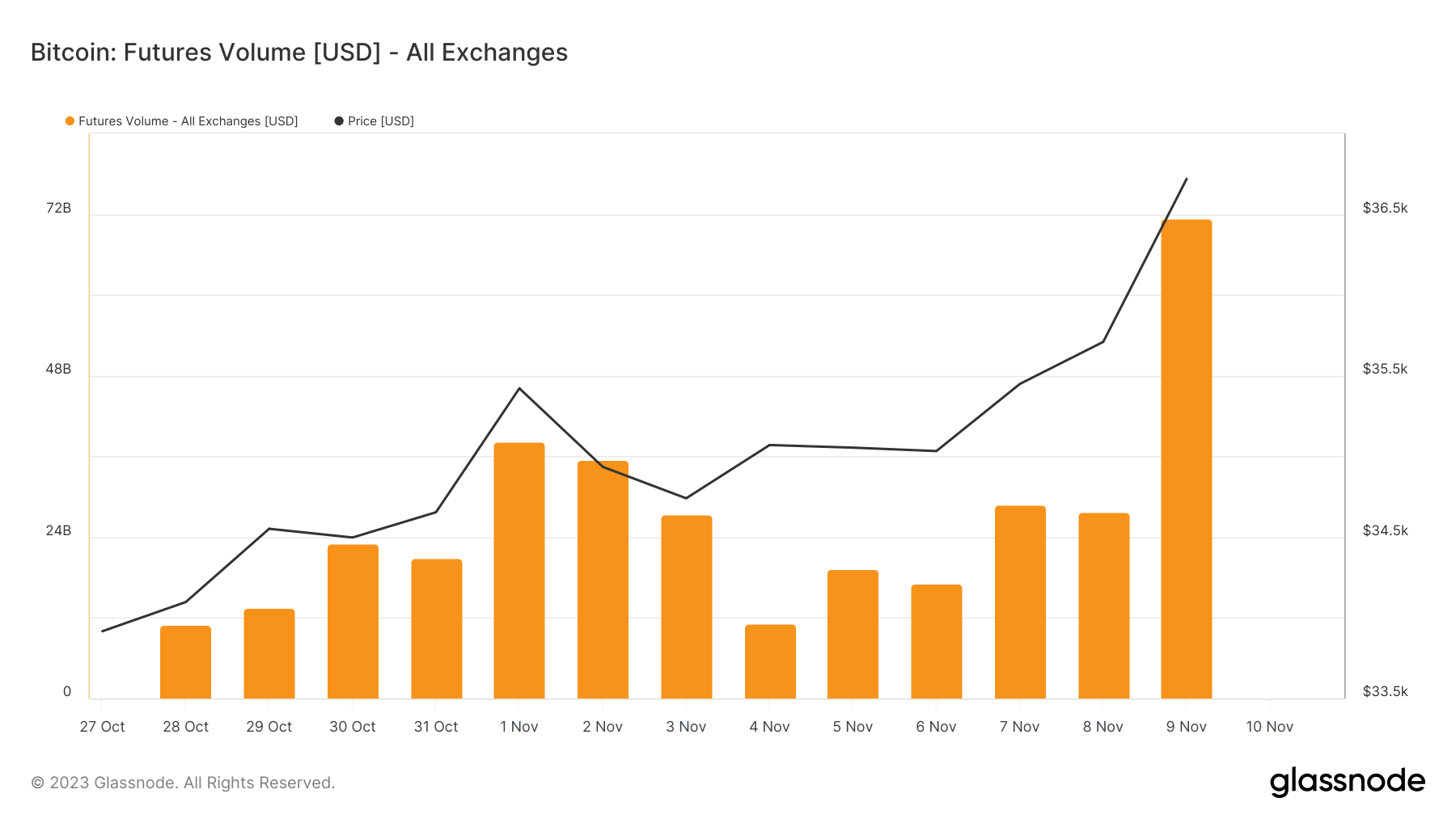
Bitcoin’s price jumped from $35,708 to $37,279 between Nov. 8 and Nov. 9, triggering a massive response from the futures market.
The total volume of Bitcoin futures traded across all exchanges leaped from $27.69 billion to $71.29 billion, showing a notable increase in speculative activity in Bitcoin.
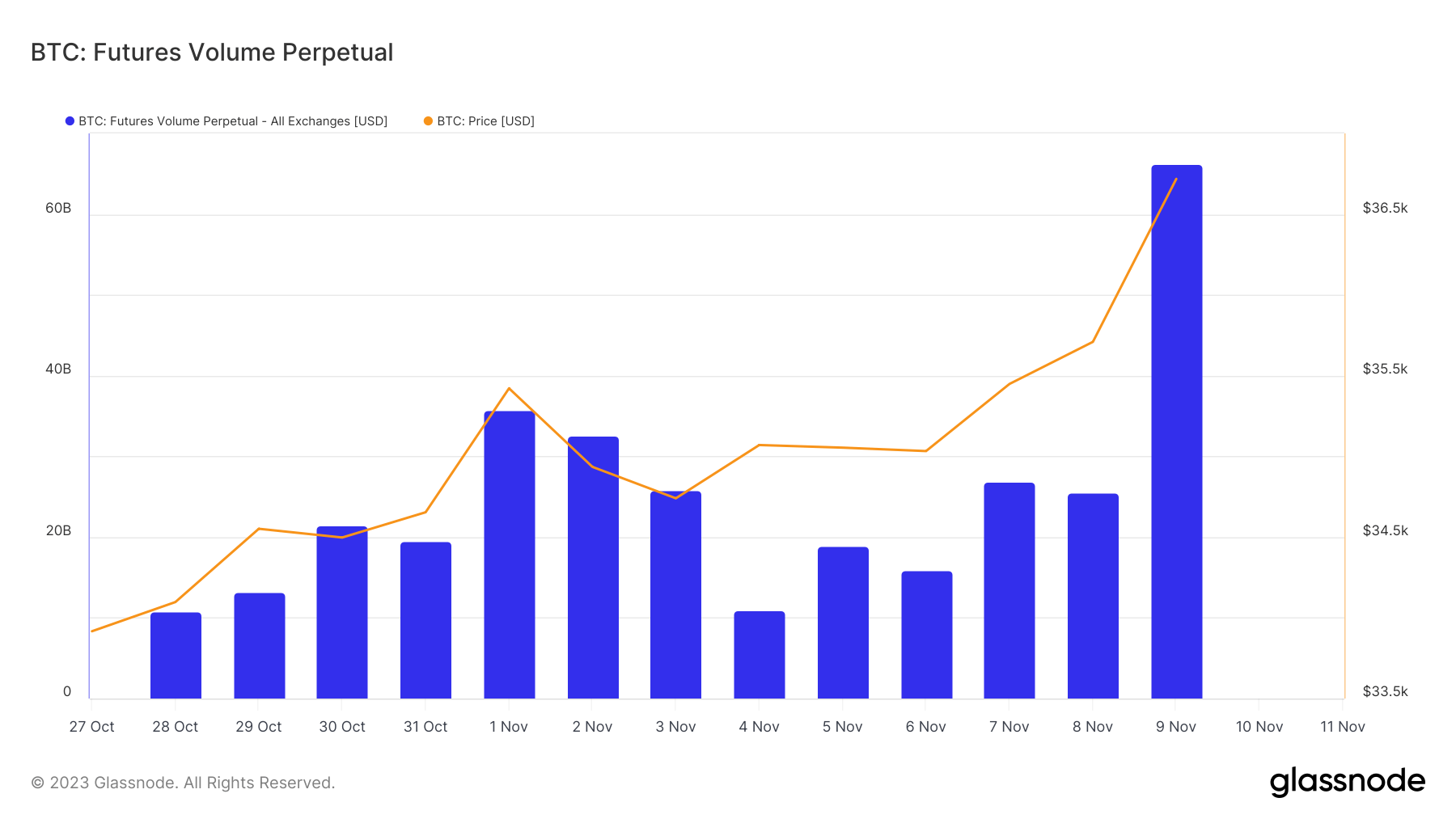
This was followed by a similar trend in perpetual futures volume, which grew from $25.06 billion on Nov. 8 to $66.31 billion on Nov. 9. Such a high volume in perpetual futures is particularly noteworthy as it indicates ongoing interest and a speculative mood among traders due to their non-expiry nature.
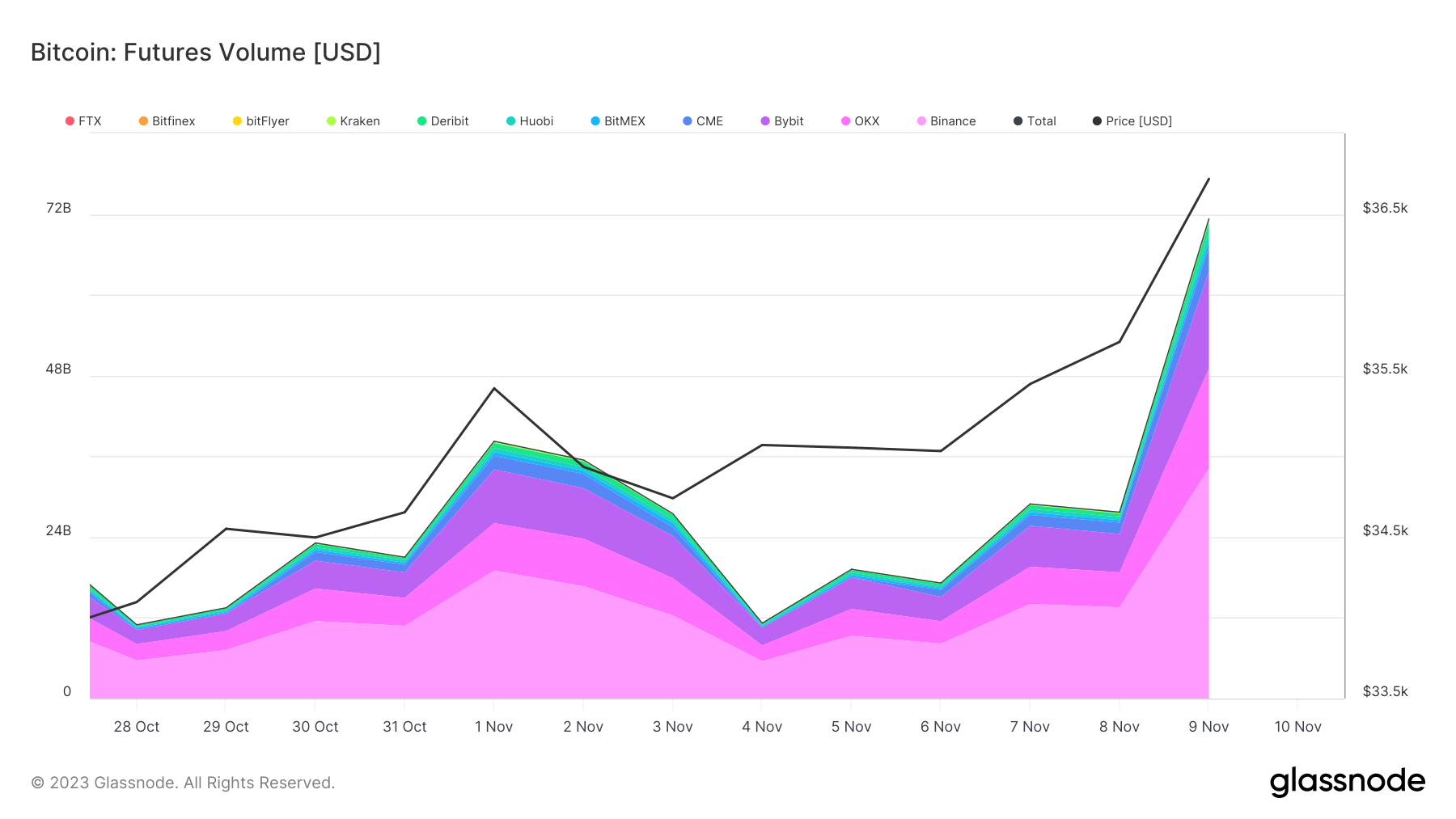
The distribution of this increased volume across major exchanges like Binance, OKX, Bybit, and CME provides insight into the market’s breadth. Binance, for instance, saw its futures volume more than double, reaching $34.19 billion. This broad-based increase is indicative of widespread trader participation and interest.
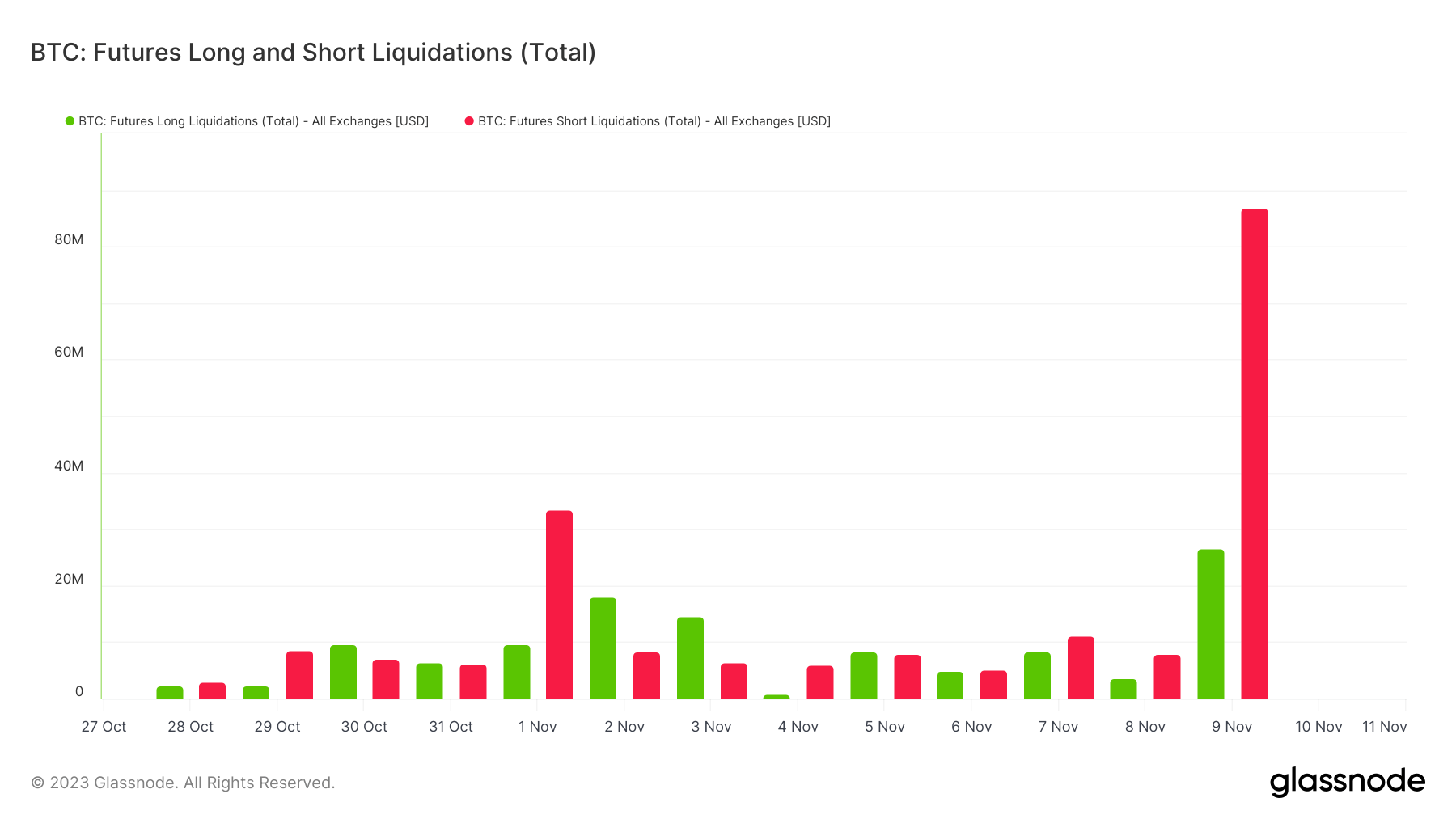
An essential aspect of this market movement is the pattern of liquidations. Long liquidations rose from $3.72 million to $26.5 million, but more dramatically, short liquidations increased from $7.83 million to $86.86 million. This suggests that many traders who bet against Bitcoin were compelled to exit their positions, possibly fueling the upward price momentum.
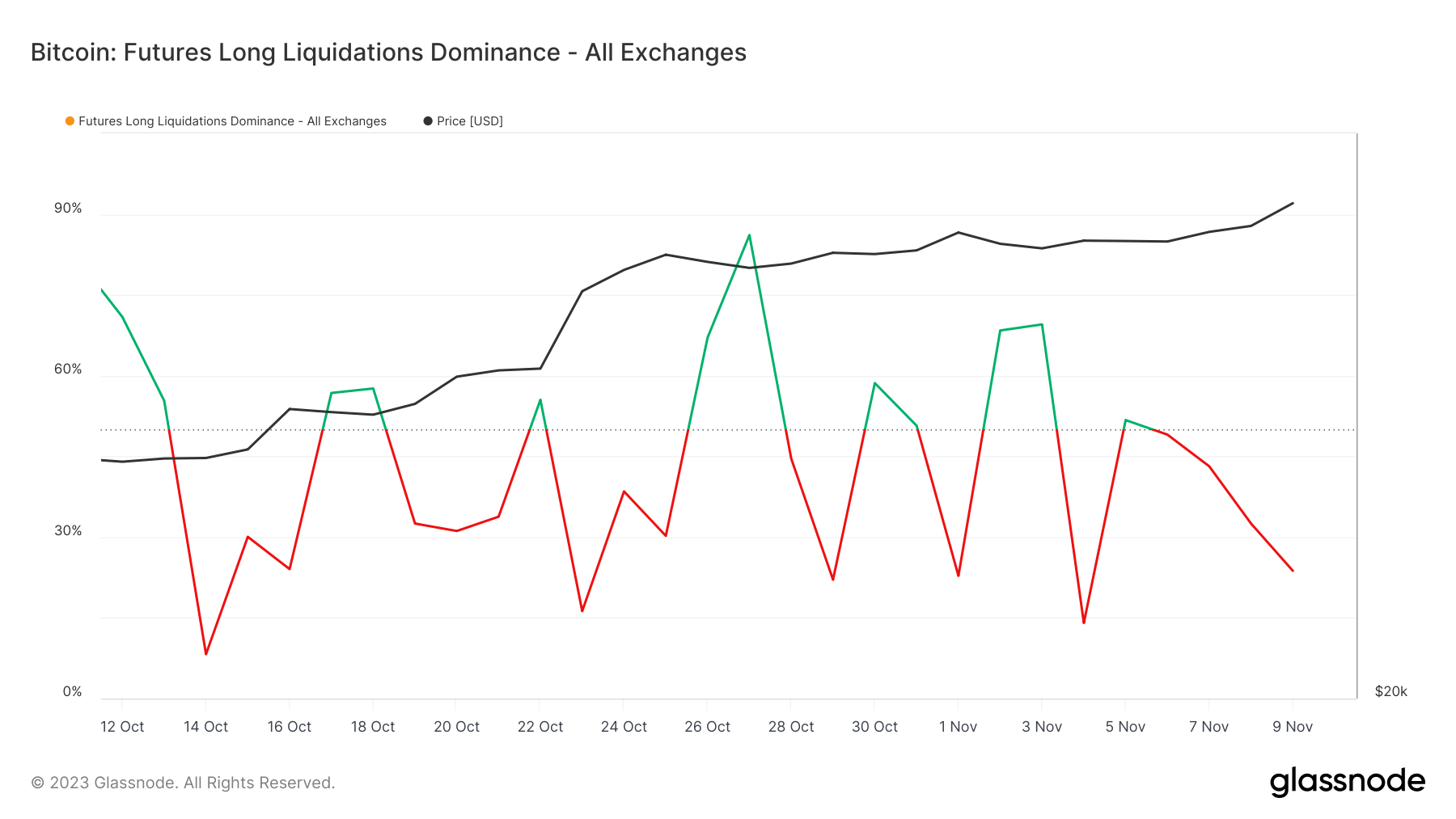
The long liquidations dominance at 23.73% on Nov. 9 implies that while there were significant long liquidations, the market predominantly experienced a squeeze on short positions.
Monitoring the futures market is vital as it indicates trader sentiment and potential price movements. The rise in liquidations, particularly the sharp increase in short liquidations, can signal a shift in market sentiment and often precedes a price movement, as seen in this instance. Similarly, the rise in volume, especially in a market like Bitcoin’s, can denote heightened investor interest or speculative trading, both of which can significantly impact the price.
The significant increase in short liquidations indicates a strong market correction against bearish bets, reinforcing the bullish trend.
The post Bitcoin futures volume surges 157% as BTC crosses $37k appeared first on CryptoSlate.

Since reporting its third-quarter results on Tuesday, shares of cloud monitoring and analytics company Datadog (DDOG 3.41%) have surged about 25%. Investors clearly love what the company had to say in its quarterly update.
Investors cheered Datadog’s strong revenue growth, improving profitability, and robust fourth-quarter outlook.
“Companies across all industries and sizes are building cloud applications and services to deliver positive business outcomes, including more users, higher revenue growth, improved productivity, and cost savings,” said Datadog CEO Olivier Pomel in the company’s third-quarter earnings release. “With our unified, cloud-native, end-to-end observability and security platform, Datadog is uniquely positioned to help our customers reach their goals.”
While there’s certainly plenty of reason to be upbeat about the company, there are also some reasons to be critical. Here are four key metrics from the quarter to better understand the company’s recent success and one more pessimistic metric that could suggest the stock’s recent hype is overdone.
Though Datadog’s revenue growth was strong in Q2, coming in at a year-over-year growth rate of 25%, it was notably a deceleration from 33% revenue growth in Q1 and 63% for the full year of 2022. Some investors, therefore, may have been worried that Datadog’s revenue growth would decelerate again in Q3. But it didn’t happen. Instead, the growth rate stabilized, with third-quarter revenue rising 25% year over year again, coming in at $547.5 million.
Strong revenue growth, combined with the company’s increased efforts to improve efficiency and reduce costs, led to improving profitability in Q3. This is particularly evident in the company’s non-GAAP (generally accepted accounting principles) operating income as a percentage of revenue. Datadog’s operating margin for the quarter was 24%, up from 21% last quarter and 17% in the year-ago quarter.
Another way to measure Datadog’s improving profitability is its free cash flow, or the company’s cash from operations, less capital expenditures. Free cash flow rose from about $67 million (15% of revenue) to approximately $138 million (25% of revenue).
Such robust cash flow, of course, is beefing up the company’s already strong balance sheet. Datadog wrapped up the quarter with $2.3 billion in cash, cash equivalents, and marketable securities.
Finally, investors were likely pleased with the company’s revenue guidance. Datadog guided for fourth-quarter revenue to be between $564 million and $568 million. This is well ahead of analysts’ average estimate for fourth-quarter revenue of about $543 million. This guidance range implies 20% to 21% year-over-year growth for the final quarter of the year.
Another area the company continues to do well in is its momentum with large customers (i.e., customers with annual recurring revenue of $100,000 or more). At the end of Datadog’s third quarter, these customers totaled 3,130, up 20% or more. Datadog also said it closed deals with a record number of customers worth $100,000 or more in annual revenue.
However, Datadog’s year-over-year growth rate in large customers may also be a reason to be concerned. Despite this metric’s good performance in absolute terms, it’s down meaningfully sequentially.
Its customers with more than $100,000 in annual recurring revenue grew 24% year over year in Q2 — four percentage points higher than the company’s 20% growth rate in Q3. If this deceleration persists in Q4 and into 2024, investors may have to revisit whether shares are worth their high valuation. The company’s current market capitalization of more than $32 billion prices in rapid growth for years to come.
Overall, however, Datdog’s third-quarter performance is good news for investors. Despite the company’s strong growth, management emphasized that Datadog is still operating in a tough environment, rife with cloud optimizations (i.e., when organizations try to lower their cloud expenses or at least be more disciplined about spending) and macro uncertainty.
Despite its current challenges, Datadog remains confident in its long-term growth outlook.
“We continue to believe digital transformation and cloud migration are long-term secular growth drivers of our business and critical motions for every company to deliver value and competitive advantage,” said Pomel.

Prenuvo MRI machine
Courtesy of Prenuvo
While celebrating the July Fourth holiday last year on a boat in Tyler, Texas, Dr. Julianne Santarosa received the results from her full-body MRI scan. What she saw put a damper on the festivities.
Radiologists at Prenuvo, which performed the scan, had identified a nodule in her lungs. Santarosa, who works as a spinal access surgeon in Dallas, could see the spot circled as she looked at the images from the patient portal on her phone.
“I was like, unless I swallowed a taco chip, that something should not be there,” she told CNBC in an interview.
Before paying $2,500 for the Prenuvo scan, Santarosa, who was 41 at the time, hadn’t felt any pain in and around her lungs and had no reason to suspect anything specific was wrong. Rather, she’d felt generally off since going through in vitro fertilization and had a gut feeling she should do the scan after seeing a Prenuvo ad on Facebook.
The day after seeing her Prenuvo results, Santarosa had a follow-up CT scan at a local hospital. The nodule was cancerous. She had it removed the following week.
Curious and concerned patients like Santarosa are flooding Prenuvo’s nine clinics in the U.S. and Canada. There’s so much demand that the 5-year-old Silicon Valley-based company has announced 11 more locations opening by 2024, including one in London and another in Sydney.
Kim Kardashian called Prenuvo a “life saving machine” in an August post on Instagram that’s generated more than 3.4 million likes. Actress and model Cindy Crawford is an investor, alongside Google ex-Chairman Eric Schmidt, 23andMe co-founder Anne Wojcicki and Nest Labs founder Tony Fadell. The company raised $70 million late last year in a funding round led by Felicis Ventures.
Prenuvo CEO Andrew Lacy said he wants to help customers understand what’s going on beneath their skin, which his company’s technology can do by identifying more than 500 conditions like cancer, multiple sclerosis and brain aneurysms. As of now, the scans have a limited audience because they aren’t covered by insurers, requiring patients to pay out of pocket.
For Santarosa, the imaging was worth every penny and more. Her cancer was detected early enough that she didn’t need to undergo treatments like chemotherapy or radiation. More importantly, it hadn’t spread to the point that it was life threatening.
“There’s no screening test for this,” Santarosa said. “I would’ve been stage 4. I would’ve figured this out when I was coughing up blood.”
Prenuvo CEO Andrew Lacy
Courtesy of Prenuvo
An MRI, which stands for magnetic resonance imaging, is traditionally used when ordered by a doctor. Interpreting the images is a complex science, and the scan alone can take more than an hour, even if it covers just part of the body.
Prenuvo’s custom MRI machines, which received clearance from the U.S. Food and Drug Administration in 2018, can scan a person’s entire body in about an hour. Once a scan is complete, the images are reviewed by one of the company’s 30 licensed radiologists. Customers usually receive their results back within five to 10 business days.
Waitlists are long. According to Prenuvo’s website, the next available slot for a full-body scan in New York is in March. The same is true for the Los Angeles clinic. In the Dallas suburb of Irving, there’s availability starting in mid-December.
Lacy said the business has spiked as awareness in the past 12 months has grown “incredibly.”
“These days, when people ask me what I do, and I say I work at Prenuvo, it’s ‘Oh, I heard that on this podcast,’ or ‘That influencer talked about it,'” he said.
In addition to full-body scans, Prenuvo offers a head and torso scan for $1,800 and a scan of just the torso for $1,000.
Lacy said Prenuvo is working to bring prices down through “old-fashioned scaling.”
Some companies have started offering Prenuvo scans as a perk for employees, which has helped increase access to the technology. Lacy said it works for companies with self-funded insurance plans, because they’re able to customize their offerings while assuming the risks.
Traditional insurance companies are paying attention.
“Over time, that data helps inform insurance companies about whether this should be something that would be covered across the insurance plans that they offer,” Lacy said.
Prenuvo is looking for other ways to lower costs through artificial intelligence and by potentially reducing the durations of the scans even further. Lacy said the cost is directly correlated to the amount of time customers spend in the expensive machines.
Prenuvo MRI machine
Courtesy of Prenuvo
Radiologists are at the core of Prenuvo’s business. That brings its own challenges.
Many radiologists are fighting burnout as an aging population has led to mounting caseloads. Emerging technologies like AI have also discouraged some young physicians from pursuing the practice. By 2034, the U.S. could see an estimated shortage of up to 35,600 radiologists and other specialists, according to a report from the Association of American Medical Colleges.
So far, it’s a problem Prenuvo has managed to avoid.
Lacy said Prenuvo has a backlog of radiologists who want to work for the company. In traditional medicine, radiologists are often diagnosing patients with serious and advanced diseases, so identifying conditions early can be a welcome change, he said.
“When you’re catching stage 1 cancer, what you’re doing will save lives,” Lacy said.
Prenuvo is still in its early days. Medical experts caution that, in addition to the steep price, full-body MRI scans won’t catch everything and aren’t meant to replace targeted screenings like colonoscopies and mammograms.
“It is a tool that your physician and you can use, but it does not replace a full diagnostic examination,” said Dr. Jasnit Makkar, an assistant professor of radiology at Columbia University Medical Center, in an interview. “It is a work in progress.”
Dr. Kimberly Amrami, vice chair of the department of radiology at Mayo Clinic Rochester, said that because of the limitations, patients’ expectations have to be set accordingly. She said it can be challenging to identify lesions in the lungs, for instance, and scanning different body parts like the knee, the pelvis, the breasts and the prostate all require different techniques.
“There’s always a wish to do an exam that’s going to answer every question,” Amrami said in an interview. “It’s just not really the way that it works with MRI in particular, because the way that you evaluate different body parts in different disease states is quite different.”
Prenuvo doesn’t use contrast, a heavy metal that’s injected into the blood vessels, when conducting its scans. Contrast can help radiologists visualize certain conditions better, but there’s controversy surrounding its use, and the company doesn’t want to deter people.
Lacy said Prenuvo’s hardware was designed to do “almost as good a job” as contrast by using other techniques.
“We believe that that’s the best possible solution for screening patients who are at normal risk and asymptomatic,” he said. “If we find something that’s very concerning, oftentimes, we will suggest that the patient gets some type of follow-up dedicated imaging that might involve contrast.”
Amrami said people should consult with their physicians to determine what kind of imaging works best for them.
“There is no one-size-fits-all for MRI,” Amrami said.
Prenuvo’s clinic in New York City, New York.
Courtesy of Prenuvo
Lacy said he was inspired to create Prenuvo after he started to wonder about how his high-stress lifestyle was affecting his body. He previously started an internet search company and helped found a gaming company, among other ventures.
He found a radiologist who was offering an early version of a full-body MRI scan. Lacy said he learned a lot from that experience.
“Although my lifestyle was impacting my health, there was nothing crazy going on,” Lacy said. “I remember just this incredible feeling of peace of mind.”
Prenuvo designed its experience for relaxation. Its New York location has the feel of a cross between a spa and a doctor’s office.
Upon arrival at the clinic, patients are led from a cozy waiting room to a private area where they can change into scrubs and remove their jewelry.
While lying down in the machine, patients are given a pair of headphones and can choose to listen to music or watch TV during the scan.
Dr. Eduardo Dolhun, a family physician in San Francisco, decided to get his first Prenuvo scan more than five years ago after Lacy stopped by his office. He said he was skeptical but intrigued by the technology, so he decided to fly to Vancouver, British Columbia, to try an early version of it.
After going through his results with a Prenuvo radiologist, Dolhun called one of his medical school peers at the Mayo Clinic.
“I think this is going to change medicine,'” Dolhun said, recalling the conversation.
Dolhun said he gets a scan every 18 months or so and recommends it to some of his patients. He still advises them to get screening exams like physicals and mammograms as well.
“Good science takes time,” he said.
WATCH: Amazon links One Medical to Prime offering


An aerial view of Funafuti, Tuvalu, from 2019. Tuvalu’s Department of Foreign Affairs describes climate change as “one of the most existential security risks currently threatening” the country.
Mario Tama | Getty Images News | Getty Images
Australia and the South Pacific island nation of Tuvalu are to forge closer ties thanks to a new agreement covering areas including security, migration and climate change.
The Australia-Tuvalu Falepili Union, a bilateral treaty, sees Australia pledging to create “a special mobility pathway” that will enable Tuvaluans to go to Australia to work, study and live. To start with, the number of Tuvaluans eligible to go to Australia will be capped at 280 a year.
“With a population of just over 11,000 people, Tuvalu is extremely vulnerable to the impact of climate change, especially rising sea levels, and is trying to preserve its culture, traditions and land,” the Australian government said in a statement.
The pact also includes an Australian pledge to “provide assistance to Tuvalu in response to a major natural disaster, health pandemics and military aggression.”
In addition, both countries have made a commitment to “mutually agree any partnership, arrangement or engagement with any other State or entity on security and defence-related matters in Tuvalu.”
Made up of nine islands, Tuvalu — as the Australian government’s statement notes — is seriously threatened by the effects of climate change, and Tuvalu’s Department of Foreign Affairs describes climate change as “one of the most existential security risks currently threatening” the country.
At last year’s COP27 climate change summit in Sharm el-Sheikh, Egypt, Tuvalu urged countries to set up a global treaty focused on phasing out the use of fossil fuels — the chief driver of the climate crisis.
The deal on migration is significant, and highlights how countries are having to find solutions to deal with the considerable effects of climate change.
In a joint statement issued Friday, the prime ministers of Australia and Tuvalu — Anthony Albanese and Kausea Natano — referenced a reclamation project in Funafuti, Tuvalu’s capital, that will expand land there by roughly 6%.
This initiative, they said, would create “vital space for new housing and essential services for Tuvaluans, and enabling people to remain living in Tuvalu in the face of sea-level rise. We call on others to join us in supporting Tuvalu’s long-term adaptation vision.”
“At the same time, we believe the people of Tuvalu deserve the choice to live, study and work elsewhere, as climate change impacts worsen,” they added.
“Australia has committed to provide a special pathway for citizens of Tuvalu to come to Australia, with access to Australian services that will enable human mobility with dignity.”