In a recent analysis, economist Peter Schiff draws stark comparisons between the current U.S. economic optimism and the prelude to the 2008 financial crisis. Schiff, leveraging his expertise, warns of impending financial turmoil, emphasizing the critical role of money supply in understanding economic health. Peter Schiff Warns: U.S. Economy on the Brink, Echoes of 2008 […]
Source link
CoinNews
1 Semiconductor Stock to Buy Hand Over Fist After Micron Technology’s Stellar Report
Micron Technology (NASDAQ: MU) wowed investors last week with an outstanding set of results for the second quarter of its fiscal 2024, reporting a massive jump in its revenue and a surprise profit, and this sent shares of the memory specialist soaring.
The chipmaker benefited from a jump in demand for memory chipsr. As a result, its revenue increased a massive 58% year over year to $5.8 billion. Micron is anticipating stronger year-over-year growth of 76% in its top line in the current quarter, driven by increased appetite for memory chips from artificial intelligence (AI) servers, smartphones, and personal computers (PCs).
The memory industry has witnessed a significant turnaround of late as demand for consumer electronics is back on track, while AI has created the need for advanced memory chips known as high-bandwidth memory (HBM). Micron management remarked on the latest earnings-conference call that its HBM capacity for 2024 is sold out, while the “overwhelming majority of our 2025 supply has already been allocated.”
This is good news for Lam Research (NASDAQ: LRCX), a semiconductor equipment manufacturer that gets a big chunk of its revenue from selling its goods to memory manufacturers such as Micron. Let’s look at the reasons why Micron’s latest results are an indication that investors would do well to buy Lam Research stock right now.
Lam Research is about to witness a solid turnaround
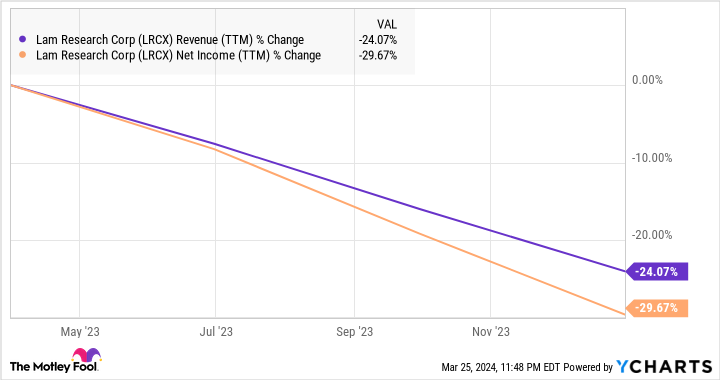
In the most recent quarter, Lam Research got 48% of its revenue from selling semiconductor manufacturing equipment to memory manufacturers. This explains why the company’s results in recent quarters have been poor. An oversupply in the memory market forced the likes of Micron and others to put a hold on capacity expansion, and so Lam’s top and bottom lines have been heading south.
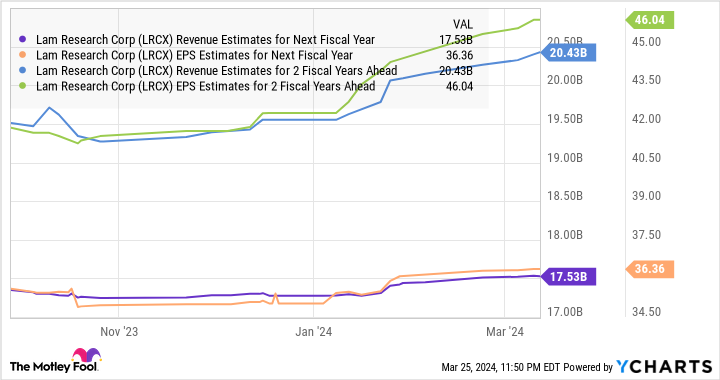
Analysts expect the company to finish the current fiscal year with a 22% decline in revenue to $13.6 billion. Additionally, earnings are expected to drop to $26.76 per share from $34.16. However, as the following chart shows, Lam Research’s revenue and earnings could jump sharply in the next fiscal year, which will begin at the end of June 2024.
Micron’s latest results and management commentary tell us just why Lam’s fortunes are set to turn around. Memory makers will need to increase their supply of HBM to cater to the growing demand from AI servers. The good part is that Lam is already witnessing solid orders for HBM equipment. CEO Tim Archer pointed out on the company’s January conference call with analysts: “In 2024, we expect our HBM-related DRAM and packaging shipments to more than triple year on year… “
It is also worth noting that the overall memory market is set to jump big time in 2024. According to Gartner, the memory industry’s revenue could jump 66% this year following a 39% drop in 2023. More importantly, the growing adoption of AI is set to drive robust long-term memory demand.
According to Micron, AI-enabled PCs are likely to carry 40% to 80% more DRAM (dynamic random access memory) content when compared to traditional PCs. On the other hand, the company expects AI-capable smartphones to “carry 50% to 100% greater DRAM content compared to non-AI flagship phones today.”
Meanwhile, the demand for HBM is forecast to more than double in 2024, generating $14 billion in revenue as compared to $5.5 billion last year. Even better, the HBM market could generate almost $20 billion in revenue next year. All this indicates that memory manufacturers will have to ramp up their production capacities, and a closer look at the industry indicates this is just what’s happening.
Samsung, for example, is expected to increase HBM production by 2.5 times in 2024, followed by a 2x increase next year. Similarly, SK Hynix expects to increase its capital expenditure this year to support increasing HBM demand. As such, the end-market conditions are set to turn favorable for Lam Research.
Buying the stock is a no-brainer right now
Lam Research is currently trading at 27 times forward earnings estimates. That’s a small discount to the Nasdaq-100‘s average multiple of 28 (using the index as a proxy for tech stocks). If Lam Research’s earnings hit the $46 estimate, and it were to trade at 28 times earnings, that would put its stock at $1,288, a 33% jump from its current price.
However, don’t be surprised to see the stock delivering stronger gains as the market may reward it with a higher earnings multiple thanks to its AI-fueled growth, which is why investors should consider buying this semiconductor stock before it jumps higher.
Should you invest $1,000 in Lam Research right now?
Before you buy stock in Lam Research, consider this:
The Motley Fool Stock Advisor analyst team just identified what they believe are the 10 best stocks for investors to buy now… and Lam Research wasn’t one of them. The 10 stocks that made the cut could produce monster returns in the coming years.
Stock Advisor provides investors with an easy-to-follow blueprint for success, including guidance on building a portfolio, regular updates from analysts, and two new stock picks each month. The Stock Advisor service has more than tripled the return of S&P 500 since 2002*.
*Stock Advisor returns as of March 25, 2024
Harsh Chauhan has no position in any of the stocks mentioned. The Motley Fool has positions in and recommends Lam Research. The Motley Fool recommends Gartner. The Motley Fool has a disclosure policy.
1 Semiconductor Stock to Buy Hand Over Fist After Micron Technology’s Stellar Report was originally published by The Motley Fool
Dogwifhat Rises to Become the Third-Largest Meme Coin by Market Valuation
This week, the crypto asset dogwifhat (WIF), a meme coin, ascended to the third-highest valuation among all meme tokens. In the last day, WIF appreciated by 17% against the U.S. dollar and saw a 435% increase over the past 30 days. WIF Surpasses Major Competitors, Securing Third Spot Among Meme Coins In the recent week, […]
Source link
The Solana network’s native cryptocurrency, SOL, has been on an upward surge in the past three days, climbing from around $180 to over $210.
Having failed to break its previous low of $162.74, the coin, which is currently ranked 5th in the crypto market with a total supply of 441 million and a market capitalization of over $88 billion, SOL is showing no signs of stopping.
Will Solana Continue To Surge Upward?
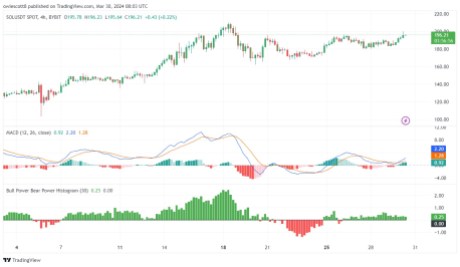
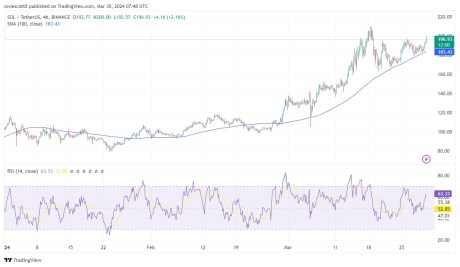
At the time of writing, Solana has been up by 6.25% trading around $198 in the past 24 hours, and has broken above the previous resistance level of $195. The price is also trading above the 100-day moving average on the 4-hour chart of the SOL/USD pair. If the price continues to move upward, it might break above its major resistance level of $210 and move even higher to create a new high for the year.
All these can be seen in the image below:

Looking at the chart with the help of the RSI (Relative Strength Index) indicator in the image above, we can see that the RSI line is trending above the 50 level. This is an indication that the price of SOL is still in a bullish zone and could even surge further upward.
A further look at the 4-hour timeframe chart with the help of the MACD indicator, we can see that the MACD is on the bullish side as the MACD line, the signal line, and the MACD histogram are all trending above the zero line.
Finally, using the bull vs bear power histogram indicator, it appears buyers have taken over the market with powerful momentum and are ready to push the price even higher.
We can confirm this in the image below:

With the momentum that Solana is moving with, there is a possibility that it could break above its previous resistance level of $210.27. If this manages to happen we could see prices soaring higher especially with the level of demand momentum in the market
Could SOL Dip?
If the price of Solana fails to break above the resistance level of $210, it could start a downside correction to its initial support level of 162. If the price closes below this support level, it could decline even further and probably start a downward trend.
Featured image from YouTube, chart from Tradingview.com
Disclaimer: The article is provided for educational purposes only. It does not represent the opinions of NewsBTC on whether to buy, sell or hold any investments and naturally investing carries risks. You are advised to conduct your own research before making any investment decisions. Use information provided on this website entirely at your own risk.
The price of Dogecoin (DOGE) recently broke a 3-year high after rising to $0.22. This move continues the remarkable run made by the foremost meme coin and has strengthened the belief that DOGE could increase to $1 before the end of this bull run.
Interest In Dogecoin Set To Skyrocket With Coinbase Listing
Bitcoinist reported that the foremost US crypto exchange, Coinbase, had finalized plans to introduce the meme coin to its futures contract offerings. Coinbase’s institutional arm also recently confirmed that Coinbase Derivatives will launch the first leveraged and CFTC-regulated futures contracts for Dogecoin in April.
This means that institutional investors will have the opportunity to trade DOGE futures starting in April. This could be huge for the meme coin, considering the amount of capital this class of investors could inject into its ecosystem. As noted by Coinbase, DOGE has become more than just a meme coin and is sure to attract interest from these investors.
Meanwhile, the derivatives market is known to have a massive impact on a crypto token’s price. Therefore, depending on the sentiment among these investors, DOGE’s price could experience a lot of upside volatility on its way to $1.
Bitcoin is now trading at $ 69.964. Chart: TradingView
Dogecoin’s New Wallet Set To Enhance Its Utility
Dogecoin Foundation recently revealed in an X (formerly Twitter) post that the Dogecoin GigaWallet v1.0 has been released. The foundation further explained that the GigaWallet “provides a convenient integration API for platforms such as online shops, exchanges, social media platforms etc, to programmatically transact Dogecoin.”
The GigaWallet launch is undoubtedly significant as it could play a primary role in expanding DOGE’s adoption. An increase in the number of users could reflect positively on DOGE’s price. The wallet launch is also timely, as it comes at a time when retail investors are turning their attention again to the crypto market.
As highlighted by Crypto expert Scott Melker, DOGE was known to have attracted this category of investors in the last bull run, and developments like this could make DOGE their preferred choice once more with such accessibility. Moreover, those who couldn’t possibly invest in the meme coin then would find it much easier to do so now.
Interestingly, GigaWallet also sets the stage for the integration of DOGE payments into the X platform. There continue to be speculations that the social media platform could include DOGE in its payment service, considering Elon Musk’s fondness for the meme coin. If that happens, Gigawallet could help make the process more seamless and enhance DOGE’s utility.
At the time of writing, DOGE was trading at around $0.21, down in the last 24 hours, according to data from CoinMarketCap.
Featured image from Pexels, chart from TradingView
Disclaimer: The article is provided for educational purposes only. It does not represent the opinions of NewsBTC on whether to buy, sell or hold any investments and naturally investing carries risks. You are advised to conduct your own research before making any investment decisions. Use information provided on this website entirely at your own risk.
If Tony’s Chocolonely founder Teun van de Keuken had his way, he would’ve ended up behind bars long before he created his popular chocolate company.
The Dutch journalist made an attempt to get himself arrested in 2005, showing up to a police station and declaring himself a criminal. The crime? Fueling slavery by knowingly purchasing a chocolate bar made with illegal child labor.
When his activist stunt failed, van de Keuken came up with a new plan: creating a chocolate bar of his very own that proved the candy could be made without any exploitation of children.
His chocolate company would pay West African cocoa farmers a living income to help combat the scourge of child labor, and its beans would be sourced from land that had been deforested.
Nearly 20 years later Tony’s Chocolonely is not only one of the most popular chocolate brands in van de Keuken’s native Netherlands, it is known around the world.
The brand, whose stated mission is to make “100% slave free the norm in chocolate,” can be found at manor US retailers like Whole Foods, Target and Walmart. Its revenue grew 23% last year to $162 million.
“We’ve demonstrated it’s possible to pay a living income to farmers to address the challenges of child labor,” CEO Douglas Lamont told CNBC Make It in a recent interview. “[We’ve shown] you can be a successful chocolate company doing it the right way, in an ethical way.”
For the full story of how Tony’s Chocolonely went from a stunt to a global brand, check out CNBC Make It’s video.
Want to make extra money outside of your day job? Sign up for CNBC’s new online course How to Earn Passive Income Online to learn about common passive income streams, tips to get started and real-life success stories. Register today and save 50% with discount code EARLYBIRD.
Plus, sign up for CNBC Make It’s newsletter to get tips and tricks for success at work, with money and in life.
When I buy a stock, I try to remind myself that I am buying a small part of a business and that I intend to hold my stocks for the long term. Warren Buffett famously said that his favorite holding period is forever. While that’s aspirational more than anything, it’s an important reminder that success in investing comes from identifying great businesses and then letting them compound over decades.
While some stocks in my portfolio have a lot more to prove to stay there forever, there are some that I can’t imagine myself selling. These businesses have long track records and competitive advantages that should pave the way for bright futures. As the saying goes, “Never say never.” Yet with these stocks, I’m as close to never selling as one can be.
Costco
Every time I am struggling to find parking or waiting in the long (but efficient) line to check out, I ask myself why I don’t own more Costco Wholesale (COST 0.07%) stock. While most of my fellow shoppers are likely not having the same thought, we’re all there to take advantage of the bulk quantities and low prices. History tells us that this business model has been wildly successful with Costco shares gaining more than 81,000% since its IPO.
Costco ended its fiscal 2024 second quarter (ended February 2024) as the third-largest global retailer and the 12th-largest company in the Fortune 500, with 874 locations worldwide. Its membership model works well. More than 92% of Costco members renew their membership and the company brought in nearly $5 billion in membership fees in the past 12 months.
The low prices keep customers coming in the door, and because Costco sells fewer items than its competitors and turns its inventory over very quickly, it can sometimes even sell items before they need to be paid for. This helps cash flows and reduces expenses.
Amazon
If there’s a retailer that comes first to mind for me other than Costco, it has to be Amazon (AMZN 0.31%). I don’t think I am alone in finding myself shopping there before almost anywhere else. Over the trailing 12 months, Amazon stock is up 82%. However, during the market slump of 2022, the company fell nearly 50% as it struggled to get its finances back in order following the massive distribution build-out necessitated by the pandemic surge in orders.
Amazon is certainly back on track and ready to reaccelerate its growth. In 2023, Amazon grew revenue by 12% but the more impressive results were further down the income statement. Operating income increased by 202% and net income grew by 1,226%. These results were driven by a recovery in the e-commerce business, which finally turned the corner after its 2022 struggles. It’s also worth remembering that Amazon Web Services (AWS) remains the leader in cloud infrastructure and it grew its revenue by 13% in 2023.
Apple
Consumer electronics giant Apple (AAPL -1.06%) has been in the news lately for all the wrong reasons. Finding itself increasingly under the microscope of federal antitrust investigations, the stock has fallen 12% over the past three months. This news is certainly worth watching, but it will take years to play out and the rather modest decline in Apple’s share price suggests the market’s level of concern is less severe than some of the headlines indicate.
Taking a step back, it’s important to remember that Apple is still a ubiquitous brand around the world, and especially within the United States. Known for its iPhone and other consumer electronic devices, Apple is slowly becoming a software company. Apple now has an installed base of more than 2.2 billion devices.
This creates an ecosystem of apps and subscription services that provide a high-margin income stream for the company. In the most recently reported quarter, services revenue (which is where all the subscription products are reported) grew by 11% to $23 billion. This represents 19% of total revenue, up from 18% in the year prior.
Why I’m “never” selling
Are there scenarios in which I might sell these companies? Sure, anything is possible. However, these three businesses are so competitively advantaged and are still growing so impressively at their large scale, that it’s difficult to envision a scenario where they wouldn’t warrant a spot in my portfolio. Investing can be as simple or as complicated as you want it to be. In my mind, buying and owning these three stocks is about as simple as investing can be.
John Mackey, former CEO of Whole Foods Market, an Amazon subsidiary, is a member of The Motley Fool’s board of directors. Jeff Santoro has positions in Amazon, Apple, and Costco Wholesale. The Motley Fool has positions in and recommends Amazon, Apple, and Costco Wholesale. The Motley Fool has a disclosure policy.