After Judge James Mellor in the U.K. rendered his decision in the notable lawsuit initiated by the Crypto Open Patent Alliance (COPA) against Craig Wright, he concluded that Wright did not embody the persona of the pseudonymous Satoshi Nakamoto. Subsequently, Mellor enforced a worldwide injunction on Wright’s holdings, freezing assets valued at £6.7 million (approximately […]
Source link

CoinNews
World’s biggest shipping firm dumps port cargo problem on U.S. companies

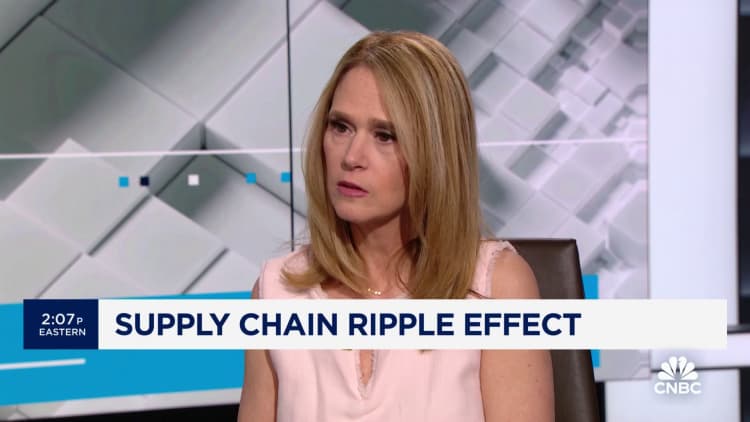
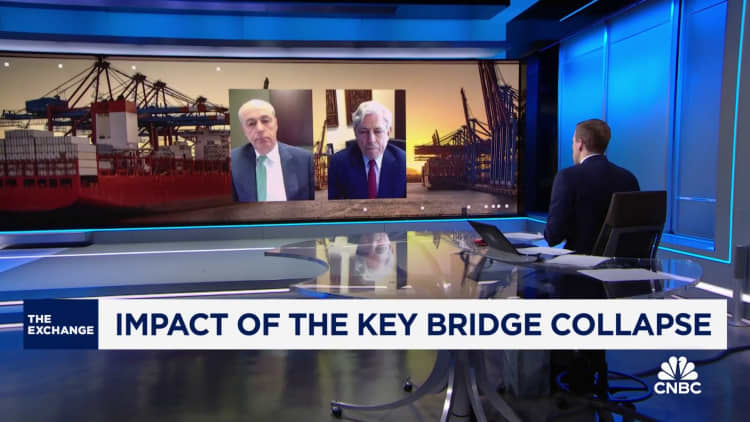
MSC, the largest ocean carrier in the world, has joined the list of ocean carriers terminating the delivery of diverted containers outside of the port for shipping clients as a result of the container ship accident near the Port of Baltimore that led to the tragic bridge collapse. With the Baltimore port indefinitely closed, the decision places the onus of cargo pick up at a diverted port and transport to its final destination on the shipper.
In an email to customers obtained by CNBC on Thursday, MSC explained that for customer containers already on the water bound for the Port of Baltimore, cargo will be rerouted and discharged at an alternate port where it will be made available for pick-up.
“For these shipments, the contract of carriage will be declared terminated at this alternate port and storage, D&Ds and on-carriage costs to the initially intended destination will be for the sole cargo’s account,” the MSC advisory said.
MSC added that “passage to and from Baltimore is at this time impossible and will not be reestablished for several weeks if not months.”
CMA CGM, COSCO, and Evergreen were the first carriers to announce similar moves and in some cases formally declare “force majeure,” a legal term which refers to the right to waive contract duties when events beyond a party’s control occur.
MSC said in its customer communication that it “apologizes for the disruption caused by this contingency plan which is required in response to events beyond our control, but which is taken in compliance with the terms of the contract of carriage.”
MSC did not immediately respond to CNBC’s request for comment.
Maersk is the only major carrier to say it will provide transport from diverted ports for customers.
Maersk was the charter of the Dali, 10,000-container capacity containership that lost control and crashed into the Francis Scott Key Bridge in the early hours of Tuesday.
After the pandemic boom which led to historic profits, ocean carriers have been through a period of financial and operational challenges, with vessel overcapacity, declining earnings, and the Red Sea Houthi attacks and Panama Canal drought leading to costly diversions from major global trade routes.
More about Baltimore’s Francis Scott Key Bridge collapse
Logistics companies have been scrambling since the accident to make alternate transport plans and keep up with carrier diversions, and executives told CNBC on Wednesday that the next few days will be critical in the movement of the diverted trade away from the Port of Baltimore.
The Port of Baltimore, the nation’s eleventh-largest port, is No. 1 in the U.S for auto/light truck and agriculture tractor imports and exports, in addition to handling clothing, household goods, construction materials, electronics and appliances, and produce.
Among the unresolved issues, logistics executives have cited ocean carriers not updating their vessel transits fast enough to alert them to the new diverted port so they can plan for their customer’s container pick-up.
Major ports up and down the East Coast, including Savannah, Brunswick, Virginia, Charleston, and New York/New Jersey, as well as the companies providing chassis for rail and truck transport, have told CNBC they have the capacity to ramp up operations to meet the needs of incoming cargo.
In a series of updates, MSC sent a list of 23 vessels arriving to the diverted ports from March 28-April 29. Eight have an unknown diverted port, 11 are headed to the Port of New York/New Jersey; three to Norfolk; and one to Philadelphia.
On Thursday, Transportation Secretary Pete Buttigieg had a meeting with supply chain professionals about the crisis and how to mitigate any congestion. The meeting included ocean carriers CMA CGM, Maersk, MSC, Evergreen, and railroads CSX and Norfolk Southern. The Port of New York/New Jersey, Georgia, Baltimore, Philadelphia, Jacksonville, South Carolina and Virginia were also in attendance. Shipping clients at the meeting included John Deere, Stellantis, Home Depot, Under Armour, and Volkswagen.
“We are much better equipped to mitigate supply chain disruptions than we were just a few years ago, thanks to increased coordination across the supply chain and new efforts to strengthen both our physical and digital infrastructure,” Buttigieg said, according to a readout from the meeting.
National Economic Advisor Lael Brainard, who was also in attendance, noted that in previous disruptions, the lack of complete information across different components of the private sector and the public sector hampered the decision-making capabilities and responses. She cited the recent DOT FLOW initiative as a difference maker. “It has already been activated to bring the full capacity of all the agencies in the federal government to make sure that we’re helping ocean carriers, port leaders, railroads, shippers, and unions to all come together to assess potential supply chain impacts and then work together to address them.”
Paul Brashier, vice president of drayage and intermodal at ITS Logistics, said the greatest challenges may be experienced by smaller companies that coordinate the bookings themselves and may not have relationships at these diverted ports. “You want to get your diverted container out of the port as soon as possible so you don’t incur any detention and demurrage fees. For some of these shippers they are starting from scratch,” Brashier said.
Once a container arrives at a terminal, the clock begins ticking on the free time allocated to a container. Once that free time expires, detention and demurrage fees start unless ports agree to waive them.
“We are looking to see if terminals will either give an extension of free time or waive the fees,” Brashier told CNBC on Wednesday. “That’s the rub right now.”

Base network TVL exceeds $3 billion, with daily users surpassing 5 million
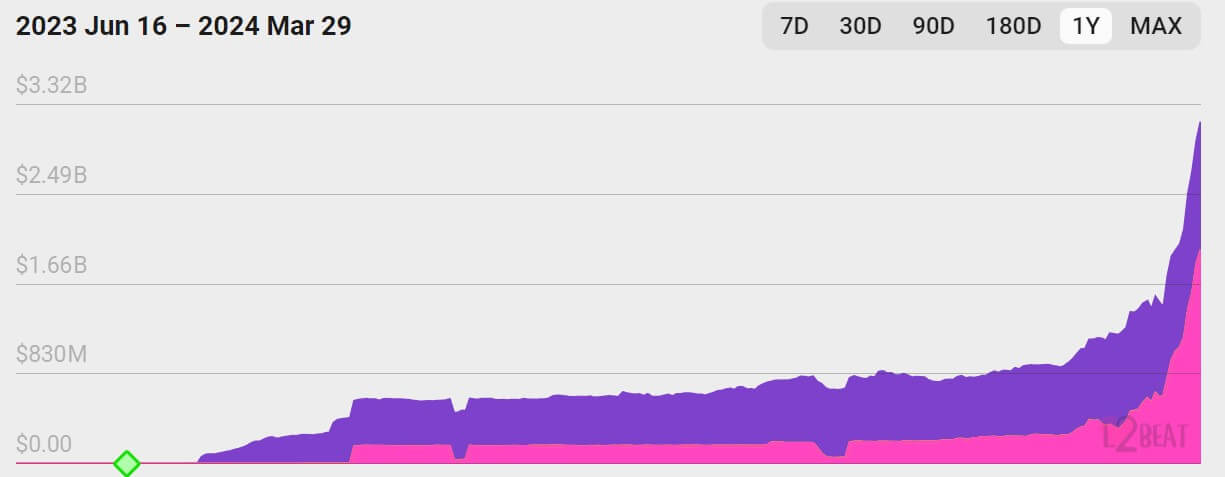
The Ethereum layer-2 network, Base, has witnessed a remarkable surge in assets locked, soaring by approximately 200% over the last month to over $3 billion, according to L2beat data.
Key contributor Jesse Pollak disclosed that Base hit the $3 billion milestone five days after crossing the $2 billion threshold. Notably, the network took 203 days to reach its first billion mark and just 23 days to touch $2 billion.
Furthermore, on-chain data shows that the increased TVL is matched with an ever-expanding user base. According to the Dune analytics dashboard curated by Watermeloncrypto, Base’s daily active users have surpassed 5 million this week, with the network’s total revenue already exceeding $36 million.

Consequently, industry experts foresee Base’s growth catalyzing the entry of more firms into on-chain development. Ryan Watkins, the founder of Syncracy Capital, said:
“Imagine when Wall Street realizes Coinbase is printing $500M+ in annual revenue from an Ethereum rollup. Base may be the ultimate catalyst that gets enterprises building onchain.”
Why Base metrics are rising
The network’s exponential growth can be attributed to various factors, including the notable surge in meme coin activities and the advent of innovative products.
There has been a notable surge in memecoins traction on Base recently. Consequently, Base has experienced heightened liquidity and more favorable market sentiment as industry analysts speculated that the assets could spearhead the next adoption phase.
Notably, CryptoSlate reported that Base’s memecoins proliferation briefly spiked its network fees above that of rival layer-2 networks despite the introduction of the Dencun upgrade. To manage this surge, the network adjusted its gas fee target to 3.75 mgas/s, which gave it 50% more capacity.
Moreover, Base has witnessed a surge in crypto developers creating new products on the layer-2 solution, further fostering adoption and usage.
For context, Base recently welcomed one of the pioneer layer-3 networks, Degen, to its ecosystem on March 28. It said:
“L3s are appchains which deliver lightning-fast transactions because they settle on L2s like Base instead of connecting directly to Ethereum. A new onchain internet demands new models for scaling, and L3s utilize the power of L2s in new ways.”
Andrew Forte, the director of business development at Dappd, also highlighted Coinbase’s recent efforts to develop a native smart wallet that does not need seed phrases or private keys for the layer-2 solution. According to him, this wallet could help drive Coinbase’s vast user base to Base.
Coinbase plans to incentivize developers to contribute to the network through grants, allowing them to build freely and rewarding those who positively impact the ecosystem.
Pollak added:
“Gas grants will be upfront, with path to scaling. Builder grants will be primarily retroactive because we’ve observed that creates aligned incentives and a strong builder culture.”
Mentioned in this article
Analysts eye MicroStrategy share price to Bitcoin holdings ratio closely as MSTR falls 11%
Quick Take
MicroStrategy (MSTR), the business intelligence firm renowned for its substantial Bitcoin holdings, experienced a significant share price decline of over 11% on March 28. The company’s shares are currently trading at $1,704, starkly contrasting the recently anticipated $2,000 mark reported by CryptoSlate just days earlier. Despite the recent setback, MSTR’s year-to-date performance remains impressive, with a remarkable 150% gain.
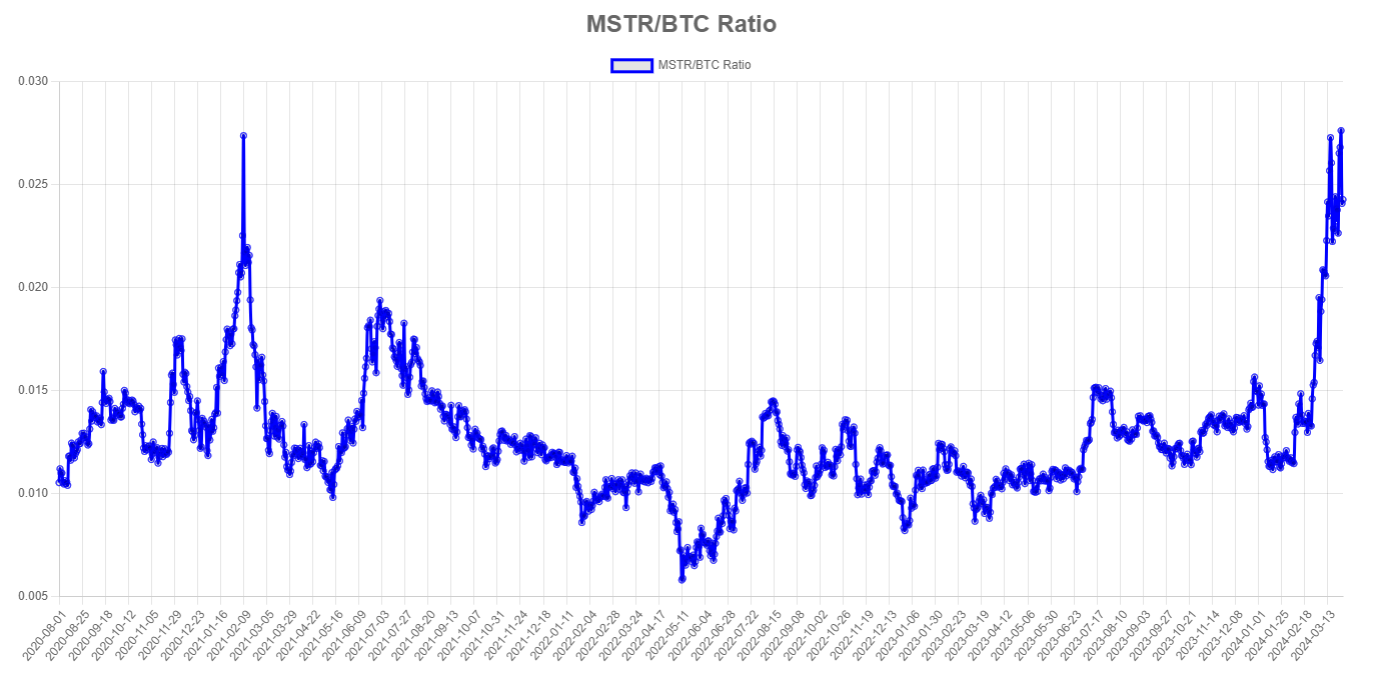
Analysts closely monitor the “MSTR/BTC Ratio,” a comparative value ratio between MicroStrategy’s stock price and the price of Bitcoin. This ratio illustrates how the company’s stock value trends in relation to Bitcoin’s market movements. Currently trading at 0.024, the ratio hit a recent high of 0.028, mirroring the levels observed in June 2021 at approximately 0.027, according to mstr-tracker.

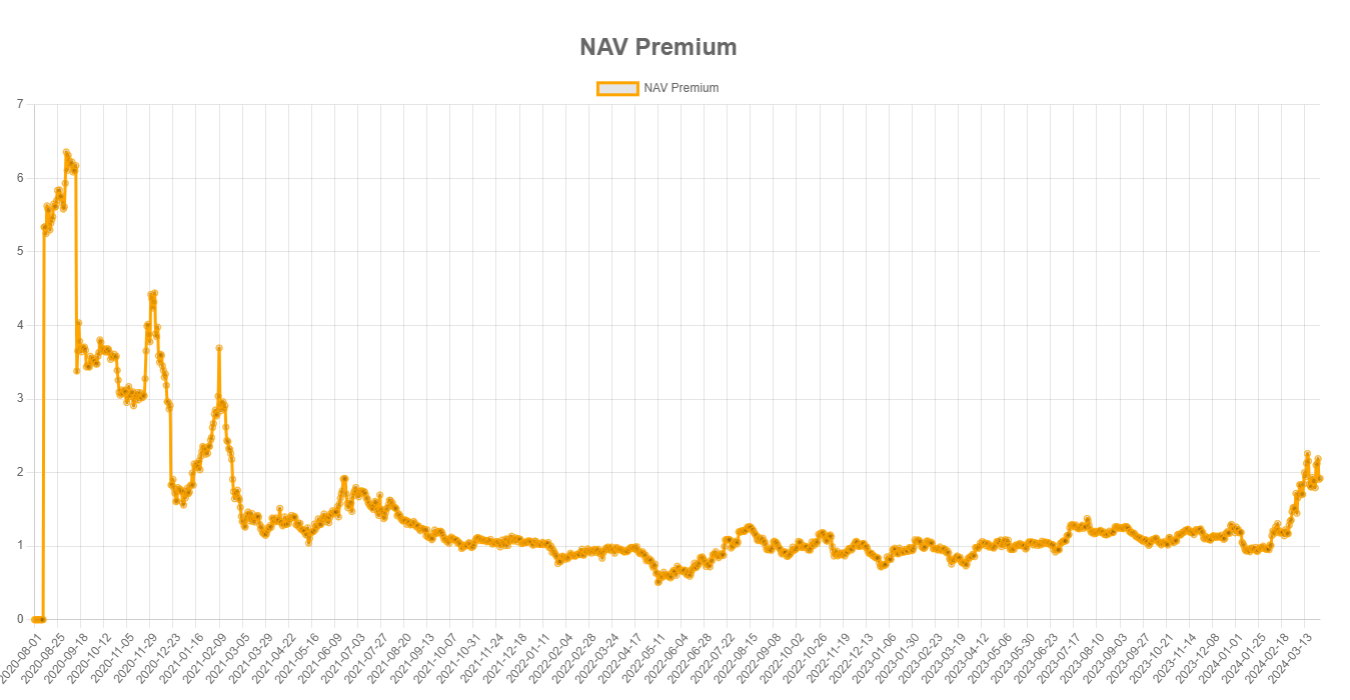
The “NAV Premium” chart, provided by mstr-tracker, which displays the premium of MicroStrategy’s stock over its proxy-NAV in Bitcoin, indicates that the market values the company’s stock at 1.92 times its Bitcoin holdings. The site has a unique methodology for defining an equivalent NAV for MicroStrategy, which considers its Bitcoin holdings, outstanding shares, share price, and market cap. Intriguingly, the current NAV figure matches the high observed in June 2021, when MSTR’s share price hovered around $500-$600, and Bitcoin traded at approximately $35,000.

The post Analysts eye MicroStrategy share price to Bitcoin holdings ratio closely as MSTR falls 11% appeared first on CryptoSlate.
Amid the recent momentum displayed by the meme-inspired cryptocurrency Dogecoin (DOGE), Rekt Capital, a crypto trader and analyst, has identified a new trend that could propel DOGE’s price to the $0.3 price mark in the short term.
Dogecoin (DOGE) Inititate New Macro Uptrend
Over the past few weeks, Dogecoin has been performing fairly well, triggering optimism and expectations for more price growth. Due to this, the top meme currency in the world in terms of overall market valuation has always generated discussion within the sector.
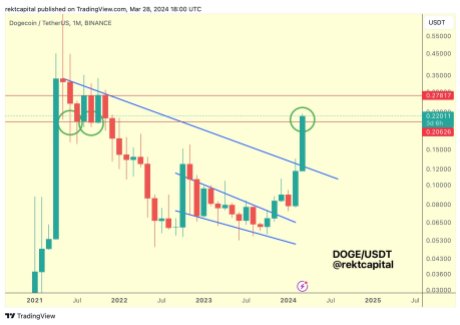
DOGE’s recent spike in price resulted in the conclusion of its Macro Downtrend, according to Rekt Capital. However, the breakout has triggered DOGE into a new Macro Uptrend on the upside.

Additionally, DOGE Monthly would recapture historical support if it closed above the red $0.20 price level. As a result, it would provide more momentum for a move towards the $0.30 range and even further.
The post read:
Dogecoin has ended its Macro Downtrend and begun a new Macro Uptrend. And if DOGE Monthly Closes above the red ~$0.20 level, it would reclaim historical support that could offer further fuel for a move towards the $0.30+ area.
It is worth noting that it took Dogecoin less than two weeks to break out from the macro downtrend after entering the area. Rekt Capital pointed out that the crypto asset successfully retested its support after breaking its macro downtrend two weeks ago.
During this period, the analyst underscored DOGE was still in the retest phase because the coin was still declining. Furthermore, the meme coin was moving sideways within a new macro range he dubbed black-red, around $0.12 and $0.20.
Prior to the breakout, Rekt Capital stated that DOGE is taking all the appropriate steps to validate its new macro uptrend. Given that the token has broken through strong resistances, it could be headed for a new peak in this cycle.
Potential Catalyst For The DOGE’s Performance
Rekt Capital’s forecast came in light of DOGE witnessing a significant increase to $0.22, its highest level in the past 2 years. It is believed that the upswing was triggered by rumors that the asset could be incorporated into Elon Musk‘s X platform very soon.
Ever since the rumors developed, Dogecoin’s price has doubled in less than a month, suggesting interest growth from investors. Dogecoin is currently the eighth-largest crypto asset by market value, with a market cap of $31.087 billion, following its remarkable price explosion.
Presently, Dogecoin is trading at about $0.21, with a notable $5.157 billion trading volume in the past day. Despite the recent price development, DOGE is still more than 50% down from its all-time high of $0.74.
The resurgence of Dogecoin in the rapidly evolving cryptocurrency space is indicative of the dynamics of the market. This huge increase also reflects the general state of the market, showing investors’ ongoing interest in meme coins today.
Featured image from iStock, chart from Tradingview.com
Disclaimer: The article is provided for educational purposes only. It does not represent the opinions of NewsBTC on whether to buy, sell or hold any investments and naturally investing carries risks. You are advised to conduct your own research before making any investment decisions. Use information provided on this website entirely at your own risk.

In this video, I will cover the recent updates regarding Palantir (NYSE: PLTR).
*Stock prices used were from the trading day of March 28, 2024. The video was published on March 29, 2024.
Should you invest $1,000 in Palantir Technologies right now?
Before you buy stock in Palantir Technologies, consider this:
The Motley Fool Stock Advisor analyst team just identified what they believe are the 10 best stocks for investors to buy now… and Palantir Technologies wasn’t one of them. The 10 stocks that made the cut could produce monster returns in the coming years.
Stock Advisor provides investors with an easy-to-follow blueprint for success, including guidance on building a portfolio, regular updates from analysts, and two new stock picks each month. The Stock Advisor service has more than tripled the return of S&P 500 since 2002*.
*Stock Advisor returns as of March 25, 2024
Neil Rozenbaum has positions in Palantir Technologies. The Motley Fool has positions in and recommends Palantir Technologies. The Motley Fool has a disclosure policy. Neil is an affiliate of The Motley Fool and may be compensated for promoting its services. If you choose to subscribe through his link, he will earn some extra money that supports his channel. His opinions remain his own and are unaffected by The Motley Fool.
Massive News for Palantir Stock Investors was originally published by The Motley Fool
SBF to serve jail term in medium security prison near San Francisco, ordered to forfeit $11 Billion

Samuel Bankman-Fried, the former CEO of FTX, has been sentenced to serve his 24-year jail time in a medium-security prison, with a recommendation for a facility as close to the San Francisco – Bay Area as possible. This decision, made by Judge Lewis A. Kaplan during the sentencing on March 28, 2024, takes into account Bankman-Fried’s notoriety, his previous association with vast wealth, and his personal challenges, including autism and social awkwardness, which are likely to make him particularly vulnerable in a high-security prison environment.
Sam Bankman-Fried was held at the Metropolitan Detention Center (MDC) in Brooklyn, New York, prior to his trial and sentencing. The MDC is known for its stringent security measures and has faced criticism for its conditions that house both pre-trial detainees and inmates serving short sentences.
The sentencing details, as outlined in the minute entry from the proceedings, reveal a complex structure, with Bankman-Fried receiving a total of 291 months (approximately 24 years and three months) in prison. This sentence is broken down across multiple counts, with specific terms to be served concurrently and consecutively, highlighting the gravity of the charges against him.
In addition to the prison sentence, Bankman-Fried has been ordered to forfeit a staggering $11,020,000,000. This forfeiture is part of the court’s efforts to address the financial ramifications of the case, which has had a profound impact on countless investors and customers of FTX. The court declined to order direct restitution due to the complexity of the case and the vast number of victims involved. Instead, it has authorized the government to compensate victims through a remission process using the forfeited assets, a decision that illustrates the challenges in providing restitution in such a large-scale fraud case.
Furthermore, upon his release from prison, Bankman-Fried will be placed under supervised release for a term of 3 years, during which he will be required to participate in an outpatient mental health treatment program and adhere to strict financial oversight.
Bankman-Fried will be around 57 years old when he is released from prison, following his subsequent supervision, it is possible he may be able to re-enter the financial sector in some form by his 60th birthday.
Mentioned in this article
Ethereum has, for the most part, established a foothold above the $3,500 price level throughout the week as investors continue to anticipate a return to the $4,000 mark. Interestingly, the optimism has seen the open interest of Ethereum surging to new highs. The surge in open interest, although a bullish sentiment indicator, can also serve as a bearish signal of an impending change in market trend.
Ultimately, this metric added to the current dynamics of the Ethereum ecosystem, including regulatory uncertainty and scalability concerns hinting at a complicated price trajectory for the price of Ethereum.
Ethereum Open Interest Reaches New High
Open interest is an efficient method for tracking the total number of open positions in a particular contract. Recent market dynamics and institutional investor interest have seen the total open interest in Ethereum futures surging above records set in the 2021 bull market phase.
According to data from Coinglass, the open interest on Ethereum futures, which has been on a surge since February 5, recently set a new high of $14.11 billion on March 15. This wasn’t particularly surprising, as a strong buying momentum from the bulls in the prior days saw the price of Ethereum surging past the $4,000 mark for the first time in two years.
However, Ethereum has since reversed from the $4,000 price level and is currently trading below $3,600. On the other hand, the total open interest on Ethereum contracts has maintained around its all-time high level, which allowed it to cross over $14.10 billion again on March 28. The open interest weighted average also went up to 0.0462%, indicating an increase in the demand for leveraged ETH long positions.
The majority ($4.55 billion) in the Ethereum futures market were registered on cryptocurrency exchange Binance. Bybit and OKX came in second and third, with $2.39 billion and $1.94 billion respectively. Interestingly, CME’s Ether futures also surged to $1.3 billion. At the time of writing, the CME’s Ether futures now sit at $1.31 billion, reiterating the committed bullishness among institutional investors.
What’s Next For ETH?
Ethereum has been trading flat since the beginning of the week and is currently on a 0.78% gain in the past seven days. All eyes are now on reports of the SEC looking into Ethereum’s security status, the industry awaits an official ruling similar to the one that was handed down in the XRP case that will finally provide clarity to the regulatory landscape.
At the same time, investors continue to await the SEC’s decision regarding the applications of Spot Ethereum exchange-traded fund (ETF) in the US. According to a Bloomberg senior analyst, the likelihood of approval is only 25%.
ETH price drops to $3,500 | Source: SHIBUSD on Tradingview.com
Featured image from Money, chart from Tradingview.com
Disclaimer: The article is provided for educational purposes only. It does not represent the opinions of NewsBTC on whether to buy, sell or hold any investments and naturally investing carries risks. You are advised to conduct your own research before making any investment decisions. Use information provided on this website entirely at your own risk.
Binance-backed HKVAEX shuts down, gives users 30 days to withdraw amid Hong Kong regulatory tightening

What is CryptoSlate Alpha?
A web3 membership designed to empower you with cutting-edge insights and knowledge, powered by Access Protocol. Learn more ›
Connected to Alpha
Welcome! 👋 You are connected to CryptoSlate Alpha. To manage your wallet connection, click the button below.
Important: You must lock a minimum of 20,000 ACS
If you don’t have enough, buy ACS on the following exchanges:
Connect via Access Protocol
Access Protocol is a web3 monetization paywall. When users stake ACS, they can access paywalled content. Learn more ›
Disclaimer: By choosing to lock your ACS tokens with CryptoSlate, you accept and recognize that you will be bound by the terms and conditions of your third-party digital wallet provider, as well as any applicable terms and conditions of the Access Foundation. CryptoSlate shall have no responsibility or liability with regard to the provision, access, use, locking, security, integrity, value, or legal status of your ACS Tokens or your digital wallet, including any losses associated with your ACS tokens. It is solely your responsibility to assume the risks associated with locking your ACS tokens with CryptoSlate. For more information, visit our terms page.