The U.S. Securities and Exchange Commission (SEC) is seeking nearly $2 billion in fines from Ripple Labs in the ongoing XRP lawsuit. “There is absolutely no precedent for this,” exclaimed Ripple’s CEO regarding the $2 billion fine. “We will continue to expose the SEC for what they are when we respond to this.” SEC Wants […]
Source link

CoinNews
Chainlink (LINK) has performed strongly over the past week, with the token’s price increasing 21.3% in the last seven days. Some analysts have shared their predictions and thoughts on LINK, suggesting keeping an eye on the token and its long-term performance.
What Is LINK’s Next Steppingstone?
Recently, Chainlink announced its partnership with blockchain platform Avalanche and the Australia and New Zealand Banking Group to connect the Avalanche and Ethereum blockchains using Chainlink’s Cross-Chain Interoperability Protocol (CCIP).
As reported by NewsBTC, the partnership aims to facilitate the “access, trade, and seamless settlement of tokenized assets across networks in different currencies in a process called Delivery vs. Payment (DvP).”
The crypto community appeared to receive the news well. X users expressed their positive sentiments towards the collaboration and Chainlink’s token. The sentiment has seemingly translated to LINK’s performance, as the token’s price soared 9% in the last 24 hours.
Crypto analyst and trader The Lord of Entry shared his prediction for LINK. In the X post, the trader highlights that the token’s performance in the past day had been strong as it broke above the $18.5 resistance level. Chainlink’s LINK unsuccessfully tested the resistance zone over the past week after falling below it on March 18.
$LINK 4hr – #LINK has been strong today, but now banging into some resistance – if it can flip this into support your next big target is around 28#LINKusdt pic.twitter.com/YlCDRDOFTq
— @TheLordofEntry (@thelordofentry) March 26, 2024
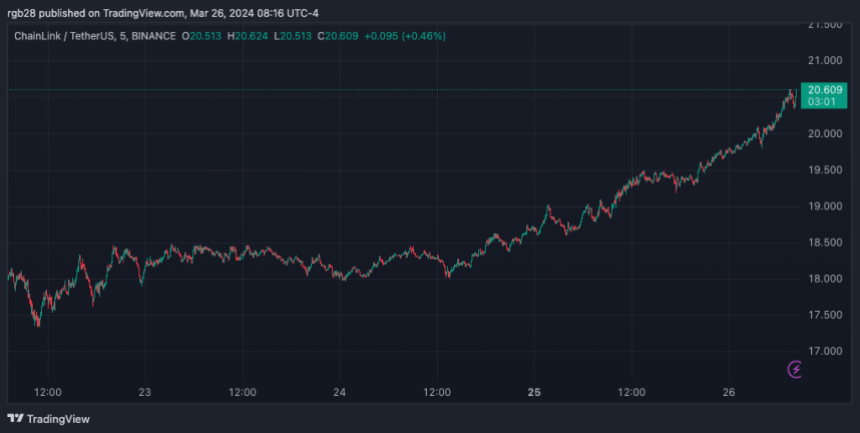
The token continued the upward trajectory throughout the day after successfully rising above the $18.5 price. In the early hours of Tuesday, LINK surged above the $20 mark but faced resistance near the $20.5 range.
According to the trader, if the token can break above this level and turn it into a support zone, the next big target for LINK would be the $28 price range.
As of this writing, LINK tested this new resistance level, which has been rising above it twice in the past hour. The token reached $20.6 in the first attempt and briefly surpassed the $20.7 price range during the second attempt. However, the token momentarily failed to flip the resistance zone and fell below $20.5 again.
Chainlink’s “Very Strong” Long-Term Performance
Despite the failed attempts, LINK’s price surged 9% in the past 24 hours. Interest in the token has seemingly risen in the same timeframe as its market activity increased by 55.19%, reaching a daily trading volume of $539.9 million.
Its market capitalization also increased by 8.16% in the past day, reaching $12.02 billion. Chainlink is the 14th-largest cryptocurrency by this metric, according to CoinMarketCap data.
Moreover, LINK has shown a remarkable 182.6% performance in the last year. As a result, crypto analyst Altcoin Sherpa shared some notes on LINK, suggesting that it shouldn’t be actively traded. Sherpa stated that the token is a better fit to “buy and hold” as it is a “safe coin that is going to do strong numbers.”
$LINK: A few notes w. this one-
-you shouldn’t be actively trading this. Loads more volatile coins (though this has nice liquidity)
-Better to buy and hold, this is a safe coin that is going to do strong numbers
-Still fundamentally v. strong, 1 of the best.
-still expecting… pic.twitter.com/NeJAm2ixXj
— Altcoin Sherpa (@AltcoinSherpa) March 25, 2024
The analyst considers LINK fundamentally “very strong” and one of the best tokens based on its long-term performance. Ultimately, Sherpa predicts the price will “consolidate for a bit longer before its next move.”

Chainlink hits $20.6 in the 3-day chart chart. Source: LINKUSDT on Trading.view.com
Featured Image from Unsplash.com, Chart from TradingView.com
Disclaimer: The article is provided for educational purposes only. It does not represent the opinions of NewsBTC on whether to buy, sell or hold any investments and naturally investing carries risks. You are advised to conduct your own research before making any investment decisions. Use information provided on this website entirely at your own risk.
In the XRP lawsuit, the US Securities and Exchange Commission (SEC) filed its motion for remedies and entry of final judgment against Ripple, proposing a suite of penalties that includes injunctive relief, disgorgement of profits, and a notable $2 billion in civil penalties today. But that’s not the whole story as the 210-page document contains some interesting statements and assertions.
#XRPCommunity #SECGov v. #Ripple #XRP The @SECGov has filed its Motion for Remedies and Entry of Final Judgment, its Memorandum of Law in Support of that Motion, and its “Proposed” Judgment.
— James K. Filan 🇺🇸🇮🇪 (@FilanLaw) March 26, 2024
Did Ripple Favor Select Institutional Investors?
One of the assertions made in the SEC document and pointed out by XRP community lawyer Bill Morgan was a key revelation that Ripple engaged in discriminatory pricing practices, offering substantial discounts on XRP tokens to a select group of institutional investors. This practice, the SEC alleges, created an uneven playing field, benefiting certain “favored” investors at the expense of others.
XRP community lawyer Bill Morgan provided a summary of this aspect, highlighting the potential damage to Ripple’s standing in the eyes of institutional investors. “The SEC’s brief is a possible problem for Ripple beyond this case. The SEC is able to argue that there were two groups of institutional sales investors (it calls them favored and unfavored) and Ripple offered one group significant discounts in XRP price over the other group that did not receive them,” Morgan noted via X (formerly Twitter).
He further delved into the SEC’s claim that such practices harmed the “unfavored” group of investors to the tune of $480 million, a figure based on assumptions that Morgan suggests need thorough examination. “The evidence of causation of this alleged harm seems thin,” he added.
The SEC’s filing goes on to argue that Ripple’s sales tactics, specifically the discounted sales to certain investors, directly contributed to downward pressure on the overall market price of XRP. This point is not just a matter of regulatory compliance but also raises the specter of legal action from those institutional investors who may feel aggrieved by not being privy to the same discounts.
Morgan also touched upon the ramifications of these actions being classified as investment contracts by the SEC, saying, “As these sales to institutions were found to be investment contracts, it means that this offering of discounts to some but not other institutions is the very disclosure according to the SEC that should have, and would have been made to the institutions, if the sales to institutions had been registered.”
He further noted that these claims by the SEC are also not great for the reputation of Ripple. “Not sure this revelation is great for Ripple’s reputation with institutional investors,” Morgan remarked.
Ripple CLO Alderoty Responds
Ripple’s Chief Legal Officer, Stuart Alderoty, also issued a broad response to the SEC’s filing via X, vehemently disputing the narrative presented by the regulatory body. Alderoty stated, “Our response will be filed next month, but as we all have seen time and again, this is a regulator that trades in statements that are false, mischaracterized and designed to mislead.”
He further attacked the SEC for its illegitimate reasoning, stating: “They stayed true to form here. Rather than faithfully apply the law, the SEC remains bent on wanting to punish and intimidate Ripple – and the industry at large. We trust the Court will approach the remedies phase fairly.”
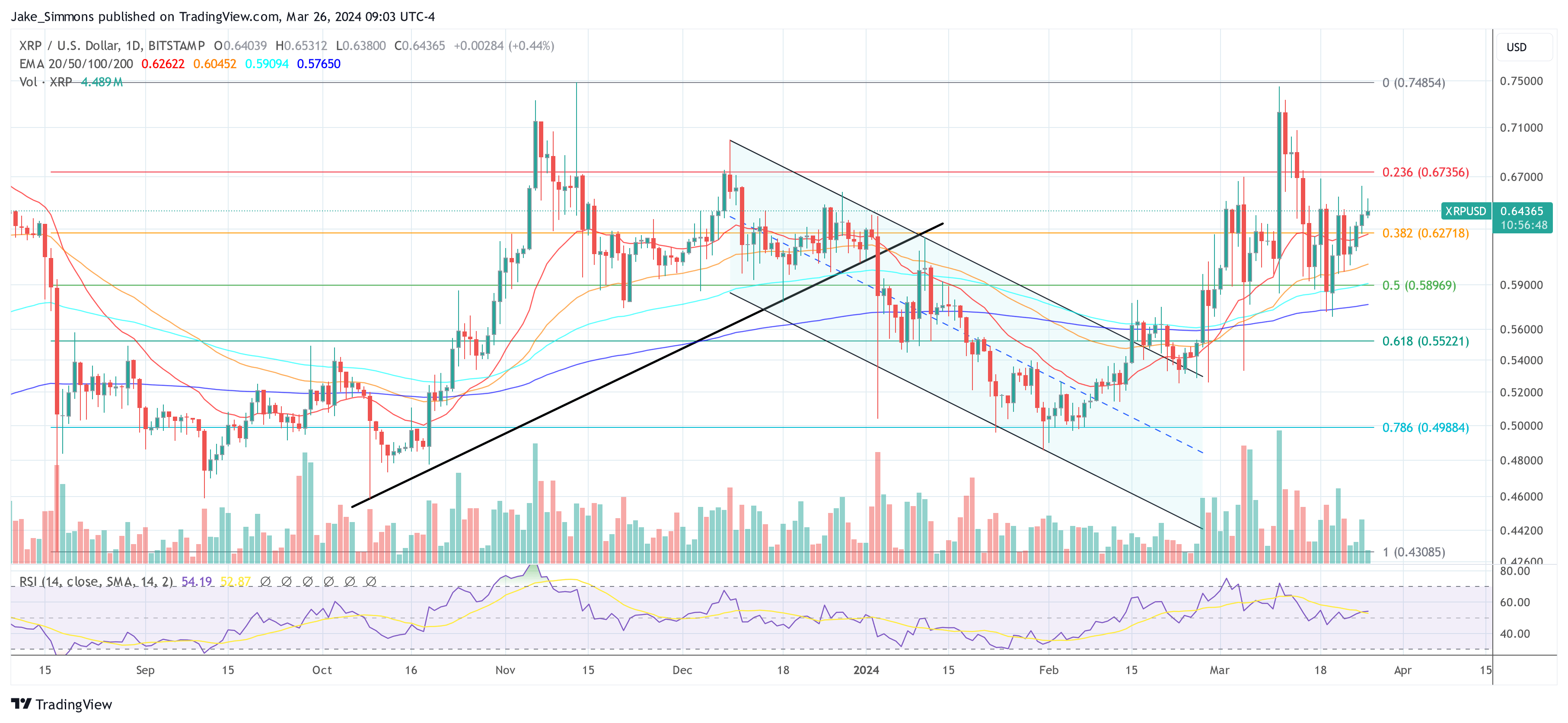
At press time, XRP traded at $0.64365.

Featured image from Shutterstock, chart from TradingView.com
Disclaimer: The article is provided for educational purposes only. It does not represent the opinions of NewsBTC on whether to buy, sell or hold any investments and naturally investing carries risks. You are advised to conduct your own research before making any investment decisions. Use information provided on this website entirely at your own risk.

Portugal’s National Data Protection Commission (CNPD) said on March 26 that it will ban Worldcoin from collecting biometric data for three months.
The CNPD said that the limitations apply for 90 days until an investigation is concluded and a final decision is reached. The ban applies to biometric data on the iris, eyes, and face.
Ban details
CNPD imposed the ban for several reasons. First, Worldcoin allegedly has “no mechanism for verifying the age of members” and allegedly collected data from minors without parental permission.
Additionally, Worldcoin did not provide sufficient information to users on some matters, leaving users unable to delete their data or revoke consent.
CNPD said that the General Data Protection Regulation (GDPR) includes special protections for both biometric data and minors. It also mentioned other possible violations of GDPR standards and said that all of these factors justified urgent intervention against Worldcoin.
Paula Meira Lourenço, President of the CNPD, called the new measures “an indispensable and justified measure” at the moment as they will protect the rights of the public and minors.
Worldcoin denies wrongdoing
According to a separate report from Reuters, Worldcoin has denied any wrongdoing and claimed that it does not allow minors to register through the ORB.
Worldcoin Foundation’s data protection officer, Jannick Preiwisch, said Worldcoin is “fully compliant with all laws and regulations in its operating areas.
Preiwisch said that Worldcoin had not previously heard from the CNPD about the issues. He asserted that Worldcoin has “zero tolerance” for registrations by minors and said the project is addressing the reports.
Worldcoin emphasized that it recently introduced a user-controlled Personal Custody model, giving users greater control over their data. It initially announced the new model on March 22 as it released its Orb software under an open-source license.
Spain also imposed a three-month ban on Worldcoin’s data collection activities on March 6 for identical reasons. The biometric data collection has raised concerns among regulators in several other countries as well, with Kenya labeling it “espionage.”
The post Portugal imposes 3 month data collection ban on Worldcoin appeared first on CryptoSlate.
This American City Is Offering $1 Homes In Its Crime-Filled Neighborhoods, Sparking Concerns of Gentrification And Violence

With home affordability near its lowest level in over 40 years because of high mortgage rates and home prices, being able to purchase a home for $1 might seem impossible.
However, the city of Baltimore is offering a deal intended to attract new homebuyers. It’s practically giving away houses.
An estimated 13,000 homes in Baltimore are vacant with the city owning about 1,000 of them.
Don’t Miss:
For now, 200 of these properties have been approved to be marketed to Baltimore residents who commit to both living in and fixing up the properties, with city officials saying properties in the program are in the city’s most “stressed” housing markets.
The program was approved despite objections from City Council President Nick Mosby, who said that the new policy left him “deeply concerned.”
“If affordability and affordable home ownership and equity and all of the nice words we like to use are really at the core competency as it relates to property disposition, this is a really bad policy … because it doesn’t protect or prioritize the rights of folks in these communities,” Mosby said.
Other city officials pushed back on the characterization, pointing out that there is a 90-day window that gives Baltimore locals the right to buy before outsiders are allowed to make bids.
Trending: Fortnite’s creator company greenlights partial ownership for investors in the upcoming series.
It’s worth noting that the $1 deal isn’t available to everyone — just individual buyers and community land trusts. Still, developers would only have to pay $3,000, leading to possible opportunities for large profits if home values in the areas increase.
While the chance to get a home for $1 might sound like anyone could participate in the city’s offerings, a prospective buyer needs to be able to afford the costs to make many of these vacant homes safe to live in.
To help contribute to the initiative, the city is also giving out home-repair grants of up to $50,000 to individuals who prequalify for a construction loan.
Resident Maurice Brock warned of the dangers from these properties, telling WJZ-TV in Baltimore, “There are so many risks and hazards associated with these vacant properties … it’s a definite safety risk for citizens, for city employees and firefighters.”
Given that the city of Baltimore regularly ranks in the top five U.S. cities for violent crime, safety concerns are valid, especially as these properties are already in some of the toughest areas of the city.
Prospective homeowners or investors looking to invest in real estate without the headache of owning the actual property can consider purchasing real estate investment trust (REIT) stocks or buying into a fund such as the Vanguard Real Estate Index Fund ETF (NYSE:VNQ), which invests in a diversified basket of REITs.
Read More:
“ACTIVE INVESTORS’ SECRET WEAPON” Supercharge Your Stock Market Game with the #1 “news & everything else” trading tool: Benzinga Pro – Click here to start Your 14-Day Trial Now!
Get the latest stock analysis from Benzinga?
This article This American City Is Offering $1 Homes In Its Crime-Filled Neighborhoods, Sparking Concerns of Gentrification And Violence originally appeared on Benzinga.com
© 2024 Benzinga.com. Benzinga does not provide investment advice. All rights reserved.
Badgerdao, in partnership with Lido, has unveiled eBTC, an ether-backed synthetic bitcoin token aimed at enhancing the decentralization and capital efficiency of borrowing bitcoin in the decentralized finance (defi) space. Badgerdao and Lido Forge Partnership to Launch eBTC Badgerdao, a decentralized autonomous organization (DAO) committed to integrating bitcoin (BTC) into defi, has announced the launch […]
Source link
Bitcoin Held On Coinbase Exchange Reach 9-Year Low, Can Bitcoin Reach $75,000?
In a recent development, data from crypto analytics firm Glassnode shows that the amount of Bitcoin held on Coinbase has reached a 9-year low. This has raised the possibility of the flagship crypto rising to a new all-time high (ATH) of $75,000 soon enough.
BTC Held On Coinbase Drops Significantly
According to Glassnode, the Bitcoin balance on Coinbase dropped to a nine-year low of 344,856 on March 18. This suggests that Bitcoin investors are choosing to move their holdings off exchanges and hold for the long term rather than sell anytime soon. A move like this reduces the short-term pressure on Bitcoin and could spark an upward trend in BTC’s price.
Meanwhile, the drop in BTC held on Coinbase looks to be a trend, with data from market intelligence platform Santiment showing a drop in the total amount of Bitcoin held on centralized exchanges (CEXs). This data is also supported by the fact that these exchanges have recorded more outflows than inflows lately.
Further data from Santiment also shows that the supply on exchanges as of March 22 stood at just over 836,000 BTC compared to the 18.82 million BTC that resides out of these CEXs. The decline in the number of BTC held on exchanges is undoubtedly a welcome development, considering how the flagship crypto token has recently been plagued with a wave of profit-taking.
Before now, the bearish sentiment surrounding BTC was further strengthened by JPMorgan’s theory that Bitcoin was overbought and that the crypto token could experience further price declines soon enough. However, with BTC back over $70,000, there is the belief that this is just the beginning of an upward trend that could see it reach new highs.
Spot Bitcoin ETFs Record Net Inflows
BitMEX Research revealed in an X (formerly Twitter) post that the Spot Bitcoin ETFs recorded a combined net inflow of $15.7 million on March 25. This represents a positive turn of events after these funds recorded negative flows throughout last week. The wave of profit-taking by these Bitcoin ETF investors contributed to the BTC dip that occurred during that period.
The crypto community will no doubt keep their eyes on the flows recorded by these Spot Bitcoin ETFs this week as they could give an idea of whether or not the outlook towards BTC has become bullish again. These Bitcoin ETFs now play a prominent role in the Bitcoin ecosystem, considering how much BTC these fund issuers accumulate whenever there is a high demand for them.
At the time of writing, Bitcoin is trading at around $70,700, up over 5% in the last 24 hours according to data from CoinMarketCap.
BTC price trending north of $70,000 | Source: BTCUSD on Tradingview.com
Featured image from BBC, chart from Tradingview.com
Disclaimer: The article is provided for educational purposes only. It does not represent the opinions of NewsBTC on whether to buy, sell or hold any investments and naturally investing carries risks. You are advised to conduct your own research before making any investment decisions. Use information provided on this website entirely at your own risk.