
3 Stocks That Can Turn $10,000 Into $50,000 by 2025

T-Mobile Pushes the Envelope on Pricing

Warren Buffett Dumps 45% of This Auto Stock: Time to Panic?
Warren Buffett Will Collect $4.31 Billion in Annual-Dividend Income From These 5 Stocks



3 Stocks That Can Turn $10,000 Into $50,000 by 2025
T-Mobile Pushes the Envelope on Pricing
Warren Buffett Dumps 45% of This Auto Stock: Time to Panic?
Warren Buffett Will Collect $4.31 Billion in Annual-Dividend Income From These 5 Stocks

On-chain data shows the Bitcoin NVT ratio is currently flashing a buy signal, a sign that the bottom for the asset’s price might now be in.
As pointed out by an analyst in a CryptoQuant post, the Network Value to Transactions (NVT) Golden Cross has now dipped below the -2 mark. The “Network Value to Transactions (NVT) ratio” is an indicator that measures the ratio between the Bitcoin market cap and transaction volume (both denominated in USD).
When the value of this metric is high, it means that the price of the asset (that is, its market cap) is high when compared to its ability to transact coins (the transaction volume). Such a trend may imply that BTC is overvalued right now.
On the other hand, low values can suggest that the market cap isn’t that much relative to the volume, so the cryptocurrency’s price may be undervalued at the moment.
In the context of the current discussion, the NVT ratio itself isn’t of interest, but rather a modified form of it called the “NVT Golden Cross” is. This new indicator aims to pinpoint tops and bottoms in the NVT ratio by comparing its 30-day moving average (MA) with the 10-day one.
Now, here is a chart that shows the trend in the Bitcoin NVT Golden Cross over the past year:
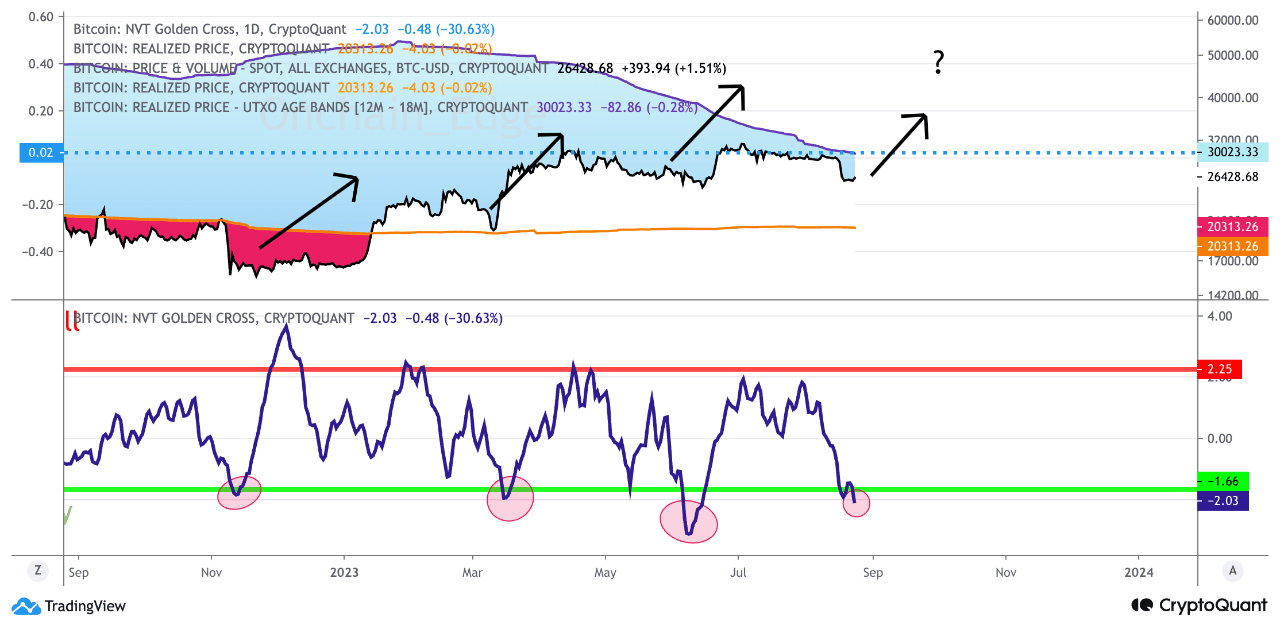
Looks like the value of the metric seems to have been heading down in recent days | Source: CryptoQuant
As displayed in the above graph, the Bitcoin NVT Golden Cross has plunged recently as the cryptocurrency’s price has gone through a crash. Following the latest drawdown, the indicator is now deep inside the negative territory, at a value below -2.
In the chart, the quant has marked two lines for the metric that have held some significance for the asset during the past. The first of these (marked in red) takes place at around 2.2, while the other one (green) is at -1.6.
Historically, whenever the NVT Golden Cross has crossed above the former line, the cryptocurrency has generally observed the formation of a local top. Similarly, a break below the latter level has resulted in bottoms for the coin.
From the chart, it’s clear that the indicator has now dipped firmly below the bottom line, implying that Bitcoin might be undervalued currently. In the past year, there have been three other instances of the indicator plunging below the line, each coinciding with some sort of low for the price.
The first two of these had reached bottom values similar to now, while the third occurrence (which is the latest one) saw the NVT Golden Cross dip much deeper towards the -3.1 mark before the bottom was hit.
It’s unclear which scenario might play out for Bitcoin this time, but one thing may be clear from this pattern: the bottom could be near for the cryptocurrency, or may even already be in.
At the time of writing, Bitcoin is trading at around $26,500, down 7% in the last week.
BTC hasn't made much recovery yet | Source: BTCUSD on TradingView
Featured image from Michael Förtsch on Unsplash.com, charts from TradingView.com, CryptoQuant.com

The Tesla Cybertruck during a tour of the Elkhorn Battery energy storage system in Moss Landing, California, June 6, 2022.
Nik Coury | Bloomberg | Getty Images
Tesla CEO Elon Musk has been promoting the company’s long-delayed, sci-fi inspired Cybertruck on social media this week. However, the electric vehicle maker still hasn’t issued final pricing and specs for the trapezoidal pickup, which it first unveiled in November 2019, and a company-wide email sent by Elon Musk implies he’s worried about “precision” in manufacturing the truck because its “straight edges” mean variations show up “like a sore thumb.”
In its second-quarter financial filing with the U.S. Securities and Exchange Commission, Tesla said its factory in Austin, Texas, was working on “tooling” for the Cybertruck, and production status was not yet active. The company also said in a shareholder deck that it was “working on equipment installation for Cybertruck production, which remains on track for initial deliveries this year.”
The company has not said when it expects to be able to mass produce the vehicle.
On Wednesday, Musk shared a post on X, formerly Twitter, with an image of the Cybertruck, saying, “Just drove the production candidate Cybertruck at Tesla Giga Texas!” In automotive manufacturing, a “candidate” is an early model of a vehicle that the manufacturer uses to gauge the quality of its production systems and vehicle assembly lines.
A Tesla promoter and fan pressed Musk for more details on the social platform Wednesday, writing in a post, “Enough with the hype, let’s get down to business. Please announce the specs, pricing and new estimated delivery event date.”
The Tesla CEO, who also owns and runs X after a $44 billion buyout last year, replied: “When we are ready to do so, we will. While I think it is our best product ever, it is an extremely difficult product to build. We are in uncharted territory, because it is not like anything else.”
Musk also sent an email to “everybody” at Tesla on Wednesday about the Cybertruck and the challenges of producing the vehicle. Tesla employees shared a copy of the email with CNBC and asked to remain unnamed since they were not authorized to speak with press about internal matters. News of the memo was previously published by Electrek.
What Musk said in the email implies that Tesla is still struggling with Cybertruck quality. Shares of Tesla were dipping slightly early Thursday following Musk’s Cybertruck comments and the email.
Here’s what the email said, as transcribed by CNBC.
From: Elon Musk
To: Everybody
Date: August 23, 2023 [time stamp removed]
Subj. Cybertruck Precision
Due to the nature of Cybertruck, which is made of bright metal with mostly straight edges, any dimensional variation shows up like a sore thumb.
All parts for this vehicle, whether internal or from suppliers, need to be designed and built to sub 10 micron accuracy.
That means all part dimensions need to be to the third decimal place in millimeters and tolerances need be specified in single digit microns.
If LEGO and soda cans, which are very low cost, can do this, so can we.
Precision predicates perfectionism.
Elon


The Cayman Islands has long been an idyllic beach getaway for tourists, but the archipelago could soon welcome Bitcoin (BTC) holders as new residents through BTC-backed loans used to invest in real estate.
Bitcoin banking firm Ledn, which is registered with the Cayman Islands Monetary Authority as a virtual assets service provider (VASP), is providing an avenue for Bitcoin holders to use their BTC as collateral for loans to invest in real estate on the islands.
This is just one avenue that prospective new residents of the islands could take to obtain citizenship, with investments over $2.4 million in real estate in the Cayman Islands qualifying a buyer for permanent residency.
Related: Noted tax haven Cayman Islands sees new bills to bring local crypto to FATF’s heel
Speaking directly to Cointelegraph, Ledn CEO Adam Reeds unpacked a new partnership with local real estate agency Parallel, which has also facilitated a number of cryptocurrency-based property sales in the Cayman Islands.
“Ledn will provide real estate buyers in the Caymans with crypto-backed loans, which Parallel will accept as a means to finance purchases. Parallel will only accept borrowed funds if they’ve been loaned by Ledn — it is an exclusive partnership in this sense.”
According to Reeds, Parallel handles conversion to fiat currency if either a buyer or seller prefers the option over a cryptocurrency payment. Meanwhile, Ledn’s portion of any transaction will be fiat-free, paid in either BTC or United States dollar-backed stablecoins.
“Parallel is a crypto-centric real estate broker in the Caymans, so users can now finance their purchase of real estate completely fiat-free.”
It is also possible for cryptocurrency holders to pay for a property with crypto in the Cayman Islands through Parallel. Reeds, however, highlighted a potential draw card in that investors can leverage their BTC holdings as collateral without selling a portion.
“Then if or when BTC goes up, your loan-to-value ratio goes down, so your house is appreciating, and so is the asset you’re borrowing against.”
Given that Parallel has previously sold real estate in cryptocurrency-facilitated transfers, Reeds added that both companies have seen demands for the service to finance significant property transactions.
The real estate firm sold a $10 million property in December 2022, which was paid for entirely in cryptocurrency. The company is also registered as a VASP with the Cayman Islands Monetary Authority, allowing it to facilitate cryptocurrency transactions.
Both Ledn and Parallel must adhere to comprehensive compliance requirements as part of their registration with the local monetary authority.
The concept of attaining residency by investment involving cryptocurrencies is not entirely new. Vanuatu claims to be the first country to accept Bitcoin as a means of payment to obtain citizenship by investment.
A number of other countries have emerged as cryptocurrency-friendly destinations to try and obtain citizenship. Portugal, Malta and El Salvador have all emerged as relatively crypto-friendly countries, but it is still not possible to directly invest in Bitcoin to obtain or be eligible for residency.
Magazine: Tokenizing music royalties as NFTs could help the next Taylor Swift

U.K. regulators want to ban cold calls for consumer financial services, and the crypto sector will likely be one of the affected industries. This is part of the U.K. Treasury Fraud Strategy introduced in May to curb fraudulent activities in the country.
In a recent consultation paper published by His Majesty’s Treasury, the government has invited public input regarding the potential impacts of a complete ban on businesses. Stakeholders are encouraged to provide their perspectives and supporting evidence on this matter.
The consultation paper presented various case studies illustrating instances where scammers employed cold calling to deceive investors. One of these cases specifically revolved around cryptocurrency.
While the individual’s identity was altered, this particular case highlighted an investor’s unfortunate loss of £65,000 after being persuaded to invest in cryptocurrencies via a cold call.
The paper, citing data from OFCOM, said 80% of U.K. landline users received suspicious calls between August and November 2022. Thus, these case studies and the rise in suspicious calls further show the need to regulate cold calling.
“Cold calling for financial services and products has long been the tool of choice for fraudsters seeking to manipulate unsuspecting individuals into scams, especially targeting the most vulnerable,” the paper noted.
Regulations governing cold calling have proven largely ineffective, prompting the move towards an outright ban. This ban encompasses a range of products and services, notably crypto assets, banking, insurance, mortgages, and various tangible investments. However, exceptions will be made for cold calls when consumers provide explicit and specific consent.
In recent months, various nations have intensified efforts to combat cryptocurrency-related fraud. In Australia, prominent banks have taken proactive steps, including suspending payments to high-risk crypto exchanges and implementing enhanced security measures to protect their customers better.
Meanwhile, Belarus is pursuing legislation to prohibit decentralized exchanges and peer-to-peer trading, aiming to channel all cryptocurrency transactions exclusively through regulated exchanges.
The post UK treasury eyes cold calling ban impacting crypto industry appeared first on CryptoSlate.

3 Stocks That Can Turn $10,000 Into $50,000 by 2025

Warren Buffett Dumps 45% of This Auto Stock: Time to Panic?

T-Mobile Pushes the Envelope on Pricing

A Bull Market Is Coming: 2 Red-Hot AI Growth Stocks to Buy Hand Over Fist Before They Soar 40% to 85%


Being rich and being wealthy are often seen as being the same thing. After all, people who are rich or wealthy tend to have more assets and greater financial freedom than the typical person. In reality, there are some major differences that define what it means to be rich vs. wealthy. If your financial goals include rising to the ranks of the rich or growing wealth, it’s important to know how they compare.
A financial advisor can help you create a financial plan for your wealth management needs and goals.
Finding a qualified financial advisor doesn’t have to be hard. SmartAsset’s free tool matches you with up to 3 fiduciary financial advisors in your area in 5 minutes. Each advisor has been vetted by SmartAsset and is held to a fiduciary standard to act in your best interests.
If you’re ready to be matched with local advisors that can help you achieve your financial goals, get started now.
What Does It Mean to Be Rich?
Income is often used as a standard when measuring what it means to be a rich person. So what income is considered rich?
If you’re looking at the top 1% of earners, then you’d need an annual income of $540,009 to be rich, according to the Internal Revenue Service (IRS). The Economic Policy Institute (EPI) defines the top 1% as people who earn $819,324 or more per year.
What about the top 5% or the top 20%? If you think of the top 5% as being rich, then you’d need to make $335,891 per year according to the EPI. If you’d like to crack the top 20%, you’d need to earn $130,545 per year, according to a SmartAsset analysis of income distributions in the top 100 largest U.S. cities.
It’s important to keep in mind that income alone does not necessarily determine whether you’re rich or not. Someone who makes a higher income but spends instead of saving or has significant amounts of debt, for example, may live a rich lifestyle but be broke on paper.
What Does It Mean to Be Wealthy?
Wealth is often defined in terms of net worth. Net worth is a measurement of the difference between your assets and liabilities.
Generally, a liquid net worth of $1 million would make you a high net worth (HNW) individual. To reach very high net worth status, you’d need a net worth of $5 million to $10 million. Individuals with a net worth of $30 million or more might qualify as ultra-high net worth.
Those numbers reflect how the financial industry typically views wealth. The average American views a net worth of $774,000 as enough to be financially comfortable, with a net worth of $2.2 million required to be wealthy. That’s according to Schwab’s 2022 Modern Wealth Survey.
If you’re ready to be matched with local advisors that can help you achieve your financial goals, get started now.
Differences Between Rich vs. Wealthy

Looking at income or net worth is just one way to separate the rich from the wealthy. Again, however, how you use the income and assets that you have matters when determining where you land on the financial spectrum.
Here are some of the key differences between the rich vs. the wealthy.
Money mindset. Someone who is rich may see money as a means of getting the things they want. Money helps them live a certain lifestyle and they may tend to take more of a short-term view of their finances. It’s possible to be considered rich based on income and still live paycheck to paycheck, for example.
Wealthy people may see money as a tool for achieving short- and long-term financial goals. They may be less concerned with what they can buy with their money versus how they can use it to create additional wealth.
Spending habits. How a rich person spends their money may be very different from how a wealthy person spends. Someone who’s rich may enjoy spending money on fancy clothes, cars or vacations. They may not observe a strict budget or track their spending closely.
A wealthy person, on the other hand, may prefer to spend on items that are likely to hold their value for the long term or appreciate in value, such as fine art, real estate or high-end jewelry. By spending money on those types of assets, they can increase their net worth and wealth.
Expenses and debt. Someone who’s rich may supplement their income with credit cards or have a higher-than-average cost of living. For example, they may have one or more car leases or car payments or pay for their children to participate in pricey extracurriculars. They might also have an expensive mortgage because they purchased a home in an upper-scale neighborhood, which can mean paying higher property taxes as well.
Wealthy people may see credit cards as more of a convenience than a means of funding a certain lifestyle. They may have a higher cost of living, but they have a higher income sufficient to maintain it. If they have debt, it may be linked to assets that are likely to grow in value, such as homes, yachts or collectible cars. Their monthly spending plan may include expenses that a rich person’s may not, such as payments to housekeepers, groundskeepers or personal staff.
Income. A rich person may derive their income from just one or two streams. For example, they may work a full-time job or run a business. Their income is typically entirely dependent on them doing some type of work to earn money.
Wealthy people often have more than one stream of income. They may earn money from working but they also derive income from investments, business ventures or consulting. Some of their income streams may be passive, meaning they don’t require much or any work at all in order to make money.
Savings and investments. A rich person may have an emergency fund and be investing for retirement through their 401(k) or a similar workplace plan. They might also have an IRA or a taxable brokerage account, which they use to trade stocks, exchange-traded funds or cryptocurrency. They may or may not work with a financial advisor on a regular basis.
Someone who’s wealthy may have an extensive portfolio that includes commercial real estate, business holdings, hedge funds, gold and precious metals, artwork or fine wine. They likely have a financial advisor and or/a private wealth manager who offers advice on building their portfolio and making smart investments to increase wealth.
Financial planning. As mentioned, someone who’s rich may work with a financial advisor to develop a plan for managing their money. That plan might include saving for retirement, paying down debt or higher education planning for their kids.
Wealthy individuals may have a broader scope of issues to tackle when formulating their financial plan. For example, they may be interested in philanthropic efforts and charitable giving. Or they may need specialized advice with regard to estate planning and the most effective strategies for passing on a legacy of wealth to their children, grandchildren or great-grandchildren.
How to Become Wealthy
If you’d like to become wealthy, you’ll need to have a plan in order to get there. Starting your planning early gives you a longer time frame in which to achieve your wealth goals. But even if you’re getting a later start, it’s still possible to reach a net worth of $1 million or more.
Here are some of the key steps for building wealth.
Invest consistently. Investing money in the market offers greater potential for growth than simply saving it. One of the secrets to creating wealth is investing on a regular basis. Contributing 10 to 15% of your paychecks to your 401(k) or an IRA automatically can be one of the easiest ways to do that.
Diversify your investments. Diversification allows you to manage risk and achieve the level of returns you desire. If you’ve only invested in stocks up to this point, for example, consider how you can broaden your horizons. Real estate, for example, can be an excellent hedge against inflation and generate consistent passive income over time.
Streamline spending and debt. Frivolous spending or overspending, paired with high levels of debt, can be significant roadblocks to growing wealth. If you’re not following a monthly budget or you’re carrying a substantial amount of debt, improving in those areas could help you get closer to wealthy status. Talking to a financial advisor can give you insight into how to get spending under control and pay down debts.
Set clear goals. What being wealthy means to you might be different from someone else and it’s important to have specific goals in mind. For example, if you believe having $2 million in assets would make you wealthy then you’d want to reverse engineer the steps you need to take to reach that target. The more specific you’re able to make your goals, the easier it becomes to break them down into actionable steps.
Rethink your mindset. How you think about money can impact your ability to build wealth. If you’re only interested in what your money can do for you today, then it can be harder to figure out what to do with it to get you where you want to be five, 10 or 20 years from now. Developing a wealth mindset can make it easier to adopt the behaviors and habits that are necessary to increase net worth.
Bottom Line

The gap between rich vs. wealthy isn’t just about income or net worth. It also reflects the way rich and wealthy people perceive and manage their financial lives. Knowing the difference between the two can help you clarify what your own goals are when it comes to your money.
Financial Planning Tips
Consider talking to your financial advisor about what steps you can take to build wealth. SmartAsset’s free tool matches you with up to three vetted financial advisors who serve your area, and you can interview your advisor matches at no cost to decide which one is right for you. If you’re ready to find an advisor who can help you achieve your financial goals, get started now.
Not sure what your net worth is yet? Using a net worth calculator can help you figure it out. Once you know where you stand financially, you can begin taking steps to reduce debt and increase assets in order to boost your net worth.
Photo credit: ©iStock/recep-bg, ©iStock/AsiaVision, ©iStock/EXTREME-PHOTOGRAPHER
The post Key Differences Between Rich and Wealthy People appeared first on SmartAsset Blog.


With the Federal Reserve raising its benchmark interest rate month after month, rates on lending products have climbed as well. Certificates of deposit (CDs) are no different. The average rate on a six-month CD has ticked back up to just below 1%, significantly above the lows of 0.14% in recent years.
With all that going on, financial advisors might ask, is the certificate of deposit back? Whether you’re looking for short-term savings or a long-term place to invest, is this a product worth recommending?
To answer that question, SmartAsset spoke with Yale Kofman, deputy chief investment officer with BMO Wealth Management’s Family Office. Read on for his answer.
If you are looking to grow your financial advisory business, check out SmartAsset’s SmartAdvisor platform.
CDs Are Not Enough to Combat Inflation

Kofman says he understands why someone would to want to put their money in CDs. Rising interest rates have certainly drawn attention back to the certificate of deposit and other banking products. “But they’re forgetting that they’re still losing to inflation,” he says.
The problem with a certificate of deposit is twofold, he says. First, there is the absolute return. An average 12-month certificate of deposit pays 1.49% interest. Yet year-over-year inflation is currently around 5.5%. For an investor, this means that they will lock their money up for 12 months while it loses four points’ worth of value.
This isn’t just a low return, it’s a money-losing position.
If you’re ready to be matched with local advisors that can help you achieve your financial goals, get started now.
CDs and Opportunity Costs
The second, bigger issue Kofman cites is opportunity cost. Investors who want a stable, safe asset can almost always get a better return with Treasury debt or corporate bonds. That’s particularly true once you factor in taxes and inflation.
Kofman says he calls out taxes because “our perspective is always after inflation, after tax, after fees, what’s what you take home?”
For example, consider someone buying a short-term product to hold their cash. They might buy a six-month CD or a six-month Treasury bill. The Treasury bill yields 4.8%, already far higher than the 0.97% that an average six-month CD will offer. But given the special tax status of Treasury debt, the effective return on the Treasury asset would be even higher. For an investor making around $75,000, they would need to find a CD paying 5.32% to generate the same after-tax return as a short-term Treasury bill paying 4.8%.
“From a tax-equivalent perspective, just even owning a T-Bill is going to be better for them than being in a CD,” he says.
The Case for CDs

Unless someone has a lot of money to invest, the difference in absolute return between a good certificate of deposit and a bond will often be relatively small. This is particularly true for short-term assets. Someone who even invests $50,000 will likely see little yield over a six- or even 12-month period in terms of money gained. That’s true regardless of which product they buy.
In this case, investors may sometimes want assets that they have a greater comfort level with. And this is the one area where CDs do have an advantage over bonds and Treasury debt.
“There’s kind of an ease-of-use concept here,” Kofman says. “Let’s say that you have an account with your bank, and it’s in a checking account, but you don’t need that much. So, OK, what are you going to do with your excess cash? And you’re being prudent … maybe you look at a CD.”
Yes, an investor will get a better return with a Treasury bill or an I bond, but investors need to understand what these products are. They need to understand the after-tax and after-inflation advantages of debt products, and they need to know how to buy assets like a Treasury bond or corporate debt.
“You gotta go through the hoops of doing that,” Kofman says. “Some people find that a little bit daunting.”
By contrast, an investor can simply ask their existing bank about certificates of deposit. There is significant convenience and comfort level with that transaction. Retail investors are likely to understand this product in a way that they don’t fully understand the bond market. They also may not be familiar with navigating Treasury.gov or a brokerage site at all.
Bottom Line
With interest rates rising, certificates of deposit now offer better yields than they have in several years. But they will still lag behind other competing investment products investors can choose.
If your client wants a better yield, a certificate of deposit will almost always underperform. If your client prioritizes familiarity, however, a certificate of deposit can provide that.
Tips for Growing Your Financial Advisory Business
Let us be your organic growth partner. If you are looking to grow your financial advisory business, check out SmartAsset’s SmartAdvisor platform. We match certified financial advisors with right-fit clients across the U.S.
Expand your radius. SmartAsset’s recent survey shows that many advisors expect to continue meeting with clients remotely following COVID-19. Consider broadening your search. And work with investors who are more comfortable with holding virtual meetings or spacing out in-person meetings.
Photo credit: ©iStock.com/Delmaine Donson, ©iStock.com/fizkes, ©iStock.com/PeopleImages
The post Are CDs Back? Where Advisors Are Telling Clients to Stash Cash as Rates Rise appeared first on SmartAsset Blog.

Warren Buffett has arguably been the most prominent face of the U.S. stock market for several decades. That’s what happens when your net worth is currently more than the market cap of companies like Starbucks, Goldman Sachs, and AT&T.
It also helps that his company, Berkshire Hathaway (BRK.A 0.12%) (BRK.B 0.01%), has been one of the better stock investments in the past 20 years, far outpacing the S&P 500.
With Buffett’s success, it’s no wonder people attempt to mimic his moves to try to recreate his success. There are a lot of lessons, both directly and indirectly, to be learned from Buffett and Berkshire, but one of my favorites comes from their Coca-Cola (KO -0.27%) investment.
Coca-Cola has been one of Berkshire’s most successful and longest-standing investments with the company buying its first shares in 1988. Berkshire now owns 400 million Coca-Cola shares as of June 30. It’s the company’s fourth-largest holding, accounting for 6.8% of Berkshire’s stock portfolio.
There’s no doubt Coca-Cola is a great business — it’s one of the quintessential blue chip stocks. You can point to its global distribution, diverse portfolio, and many other factors to show why it’s a good investment, but Buffett loves it for one reason in particular: the dividend.
Coca-Cola’s current annual dividend is $1.84. That means Berkshire will earn $736 million in dividends from Coca-Cola alone this year. Many corporations around the world don’t earn that annually from their operations, and Berkshire earns it in its sleep.
It’s not the dividend itself that’s the important lesson, though.
It’s one thing to offer a high dividend yield. It’s a whole different ballgame to offer a payout that’s all but guaranteed to increase each year. When Coca-Cola announced its annual dividend increase in Feb. 2023, it was the 61st consecutive year it had done so. Coca-Cola is a certified Dividend King, with only nine companies boasting a longer streak.
Besides the obvious quarterly increase, having a stock that raises its annual dividend each year can work wonders for your total returns over the long haul.
Let’s imagine you invest $10,000 into a stock that averages 7% annual returns with a 3% dividend yield over 20 years. Without the dividend, your investment would grow to over $38,600. With it (and assuming you reinvest the dividends), it would be worth over $67,200.
Now, let’s imagine you spent the $10,000 and bought 100 shares while the dividend stock was trading at $100. Here’s how your investment value would stack up if the company increased its annual dividend by 4% each year.
| Dividend Paid | Dividend Reinvested | Dividend Reinvested and Increased Annually | Investment Value After 20 Years |
|---|---|---|---|
| No | No | No | $38,600 |
| Yes | Yes | No | $67,200 |
| Yes | Yes | Yes | $90,250 |
Source: Author calculations. Rounded to the nearest hundred. Does not include any capital gains owed.
With the annual dividend increase, the investment total increased another 34%. You’ll also now own over 220 shares instead of the 100 you originally bought. You can rarely go wrong with accumulating shares over time and then electing to receive your dividends as cash when you retire.
Since dividend yields increase as stock prices decrease, you don’t want to make investment decisions based solely on a company’s dividend yield. You want to make sure the stock’s payouts are sustainable, or it defeats a lot of the purpose.
One of the most straightforward ways to know if a company’s dividend is sustainable is by checking its payout ratio. A company’s dividend payout ratio tells you how much of its profit is paid out to shareholders.
What’s considered a “good” ratio varies by industry, so it’s important to look at similar companies when deciding if a company’s payout ratio is sustainable. For example, it’s more common for a utility company to pay a dividend than a technology company, so it would make sense if the former had a higher payout ratio.
Coca-Cola’s payout ratio is 56%, which is a great mix of being shareholder-friendly and leaving enough profits to ensure the business can continue to make investments and not become stagnant. That’s a recipe for longevity.
Stefon Walters has no position in any of the stocks mentioned. The Motley Fool has positions in and recommends Berkshire Hathaway, Goldman Sachs Group, and Starbucks. The Motley Fool recommends the following options: long January 2024 $47.50 calls on Coca-Cola. The Motley Fool has a disclosure policy.

In this photo illustration, a Subway meal is seen on a table at a Subway restaurant on January 12, 2023 in Austin, Texas.
Brandon Bell | Getty Images
Roark Capital is buying Subway, ending the sandwich chain’s more than five decades of family ownership and marking a new era for the struggling company.
The announcement Thursday ends the chain’s lengthy sale process, which publicly kicked off in February. Subway reportedly sought $10 billion, a high price that alienated many potential suitors like restaurant conglomerates, leaving only private equity firms to duke it out in an auction. Other reported bidders included TDR Capital and Sycamore Partners.
Subway and Roark did not announce a transaction price, but The Wall Street Journal reported Monday that the firm’s final bid was roughly $9.6 billion.
Roark’s current portfolio includes more than a dozen restaurant chains. Subway dwarfs all of them by number of restaurants, and brings in more annual sales than all but Dunkin’.
Through holding company Inspire Brands, Roark owns Dunkin’, Baskin-Robbins, Sonic, Arby’s, Buffalo Wild Wings and Jimmy John’s. Separately, housed under Focus Brands, the firm owns Auntie Anne’s, Carvel, Cinnabon, Jamba, McAlister’s, Moe’s Southwest Grill and Schlotzsky’s. Roark also invested $200 million in the Cheesecake Factory during the early days of the Covid pandemic to help the struggling chain stave off insolvency.
“In essence, Roark brings more to the table than other investors would have, and while the deal closed based on cold hard cash, the outcome is a good one,” Neil Saunders, a retail analyst and managing director of GlobalData analytics, wrote in a note.
Roark plans to keep Subway as a separate entity within its portfolio, Subway CEO John Chidsey told the Journal.
Subway has been trying to turn around its business under Chidsey, who joined the company in 2019. The company has revamped its menu, recruited new franchisees and invested in technology. In the first of half of the year, its same-store sales climbed 9.8%, showing that the turnaround may be taking hold.
“This transaction reflects Subway’s long-term growth potential, and the substantial value of our brand and our franchisees around the world,” Chidsey said in a statement Thursday.
Founded in 1965 by Fred DeLuca and Peter Buck, Subway grew from a single sandwich shop in Connecticut to a global restaurant giant.
But for roughly a decade, the company’s sales have fallen. Its popular $5 footlong sandwich deal and aggressive development put pressure on franchisees’ profits. The chain was hurt further by the high-profile trial of former spokesman Jared Fogle and the death of CEO DeLuca, which both occurred in 2015.
Subway ended 2022 with roughly 20,600 locations open in the U.S., down from its peak of 27,100 in 2015, according to franchise disclosure documents. While the chain is still closing franchised locations, the pace has slowed down considerably. The chain shuttered 571 units last year, down from the more than 1,600 restaurants it closed in 2020.
DeLuca’s half of the company was left to his family after his death. Buck, who died in 2021, bequeathed his to a charity run by his sons. Chidsey told Restaurant Business Online that he convinced the two families to consider selling the company.
