Authorities in Egypt recently allowed the local currency’s exchange rate versus the U.S. dollar to decrease by more than 60%. Additionally, the central bank raised interest rates by 600 basis points. Both steps were key conditions set by the IMF which Egypt had to meet before the approval of a new financial aid package. IMF […]
Source link
CoinNews
Jerome Powell says ‘the housing market is in a very challenging situation right now’ and interest rate cuts alone won’t solve a long-running inventory crisis
The housing market has a problem—millions of them. The country is short between 3.5 and 5.5 million housing units, according to various estimates. The roots of the shortage go back to the aftermath of the Global Financial Crisis, when cautious developers were hesitant to invest in new construction and set a precedent of undersupply that’s continued to now. Jerome Powell.
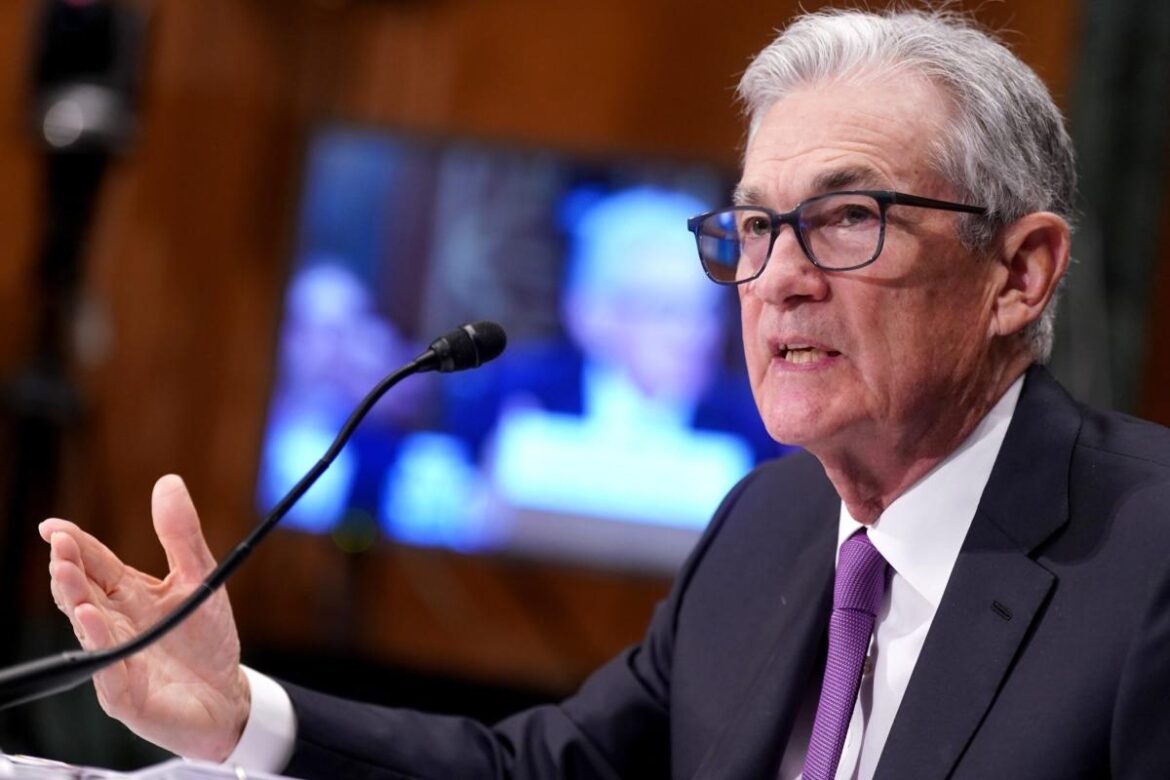
On Thursday, the Federal Reserve chair testified to the Senate Banking Committee against the backdrop of his recent decision not to cut interest rates, the big question investors and homebuyers are asking. Potential rate cuts have given investors hope about some much-needed relief for the housing market, which has struggled to cope with soaring mortgage and refinancing rates, but Powell testified that the housing market’s real problems run much deeper—and it will take more than just monetary policy to fix them.
“The housing market is in a very challenging situation right now,” Powell said on Capitol Hill on Thursday. “Problems associated with low rate mortgage [lock-in] and high [mortgage] rates and all that, those will abate as the economy normalizes and as rates normalize,” he said, referring to the mismatch between something approaching 90% of homeowners with mortgage rates below 6% and the current market offering above 7%. “But we’ll still be left with a housing market nationally, where there is a housing shortage.”
‘There are a ton of things happening’
Powell explained the current problems facing homebuyers and sellers to the committee: “You have a shortage of homes available for sale because many people are living in homes with a very low mortgage rate and can’t afford to refinance, so they’re not moving, which means the supply of regular existing homes that are for sale is historically low and a very low transaction rate,” Powell said. “That actually pushes up the prices of other existing homes, and also of new homes, because there’s just not enough supply.”
But it’s a bigger issue than buyers and sellers being locked in, he said. “There are a ton of things happening … because of higher rates, and those in the short-term are weighing on the housing market … it’s more difficult [for builders] to get people [labor] and materials,” Powell said. “But as [mortgage] rates come down, and that all goes through the economy, we’re still going to be back to a place where we don’t have enough housing.”
The pandemic only made things worse. High inflation has made materials and labor costs far pricier, and ballooning mortgage rates have pumped the brakes on an already-slow sector. National Association of Realtors data showed that there were only 3.2 months of available housing supply as of the end of last year, about half as much as there should be in a balanced market.
Markets expect the Fed to announce rate cuts this year—but while that will offer some short-term relief, it won’t solve the housing market’s deep–set supply problems.
Powell noted that restrictive zoning laws play an important role in limiting new construction. He also pointed out that rising mortgage rates have discouraged longtime homeowners who locked in lower rates from moving, which has limited the number of existing homes on the market and left new homebuyers struggling to find affordable options.
Powell’s threading a tricky needle—the housing market is a big driver of the domestic economy, and overstressing it by keeping interest rates high for too long could threaten the rest of the economy. On the other hand, cutting rates too soon—or too quickly—in line with the industry’s demands could undermine the Fed’s yearslong attempts to stick a soft landing and keep inflation under control.
“Housing activity accounts for nearly 16% of GDP according to NAHB estimates,” wrote a group of housing industry trade organizations in a letter to Powell last fall. “We urge the Fed to take these simple steps to ensure that this sector does not precipitate the hard landing the Fed has tried so hard to avoid.”
This story was originally featured on Fortune.com
Anthony Pompliano Predicts Bitcoin’s Price Could Double Soon; Leading Crypto Could Eventually Eclipse Gold
In a CNBC interview, Pomp Investments’ Anthony Pompliano delivered an optimistic forecast for bitcoin, suggesting a potential rise to $138,000 per unit shortly. He pointed out that historically, bitcoin has doubled its value within 18 days or less after surpassing previous peak prices on three out of four occasions. Pomp Investments’ Founder Envisions Bitcoin Outperforming […]


Source link
Email Shows Digital Currency Group and Gemini Explored Merger Before Genesis Bankruptcy
In an email found within the motion by Digital Currency Group (DCG) and Barry Silbert to dismiss the lawsuit initiated by the New York Attorney General, discussions of a potential merger between Gemini and Genesis were revealed before Genesis ultimately opted to declare bankruptcy. “Combined Gemini and Genesis would be a juggernaut and would be […]

Source link
Bitcoin sees violent volatility after hitting new ATH second time in a week
Bitcoin hit a new all-time high for the second time this week and once again experienced a violent sell-off that erased its gains and stirred memories of past volatilities in the crypto space.
Bitcoin broke its previous record early in the US trading hours on March 8, climbing to an all-time high of $70,136 after US jobs data raised expectations of rate cuts in the coming month.
However, the jubilation was short-lived as a wave of sell pressure engulfed the market, driving the price down by more than 3% to a low of $66,500 in less than an hour. The wider crypto market experienced similar volatility.
As of press time, BTC was trading at $67,890, according to CryptoSlate data.
Over the past four hours, the volatility caused $181.5 million in total liquidations, with longs making up more than $100 million. Meanwhile, Bitcoin liquidations during the period stood at $70.57 million, with longs accounting for $40.3 million, according to CoinGlass data.
The wall
This week’s market movements have been particularly turbulent, with Bitcoin’s value fluctuating widely. After setting a new record earlier in the week, BTC suffered a dramatic 14% drop, plummeting to around the $59,000 level before recovering.
Such volatility has become a defining characteristic of the crypto market, reflecting both the speculative nature of digital assets and the evolving landscape of financial markets.
Analysts identified a significant volume of sell orders on major exchanges, including Binance and OKX, as a pivotal factor in the rapid price reversal.
The sell orders, valued at roughly $70 million and totaling approximately 1000 BTC, created a formidable barrier that halted any further price increase beyond the $70,000 mark.
Institutional influence
Market analysts attribute the initial price surge to a combination of factors, including investor optimism regarding the US economic outlook and the introduction of spot Bitcoin exchange-traded funds (ETFs).
These developments have increasingly aligned crypto trading activity with traditional stock market hours, highlighting the growing integration of digital assets into conventional financial systems.
The backdrop to Bitcoin’s record-breaking rally was the latest US unemployment data, which suggested a potential easing of inflationary pressures and fueled speculation about the Federal Reserve’s interest rate policy.
The unexpected rise in the unemployment rate to 3.9%, coupled with downward revisions to job growth figures, has bolstered hopes for a more accommodative monetary stance.
As Bitcoin’s price ascension coincides with a weakening US dollar, the implications for the Fed’s upcoming policy decisions are being closely watched.
With the Fed’s next interest rate decision anticipated on March 20, market participants remain vigilant as the interplay between macroeconomic indicators and monetary policy could significantly influence the trajectory of Bitcoin and the wider digital assets market.
Bitcoin Market Data
At the time of press 5:39 pm UTC on Mar. 8, 2024, Bitcoin is ranked #1 by market cap and the price is up 1.19% over the past 24 hours. Bitcoin has a market capitalization of $1.35 trillion with a 24-hour trading volume of $53.2 billion. Learn more about Bitcoin ›
Crypto Market Summary
At the time of press 5:39 pm UTC on Mar. 8, 2024, the total crypto market is valued at at $2.59 trillion with a 24-hour volume of $148.59 billion. Bitcoin dominance is currently at 51.89%. Learn more about the crypto market ›
Mentioned in this article
Latest Alpha Market Report
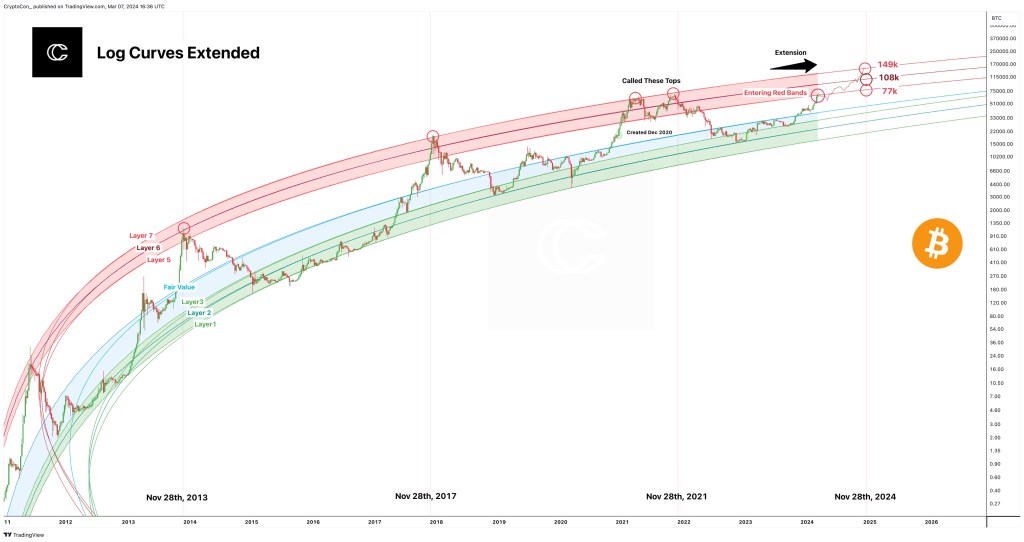
Amidst widespread bullish sentiment surrounding Bitcoin, one analyst on X thinks the leg up won’t be as strong as it was in the past few weeks. Pointing to developments in the Bitcoin log curves, the analyst expects the coin to find resistance as it attempts to break higher.
Bitcoin Uptrend To Slow Down
The analyst doubts the current excitement around the uptrend, and technical formations advise the contrarian view. Many in the industry think Bitcoin will not only ease past $70,000, a round number nearly tested this week, but also float to $100,000 in the next few weeks.

On X, the analyst remains confident about the coin’s prospects. However, based on the Bitcoin log curve assessment, the leg up will likely be labored. The analyst compares the current price formations with the Bitcoin log curves. In 2021, the tool was used to identify price peaks.
Based on price formation, the analyst notes that if BTC peaks in 2024, then prices will likely turn around from between $77,000 and $149,000. These prospective peaks’ upper and lower bands represent layers 5 and 7 of the log curve.
Even with BTC possibly rising to $149,000, at least from the tool, the Layer 7 target is relatively lower. By factoring in a one-year slowdown in growth, the predicted peak is revised downwards from $180,000 to $149,000.
When writing, the “red band” of the log curve has been breached earlier than usual. Looking back, Bitcoin prices tend to peak three months after this breakout.
That likely places Bitcoin’s peak at around the $77,000 level but below $100,000. Nonetheless, this is hard to predict, considering the volatile nature of prices and the dynamic nature of fundamental factors.
The community remains optimistic about what lies ahead. So far, Bitcoin prices have been trending at historical highs, but there has been a sharp drop in the momentum of upside.
BTC Bears In A Commanding Position
The daily chart shows that prices are still inside the bear bar of March 5. The candlestick had a high trading volume and was wide-ranging. For the uptrend to be valid, prices must break above $70,000, based on rising trading volume.

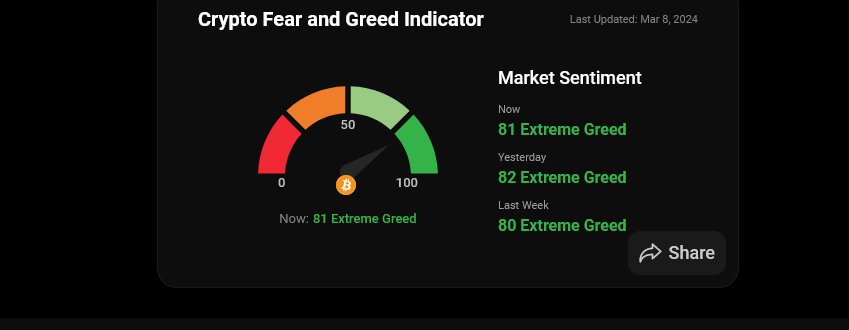
Lower prices incentivize issuers to spot Bitcoin exchange-traded funds (ETFs) to load up on dips. Their actions have spurred demand over the past few weeks, lifting sentiment and prices. According to Coinstats’ Fear and Greed Index, “extreme greed” exists in the market.
Feature image from DALLE, chart from TradingView
Disclaimer: The article is provided for educational purposes only. It does not represent the opinions of NewsBTC on whether to buy, sell or hold any investments and naturally investing carries risks. You are advised to conduct your own research before making any investment decisions. Use information provided on this website entirely at your own risk.
BitMEX co-founder believes this stablecoin could flip Tether one day
Ethena, the protocol powering the USDe synthetic dollar, raked in $6.53 million in fees over the last 24 hours, cementing its position as the top fee-generating decentralized application (dApp) in the crypto space, according to data from DeFillama.
Seraphim Czecker, Ethena Labs’ Head of Growth, shared insights from Token Terminal, affirming the project’s remarkable milestone. Czecker’s data indicates that Ethena amassed approximately $6.8 million in fees over the past week, outpacing competitors like MakerDAO and Arbitrum.
Yet, compared to leading blockchain networks, its revenue pales in comparison. Tron and Ethereum, for instance, boasted revenues of $38.6 million and $182.5 million, respectively.
What exactly is USDe?
USDe is a token pegged to the dollar’s value, offering lucrative yields. Though often labeled as a stablecoin, the team eschews this term, instead favoring “synthetic dollar.”
Ethena Labs launched the synthetic dollar on the public mainnet on Feb. 19 to widespread investor interest. At the time, the project debuted with a staggering 27.6% annual percentage yield (APY), surpassing the 20% yield offered by Anchor Protocol on the TerraUSD (UST) algorithmic stablecoin before its collapse in May 2022.
USDe’s unique model attracted $14 million in investments from prominent players such as Arthur Hayes, Brevan Howard, Franklin Templeton, Galaxy Digital, and Binance Labs.
In a recent update, Hayes, the co-founder of the BitMEX exchange, predicted that the project could flip Tether’s USDT dominance in the industry.
Hayes said:
“I believe that Ethena can eclipse Tether as the largest stablecoin. [However,] it will take many years for this prophecy to manifest itself.”
Rapid growth
Since its mainnet launch, USDe has experienced exponential growth, witnessing a staggering 44% surge in total value locked over the past week and an impressive 409% surge over the last month, reaching $838 million, according to DeFillama data.
This rapid growth has contributed to USDe’s development into one of the top 10 stablecoins by market capitalization, achieving this milestone in less than three weeks.
Market analysts have attributed this remarkable growth to the project’s enticing staking yield. Ethena, as stated on its website, offers a substantial 67.2% yield on its USDe synthetic dollar.
Furthermore, USDe now commands a significant portion of the global ether perpetual futures open interest, comprising nearly 8.69%. Notably, its average funding rate stands at an impressive 58.35%, as per data available on its website.
Mentioned in this article
Latest Alpha Market Report
Bitcoin Hits New All-Time High, Surging Past $70,000 For The First Time In History
Bitcoin (BTC), the dominant cryptocurrency, has made history by briefly breaking its consolidation phase and reaching an all-time high of $70,000. Despite encountering resistance near this level, Bitcoin’s market capitalization has reached $1.3 trillion, showcasing its continued upward momentum.
However, as the cryptocurrency faces a double top in the same price zone after almost three years, it must overcome a significant hurdle to consolidate above $69,000 and pave the way for further price gains.
Bitcoin Sets New Record
In the past 24 hours, Bitcoin experienced a 2% uptrend, propelling it to breach the $70,000 milestone for the first time. The cryptocurrency had previously reached $69,300 on Tuesday, indicating the growing strength of its upward trajectory. However, the $69,000 mark has proven to be a formidable resistance level, leading to increased volatility once breached.
The double-top formation in this price zone over a three-year period adds further complexity to Bitcoin’s consolidation efforts. Breaking through this resistance is crucial for Bitcoin to establish a solid foundation for future price gains and sustainably consolidate above $70,000.
The success of Bitcoin spot exchange-traded funds (ETFs) within a short span of two months has bolstered investor confidence and generated anticipation for future price appreciation.
With investors betting on Bitcoin’s long-term prospects, it appears to be only a matter of time before the cryptocurrency overcomes its current resistance level and continues its upward trajectory. This positive sentiment provides a favorable backdrop for Bitcoin’s potential breakthrough.
Following its brief touch of $70,000, Bitcoin experienced a rapid retracement to the $68,000 level. The timing and extent of its consolidation above the resistance mark remain uncertain. However, market observers are closely monitoring Bitcoin’s performance, anticipating a potential breakthrough that could fuel additional price gains.
Featured image from Shutterstock, chart from TradingView.com
Disclaimer: The article is provided for educational purposes only. It does not represent the opinions of NewsBTC on whether to buy, sell or hold any investments and naturally investing carries risks. You are advised to conduct your own research before making any investment decisions. Use information provided on this website entirely at your own risk.
I’m 68 and My Long-Term Care Insurance Now Costs $600 Per Month. Is This Too Much?

Imagine that you’re 68 years old and have a long-term care insurance policy in place that will help you pay for this all-important type of care later in life. You pay $600 per month in premiums and tell yourself it’s a good investment, considering how expensive long-term care can be.
Consider working with a financial advisor if you need additional help planning for long-term care and other needs you’ll have later in life.
The problem? Your premiums are well above the average monthly cost of long-term care coverage. Here’s what you should be thinking about if you’re interested in buying long-term care insurance or evaluating whether you’re paying too much for it.
What Is Long-Term Care Insurance?
Long-term care insurance helps pay for extended or residential treatment such as in-home care (like a home health aide) or residential/custodial care (such as a nursing home or assisted living).
Long-term care insurance generally doesn’t cover medical bills outside of the extended treatment itself. For example, if you stay in a nursing home and need to see the doctor, your long-term care insurance would pay for the nursing home while health insurance/Medicare would pay for the doctor’s appointment.
Health insurance and Medicare, on the other hand, don’t pay for residential care. This is what makes long-term care insurance so important for retirement planning. As the American Council on Aging found in 2021, staying in a nursing home can cost more than $100,000 per year. Meanwhile, the median cost of a private room in a nursing home is expected to reach $13,267 per month by 2034, according to Genworth. This is beyond the means of most households to pay out of pocket. While Medicaid can cover these costs you must fall below the program’s income and asset limits, which forces some middle-class retirees spend down their assets until they can qualify for care.
It is not uncommon for people to sell off family homes and liquidate their retirement portfolios to afford assisted living. This can be tragic, particularly if you want to come home someday or leave those assets to your children. Long-term care insurance can potentially prevent that and a financial advisor can help you plan for it.
What Determines the Cost Of Long-Term Care Insurance?

Long-term care is structured around a monthly or annual premium that’s set when you buy the policy. Then, if you need care, the insurer pays your costs up to the limit of your coverage. For example, if you have a $100,000 per year policy your insurer will cover the first $100,000 in care that you receive each year and you will pay for the remainder. Many, if not most, policies offer lifetime coverage, meaning that if you need permanent care the program will cover you indefinitely.
The costs of a long-term care policy are based on a few key factors, including:
-
Your age when you buy the policy
-
Your gender
-
The policy’s coverage amount
-
The duration of coverage (if it covers lifetime stays vs. a limited stay)
-
Inflation coverage (if the policy grows by a percentage each year)
The younger you are when you buy the policy the longer it will be until you will likely need it. As a result, your premiums will likely be lower. Women pay significantly more than men because they have a longer life expectancy, and so will likely use more care if they need assisted living.
Coverage growth protects your policy from inflation. At a 2% rate of inflation, prices will double roughly every 30 to 35 years, meaning that a policy you buy at 55 may lose half its spending power by the time you’re 85. If you need help assessing your options for long-term care insurance or even purchasing a policy, speak with a fiduciary financial advisor.
Is $600 Per Month Too Much For Long-Term Care Insurance?

The question is, what should your policy cost, and more specifically, is $600 per month too much for a 68-year-old single person to be paying? Long-term care insurance isn’t cheap, and it gets more expensive the later in life you purchase it but it doesn’t have to be this expensive.
According to the American Association for Long-Term Care Insurance, you should probably pay somewhere between $100 and $400 per month for your insurance. While there’s a lot of variability, if you’re an individual with $165,000 in coverage and 2% inflation protection, an average policy will cost:
-
$1,650 per year ($137.50 per month) for a male purchasing at age 55
-
$2,725 per year ($227 per month) for a female purchasing at age 55
-
$2,600 per year ($217 per month) for a male purchasing at age 65
-
$4,230 per year ($352.50 per month) for a female purchasing at age 65
Just going off these average premiums, a 68-year-old can pay a lot less than $600 per month for long-term care coverage. However, a premium that high isn’t completely out of the ordinary. For example, the average cost of coverage for a 65-year-old woman who wants an annual 5% inflation adjustment is $7,225 per year or just over $600 per month.
Like all insurance, long-term care policies tend to get more expensive the longer you wait to purchase one. Buying a new policy at 68 won’t be cheap, but it may be cheaper than doing so at 73. Consider working with a financial advisor to determine how much coverage you may need and how much you’ll be able to afford.
Bottom Line
A year at a nursing home can cost over $100,000, placing immense financial strain on the person who needs it and/or their family. While Medicare typically does not cover these costs, long-term care insurance can fill that gap. However, it isn’t cheap. If you can buy it well in advance, though, it can protect your future for a couple hundred dollars per month.
Retirement Insurance Tips
-
Insurance in retirement can be a very complicated subject. Among the many moving pieces here is the concept of life insurance as a savings account. Depending on the policy you hold, your life insurance policy can act as a retirement portfolio from which you can withdraw assets. See how these policies stack up against standard investments.
-
A financial advisor can potentially help you plan for your insurance needs. Finding a financial advisor doesn’t have to be hard. SmartAsset’s free tool matches you with up to three vetted financial advisors who serve your area, and you can have a free introductory call with your advisor matches to decide which one you feel is right for you. If you’re ready to find an advisor who can help you achieve your financial goals, get started now.
Photo credit: ©iStock.com/Hailshadow, ©iStock.com/kazuma seki, ©iStock.com/brizmaker
The post I’m 68 and My Long-Term Care Insurance Now Costs $600 Per Month. Is This Too Much? appeared first on SmartReads by SmartAsset.
A good way to invest in the healthcare industry’s continued growth is by targeting businesses that make medical devices. Such equipment aids physicians in surgery, helps patients recover, and can assist people in staying on top of chronic conditions, including hypertension and diabetes.
This hasn’t exactly been a hot place to invest in, however. Since 2021, the iShares US Medical Devices ETF has risen by just 6%, while the S&P 500 has achieved gains in excess of 36%. But as many investors have been overlooking medical device stocks, that has created some attractive buying opportunities today.
Two stocks that are big players in this space and that can make for solid investments are Medtronic (MDT -0.02%) and DexCom (DXCM 1.51%). These are stocks investors should buy hand over first given their strong financials and long-term growth opportunities.
1. Medtronic
Medtronic is a massive medical device company that helps thousands of people all over the world. Its products, which can improve the quality of life for patients, help treat over 70 different conditions. It has over 49,000 patents in its portfolio and hundreds of clinical trials in progress as the company continues to innovate and bring new products to market.
Supply chain issues and rising costs have been a couple of big challenges the healthcare company has faced in recent years. But if you’re investing for the long haul, those can be temporary issues in the grand scheme of things. In the long run, the opportunities far outweigh these short-term challenges.
In its third quarter, which ended Jan. 26, Medtronic reported net sales of $8.1 billion, which rose 4.7% from the prior-year period. Net income of $1.3 billion increased by 8.8%. Buoyed by the strong results, the company also modestly raised its guidance as it feels confident that things are moving in the right direction. It now projects an organic revenue-growth rate for the fiscal year between 4.75% to 5% (previously, it was forecasting just 4.75%).
The stock has risen just 2% over the past 12 months. But with strong profits and modest gains, it makes for an attractive deal for investors. Based on analyst expectations, Medtronic stock is trading at a forward price-to-earnings multiple of 15; the healthcare industry average is 19.
Medtronic is an excellent stock to buy and hold for the long term. Not only is its valuation cheap, but it also provides investors with a dividend that yields 3.3%, giving you plenty of incentive to remain patient with the stock as the business grows.
2. DexCom
DexCom doesn’t have as broad of a business as Medtronic; its focus is on diabetes care and helping patients stay on top of their glucose levels with its continuous glucose monitoring devices, or CGMs. Diabetes is a growing issue, and analysts estimate that by 2060, there could be 60.6 million adults in the U.S. with the condition, which is nearly three times the 22.3 million people who had diabetes in 2014.
CGMs can play a key role in helping people with high sugar levels stay on top of diabetes and lower the risk of complications. DexCom is a leading provider of CGMs and in 2022, the Food and Drug Administration (FDA) cleared the G7, which is the company’s most accurate and smallest device to date.
An exciting opportunity for the business is the launch of Stelo, a glucose sensor for people with diabetes but who do not require insulin injections (the majority of diabetics fall into this category). The FDA just approved this device, which could unlock even more growth opportunities for the business in the long run.
In February, DexCom posted its latest numbers, which demonstrated strong double-digit growth as sales came in at just over $1 billion for the last three months of 2023, rising by 27% year over year. What’s great is the business also generates strong margins; DexCom’s net income totaled $256.3 million last quarter, which was just under 25% of its top line. For 2024, DexCom projects organic-revenue growth between 16% and 21%.
Despite the promising growth opportunities ahead for DexCom, investors have appeared to overlook the stock as its shares have been flat over the past 12 months. Although it isn’t a cheap stock, trading at a forward-earnings multiple of 70, with plenty of room for the business to get bigger and more profitable in the future, this is still an exciting stock to load up on for the long term.