The latest figures reveal that the nine new spot bitcoin exchange-traded funds (ETFs) now control 390,525.3 bitcoins, valued at just over $26 billion at current market rates. These nine ETFs are rapidly approaching the holdings of Grayscale’s Bitcoin Trust (GBTC), which presently has 405,713.31 bitcoins in its possession. Emerging Bitcoin ETFs Challenge Grayscale’s Reign Collectively, […]
Source link
CoinNews
Here are the Ethereum-based altcoins that are currently witnessing a high amount of activity from the whales, according to on-chain data.
These Ethereum Altcoins Are Seeing High Whale Transactions Right Now
In a new post on X, the on-chain analytics firm Santiment has discussed how several Ethereum-based altcoins have been seeing notable whale activity recently.
The indicator of relevance here is the “whale transaction count,” which keeps track of the total number of transfers taking place on the network for a given cryptocurrency that is valued at $100,000 or more.
Generally, only the whales are capable of moving such large amounts in single transactions, so transfers carrying this much value are assumed to involve these humongous entities.
When the value of this metric is high, it means that the whales are making a large amount of moves on the network right now. Such a trend implies these large investors have a high interest in the asset currently.
On the other hand, low values suggest the cryptocurrency may have a lack of whale interest behind it, as there are barely any large transactions occurring on the chain.
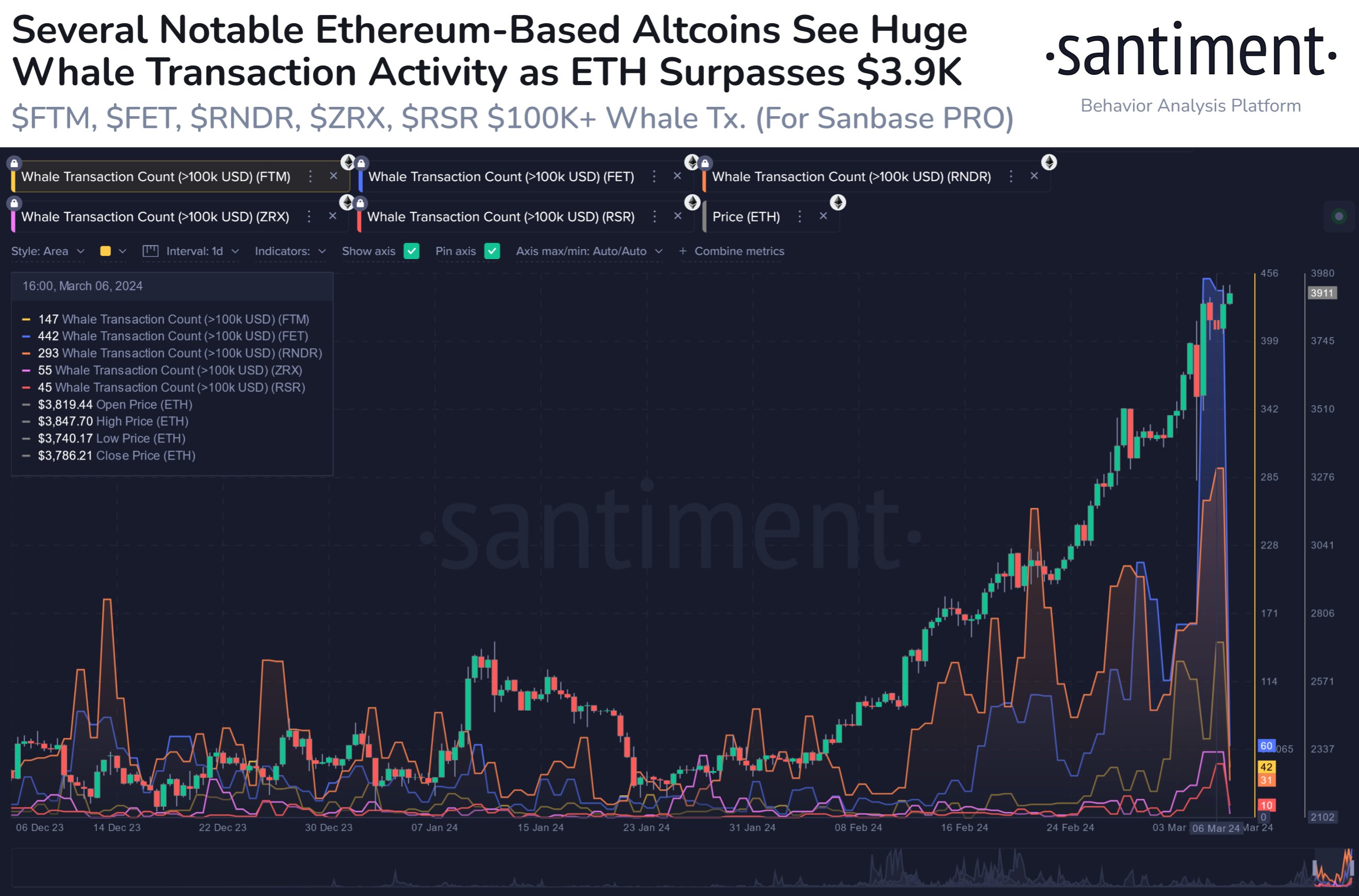
Now, here is a chart that shows the trend in the whale transaction count for a few different Ethereum-based altcoins over the past few months:

The value of the metric seems to have been high for all of these assets recently | Source: Santiment on X
As displayed in the above graph, the whale transaction count has recently seen a sharp surge for these five altcoins: Fantom (FTM), Fetch.ai (FET), Render (RNDR), 0x Protocol (ZRX), and Reserve Rights (RSR).
“Ethereum’s market value is up to $3,920 and the #2 cap ranked market price ratio vs. Bitcoin is +9.5% in the past 3 days,” Santiment notes. “When these kinds of price dominance flips occur, we often see profits quickly redistribute, and whales becoming very active in ERC20-based altcoins.”
The alts in question here have all recently registered at least three-month highs in their whale activity. From the chart, it’s visible that Fetch.ai has observed the largest spike out of these assets.
Render leads in second place, while Fantom has followed after it in third. The prices of all three of these altcoins have registered rapid increases, with FTM coming out as the winner so far, with more than 67% in profits over the past week.
Thus, it would appear that the recent whale activity likely corresponded to buying pressure in these alts. It should be noted, however, that even if the whale transaction count remains high in the near future, it doesn’t necessarily have to lead to a bullish outcome.
The indicator merely counts the number of all whale-sized transactions and doesn’t contain any information about whether they are being made for buying or selling.
All that the whale transaction count can say about these altcoins is that, should whale activity remain high, their prices would be probable to witness volatile action, but its direction could go either way.
ETH Price
Ethereum has managed to outperform Bitcoin in the past week, as the second-largest coin has seen an increase of around 15% that has now taken its price beyond the $3,900 level.
Looks like the price of the coin has been going up in recent days | Source: ETHUSD on TradingView
Featured image from Yilei (Jerry) Bao on Unsplash.com, Santiment.net, chart from TradingView.com
Disclaimer: The article is provided for educational purposes only. It does not represent the opinions of NewsBTC on whether to buy, sell or hold any investments and naturally investing carries risks. You are advised to conduct your own research before making any investment decisions. Use information provided on this website entirely at your own risk.
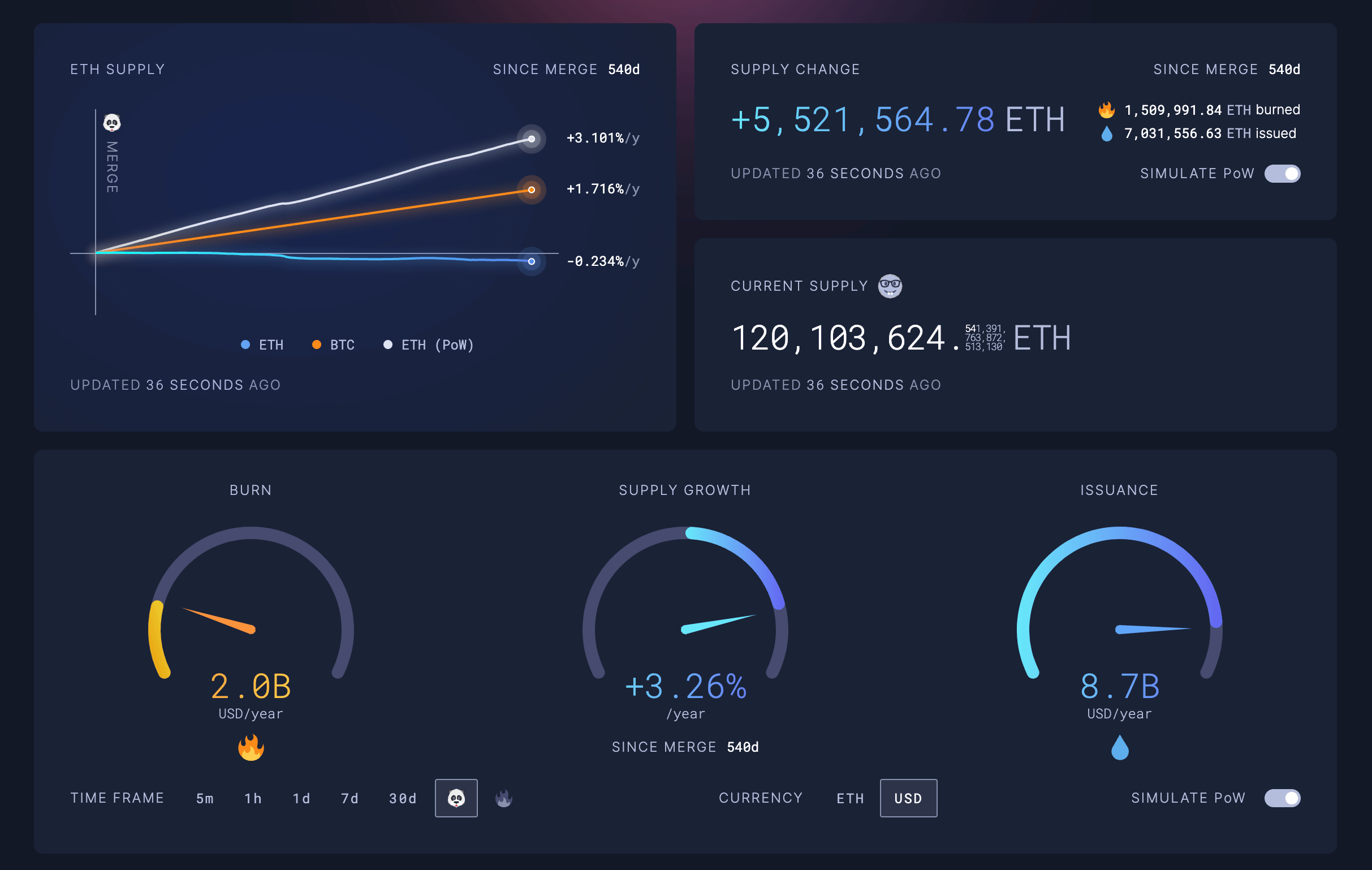
The Ethereum network has seen a reduction of 417,413 ETH in supply since transitioning to a Proof-of-Stake (PoS) consensus mechanism in September 2022, per data from ultrasound.money. In the 540 days since The Merge, 1,509,991 ETH has been burned while the network has issued 1,092,578 new ETH, resulting in a net decrease.
As of press time, the market value of the ETH removed from the supply stands at $1,653,797,635, marking an annual inflation rate of -0.23%.

In contrast, Bitcoin’s supply has grown by 1.716% over the same period. This highlights the divergent monetary policies of the two largest cryptocurrencies, as Bitcoin maintains a predictable issuance schedule. At the same time, the balance between staking rewards and transaction fee burning now determines Ethereum’s supply change.
A Proof-of-Work (PoW) simulation on the ultrasound.money dashboard shows Ethereum’s supply would have increased by over 5.5 million ETH during the same period had the network not shifted to PoS. Under the PoW model, the simulation indicates 7,031,556 ETH would have been issued with the same 1.5 million ETH burn rate, leading to a net increase of 5,521,564 ETH since The Merge. The value of the ETH issued under this simulation would amount to $21,865,393,440, representing a theoretical inflation rate of 3.26%.

The stark difference highlights the deflationary impact of Ethereum’s new consensus design compared to its previous mining-based system. The transition to PoS has significantly reduced new ETH issuance, as validators staking ETH now secure the network instead of PoW miners. This shift, combined with the ongoing burn mechanism introduced in EIP-1559, has put downward pressure on Ethereum’s supply growth.
According to the real-time data, Ethereum’s total circulating supply currently stands at 120,103,624 ETH. Meanwhile, the PoW simulation estimates the supply would have reached 125,625,188 ETH if miners were still powering the network under the old model.
The supply reduction since The Merge aligns with the Ethereum community’s vision of making ETH a deflationary asset over time, diverging from Bitcoin’s fixed inflationary schedule. Proponents believe the combination of staking rewards and fee burning will continue to offset new issuance, potentially leading to net negative supply change periods.
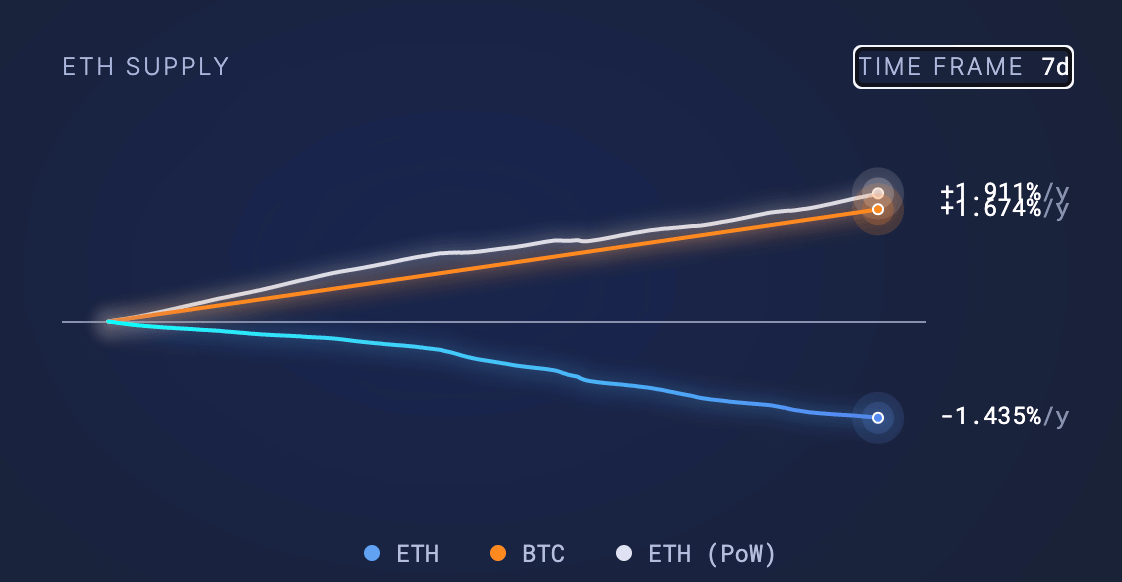
Over the past seven days, increasing ETH network fees has facilitated an uptick in deflationary behavior as it rose to -1.435%. Moreover, even under PoW, its inflation rate would have fallen to 1.911% due to the surge in network activity and its correlation with the burn mechanic.

However, critics argue the move to PoS has centralized control of the network in the hands of major staking entities and exchanges. Some warn that the concentration of staked ETH could undermine Ethereum’s decentralization and security guarantees, in contrast to Bitcoin’s more distributed mining network.
As Ethereum continues to evolve under its new PoS regime and Bitcoin maintains its established PoW model, observers will closely watch how their respective supply dynamics and security trade-offs unfold. With Bitcoin’s issuance about to half due to the upcoming halving, its inflation rate will drop to 0.8%, which is within 1% of Ethereum. Bitcoin, however, has a fixed supply and will eventually have an inflation rate of zero. Ethereum’s inflation rate is tied to network activity and the amount burned through network transactions.
Still, the deflationary trend in ETH over the past 540 days offers an early glimpse into the potential future of the two largest cryptocurrencies ahead of the first Bitcoin halving since The Merge. The long-term sustainability and implications for both networks remain to be seen, with Bitcoin currently thriving at a $1.3 trillion market cap and Ethereum next in line at $478 billion.
Mentioned in this article
Latest Alpha Market Report
Target (TGT -1.06%) and Chewy (CHWY 1.14%) represent two very different ways to invest in the retail sector. Target is one of the largest superstore retailers in America, and about 75% of the U.S. population lives within 10 miles of one of its 1,956 stores. Chewy is an e-tailer that exclusively sells food, drugs, and other products for pets.
Over the past 12 months, Target’s stock rose by less than 2% as Chewy’s stock plunged 57%. Let’s see why the brick-and-mortar giant outperformed the pet-oriented e-tailer by such a wide margin — and if it’s still the better stock to buy right now.
Image source: Getty Images.
Target faces a near-term slowdown
Target survived the retail apocalypse by expanding its e-commerce ecosystem with more delivery and pick-up options, turning its stores into fulfillment centers for online orders, and closely matching Amazon‘s (NASDAQ: AMZN) prices. It continued to open new stores even as other big-box retailers closed down, it opened new smaller-format stores to reach new shoppers in urban areas, and it differentiated itself from its competitors with dozens of private label brands.
Those strategies set Target up for a major growth spurt as consumers stocked up on food, other essentials, and electronic devices during the pandemic. Its comparable store sales (or “comps”) rose 19% in fiscal 2020 , which ended in Jan. 2021, and increased 13% in fiscal 2021; yet, only grew 2% in fiscal 2022 as its post-pandemic slowdown was exacerbated by inflation, higher freight costs, and supply chain disruptions.
In fiscal 2023, Target’s comps fell 4% as it struggled with slower sales of discretionary products in an inflationary environment, theft and safety issues that led to the closures of several of its smaller format stores, and a boycott from conservative groups in response to some controversial products in its Pride Month Collection.
That marked its first annual decline in comparable store sales in seven years. But as its sales growth cooled off, it cut costs and boosted its EPS by 49% in fiscal 2023.
For fiscal 2024, Target expects its comps to rise 0%-2% as its EPS lands between a 4% decline and 7% growth. Based on the midpoint of those estimates and its current price of $168, it looks reasonably valued at 18 times forward earnings. It also pays a decent forward yield of 2.6%, and it’s raised that payout annually for 52 consecutive years.
Chewy’s high-growth days might be over
Chewy’s revenue surged 47% in fiscal 2020 (which ended in Jan. 2021) and rose 24% in fiscal 2021 as pet owners bought more products online during the pandemic. But its revenue only grew 14% in fiscal 2022 and 12% year over year in the first nine months of fiscal 2023 as the pandemic passed. Analysts anticipate 10% growth for the full year.
Chewy’s number of active customers dipped from 20.4 million at the end of fiscal 2022 to 20.1 million in the third quarter of fiscal 2023. It’s trying to offset that slowdown and growing its net sales per active customer by pivoting toward higher-margin products, expanding its Chewy Health Insurance plans for pets, and selling more ads across its online marketplace.
But at the same time, Chewy faces intense competition from brick-and-mortar pet retailers like PetSmart, which also sells its products online; and Amazon, which has started selling more private-label pet products over the past few years.
That’s worrisome because Chewy still operates at low-single-digit adjusted earnings before interest, taxes, depreciation, and amortization (EBITDA) margins and isn’t consistently profitable on a generally accepted accounting principles (GAAP) basis yet. Analysts expect its adjusted EBITDA to rise 12% this year.
For fiscal 2024, analysts expect Chewy’s revenue and adjusted EBITDA to rise 5% and 19%, respectively, as it offsets its slower growth with its pursuit of higher-margin products and services. Based on those expectations, Chewy’s stock doesn’t seem expensive at 16 times next year’s adjusted EBITDA — but its high-growth days might be over.
The better buy: Target
Target faces tough near-term challenges, but it’s weathered plenty of downturns throughout its 56 years as a public company. It can leverage its scale to continue expanding and diluting its costs, its stock is cheap, and it can continue to pay attractive dividends for the foreseeable future.
Meanwhile, Chewy’s slowdown suggests it’s struggling to expand beyond its niche, and it could run out of run to grow its revenue per active customer to offset the persistent shrinkage of its customer base. Simply put, Target’s stock might remain out of favor until its growth stabilizes again, but it’s still a better buy than Chewy.
John Mackey, former CEO of Whole Foods Market, an Amazon subsidiary, is a member of The Motley Fool’s board of directors. Leo Sun has positions in Amazon. The Motley Fool has positions in and recommends Amazon, Chewy, and Target. The Motley Fool has a disclosure policy.
US President Joe Biden (L) and Prime Minister Benjamin Netanyahu (R) meet in Tel Aviv, Israel on October 18, 2023. (Photo by GPO/ Handout/Anadolu via Getty Images)
GPO | Anadolu Agency | Getty Images
Visible tensions are appearing in the historically close relationship between the White House and Israel, as the war in Gaza becomes a worsening humanitarian disaster and Israeli Prime Minister Benjamin Netanyahu resists the Biden administration’s push for a change in course.
While Biden vocally supports Israel’s stated goals of defeating Hamas and rescuing the hostages that the Palestinian militant group took captive during its Oct. 7 rampage in southern Israel that killed some 1,200 people, he and other administration officials have expressed increasing criticism of the way in which Israel is carrying out its operations in the Gaza Strip.
Israel’s relentless aerial bombardment and expanding ground invasion, as well as the cutting of Gaza’s water and power supplies, have killed more than 30,000 Palestinians there, according to Gaza’s health ministry, which is run by Hamas. And Israeli restrictions on the aid that can enter the besieged enclave, which is blockaded on all sides, have pushed more than 500,000 people into famine, according to the United Nations.
Still, the Biden administration has suggested no pullback in the military aid it is providing for Israel, and consistently provides diplomatic cover for it at the U.N., often being the sole country vetoing international demands for a cease-fire.
An aerial view of the heavily damaged buildings, part of which collapsed, after Israeli attacks in Rafah, Gaza on February 12, 2024.
Yasser Qudih | Anadolu | Getty Images
Biden has also stressed what his administration says is the need for an independent Palestinian state as part of the path to a durable peace — something Netanyahu ardently opposes. The right-wing Israeli leader has also rejected Biden’s proposals of a leading role for the West Bank-based Palestinian Authority in Gaza’s future once the war ends.
“These and other divisions are putting the entire ‘special relationship’ between the U.S. and Israel under pressure I have never seen before in my lifetime,” Hussein Ibish, a senior resident scholar at the Arab Gulf States Institute in Washington, told CNBC. “The relationship [between Biden and Netanyahu] is absolutely terrible.”
A report by Politico in early February cited unnamed Biden administration officials describing the president calling Netanyahu a “bad f—ng guy.” His spokespeople have denied it, saying that the leaders have “a decades-long relationship that is respectful in public and in private.”
Israeli war cabinet member Benny Gantz (L) meets US Senate Majority Leader Chuck Schumer, Democrat of New York, at the US Capitol on March 05, 2024.
Roberto Schmidt | AFP | Getty Images
The reported rift appeared to worsen as Israeli war cabinet member Benny Gantz, a longtime rival of Netanyahu and considered to be more moderate, paid a visit to Washington this week at the invitation of the White House. According to a report by Axios, the visit “enraged” Netanyahu, “who ordered the Israeli embassy in Washington to not take any part in the visit or assist Gantz in any way.”
Gantz reportedly faced a barrage of harsh questions and critiques from the administration over Israel’s handling of the Gaza war.
CNBC has reached out to the White House and the Israeli Prime Minister’s Office for comment.
Election worries and ‘campaign mode’
As the U.S. General Election nears, promising a rematch between Biden and former President Donald Trump, Biden is facing a domestic challenge over his support for Israel’s war in Gaza, particularly from many young liberals and Muslim and Arab Americans.
This threatens to cost him crucial votes, particularly in swing states. Vice President Kamala Harris issued harsh comments in a speech on Sunday urging a cease-fire, saying “People in Gaza are starving. The conditions are inhumane.”
A man explains the importance of voting ‘uncommited’ as he hands out fliers outside the Islamic Center of Detroit to ask voters to vote ‘uncommitted’ in Michigan Primary elections on Tuesday, in Michigan, United States on February 26, 2024.
Mostafa Bassim | Anadolu | Getty Images
But Netanyahu is insistent that a cease-fire would threaten the Israeli Defense Force’s momentum, and that “total victory is within reach.” Some observers say his rhetoric is aimed at staying in power as his domestic approval rating sits at its lowest of his more than 16 years at the helm.
“It seems to me that Netanyahu is in a full campaign mode, and that presently, its main theme is resisting the emerging Biden strategy and the president himself,” Nimrod Novik, a fellow at the Israel Policy Forum, which is dedicated to advancing a two-state outcome to the conflict.
Particularly telling, Novik said, is “Netanyahu’s decision to preempt the emerging Biden strategy – which offers Israel a way out of Gaza, a hopeful change on the West Bank, as well as Saudi normalization and regional integration – by distorting this unprecedented offer and portraying it as an imposition.”
“The prime minister is focused on securing and energizing his ever-shrinking base,” he said of Netanyahu. “That base is as hard line as they come and responds best to nationalist machismo as in his promise to defend Israel from the imagined Biden imposition of a Palestinian state.”
About 200 trucks loaded with humanitarian aid, cooking gas and fuel enter the Gaza Strip during the humanitarian pause between Israel and Hamas in Gaza City, Gaza on November 28, 2023.
Ashraf Amra | Anadolu | Getty Images
“I’ve watched the [Biden] administration express its being fed up with the Netanyahu policy, from haggling over every truck of humanitarian assistance, through announcing West Bank triggering settlement expansion at such an explosive moment, to provocations on Temple Mount on the eve of the holy Muslim month of Ramadan,” Novik said.
But this is going largely ignored in the Israeli administration, he noted. “What might sound in Washington as a scream is hardly a whisper in Jerusalem.”
Ibish had similar observations.
“All the American support, especially from Biden personally, is being met with total ingratitude and actually with disdain,” from Netanyahu’s government, he said.
“If Biden were getting more cooperation from Netanyahu [and] the Israelis, he would not be pulling away from them, albeit carefully and subtly. This is, after all, an election year, and he will have to be very careful.”
Unprecedented support
Yonatan Freeman, an international relations and media lecturer at Israel’s Hebrew University, believes the historically close relationship between the two countries will supersede the relationships between individual administrations and leaders.
“I think looking from a bird’s eye view we have to really focus on U.S.-Israel relations. And I don’t remember another war that Israel fought where it received so much support from a U.S. administration,” Freeman said. “Just as one example, the airlifting of U.S. military equipment to Israel occurred almost immediately … it never stopped.”
Still, he added, there is a broad perception among Israelis and many American Jews that former president Donald Trump was the most pro-Israel president in U.S. history.
“I think that this might be critical in some of the swing states where we have large Jewish and Israeli-American populations.” Roughly a quarter of Americans also identify as Evangelical Christian, a group that typically is very pro-Israel.
“So yes, this is something that could impact the elections,” Freeman said, adding that Biden’s hope of achieving normalization between Israel and Saudi Arabia is also on hold for the time being.
“That would bring him great points in terms of Israel, but also in terms of foreign policy, where Biden is looking for successes on the world stage,” he said. “But it seems like there aren’t many.”

Rivian‘s (RIVN 2.28%) biggest challenge right now is cash. The company’s cash burn is unsustainable while building out R2 and R3 capacity, which is why management announced reduced capital expenditures in Georgia.
But that’s not good news either because it likely doesn’t get the company to profitability. Travis Hoium digs into what we know now in the video below.
*Stock prices used were end-of-day prices of March 7, 2024. The video was published on March 7, 2024.
Travis Hoium has no position in any of the stocks mentioned. The Motley Fool has no position in any of the stocks mentioned. The Motley Fool has a disclosure policy. Travis Hoium is an affiliate of The Motley Fool and may be compensated for promoting its services. If you choose to subscribe through their link, they will earn some extra money that supports their channel. Their opinions remain their own and are unaffected by The Motley Fool.
Quick Take
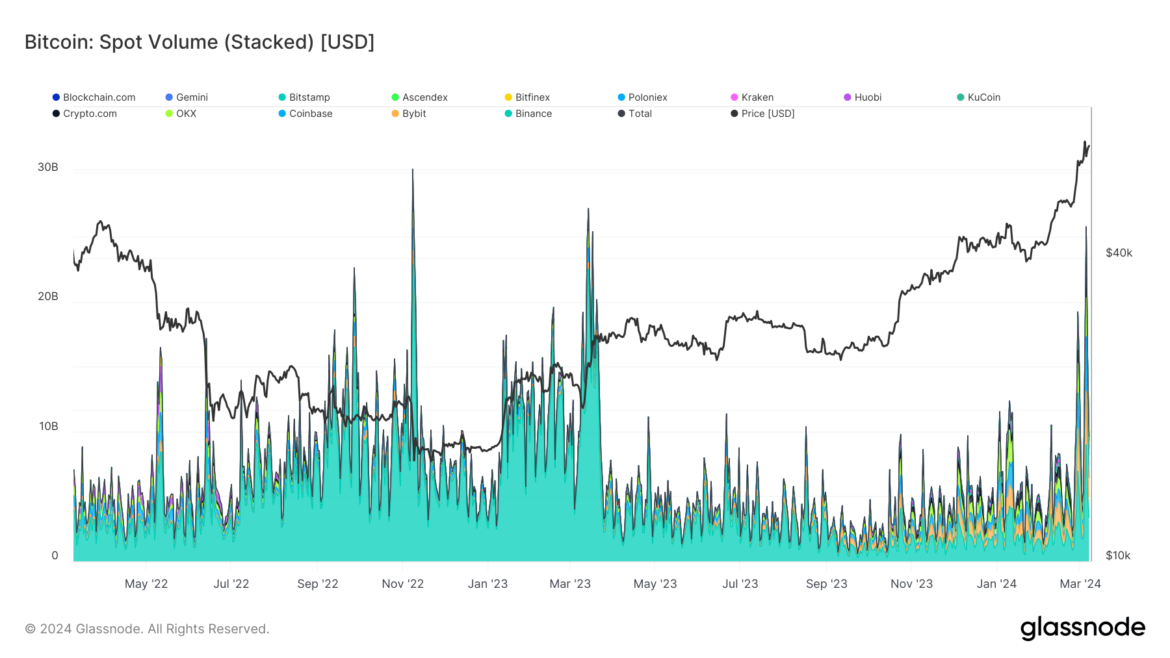
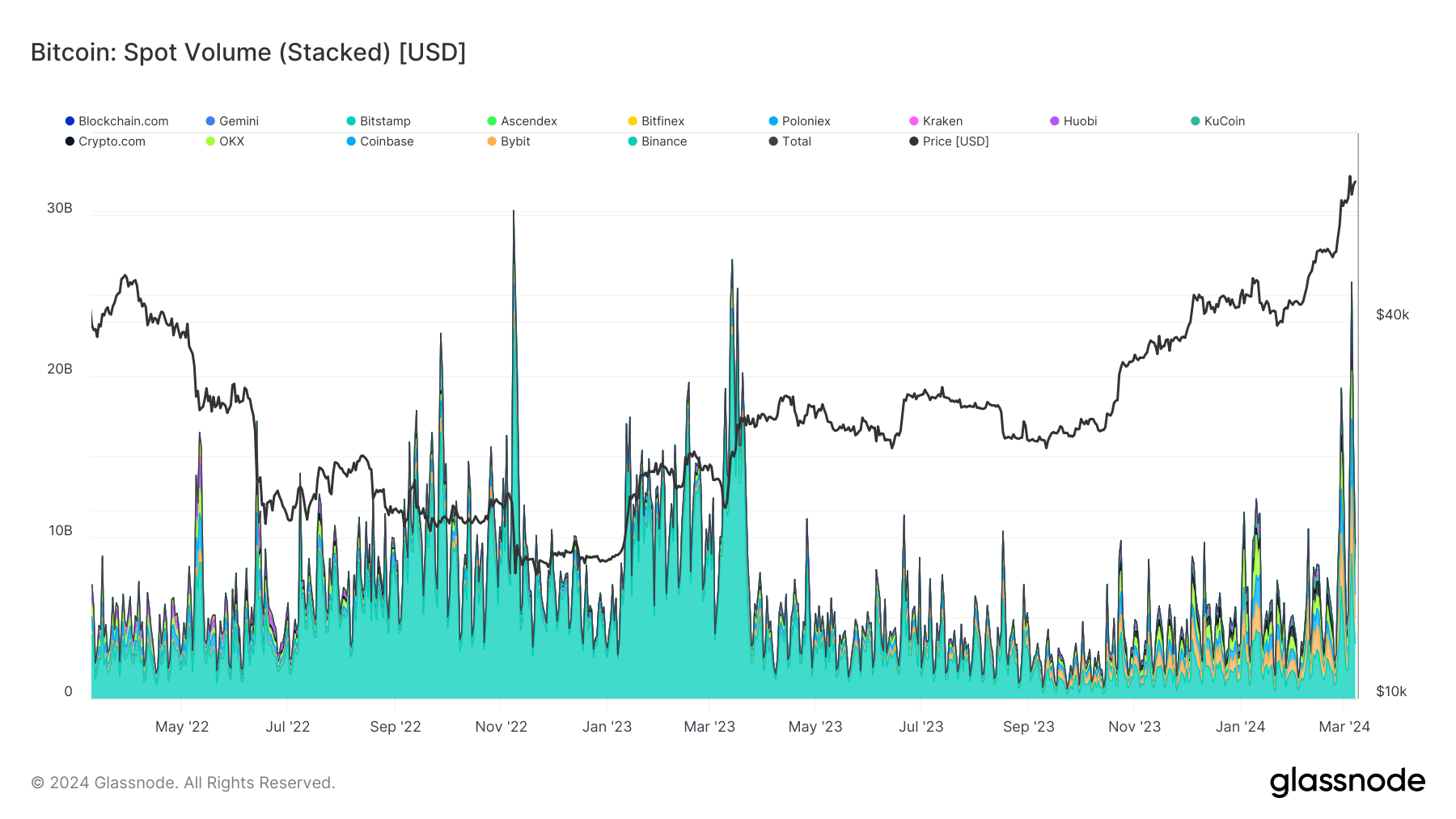
Recent Glassnode’s data captures intriguing shifts in Bitcoin’s spot volume, tracking the aggregate trading volume of Bitcoin against USD-based currencies, both fiat and stablecoin, across various exchanges. On March 5, there was a surge in spot volume to $26 billion across all exchanges, a pinnacle not reached since the SVB collapse in March 2023.
During the SVB collapse, Binance dominated the spot volume, contributing $22 billion of the total $27 billion, as reported by Glassnode. Now, spot volume has again reached a similar level, spurred by Bitcoin’s surge to a record $69,000 and its subsequent 15% drop. In this latest bout of volatility, the exchange landscape was more distributed, with Binance, Coinbase, and Bybit recording spot volumes of $9 billion, $4 billion, and $4 billion, respectively.

The data depicts a stark decrease in Binance’s market share over the year, as its spot volume shrank from $22 billion during the SVB event to $9 billion in the following year’s volatility peak.
The post High volatility drives spot Bitcoin volume to $26 billion appeared first on CryptoSlate.
Optimism Foundation sells $90M in tokens amid market rally and token unlock anticipation

What is CryptoSlate Alpha?
A web3 membership designed to empower you with cutting-edge insights and knowledge, powered by Access Protocol. Learn more ›
Connected to Alpha
Welcome! 👋 You are connected to CryptoSlate Alpha. To manage your wallet connection, click the button below.
Important: You must lock a minimum of 20,000 ACS
If you don’t have enough, buy ACS on the following exchanges:
Connect via Access Protocol
Access Protocol is a web3 monetization paywall. When users stake ACS, they can access paywalled content. Learn more ›
Disclaimer: By choosing to lock your ACS tokens with CryptoSlate, you accept and recognize that you will be bound by the terms and conditions of your third-party digital wallet provider, as well as any applicable terms and conditions of the Access Foundation. CryptoSlate shall have no responsibility or liability with regard to the provision, access, use, locking, security, integrity, value, or legal status of your ACS Tokens or your digital wallet, including any losses associated with your ACS tokens. It is solely your responsibility to assume the risks associated with locking your ACS tokens with CryptoSlate. For more information, visit our terms page.
Quick Take
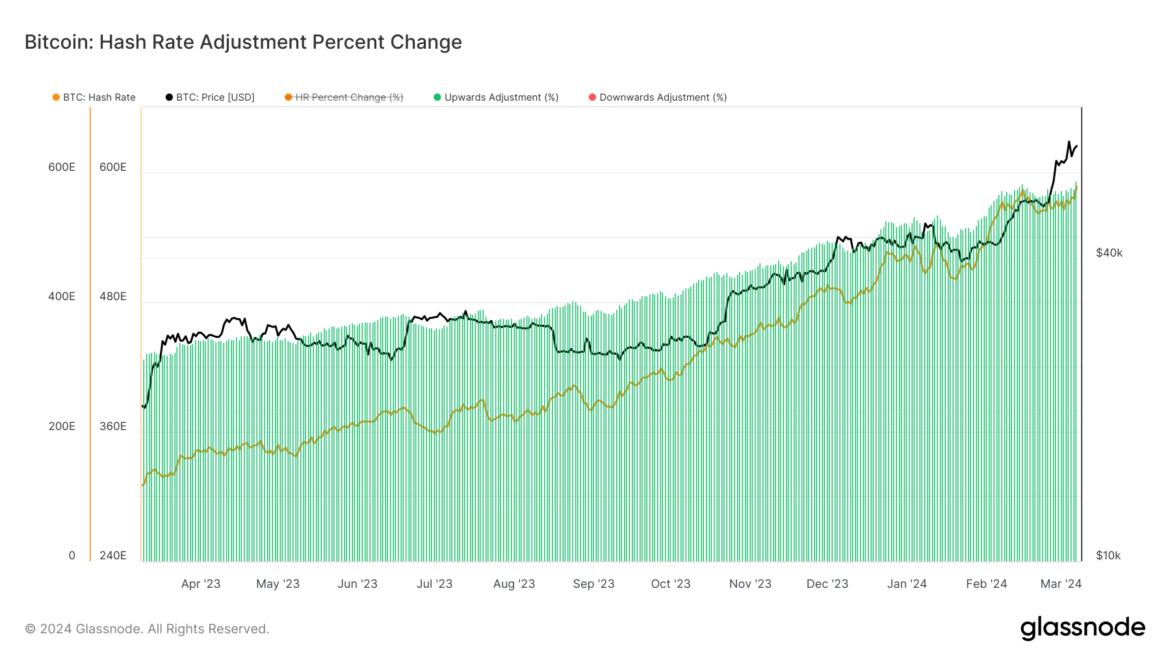
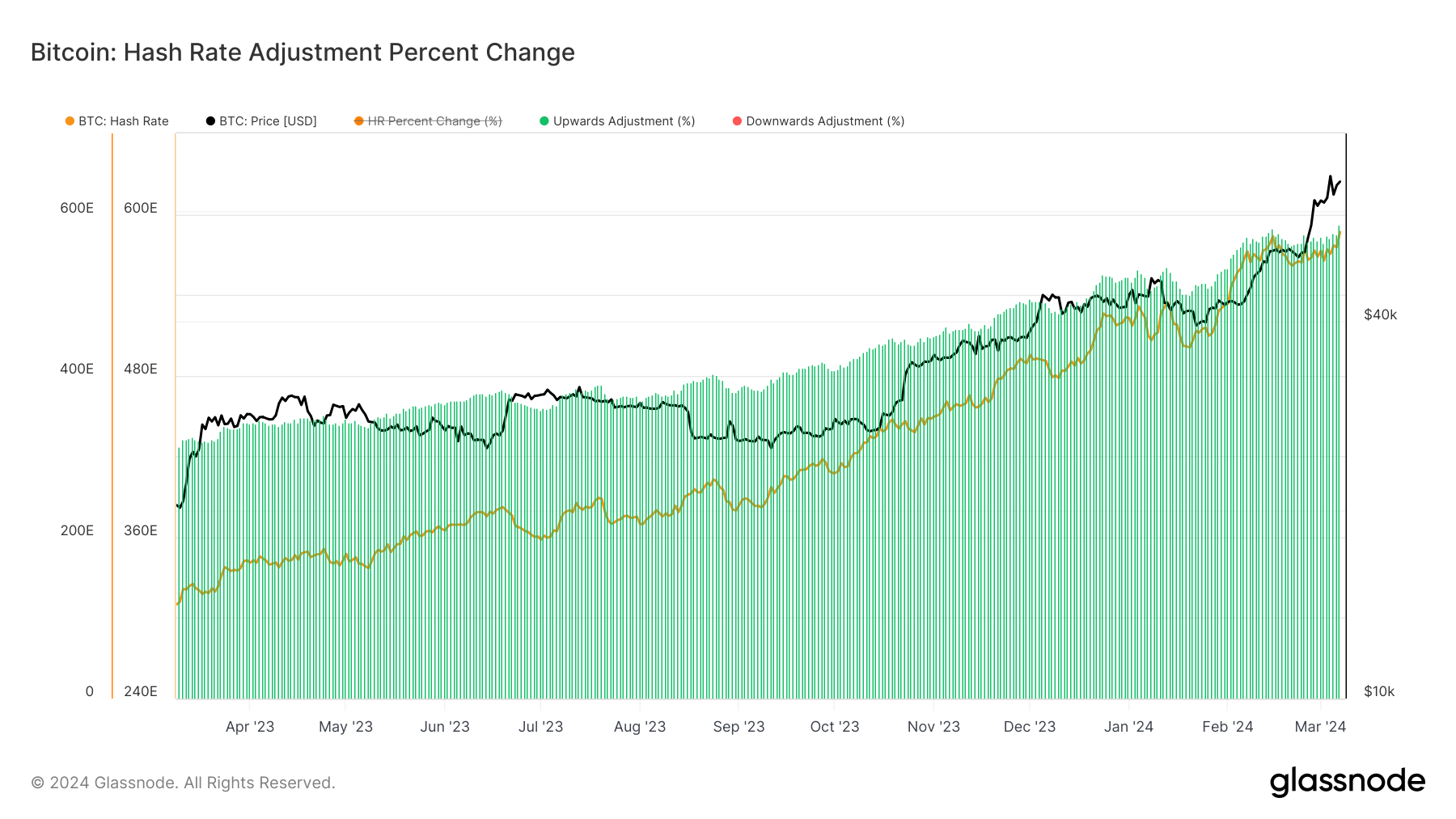
Bitcoin’s hash rate, an indicator of the computational power used for mining and processing transactions, has recently achieved a historic high. The 14-day moving average hash rate now stands at an unparalleled 586 eh/s, further enhancing the digital assets security. While the one-day hash rate peak of 711 eh/s on March 7 stands out, the 14-day moving average is considered a more reliable indicator as it smooths over short-term volatility.

This increase in hash rate signals a predicted adjustment of over 3% in the current difficulty epoch, expected on March 14, according to Newhedge.
This adjustment aligns with Bitcoin’s core design principle of maintaining a target block time of 10 minutes, directly influencing the projected timing of the next halving event. Per the Clarkmoody dashboard, if the ten-minute average block time is maintained, the halving event could potentially occur on April 21.
The post Bitcoin’s hash rate hits record high after difficulty drop appeared first on CryptoSlate.