Authorities in Egypt recently allowed the local currency’s exchange rate versus the U.S. dollar to decrease by more than 60%. Additionally, the central bank raised interest rates by 600 basis points. Both steps were key conditions set by the IMF which Egypt had to meet before the approval of a new financial aid package. IMF […]
Source link
CoinNews
Anthony Pompliano Predicts Bitcoin’s Price Could Double Soon; Leading Crypto Could Eventually Eclipse Gold
In a CNBC interview, Pomp Investments’ Anthony Pompliano delivered an optimistic forecast for bitcoin, suggesting a potential rise to $138,000 per unit shortly. He pointed out that historically, bitcoin has doubled its value within 18 days or less after surpassing previous peak prices on three out of four occasions. Pomp Investments’ Founder Envisions Bitcoin Outperforming […]


Source link
Email Shows Digital Currency Group and Gemini Explored Merger Before Genesis Bankruptcy
In an email found within the motion by Digital Currency Group (DCG) and Barry Silbert to dismiss the lawsuit initiated by the New York Attorney General, discussions of a potential merger between Gemini and Genesis were revealed before Genesis ultimately opted to declare bankruptcy. “Combined Gemini and Genesis would be a juggernaut and would be […]

Source link
Bitcoin sees violent volatility after hitting new ATH second time in a week
Bitcoin hit a new all-time high for the second time this week and once again experienced a violent sell-off that erased its gains and stirred memories of past volatilities in the crypto space.
Bitcoin broke its previous record early in the US trading hours on March 8, climbing to an all-time high of $70,136 after US jobs data raised expectations of rate cuts in the coming month.
However, the jubilation was short-lived as a wave of sell pressure engulfed the market, driving the price down by more than 3% to a low of $66,500 in less than an hour. The wider crypto market experienced similar volatility.
As of press time, BTC was trading at $67,890, according to CryptoSlate data.
Over the past four hours, the volatility caused $181.5 million in total liquidations, with longs making up more than $100 million. Meanwhile, Bitcoin liquidations during the period stood at $70.57 million, with longs accounting for $40.3 million, according to CoinGlass data.
The wall
This week’s market movements have been particularly turbulent, with Bitcoin’s value fluctuating widely. After setting a new record earlier in the week, BTC suffered a dramatic 14% drop, plummeting to around the $59,000 level before recovering.
Such volatility has become a defining characteristic of the crypto market, reflecting both the speculative nature of digital assets and the evolving landscape of financial markets.
Analysts identified a significant volume of sell orders on major exchanges, including Binance and OKX, as a pivotal factor in the rapid price reversal.
The sell orders, valued at roughly $70 million and totaling approximately 1000 BTC, created a formidable barrier that halted any further price increase beyond the $70,000 mark.
Institutional influence
Market analysts attribute the initial price surge to a combination of factors, including investor optimism regarding the US economic outlook and the introduction of spot Bitcoin exchange-traded funds (ETFs).
These developments have increasingly aligned crypto trading activity with traditional stock market hours, highlighting the growing integration of digital assets into conventional financial systems.
The backdrop to Bitcoin’s record-breaking rally was the latest US unemployment data, which suggested a potential easing of inflationary pressures and fueled speculation about the Federal Reserve’s interest rate policy.
The unexpected rise in the unemployment rate to 3.9%, coupled with downward revisions to job growth figures, has bolstered hopes for a more accommodative monetary stance.
As Bitcoin’s price ascension coincides with a weakening US dollar, the implications for the Fed’s upcoming policy decisions are being closely watched.
With the Fed’s next interest rate decision anticipated on March 20, market participants remain vigilant as the interplay between macroeconomic indicators and monetary policy could significantly influence the trajectory of Bitcoin and the wider digital assets market.
Bitcoin Market Data
At the time of press 5:39 pm UTC on Mar. 8, 2024, Bitcoin is ranked #1 by market cap and the price is up 1.19% over the past 24 hours. Bitcoin has a market capitalization of $1.35 trillion with a 24-hour trading volume of $53.2 billion. Learn more about Bitcoin ›
Crypto Market Summary
At the time of press 5:39 pm UTC on Mar. 8, 2024, the total crypto market is valued at at $2.59 trillion with a 24-hour volume of $148.59 billion. Bitcoin dominance is currently at 51.89%. Learn more about the crypto market ›
Mentioned in this article
Latest Alpha Market Report
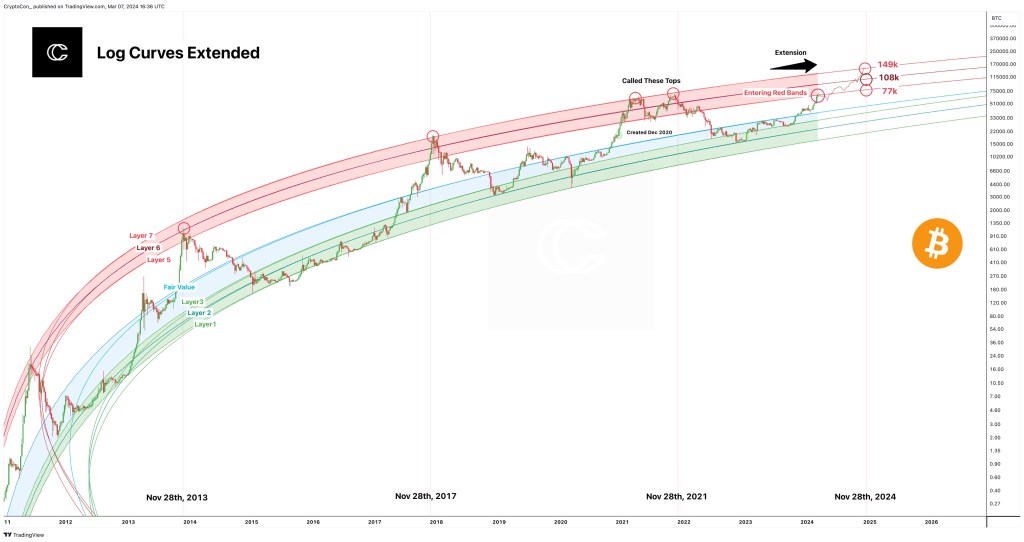
Amidst widespread bullish sentiment surrounding Bitcoin, one analyst on X thinks the leg up won’t be as strong as it was in the past few weeks. Pointing to developments in the Bitcoin log curves, the analyst expects the coin to find resistance as it attempts to break higher.
Bitcoin Uptrend To Slow Down
The analyst doubts the current excitement around the uptrend, and technical formations advise the contrarian view. Many in the industry think Bitcoin will not only ease past $70,000, a round number nearly tested this week, but also float to $100,000 in the next few weeks.

On X, the analyst remains confident about the coin’s prospects. However, based on the Bitcoin log curve assessment, the leg up will likely be labored. The analyst compares the current price formations with the Bitcoin log curves. In 2021, the tool was used to identify price peaks.
Based on price formation, the analyst notes that if BTC peaks in 2024, then prices will likely turn around from between $77,000 and $149,000. These prospective peaks’ upper and lower bands represent layers 5 and 7 of the log curve.
Even with BTC possibly rising to $149,000, at least from the tool, the Layer 7 target is relatively lower. By factoring in a one-year slowdown in growth, the predicted peak is revised downwards from $180,000 to $149,000.
When writing, the “red band” of the log curve has been breached earlier than usual. Looking back, Bitcoin prices tend to peak three months after this breakout.
That likely places Bitcoin’s peak at around the $77,000 level but below $100,000. Nonetheless, this is hard to predict, considering the volatile nature of prices and the dynamic nature of fundamental factors.
The community remains optimistic about what lies ahead. So far, Bitcoin prices have been trending at historical highs, but there has been a sharp drop in the momentum of upside.
BTC Bears In A Commanding Position
The daily chart shows that prices are still inside the bear bar of March 5. The candlestick had a high trading volume and was wide-ranging. For the uptrend to be valid, prices must break above $70,000, based on rising trading volume.

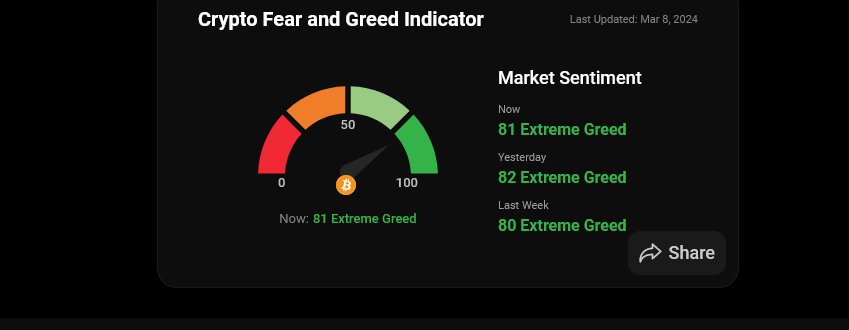
Lower prices incentivize issuers to spot Bitcoin exchange-traded funds (ETFs) to load up on dips. Their actions have spurred demand over the past few weeks, lifting sentiment and prices. According to Coinstats’ Fear and Greed Index, “extreme greed” exists in the market.
Feature image from DALLE, chart from TradingView
Disclaimer: The article is provided for educational purposes only. It does not represent the opinions of NewsBTC on whether to buy, sell or hold any investments and naturally investing carries risks. You are advised to conduct your own research before making any investment decisions. Use information provided on this website entirely at your own risk.
BitMEX co-founder believes this stablecoin could flip Tether one day
Ethena, the protocol powering the USDe synthetic dollar, raked in $6.53 million in fees over the last 24 hours, cementing its position as the top fee-generating decentralized application (dApp) in the crypto space, according to data from DeFillama.
Seraphim Czecker, Ethena Labs’ Head of Growth, shared insights from Token Terminal, affirming the project’s remarkable milestone. Czecker’s data indicates that Ethena amassed approximately $6.8 million in fees over the past week, outpacing competitors like MakerDAO and Arbitrum.
Yet, compared to leading blockchain networks, its revenue pales in comparison. Tron and Ethereum, for instance, boasted revenues of $38.6 million and $182.5 million, respectively.
What exactly is USDe?
USDe is a token pegged to the dollar’s value, offering lucrative yields. Though often labeled as a stablecoin, the team eschews this term, instead favoring “synthetic dollar.”
Ethena Labs launched the synthetic dollar on the public mainnet on Feb. 19 to widespread investor interest. At the time, the project debuted with a staggering 27.6% annual percentage yield (APY), surpassing the 20% yield offered by Anchor Protocol on the TerraUSD (UST) algorithmic stablecoin before its collapse in May 2022.
USDe’s unique model attracted $14 million in investments from prominent players such as Arthur Hayes, Brevan Howard, Franklin Templeton, Galaxy Digital, and Binance Labs.
In a recent update, Hayes, the co-founder of the BitMEX exchange, predicted that the project could flip Tether’s USDT dominance in the industry.
Hayes said:
“I believe that Ethena can eclipse Tether as the largest stablecoin. [However,] it will take many years for this prophecy to manifest itself.”
Rapid growth
Since its mainnet launch, USDe has experienced exponential growth, witnessing a staggering 44% surge in total value locked over the past week and an impressive 409% surge over the last month, reaching $838 million, according to DeFillama data.
This rapid growth has contributed to USDe’s development into one of the top 10 stablecoins by market capitalization, achieving this milestone in less than three weeks.
Market analysts have attributed this remarkable growth to the project’s enticing staking yield. Ethena, as stated on its website, offers a substantial 67.2% yield on its USDe synthetic dollar.
Furthermore, USDe now commands a significant portion of the global ether perpetual futures open interest, comprising nearly 8.69%. Notably, its average funding rate stands at an impressive 58.35%, as per data available on its website.
Mentioned in this article
Latest Alpha Market Report
Bitcoin Hits New All-Time High, Surging Past $70,000 For The First Time In History
Bitcoin (BTC), the dominant cryptocurrency, has made history by briefly breaking its consolidation phase and reaching an all-time high of $70,000. Despite encountering resistance near this level, Bitcoin’s market capitalization has reached $1.3 trillion, showcasing its continued upward momentum.
However, as the cryptocurrency faces a double top in the same price zone after almost three years, it must overcome a significant hurdle to consolidate above $69,000 and pave the way for further price gains.
Bitcoin Sets New Record
In the past 24 hours, Bitcoin experienced a 2% uptrend, propelling it to breach the $70,000 milestone for the first time. The cryptocurrency had previously reached $69,300 on Tuesday, indicating the growing strength of its upward trajectory. However, the $69,000 mark has proven to be a formidable resistance level, leading to increased volatility once breached.
The double-top formation in this price zone over a three-year period adds further complexity to Bitcoin’s consolidation efforts. Breaking through this resistance is crucial for Bitcoin to establish a solid foundation for future price gains and sustainably consolidate above $70,000.
The success of Bitcoin spot exchange-traded funds (ETFs) within a short span of two months has bolstered investor confidence and generated anticipation for future price appreciation.
With investors betting on Bitcoin’s long-term prospects, it appears to be only a matter of time before the cryptocurrency overcomes its current resistance level and continues its upward trajectory. This positive sentiment provides a favorable backdrop for Bitcoin’s potential breakthrough.
Following its brief touch of $70,000, Bitcoin experienced a rapid retracement to the $68,000 level. The timing and extent of its consolidation above the resistance mark remain uncertain. However, market observers are closely monitoring Bitcoin’s performance, anticipating a potential breakthrough that could fuel additional price gains.
Featured image from Shutterstock, chart from TradingView.com
Disclaimer: The article is provided for educational purposes only. It does not represent the opinions of NewsBTC on whether to buy, sell or hold any investments and naturally investing carries risks. You are advised to conduct your own research before making any investment decisions. Use information provided on this website entirely at your own risk.
New Bitcoin ETFs and Grayscale Control a Combined 4% of BTC Supply, Valued at $53 Billion
The latest figures reveal that the nine new spot bitcoin exchange-traded funds (ETFs) now control 390,525.3 bitcoins, valued at just over $26 billion at current market rates. These nine ETFs are rapidly approaching the holdings of Grayscale’s Bitcoin Trust (GBTC), which presently has 405,713.31 bitcoins in its possession. Emerging Bitcoin ETFs Challenge Grayscale’s Reign Collectively, […]
Source link
Here are the Ethereum-based altcoins that are currently witnessing a high amount of activity from the whales, according to on-chain data.
These Ethereum Altcoins Are Seeing High Whale Transactions Right Now
In a new post on X, the on-chain analytics firm Santiment has discussed how several Ethereum-based altcoins have been seeing notable whale activity recently.
The indicator of relevance here is the “whale transaction count,” which keeps track of the total number of transfers taking place on the network for a given cryptocurrency that is valued at $100,000 or more.
Generally, only the whales are capable of moving such large amounts in single transactions, so transfers carrying this much value are assumed to involve these humongous entities.
When the value of this metric is high, it means that the whales are making a large amount of moves on the network right now. Such a trend implies these large investors have a high interest in the asset currently.
On the other hand, low values suggest the cryptocurrency may have a lack of whale interest behind it, as there are barely any large transactions occurring on the chain.
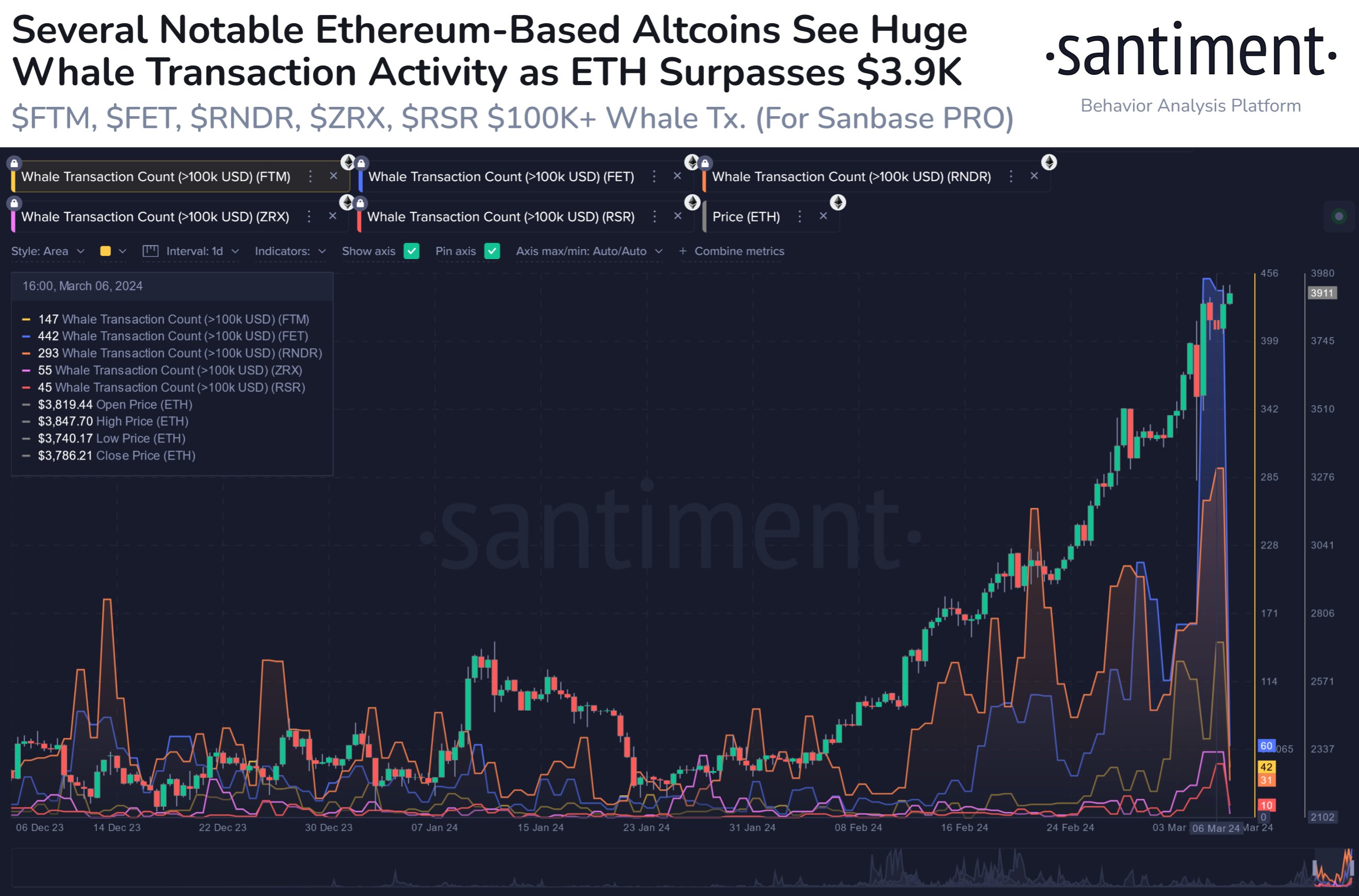
Now, here is a chart that shows the trend in the whale transaction count for a few different Ethereum-based altcoins over the past few months:

The value of the metric seems to have been high for all of these assets recently | Source: Santiment on X
As displayed in the above graph, the whale transaction count has recently seen a sharp surge for these five altcoins: Fantom (FTM), Fetch.ai (FET), Render (RNDR), 0x Protocol (ZRX), and Reserve Rights (RSR).
“Ethereum’s market value is up to $3,920 and the #2 cap ranked market price ratio vs. Bitcoin is +9.5% in the past 3 days,” Santiment notes. “When these kinds of price dominance flips occur, we often see profits quickly redistribute, and whales becoming very active in ERC20-based altcoins.”
The alts in question here have all recently registered at least three-month highs in their whale activity. From the chart, it’s visible that Fetch.ai has observed the largest spike out of these assets.
Render leads in second place, while Fantom has followed after it in third. The prices of all three of these altcoins have registered rapid increases, with FTM coming out as the winner so far, with more than 67% in profits over the past week.
Thus, it would appear that the recent whale activity likely corresponded to buying pressure in these alts. It should be noted, however, that even if the whale transaction count remains high in the near future, it doesn’t necessarily have to lead to a bullish outcome.
The indicator merely counts the number of all whale-sized transactions and doesn’t contain any information about whether they are being made for buying or selling.
All that the whale transaction count can say about these altcoins is that, should whale activity remain high, their prices would be probable to witness volatile action, but its direction could go either way.
ETH Price
Ethereum has managed to outperform Bitcoin in the past week, as the second-largest coin has seen an increase of around 15% that has now taken its price beyond the $3,900 level.
Looks like the price of the coin has been going up in recent days | Source: ETHUSD on TradingView
Featured image from Yilei (Jerry) Bao on Unsplash.com, Santiment.net, chart from TradingView.com
Disclaimer: The article is provided for educational purposes only. It does not represent the opinions of NewsBTC on whether to buy, sell or hold any investments and naturally investing carries risks. You are advised to conduct your own research before making any investment decisions. Use information provided on this website entirely at your own risk.
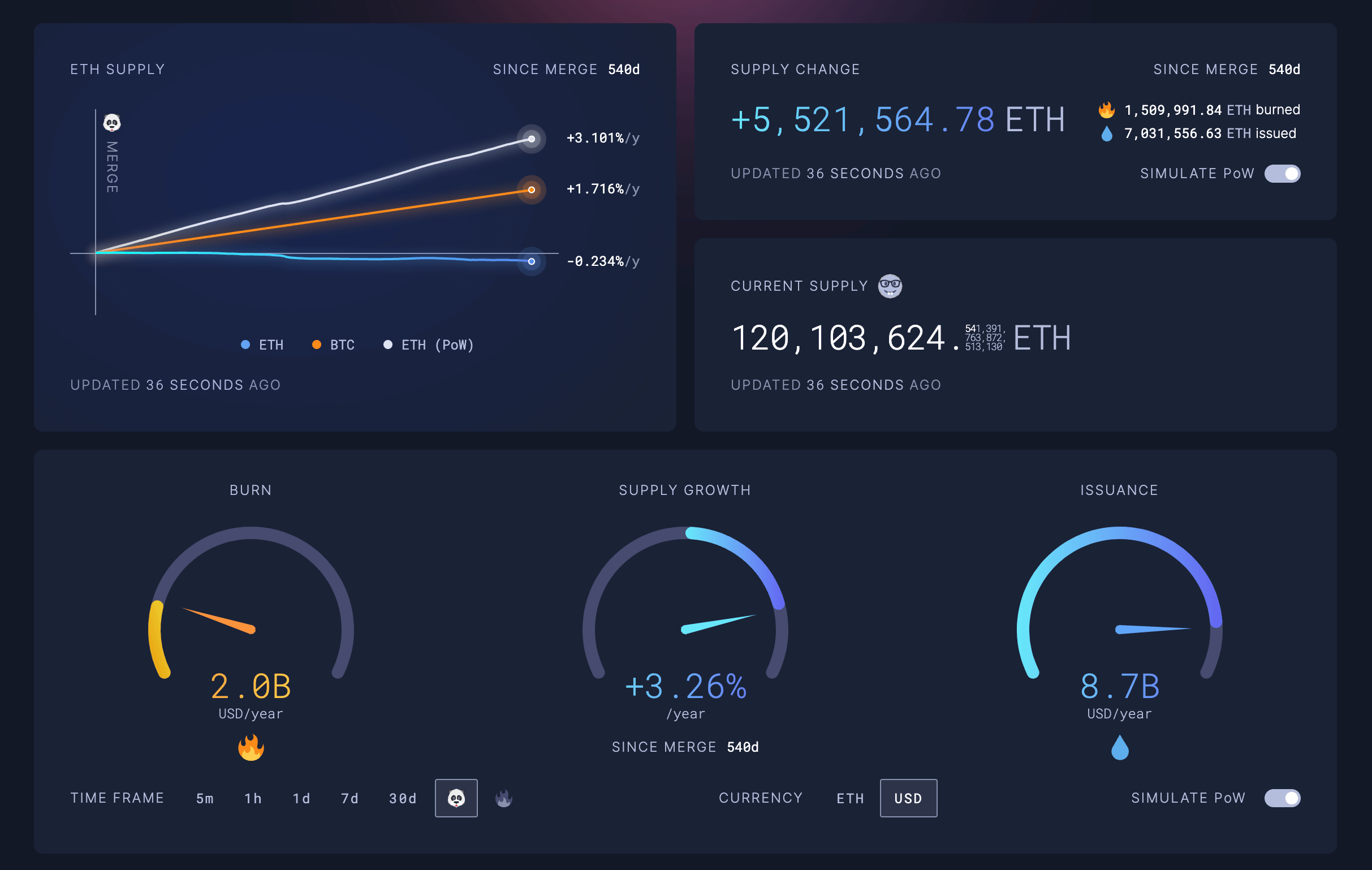
The Ethereum network has seen a reduction of 417,413 ETH in supply since transitioning to a Proof-of-Stake (PoS) consensus mechanism in September 2022, per data from ultrasound.money. In the 540 days since The Merge, 1,509,991 ETH has been burned while the network has issued 1,092,578 new ETH, resulting in a net decrease.
As of press time, the market value of the ETH removed from the supply stands at $1,653,797,635, marking an annual inflation rate of -0.23%.

In contrast, Bitcoin’s supply has grown by 1.716% over the same period. This highlights the divergent monetary policies of the two largest cryptocurrencies, as Bitcoin maintains a predictable issuance schedule. At the same time, the balance between staking rewards and transaction fee burning now determines Ethereum’s supply change.
A Proof-of-Work (PoW) simulation on the ultrasound.money dashboard shows Ethereum’s supply would have increased by over 5.5 million ETH during the same period had the network not shifted to PoS. Under the PoW model, the simulation indicates 7,031,556 ETH would have been issued with the same 1.5 million ETH burn rate, leading to a net increase of 5,521,564 ETH since The Merge. The value of the ETH issued under this simulation would amount to $21,865,393,440, representing a theoretical inflation rate of 3.26%.

The stark difference highlights the deflationary impact of Ethereum’s new consensus design compared to its previous mining-based system. The transition to PoS has significantly reduced new ETH issuance, as validators staking ETH now secure the network instead of PoW miners. This shift, combined with the ongoing burn mechanism introduced in EIP-1559, has put downward pressure on Ethereum’s supply growth.
According to the real-time data, Ethereum’s total circulating supply currently stands at 120,103,624 ETH. Meanwhile, the PoW simulation estimates the supply would have reached 125,625,188 ETH if miners were still powering the network under the old model.
The supply reduction since The Merge aligns with the Ethereum community’s vision of making ETH a deflationary asset over time, diverging from Bitcoin’s fixed inflationary schedule. Proponents believe the combination of staking rewards and fee burning will continue to offset new issuance, potentially leading to net negative supply change periods.
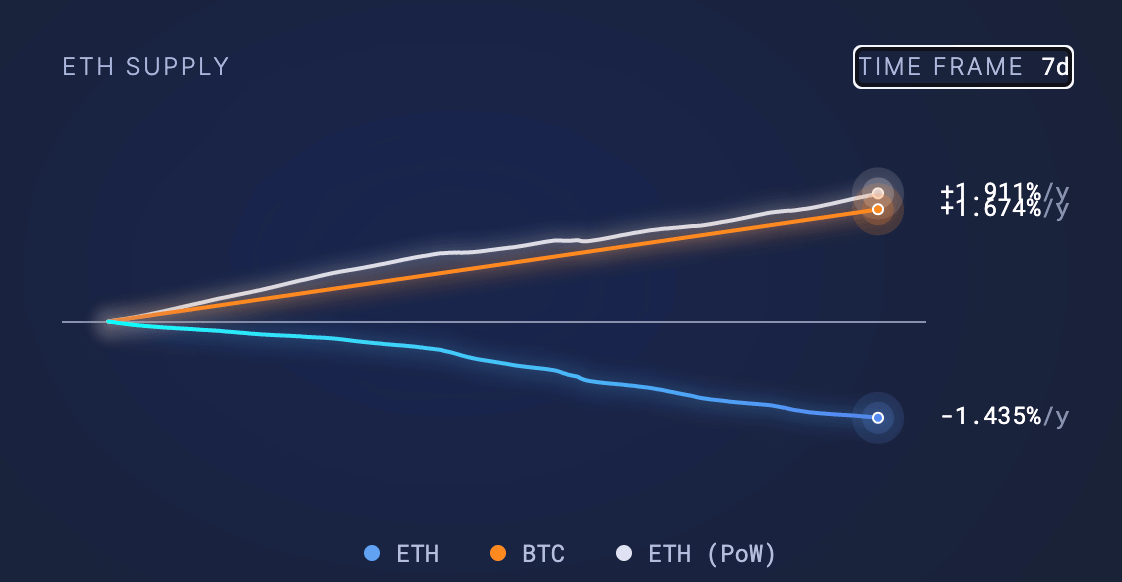
Over the past seven days, increasing ETH network fees has facilitated an uptick in deflationary behavior as it rose to -1.435%. Moreover, even under PoW, its inflation rate would have fallen to 1.911% due to the surge in network activity and its correlation with the burn mechanic.

However, critics argue the move to PoS has centralized control of the network in the hands of major staking entities and exchanges. Some warn that the concentration of staked ETH could undermine Ethereum’s decentralization and security guarantees, in contrast to Bitcoin’s more distributed mining network.
As Ethereum continues to evolve under its new PoS regime and Bitcoin maintains its established PoW model, observers will closely watch how their respective supply dynamics and security trade-offs unfold. With Bitcoin’s issuance about to half due to the upcoming halving, its inflation rate will drop to 0.8%, which is within 1% of Ethereum. Bitcoin, however, has a fixed supply and will eventually have an inflation rate of zero. Ethereum’s inflation rate is tied to network activity and the amount burned through network transactions.
Still, the deflationary trend in ETH over the past 540 days offers an early glimpse into the potential future of the two largest cryptocurrencies ahead of the first Bitcoin halving since The Merge. The long-term sustainability and implications for both networks remain to be seen, with Bitcoin currently thriving at a $1.3 trillion market cap and Ethereum next in line at $478 billion.
Mentioned in this article