In the unfolding lawsuit between the Crypto Open Patent Alliance (COPA) and Craig Wright, three key witnesses who had early interactions with Bitcoin’s creator, Satoshi Nakamoto, provided their testimonies. Among them were early Bitcoin developers Martti Malmi and Mike Hearn, as well as Adam Back, the creator of Hashcash, the proof-of-work (PoW) algorithm integral to […]
Source link

CoinNews
Elliot Wave Theory Predicts Bitcoin Bottom And Top, Here Are The Targets
Bitcoin looks to be stuck in a consolidation zone between $50,000 and $52,000, with neither the bulls nor the bears succeeding in completely taking control of the trend. This performance has sparked a number of speculations on whether the BTC price has finally found a local top. One of those who have speculated on the price direction is crypto analyst Alan Santana, who has used the Elliot Wave Theory to predict where the price of the cryptocurrency might be headed next.
Elliot Wave Points To Correction To $31,800
In the analysis shared by Alan Santana on TradingView, the Elliot Wave theory could point out the direction that the Bitcoin price could be headed next. The theory, which consists of five waves, has so far completed three waves, with the fourth wave expected to happen soon.
Given that the third wave is very bullish and the price has risen so fast, the fourth wave is expected to be more bearish. As Santana explains, this fourth wave points toward an upcoming correction. They also reveal that their analysis included Elliot’s Law of Alternation, and applying it to this scenario, the fourth wave is bearish, but would not go as low as the second wave.
Source: TradingView.com
Once this fourth wave moves into action, the Bitcoin price is expected to see a sharp correction. At the low end of this correction, though, is the $31,800 level, the analyst believes. So, in this scenario, there will be a return to the $20,000s before Bitcoin resumes its next leg up.
“This wave four of a higher degree cannot enter the territory of wave two, which puts the lowest price possible for the upcoming correction at $31,805 based on Elliot Wave Theory,” Santana said. He further added that: “Just as wave three would lead to a correction (wave four), wave four invariable leads to another impulse; the final and fifth wave of the higher degree.”
Bitcoin Top At $138,000
Not only does the Elliot Wave theory points toward a possible bottom, it also gives an idea for where the Bitcoin top might lie in the fifth wave. The crypto analyst uses one of the two Wave Principle methods to forecast this price, which takes into account the peak of the third wave and then uses that to give the peak of the fifth wave.
So far, the local top of this third wave looks to be $52,985, where Bitcoin peaked earlier this week. Since the Wave Principle says that the peak of Wave 5 would be three times higher than that of Wave 3, the analyst multiples $59,985 by 3, which gives a cycle top of $138,714.
As for when this peak will roll around, Santana explains that the whole thing could play out by 2025, which is when the peak would take place. “So the potential for the final impulse or fifth wave based on the Elliot Wave Theory system, amounts to $138,714. This can happen sometime in 2025,” the analyst stated.
BTC price at $51,700 | Source: BTCUSD on Tradingview.com
Featured image from Investopedia, chart from Tradingview.com
Disclaimer: The article is provided for educational purposes only. It does not represent the opinions of NewsBTC on whether to buy, sell or hold any investments and naturally investing carries risks. You are advised to conduct your own research before making any investment decisions. Use information provided on this website entirely at your own risk.
South Africa advances financial inclusion with crypto and digital payment reforms

South Africa announced plans to weave digital payments and crypto into its financial fabric to boost the economy for marginalized groups.
The announcement was made in the country’s 2024 budget and underlines the government’s drive to build a digital economy through active collaborations between public and private sectors to enhance financial innovation.
The budget targets enhancing access to digital payments for people in townships and rural areas who predominantly handle cash. Initiatives will provide local merchants with the infrastructure needed for digital transactions, like internet connectivity and point-of-sale systems.
Starting with a pilot in Gauteng, these efforts seek to broaden the acceptance and use of digital payments among both consumers and businesses.
Regulatory Standards
South Africa intends to legitimize crypto payments and make them an intrinsic part of the local economy over the coming years, starting with a regulatory framework for the sector. The country made crypto an official financial product in 2022, akin to company shares or debt.
The Intergovernmental Fintech Working Group (IFWG) will start issuing comprehensive guidelines in 2024 that will focus on “stablecoins” and their practical applications. This effort will complete a thorough review of the stablecoin environment domestically and create regulatory recommendations that align with global standards.
In 2023, the Financial Sector Conduct Authority (FSCA) and the Financial Intelligence Centre (FIC) started to register crypto asset service providers, following changes to the FIC Act that align with FATF recommendations. The FSCA’s classification of crypto as a financial product now requires service providers to obtain a license, ensuring they meet strict operational standards.
The government is reviewing the extension of the FIC Act’s mandate, which currently requires reporting cash transactions over R49,999, to include crypto transactions. The move aims to use such data in fighting crime.
Additionally, the government intends to explore tokenization and how blockchain technology can represent assets, with the publication of policy and regulatory implications planned for December 2024.
The South African central bank has been considering the development of a central bank digital currency (CBDC) for a number of years. However, the regulator has yet to announce any significant progress in the area.
Supporting financial inclusion
The National Treasury and the Reserve Bank, together with international partners, are rolling out four pilot projects focused on digital payments to aid small and informal businesses.
These projects aim to digitize community transactions, informal worker payments, and cross-border remittances to facilitate finance for small traders engaging in cross-border commerce. Each initiative addresses specific hurdles, from cutting remittance costs to implementing digital tipping for low-income workers.
These efforts highlight South Africa’s determination to be at the forefront of financial digitalization and inclusion, using technology to strengthen its economy and uplift its people. By integrating crypto and emphasizing a solid regulatory framework, the country shows a progressive approach that ensures innovation goes hand in hand with consumer protection and financial integrity.
Grayscale Debuts Privacy-Focused ETF Featuring Zcash Trust Allocation
According to a recent Form N-1A, Grayscale has approached the U.S. Securities and Exchange Commission (SEC) with a proposal for a unique exchange-traded fund (ETF) dedicated to the privacy and cybersecurity realm. The Grayscale Privacy ETF aims to be the first to encapsulate the burgeoning sector of privacy technology and cybersecurity. Privacy Takes Center Stage […]
Source link

Quick Take
According to Nate Geraci, President of the ETF Store, 2024 has marked a significant year for Bitcoin Exchange-Traded Funds (ETFs), particularly BlackRock IBIT and Fidelity FBTC. Geraci highlights these two Bitcoin ETFs as standing among the top 8 in terms of ETF inflows this year, a notable achievement considering the diverse ETF landscape.
CryptoSlate data on Feb. 21 reveals that IBIT has experienced net inflows totaling $5.5 billion, while FBTC has witnessed net inflows of $3.7 billion. These impressive numbers are in the company of inflows seen by three S&P 500 ETFs (VOO, IVV, & SPLG), the QQQ, Vanguard Total Stock Market ETF (VTI), and the iShares S&P 500 Value ETF (IVE), according to Geraci.
The success of IBIT and FBTC is further demonstrated by the combined net inflow of all spot US Bitcoin ETFs surpassing the $5 billion inflow benchmark. However, it is vital to quantify this success in a broader context. The aggregated investment across all Bitcoin US ETFs is estimated at around $41 billion.
Their success highlights the growing acceptance of Bitcoin as an asset and the potential future of ETFs in the digital asset space.
The post Two Bitcoin spot ETFs rank among top 8 for ETF inflows in 2024 appeared first on CryptoSlate.
The new frontier in Bitcoin mining: Stranded energy utilization and open hash power markets

In the latest episode of SlateCast, CryptoSlate’s Liam “Akiba” Wright and CEO Nate Whitehill welcomed Ryan Condron, CEO of Titan Mining and the creator of Lumerin Protocol, to discuss the current state of Bitcoin mining and the potential for hash power to become a valuable asset in the future.
How Titan Lightning streamlines the experience of mining
Titan Lightning, a new integration with the Lumerin hash power marketplace, aims to streamline the mining experience for users. As Condron explained, traditional mining setups often involved significant friction for newcomers:
“Previously, [new miners] had to set up an account with a mining pool, plug in the credentials — it was hard to onboard through that.”
Titan Lightning solves this by allowing users to simply provide a Lightning address when purchasing hash power through the Lumerin marketplace. The hash power then streams directly to the Titan Lightning pool, which pays users out in real-time on a “pay per share” basis.
Condron highlighted the powerful feeling of “purchasing hash power, which is essentially Bitcoin over time, and then you start receiving the stream of sats directly into your wallet.” This seamless integration removes barriers to entry, providing an instant and intuitive mining experience where users can see their rewards hit their Lightning wallet almost immediately after purchase.
Condron further explained:
“You can take a mining facility and put the hash power up for sale to the highest bidder. It’s an open market around hash power on a global decentralized anonymous scale.”
Why decentralizing hash power democratizes the Bitcoin network
Decentralizing hash power is crucial for maintaining the democratic nature of the Bitcoin network. As institutional investors and large mining pools increasingly dominate Bitcoin’s hash rate, there is a risk of centralization that could undermine the foundational principles of the network.
By enabling a global, decentralized marketplace for hash power like Lumerin, individual miners and smaller players can access and contribute computing resources without going through a centralized mining pool. This promotes a more evenly distributed hash rate and decision-making power over which transactions are included in blocks. Condron emphasized:
“Hash power needs to be accessible to everyone on earth if the Bitcoin network is going to stay democratized.”
A truly decentralized network, where no single entity controls a majority of the hash power, aligns with Bitcoin’s vision of monetary sovereignty for all participants. Initiatives focused on democratizing access to hash power are vital for upholding this ideal.
While acknowledging the potential for governments to regulate mining pools and on-ramps, Condron highlighted the need for a balanced approach:
“Governments really don’t like it when you mess with their money supply,” he said. “They’re going to look to regulate the ownership and control the transaction processing and interiors of the system.”
The future of Bitcoin mining: Embracing stranded energy
The future of Bitcoin mining lies in harnessing stranded energy resources worldwide. Many developing nations have abundant renewable energy potential that is underutilized due to infrastructure challenges or lack of local energy demand. Bitcoin mining presents an opportunity to monetize this stranded energy.
As Condron explained:
“With the advent of Bitcoin mining, you have miners coming in and actually government sponsoring mining build-out now because they realize that they can use up the electricity from these large production facilities to mine Bitcoin.”
Miners can establish operations near remote renewable energy sites, utilizing excess power that would otherwise be wasted. This facilitates Bitcoin’s sustainable growth and can drive economic development by bringing investment, jobs, and supplemental power to local communities with abundant but stranded energy resources.
The discussion with Ryan Condron offered insightful perspectives on the evolving landscape of Bitcoin mining and hash power. As the network grows, the democratization of hash power and the utilization of stranded energy resources will play pivotal roles in shaping the future of Bitcoin mining.
Watch the full podcast here.
Is Ripple Dumping Millions Of XRP? CTO Addresses Reasons Behind $34 Million Transaction
Ripple has always been subjected to claims of manipulating the price of XRP and its natural growth by selling coins. As the cryptocurrency’s largest holder, Ripple has faced constant criticism about the amount of XRP it holds, with detractors arguing it gives them too much control and influence over the price.
Particularly, there’s been some drama swirling around the altcoin lately and claims that Ripple has been manipulating the market and systematically dumping its large holdings. This has come in light of a large transfer of 60 million XRP tokens from Ripple to an unknown wallet address.
Ripple Accused Of Dumping XRP And Manipulating Market
Whale transaction tracker Whale Alerts recently posted on social media a transfer of 60 million XRP worth $34 million from a Ripple-controlled wallet address into a private address. A further look shows that the private recipient wallet currently holds over 138 million XRP worth $75.5 million, with this same address receiving 80 million XRP from Ripple on February 11.
🚨 🚨 60,000,000 #XRP (34,088,291 USD) transferred from #Ripple to unknown wallet
— Whale Alert (@whale_alert) February 20, 2024
At the time of writing, Ripple controls about 6% of the current circulating supply. Therefore, it is only natural that large transactions like this from Ripple would generate waves in the market and lead to speculations. Consequently, the large transfers have reignited claims of Ripple selling its holdings amidst ongoing consolidation in the price of XRP.
In addition, debates regarding XRP’s programmatic sales have resurfaced, as history shows this isn’t new to Ripple. According to details shared by a social media user, Jim_Knox, Ripple allegedly delivered XRP to three market makers in 2017 for the purpose of market sales, which resulted in a price suppression of the cryptocurrency during that particular period. Furthermore, recent accusations have taken root of Ripple using what it called the 4t and 6t bots to execute programmatic sales to exchanges.
Ripple CTO Addresses Concerns
Ripple CTO David Schwartz took to a social media thread to address the rumors of price manipulation. An XRP community member had shared a meme suggesting that Ripple’s 4t and 6t bots have always prevented the price of XRP from increasing, keeping it at the $0.50 level.
However, Schwartz pointed out that Ripple has discontinued the programmatic sales of XRP, with the company only selling its holdings through ODL transactions. The ODL transaction method is Ripple’s unique payment solution that offers instantaneous cross-border transactions. On the other hand, concerns regarding the recent large transactions from Ripple to unknown wallets are yet to be addressed, and it all remains speculative at this point.
XRP is trading at $0.5463 at the time of writing, down by 0.50% in the past 24 hours but still maintaining a meager 2% gain in a 30-day timeframe. Recent transaction alerts from Whale Alerts have shown large amounts of XRP leaving private wallets to crypto exchanges, hinting at potential selloffs.
Token price stalls at $0.54 | Source: XRPUSD on Tradingview.com
Featured image from U.Today, chart from Tradingview.com
Disclaimer: The article is provided for educational purposes only. It does not represent the opinions of NewsBTC on whether to buy, sell or hold any investments and naturally investing carries risks. You are advised to conduct your own research before making any investment decisions. Use information provided on this website entirely at your own risk.
Non-Fungible Items; Picking up Where NFTs Left off — COZ Co-Founder Tyler Adams
Many have already pronounced the death of NFTs, and in part, they are correct. Amidst the fervor of the NFT hype cycle, we saw huge valuations and sales such as Beeple’s ‘The 5000 Days’ collection selling for a staggering $69.3 million. However, not substantiated by anything beyond the hype, the market came crashing down with […]
Source link
Ping Exchange’s hybrid cold storage redefines standards for crypto exchange custody

The launch of Ping Exchange signals a potential new stage in digital assets trading. The hybrid platform merges robust security protocols with user-focused asset control, setting a high bar for how exchanges should safeguard user assets. Ping’s standout feature is an unconventional model using a hybrid custodial cold storage to redefine crypto exchange security.
Ping leverages the unique CorePass ID application for streamlined user authentication. Traditional username and password vulnerabilities and cumbersome two-factor authentication (2FA) methods are gone. Instead, CorePass utilizes blockchain-secured identity information, rapid QR code scanning, and Core Blockchain encryption for secure, decentralized login and withdrawals.
Furthermore, while assets deposited onto the platform are placed into Ping’s custody, withdrawal of any assets remains tied to the user’s CorePass ID. Ping cannot withdraw deposited funds without authorization from the user, only allowing trading of assets within the exchange. This streamlined, self-custodial approach places an unprecedented level of access control into users’ hands, merging the benefits of DeFi and CeFi into a new opportunity for users.
So much exchange-focused content references the failures of FTX, Celsius, BlockFi, etc., while claiming to “do better” by offering more secure custody methodologies and promising not to comingle funds. Proof-of-reserve attestations are a fantastic first step; however, Ping’s model puts a flag in the ground in a different, much more substantial way.
With Ping, the CoDeTech team is offering a way to trade digital assets in an exchange environment without signing away the rights to your assets or your identity. Using CorePass, you, the user, remain in control of the data attached to your KYC verification and can revoke it from the exchange at any time. Further, the assets you deposit can be traded across any of the supported trading pairs with other users through a standard exchange order book. Yet, the exchange cannot withdraw your funds without your permission. While not impossible, an FTX scenario would be much more complex with Ping when compared to many traditional exchanges.
In order to facilitate trades Ping has the ability to swap assets between users. Ping also is required to retain the ability to freeze assets to be compliant with AML/KYC regulations. Like traditional exchanges, when it creates the deposit wallet it retains the associated private keys. However, these keys are then required to do anything with deposited funds not already approved by the user.
I’ve often touted that FTX wasn’t a crypto problem but a people problem. Many exchanges don’t rely enough on blockchain technology for their day-to-day operation. I’m so excited to see products like Ping come to market, which put blockchain verification and validation at its core.
Balancing Speed with Uncompromising Security
Moreover, Ping’s focus on cold storage is a cornerstone of its security framework. While many centralized exchanges rely on a less secure mix of hot and cold wallets, Ping’s air-gapped CorePass ID wallets isolate crypto holdings. CorePass ID allows for offline signing through QR codes, creating an air-gapped approach to custody. This strategy significantly reduces the surface area for hackers, minimizing the risk of costly breaches.
The meticulous offline transaction creation and signing process on these air-gapped devices demonstrates Ping’s commitment to safeguarding user funds. Moreover, integrating the ICAN standard with crypto wallets helps prevent sending and receiving errors while supporting various blockchains through network prefixes.
Despite this uncompromising stance on security, Ping also offers exceptional transaction speeds, particularly on the Core Blockchain, with confirmation times as low as a few seconds. This speed comes without sacrificing security. Additionally, near-instant withdrawal processing, typically achievable in under a minute, aligns with Ping Exchange’s pledge to enhance the user experience.
Innovation in Compliance
Ping’s technology also improves transaction security and compliance standards through its automated Know Your Customer (KYC) process. As mentioned in Core Corner Issue 1, CorePass ID allows users to complete a KYC process for their wallet and then essentially sell this data to any third parties, such as Ping, at a later date. This puts the power back in the hands of the user, giving them greater control over their data and who has access.
Ping aligns document submission with a tiered access system to streamline the process further, granting users personalized permissions appropriate to their verification level. This approach simplifies compliance with global regulations such as GDPR and CCPA, enhancing the overall security posture of the platform. Ping’s approach to compliance aims to be accepted as ‘best standard’ by regulators, according to people familiar with the matter.
More Than Just an Exchange
Beyond these novel custody methodologies, Ping Exchange offers real-time notifications, an AntiBot trading system, and multi-language support to cater to a wide spectrum of users, promoting broader inclusion.
While this innovative exchange showcases many groundbreaking features, it’s essential to exercise caution, as with any new platform. Time will ultimately determine its ability to deliver long-term stability and attract a significant user base. Nevertheless, with its innovative solutions to common exchange vulnerabilities, Ping Exchange warrants consideration from anyone seeking a new trading platform offering security and convenience.
In its first month of trading, it has processed volumes comparable to the top 200 DeFi platforms from CryptoSlate analysis. Further, thus far, it has done so without market makers adding liquidity. Instead, all trading through the platform has been peer-to-peer among the nascent Core Blockchain community.
Ping provides unparalleled access to these assets as the world’s first exchange to feature markets for Core Coin (XCB) and Core Token (CTN). Ping users enjoy unique trading opportunities while at the forefront of Core Blockchain developments. Other assets such as Ethereum, Bitcoin, Litecoin, and USDC are also actively tradeable.
The digital assets world is one of perpetual innovation. Ping Exchange’s novel approach to custody, compliance, and user experience could shape the future of exchanges and elevate the industry’s security standards.
As the Ethereum ecosystem braces for the much-anticipated Dencun upgrade, renowned crypto analyst Miles Deutscher provides an in-depth look at the altcoins poised for significant growth.
Scheduled for March 13, the Dencun upgrade is a critical hard fork aimed at enhancing Ethereum’s scalability, security, and usability. Deutscher’s insights reveal how specific Layer 2 (L2) solutions are uniquely positioned to benefit from the upgrade’s introduction of Proto-Danksharding and other key enhancements.
Deutscher explains, “The Dencun upgrade, especially with EIP-4844, represents a paradigm shift in how Ethereum will handle transactions. By drastically lowering gas fees and increasing throughput, we’re looking at a more accessible, efficient blockchain.” This upgrade is part of Ethereum’s broader roadmap, known as “The Surge,” focusing on scalability improvements.
Top-6 Altcoins To Watch Prior To Dencun
#1 Polygon (MATIC/POL): With its impending rebrand and investment in zk-technology, Polygon is at a pivotal juncture. Deutscher notes, “Polygon’s deep dive into zk-rollups could redefine its position in the L2 landscape, making MATIC an attractive asset for forward-looking investors.”
#2 Arbitrum (ARB): As the leading L2 by TVL and transaction volume, Arbitrum’s robustness is undisputed. “Arbitrum has cemented its position as a powerhouse in the L2 space, and the Dencun upgrade will only amplify its strengths,” Deutscher remarks.
#3 Optimism (OP): Positioned as a strong contender in the L2 space, Optimism’s ecosystem is set to expand. “The announcement of Optimism’s fourth airdrop is not just a reward for its community but a strategic move to bolster its ecosystem’s vibrancy,” says Deutscher.
#4 COTI Network (COTI): With the launch of V2 and its innovative ‘Garbled Circuits,’ COTI introduces a groundbreaking privacy solution. Deutscher observes, “COTI’s approach to privacy on the blockchain through ‘Garbled Circuits’ is a game-changer, potentially setting a new standard for private transactions.”
#5 Mantle (MNT): Highlighting Mantle’s rapid growth, Deutscher points out, “With $1.5 billion in ETH now staked as mETH, Mantle is not just growing; it’s thriving, supported by strategic airdrops that reward its community.”
#6 Metis (METIS): Identified as a potentially undervalued project, Metis’s upcoming initiatives are a beacon for investors. “Metis’s decentralized sequencer and the substantial METIS Ecosystem Fund are laying the groundwork for a robust, decentralized future, making it an intriguing prospect post-Dencun,” Deutscher explains.
Broader Implications For Ethereum
Deutscher also casts a spotlight on Manta Network, Starknet, zkSync, and Linea as projects to watch, emphasizing the widespread impact of the Dencun upgrade. He advises, “The ETH/L2 trade is increasingly compelling as we approach the Dencun upgrade. Shifting a significant portion of one’s portfolio into the Ethereum ecosystem seems prudent, given the transformative potential of the upcoming changes.”
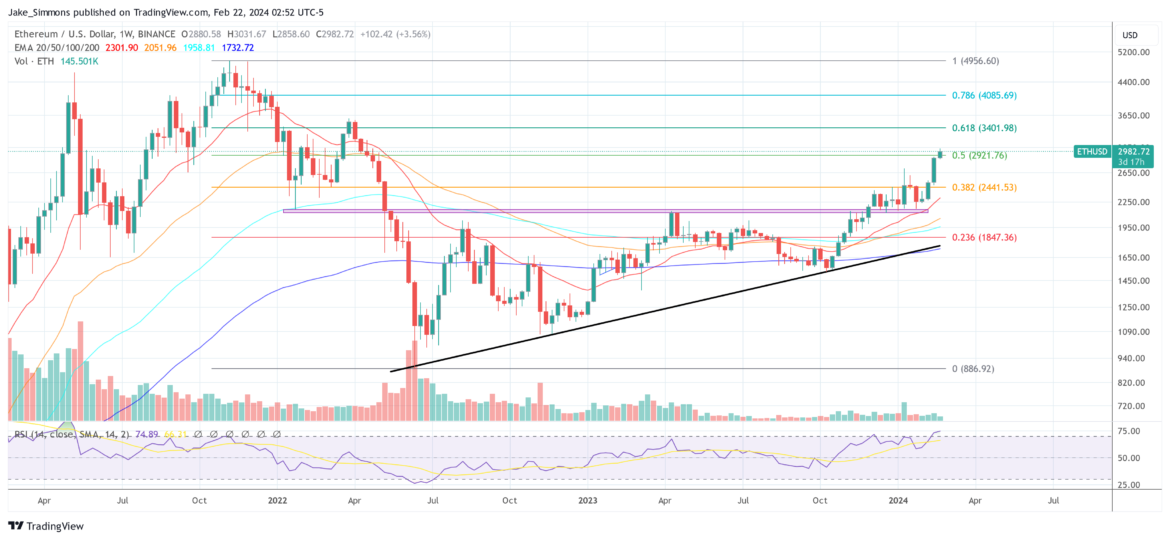
At press time, ETH still traded just below the $3,000 mark.

Featured image from Shutterstock chart from TradingView.com
Disclaimer: The article is provided for educational purposes only. It does not represent the opinions of NewsBTC on whether to buy, sell or hold any investments and naturally investing carries risks. You are advised to conduct your own research before making any investment decisions. Use information provided on this website entirely at your own risk.