Blackrock has amassed nearly 110,000 bitcoins for its spot bitcoin exchange-traded fund (ETF), Ishares Bitcoin Trust (IBIT), since its launch about a month ago. The world’s largest asset manager’s bitcoin ETF has a total net inflow of nearly $5 billion, leading the pack among all spot bitcoin ETFs. Blackrock CEO Larry Fink has stated that […]
Source link
CoinNews
Uniswap, one of the world’s largest decentralized exchanges (DEX), is poised for significant growth with the upcoming launch of its V4 upgrade. This anticipated update will introduce custom Automated Market Maker (AMM) functionality directly on top of Uniswap, eliminating the need for separate AMM designs.
In addition, Uniswap’s governance token, UNI, has seen notable growth, with a 6.8% increase in the last 24 hours and an 8% increase in the previous 30 days, bringing the UNI token to $7.318.
However, while these developments favor the exchange and investors, decentralized finance (DeFi) researcher DeFi Ignas has raised concerns regarding the launch and its potential impact on critical features.
The Ultimate DeFi Liquidity Solution With Uniswap V4?
According to DeFi Ignas’ latest analysis on X (formerly Twitter), Uniswap V4 represents a significant transformation from a protocol to a platform. Like the Apple Store’s impact on the iPhone, Uniswap V4 will consolidate all pools into a single framework, reducing creation costs by 99% and enabling more cost-effective multi-pool swaps.
The introduction of the “Hooks” system is particularly noteworthy. These hooks act as plugins or extensions, allowing for customized code execution during crucial events within a pool.
The 13 available hooks enable various functionalities, including on-chain limit orders, time-weighted average market making, liquidity depositing into lending protocols, auto compound liquidity provider (LP) fees, and know-your-customer (KYC) integration.
Introducing hooks leads DeFi Ignas to believe that the launch of Uniswap V4 will allow developers to experiment and launch their protocols while leveraging Uniswap’s liquidity.
According to the researcher, this has the potential to attract even more liquidity from other decentralized exchanges and establish Uniswap as the dominant liquidity layer for all DeFi activities, from trading to lending.
Yet, while unified liquidity may benefit users by increasing market efficiency, it raises concerns about potential market concentration and stifling of competition.
UNI Token Gains Momentum
Uniswap’s V4 liquidity sourcing could concentrate liquidity within the platform, potentially making it the go-to liquidity layer for DeFi. According to DeFi Ignas, this dominance, coupled with Uniswap’s operating license that prohibits forking until 2027, raises questions about market competition and the potential impact on decentralized finance.
In addition, reports suggest that Uniswap Labs has sent takedown notices to gateways of the InterPlanetary File System (IPFS) – a decentralized and distributed protocol designed to facilitate the storage and sharing of files on a peer-to-peer network – adding another layer of concern about decentralized access and censorship resistance.
Regarding the potential upside of Uniswap V4 acting as a catalyst for the exchange’s token, the research went on to suggest that while UNI’s value “accrual” for retail investors has been relatively modest, the introduction of Uniswap V4 and its hooks opens up new possibilities.
In this sense, DeFi Ignas believes the UNI token could function as a platform/ecosystem token, benefiting from third-party decentralized applications (dApps) developed using Uniswap’s hooks, expanding the token’s use cases and potentially attracting more investors.
Additionally, there is speculation that Uniswap may solidify its dominance and liquidity by launching its chain, potentially as a layer-two (L2) solution, which could further boost the valuation of the UNI token.
As the upgrade deadline for Uniswap approaches, the impact of the exchange’s upgrade on the UNI token remains uncertain. However, there has been a noticeable growth in the token’s value over the past few weeks.
After reaching a 17-month high of $8.260 in January, the token experienced a correction but has since broken out of that pattern. As the upgrade deadline draws near, it is yet to be determined whether the token can consolidate its gains and regain previous levels.
Featured image from Shutterstock, chart from TradingView.com
Disclaimer: The article is provided for educational purposes only. It does not represent the opinions of NewsBTC on whether to buy, sell or hold any investments and naturally investing carries risks. You are advised to conduct your own research before making any investment decisions. Use information provided on this website entirely at your own risk.
Bitcoin’s Latest Difficulty Retarget Jumps 8.24%: Miners Navigate the Toughest Mining Landscape Yet
Bitcoin’s mining difficulty has hit an unprecedented peak, marking the most significant jump of 2024. On Thursday, at the milestone of block 830,592, the network experienced its fourth adjustment this year with a sharp 8.24% uptick. Bitcoin Mining Difficulty Skyrockets, Setting New Records in 2024 Mining bitcoin (BTC) has become considerably more challenging, following an […]
Source link
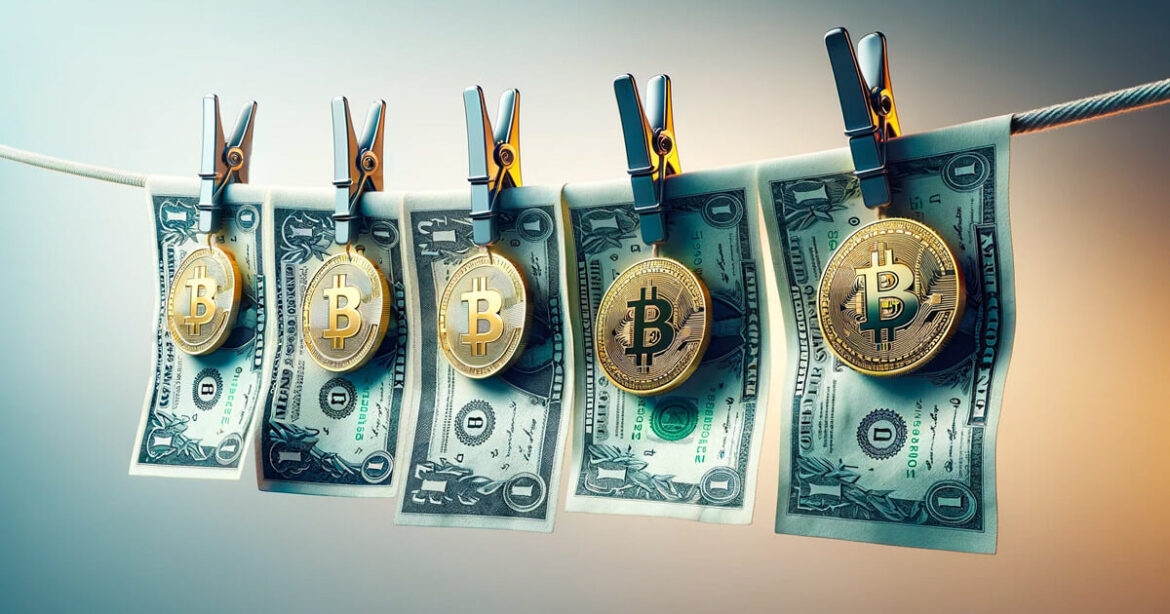
Crypto money laundering drops nearly 30% in 2023 as cyber criminals change tactics
Crypto money laundering experienced a significant decline of 29.5% in 2023 compared to the previous year, primarily due to a decrease in overall crypto transaction volume.
According to a Chainalysis report, illicit addresses moved approximately $22.2 billion in digital assets to various crypto services in 2023, marking a notable drop from the $31.5 billion transferred in 2022. This decline aligns with a 14.9% decrease in legitimate and illegal crypto transaction volumes.

Centralized exchanges remained the primary destination for funds from illicit addresses, although there was a noticeable increase in criminal fund movements toward gambling services and bridge protocols.
In detail, 109 exchange addresses received over $10 million each from illicit sources, totaling $3.4 billion in 2023, a significant rise from the $2 billion received by 40 addresses in 2022. Similarly, 1,425 exchange addresses received over $1 million each, amounting to approximately $6.7 billion in 2023, compared to $6.3 billion across 542 addresses in 2022.
Meanwhile, funds from illicit addresses to bridge protocols surged from $312.2 million in 2022 to $743.8 million in 2023.
‘Changing tactics’
Chainalysis noted that sophisticated crypto criminals with on-chain laundering skills, like the infamous North Korean-backed hackers Lazarus Group, are adapting their money laundering strategies and exploiting new services like crypto mixers and cross-chain bridges.
For context, the regulatory pressure on crypto mixing services like Sinbad and Tornado Cash, forced Lazarus Group to shift its money laundering strategy to YoMix, a new mixing service provider.

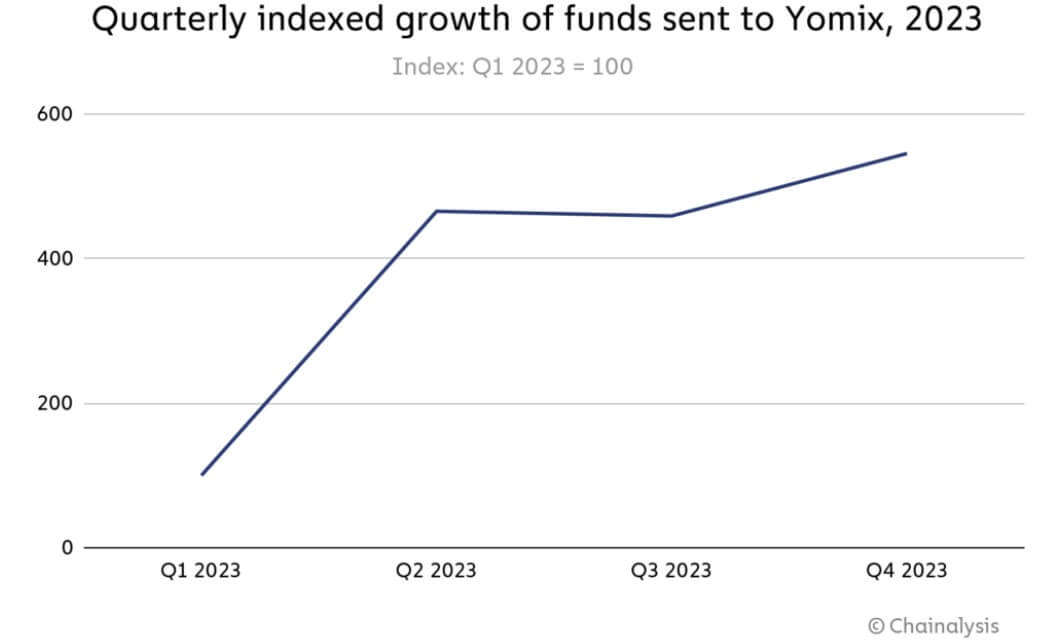
According to Chainalysis, this transition led to a notable increase in YoMix’s activity for last year, with its inflows rising more than fivefold. Additionally, nearly one-third of YoMix’s inflows can be traced back to wallets associated with crypto hacks.
“The growth of YoMix and its embrace by Lazarus Group is a prime example of sophisticated actors’ ability to adapt and find replacement obfuscation services when previously popular ones are shut down,” Chainalysis concluded.
In addition, North Korean-backed hacker groups were observed to be among the most common crypto criminals that utilized cross-chain bridges for money laundering activities.
PRESS RELEASE. February 15, 2024, London, UK — In a remarkable story one Bitcasino.io player has won a huge jackpot and another big win in the space of a few weeks, earning a massive $4.5 million dollars. Bets were placed in USDT cryptocurrency, with joy found in a Max Win, followed by a Big Win […]
Source link
Amid the XRP price unfavorable market sentiment, Changelly, a prominent global cryptocurrency exchange, has sparked new optimism by predicting a potential surge in the token’s price. The crypto exchange has projected new all-time highs for the cryptocurrency in the upcoming years.
XRP 2024 Price Prediction
On Wednesday, February, Changelly released a research report projecting XRP’s monthly prices for 2024. The crypto exchange emphasized XRP’s historical challenges, recounting significant declines that caused the cryptocurrency to trade well below its 2018 all-time high of $3.84.
Following an extensive analysis of XRP, Changelly has predicted a 23.71% increase in the price of XRP, surpassing current resistance levels at $0.5 and reaching $0.667 by February 16, 2024.

The crypto exchange noted that current technical indicators signal a 28% bearish bullish market sentiment on the token, alongside a Fear and Greed index reflecting high Greed at 74.
Changelly has also reported a positive seven-day upward trend for XRP, noting a $0.01 increase in the past 24 hours. The cryptocurrency platform foresees the average price of XRP reaching $0.617 by March, with a projected price range of $0.550 to $0.685.
Changelly forecasts that XRP will trade above the $0.50 mark in April and May, reaching average price values of $0.562 and $0.573, respectively. From June to September, the cryptocurrency is expected to gradually approach the $0.60 mark, with the average price values of XRP ranging from $0.55 to $0.59 during these months.
By November, the token is anticipated to break past resistance levels, maintaining an average price of $0.662, with a minimum and maximum value of $0.569 and $0.755, respectively. Meanwhile, Changelly has predicted a surge in the average XRP price to $0.695 for December, potentially reaching a peak value of $0.829.
Massive Price Surge In Upcoming Years
In its research report, Changelly provided a forecast of the token from 2025 to 2050. The crypto exchange platform anticipates big gains for the cryptocurrency, expecting its price to exceed $500 in the coming decades. Specifically for 2025 and 2026, Changelly projects XRP to surpass the $1 mark and trade at an average price of $1.18 and $1.72, respectively.
The cryptocurrency is expected to slowly increase over the years, surging past $2 mark in 2027 and surpassing its all-time high of 3.84 for the first time to reach an average price of $5.04 in 2028.
In the decade from 2030 to 2040, Changelly has predicted that XRP would trade at an average price of $7.39 in 2030, rapidly gaining more momentum over the years to reach a maximum level of $480.23 and a minimum of $413.15 in 2040.
By 2050, XRP is projected to surpass the $600 mark and trade at $625.74, with a maximum and minimum value of $690.55 and $595.36, respectively.
Chart from Tradingview
Disclaimer: The article is provided for educational purposes only. It does not represent the opinions of NewsBTC on whether to buy, sell or hold any investments and naturally investing carries risks. You are advised to conduct your own research before making any investment decisions. Use information provided on this website entirely at your own risk.
Tokenized real world assets (RWA) redefined as personal property in landmark Iowa digital asset bill

A seemingly progressive digital asset bill has been approved by the Judiciary Committee in Iowa, introducing significant amendments to the Uniform Commercial Code, explicitly aiming to integrate digital assets and electronic records into commercial transactions. The bill, House File 2519, is titled “An act relating to commercial transactions, including control and transmission of electronic records and digital assets.”
As reported by the Committee on Judiciary monitored with TrackBill on Feb. 15, this legislation seeks to address the complexities and opportunities presented by digital assets within the legal framework of commerce. By offering a nuanced approach to the control and transmission of electronic records, the bill promises to enhance legal clarity and security in digital transactions, catering to the needs of the evolving digital economy.
House File 2519 clarifies the legal standing of digital assets by providing comprehensive definitions for terms like “controllable electronic record,” “digital asset,” and “smart contract.” This precision aims to reduce ambiguities and foster a more secure environment for digital commerce. However, the potential for variations in such definitions across state, federal, and international jurisdictions adds potential complexity for digital asset service providers.
Recognizing digital assets as personal property
However, the new definitions are a key aspect of this bill. The bill recognizes the legality of smart contracts from Article 12 of the 2022 “Uniform Commercial Code Amendments,” stipulating that a contract cannot be denied legal effect or enforceability solely because it is executed through distributed ledger technology or a smart contract. This ensures that smart contracts, which automatically execute the terms of a contract when certain conditions are met, have the same legal standing as traditional contracts.
Further, the bill also references provisions that facilitate recording real estate through electronic means from the 2022 Act. Specifically, it highlights a county’s ability to record a real estate conveyance if the evidence of conveyance adheres to the general requirements outlined in state law and is in a format that conforms to standards set by the electronic services system. The bill specifies that this system enables counties and the Iowa County Recorders Association to collaborate in implementing the county land record information system.
Building on these aspects of the 2022 Act, House File 2519 aims to amend and add to the legal framework surrounding digital assets, focusing on adjusting the definition of “digital asset.” The bill amends the definition by eliminating exceptions previously recognized under the Uniform Commercial Code (UCC). This means that certain electronic records previously excluded from being considered digital assets, such as electronic records representing an interest in specific physical or tangible property (chattel) or a lease of such property, are no longer excluded.
For example, suppose a business takes out a loan to purchase a piece of equipment, and the loan agreement also grants the lender a security interest in that equipment as collateral. In that case, the document detailing this arrangement can be considered chattel paper. If this document is created, signed, and stored electronically, it’s an electronic record evidencing chattel paper. This digital form is increasingly common in today’s digital and financial transactions, offering a more secure and efficient way to electronically manage and transfer interests in real-world assets (RWA).
The amendment simplifies the classification of digital assets, treating them simply as personal property rather than specifically as intangible personal property. This is a shift from the possible previous categorization that might have considered digital assets more narrowly as intangible personal property. This broader classification could have implications for how digital assets are treated in various legal and commercial contexts, providing a more straightforward approach to their classification.
Intangible personal property historically referred to rights and licenses, whereas tokenized RWAs related to real estate may be more appropriately treated as personal property akin to physical property.
These provisions reflect House File 2519’s approach to further integrating digital assets into Iowa’s commercial and legal frameworks. By amending the definition of digital assets and clarifying their classification, the bill aims to simplify and modernize the regulatory environment for digital assets, making it more conducive to the evolving digital economy. Additionally, by defining terms such as “electronic services system,” the bill provides legal clarity for the operation of digital asset systems and services within the state.
Protections and recognition of digital assets
Interestingly, the legislation outlines no-action protection for qualifying purchasers of controllable electronic records, asserting that filing a financing statement under Article 9 does not constitute notice of a property right claim in a controllable electronic record.
This provision in the legislation means that individuals who purchase controllable electronic records (such as digital assets or tokens) receive legal protection against claims challenging their ownership based solely on the absence of a financing statement. Essentially, even if no financing statement is filed to declare a security interest in a digital asset publicly, the purchaser’s rights to the asset are protected. This aims to streamline transactions by simplifying the proof of ownership and reducing the administrative burden on parties engaging in digital transactions.
The state creates distance on CBDCs with neutral legislation without endorsement.
The bill also explicitly states that its provisions should not be interpreted to support, endorse, create, or implement a national digital currency. This stance ensures that the legislation remains neutral regarding a centrally issued digital currency (CBDC) by a national government or central bank, focusing instead on the regulatory framework for digital assets without promoting or facilitating the establishment of a national digital currency.
The potential implications of House File 2519 on digital asset service providers and users include heightened regulatory oversight, increased legal and operational complexities, and a need for technological adjustments to meet the legal standards for control over digital assets. These challenges highlight the bill’s comprehensive attempt to adapt Iowa’s legal framework to the digital age, balancing innovation with legal clarity and consumer protection.
Ultimately, House File 2519 represents a step towards integrating digital assets into the state’s legal landscape, aiming to provide a more secure and clarified legal framework for digital transactions. While the bill’s detailed approach introduces specific regulatory and operational challenges, it also offers opportunities for enhancing the legal infrastructure supporting the digital economy.
Solana Mobile Processed Over $20 Million in Payments Using USDC With No Processing Fees
Solana Mobile, Solana Labs’ smartphone subsidiary, processed over $20 million in payments in alliance with Shopify and USDC, the second-largest dollar-pegged stablecoin. Anatoly Yakovenko, a co-founder of Solana Labs, explained that 51% of Chapter 2’s payments were completed using USDC, with no payment processing fees associated. Solana Mobile Processed Over $20 Million in USDC Payments […]
Source link
Chainlink and Telefonica join forces to combat SIM swap attacks as LINK up 30% in Feb

Chainlink has secured a strategic partnership with Telefonica, a global telecommunications powerhouse, to secure the connection of Web3 smart contracts with Global System for Mobile Communications Association (GSMA) Open Gateway APIs, according to a Feb. 15 statement shared with CryptoSlate.
“This collaboration marks a significant step in integrating Telco capabilities into the blockchain industry and demonstrates the need for secure oracle networks to deliver real-world data onchain,” per the statement.
The first use case will involve the SIM SWAP API. According to Telefonica, the API integrates SIM swap detection and management functionality into applications and enhances security by identifying potentially fraudulent activity.
This collaboration integrates Chainlink Functions into the SIM SWAP API, facilitating data verification and allowing smart contracts to solicit information from the API, thereby ensuring the integrity of a device’s SIM card against unauthorized alterations.
Furthermore, the API extends its utility beyond this primary function, amplifying two-factor authentication (2FA) and fortifying fraud detection within Web3 decentralized applications (dApps) and DeFi services.
Johann Eid, Chainlink Labs’ Chief Business Officer, said:
“Bringing Telefónica’s OpenGateway APIs onchain with Chainlink Functions unlocks novel use cases and greater security for our industry that ultimately better protect users and their assets.”
Over the past months, the Oracle network has made several expansionary moves to drive the adoption of its products by partnering with traditional firms like the Society for Worldwide Interbank Transfers (SWIFT), South Korean gaming giant Wemade, and the New Zealand Banking Group. In addition, the network has also scored significant integrations with blockchain projects like Base and Circle’s USDC stablecoin.
LINK surges
Chainlink’s LINK token has enjoyed a largely positive week, rising by around 8% during the period to trade at more than $20, according to CryptoSlate’s data. This is LINK’s highest price level since early 2022.
This price performance propelled it into the top 10 digital assets by market capitalization during the reporting period. However, it has dropped to eleventh after a mild decline of 0.76% during the past day.
Nevertheless, LINK remains one of the top digital assets in the industry, with a market capitalization of $11.8 billion.
Chainlink Market Data
At the time of press 1:34 pm UTC on Feb. 15, 2024, Chainlink is ranked #11 by market cap and the price is down 0.95% over the past 24 hours. Chainlink has a market capitalization of $11.72 billion with a 24-hour trading volume of $531.64 million. Learn more about Chainlink ›
Crypto Market Summary
At the time of press 1:34 pm UTC on Feb. 15, 2024, the total crypto market is valued at at $1.95 trillion with a 24-hour volume of $84.93 billion. Bitcoin dominance is currently at 52.48%. Learn more about the crypto market ›
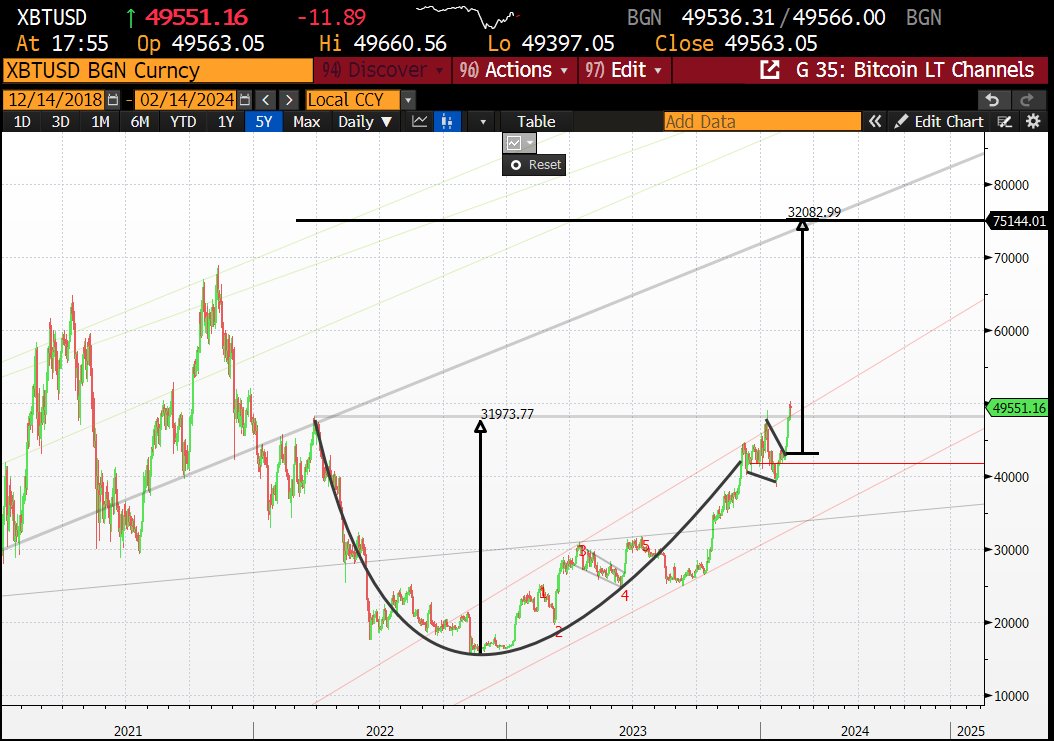
Matt Dines, the Chief Investment Officer at Build Asset Management, has identified a classical ‘Cup and Handle’ pattern in the Bitcoin (BTC) price chart, which he believes could signal an impending rally to $75,000. This technical formation is often considered a strong bullish signal and is closely watched by market analysts and traders.
Bitcoin Price Validates Cup And Handle Pattern
The ‘Cup’ part of the pattern, resembling a bowl or rounding bottom, began forming in March 2022 when the price plunged below $48,000 and entered one of the longest Bitcoin bear markets. The pattern reached its lowest point at approximately $17,600, signifying a strong support level for Bitcoin.

The left side of the pattern shows a rounded bottom resembling a “cup.” It forms when the price initially declines, then consolidates, and finally starts to rise again. Since hitting this bottom, Bitcoin’s price has made a steady recovery, mimicking the right side of the cup, indicating a bullish reversal of the previous downtrend.
“The saucer or the ‘cup’ signifies a consolidation period, a pause in the downward trend, before the price begins to rise back up to the test resistance levels,” Dines explained. The recovery to the initial resistance line completes the ‘cup’ portion of the pattern. The Bitcoin price completed this step in early January this year.
The subsequent ‘Handle’ is represented by a moderate retracement following the recovery, which forms a small dip or pullback from the peak. This handle is identified by a slight downward trajectory and is considered the final consolidation before a breakout.
BTC’s price drop to $38,600 at the end of January marked the bottom of the pullback. With the breakout above $48,000, the Bitcoin price validated the cup and handle pattern.
Setting A BTC Price Target
Dines also addressed the placement of the vertical projection from the bottom of the handle, clarifying its basis: “It’s totally arbitrary and in the eye of the beholder. But longer answer, traders are eyeing charts for formations.”
The vertical target line, or the ‘stick’ on the right, is projected from the bottom of the handle. The height of the cup — from the low at around $17,600 to the resistance line at $48,000— sets the stage for the price target.
Dines added, “A lot of traders will use the height of the bowl (from the low of the bowl to the top at the resistance line) to set their price target. Just add that height to the bottom of the handle … that’s a decent guesstimate for where we’d see the longs who entered on the breakthrough to set their price target.”
Based on the chart, the height from the cup’s low to the resistance level is roughly $31,973, marking the increase in Bitcoin’s price from its lowest point to the current level when the chart was produced. Projecting this height from the handle’s formation suggests a target in the vicinity of $75,000.
Dines further adds that the collective behavior of market participants will indeed guide the price movement: ” A lot of those longs would set a retrace at ~$75k as they close out their W. If enough participants put this trade on it will set the dominant price action … they win out and it will turn the chart into reality. I know it sounds ridiculous, but in the real world this is how markets actually discover price.”
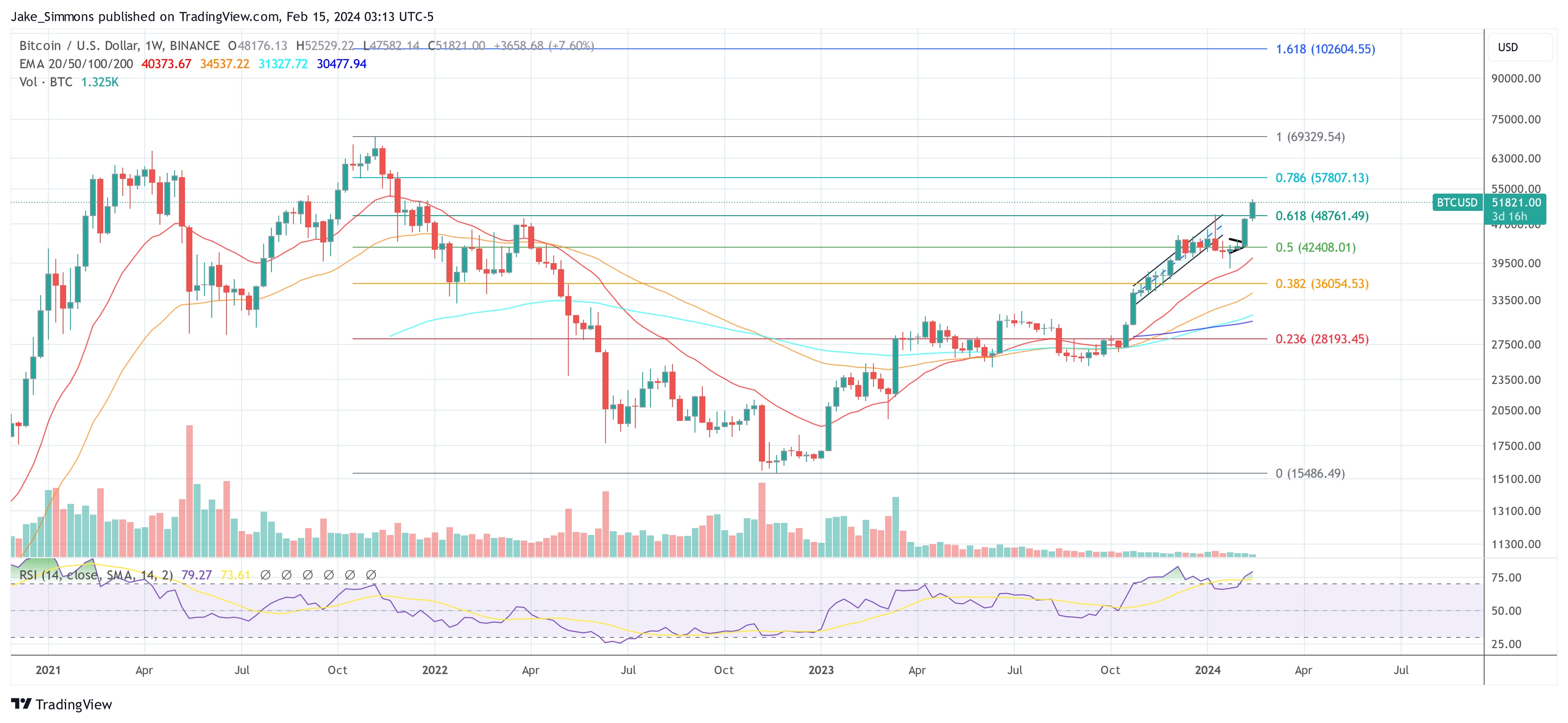
At press time, BTC traded at $51,821.

Featured image created with DALLE, chart from TradingView.com
Disclaimer: The article is provided for educational purposes only. It does not represent the opinions of NewsBTC on whether to buy, sell or hold any investments and naturally investing carries risks. You are advised to conduct your own research before making any investment decisions. Use information provided on this website entirely at your own risk.