As bitcoin edges closer to its peak historical value, the meme token domain is outperforming many within the crypto economy, boasting a more than 38% increase over the last day. Just four days prior, the meme coin market’s valuation stood at $34.32 billion, only to soar to $61.59 billion today. From Dogecoin to Shiba Inu: […]
Source link

Billion
Apple hit with more than $1.95 billion EU antitrust fine over music streaming

The European Commission, the European Union’s executive arm, on Monday hit Apple with a 1.8 billion euro ($1.95 billion) antitrust fine for abusing its dominant position in the market for the distribution of music streaming apps.
The commission said it found that Apple had applied restrictions on app developers that prevented them from informing iOS users about alternative and cheaper music subscription services available outside of the app.
Apple also banned developers of music streaming apps from providing any instructions about how users could subscribe to these cheaper offers, the commission alleged.
This is Apple’s first antitrust fine from Brussels and is one of the biggest dished out to a technology company by the EU.
Apple shares were down around 2.5% in morning trading in the U.S.
The European Commission opened an investigation into Apple after a complaint from Spotify in 2019. The probe was narrowed down to focus on contractual restrictions that Apple imposed on app developers which prevent them from informing iPhone and iPad users of alternative music subscription services at lower prices outside of the App Store.
Apple’s conduct lasted almost 10 years, according to the commission, and “may have led many iOS users to pay significantly higher prices for music streaming subscriptions because of the high commission fee imposed by Apple on developers and passed on to consumers in the form of higher subscription prices for the same service on the Apple App Store.”
Apple response
In a fiery response to the fine, Apple said Spotify would stand to gain the most from the EU pronouncement.
“The primary advocate for this decision — and the biggest beneficiary — is Spotify, a company based in Stockholm, Sweden. Spotify has the largest music streaming app in the world, and has met with the European Commission more than 65 times during this investigation,” Apple said in a statement.
“Today, Spotify has a 56 percent share of Europe’s music streaming market — more than double their closest competitor’s — and pays Apple nothing for the services that have helped make them one of the most recognisable brands in the world.”
Apple said that a “large part” of Spotify’s success is thanks to the Cupertino, California-based giant’s App Store, “along with all the tools and technology that Spotify uses to build, update, and share their app with Apple users around the world.”
Apple said that Spotify pays it nothing. That’s because instead of selling subscriptions in its iOS app, Spotify sells them via its own website. Apple does not collect a commission on those purchases.
Developers over the years have spoken out against the 30% fee Apple charges on in-app purchases.
Spotify in a statement called the commission’s decision “an important moment in the fight for a more open internet for consumers.”
“Apple’s rules muzzled Spotify and other music streaming services from sharing with our users directly in our app about various benefits—denying us the ability to communicate with them about how to upgrade and the price of subscriptions, promotions, discounts, or numerous other perks,” Spotify said.
“Of course, Apple Music, a competitor to these apps, is not barred from the same behaviour.”
Apple fine just a ‘parking ticket’
The commission said Apple prevented developers of music streaming apps from informing their iOS users within their apps about prices of subscriptions or offers available elsewhere.
App developers could not include links in their apps leading iOS users to the app developers’ websites where alternative subscription could be bought, the commission alleges.
The EU’s executive arm also said Apple prevented app developers from contacting their own newly acquired users — for example via email — to inform them about alternative pricing options.
In a press briefing, EU antitrust chief Margrethe Vestager qualified the basic amount of the fine for Apple, excluding the 1.8 billion euro lump sum, as “quite small” and likened it to a “speeding ticket, or a parking ticket” relative to the company’s scale.
“When Apple imposes these anti-steering provisions on the music provider, they as developers have no other choice than to either accept them or abandon the App store. Apple with its App Store currently holds a monopoly,” Vestager said.
She added the commission has ordered Apple to remove the so-called anti-steering provisions and to “refrain from similar practices in the future.”
EU scrutiny on tech giants rises
The fine will ramp up tensions between Big Tech and Brussels at a time when the EU is increasing scrutiny of these firms.
Last year, the commission designated Apple among other tech firms like Microsoft and Meta as “gatekeepers” under a landmark regulation called the Digital Markets Act, which broadly came into effect last year.
The term gatekeepers refers to massive internet platforms which the EU believes are restricting access to core platform services, such as online search, advertising, and messaging and communications.
The Digital Markets Act aims to clamp down on anti-competitive practices from tech players, and force them to open out some of their services to other competitors. Smaller internet firms and other businesses have complained about being hurt by these companies’ business practices.
These laws have already had an impact on Apple. The company announced plans this year to open up its iPhone and iPad to alternative app stores other than its own. Developers have long complained about the 30% fee Apple charges on in-app purchases.
Vestager fired a warning shot to Apple in regard to the DMA.
“In a couple of days on the 7th of March, Apple will have to comply with the full list of dos and don’ts under the DMA. Among others, Apple can no longer impose rules such as the anti-steering obligations … and this holds for any app on the App Store, not just music streaming apps.”
— CNBC’s Ryan Browne and Ruxandra Iordache contributed to this article.
GBTC AUM sees modest $1.6 billion drop post-ETF launch, despite major outflows
Quick Take
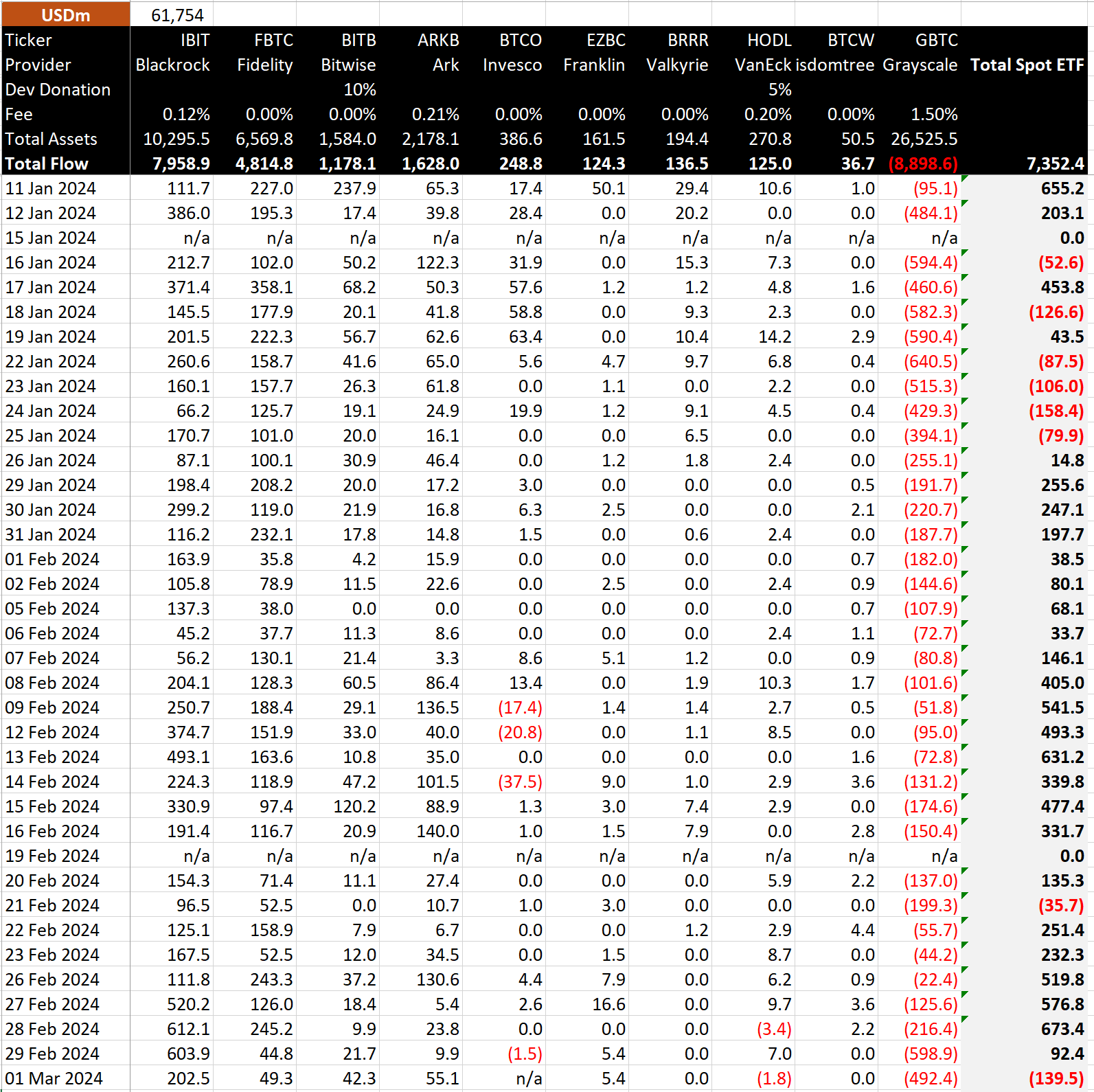
Data from BitMEX shows March began with the first total outflow since Feb. 21. The day saw an outflow of $140 million, significantly impacted by a massive $492 million outflow from the Grayscale Bitcoin Trust (GBTC), marking one of the largest single-day outflows.

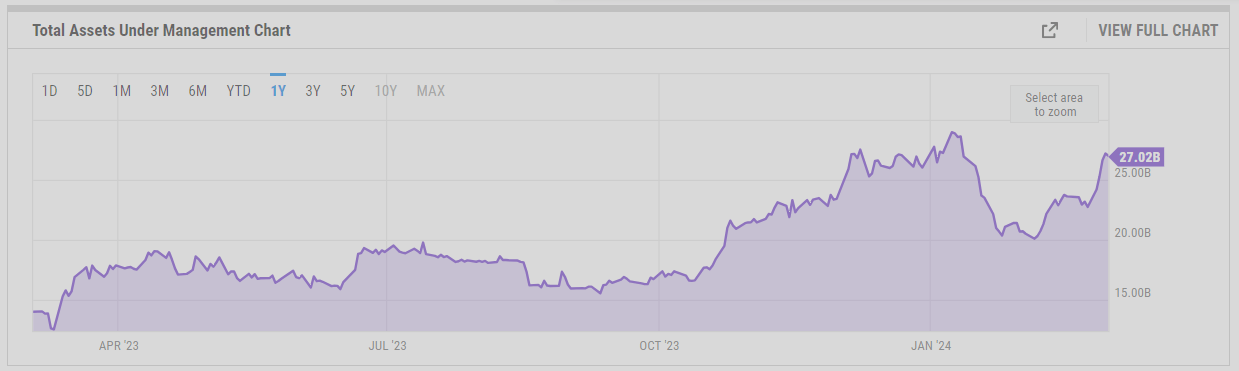
According to BitMEX data, the Grayscale Bitcoin Trust (GBTC) has experienced outflows totaling $8.9 billion. Despite this significant outflow, the assets under management (AUM) of GBTC only decreased by $1.6 billion, moving from $28.6 billion to $27 billion, as reported by ycharts.
This relatively small decrease in AUM, in the face of large outflows, can be attributed to the increase in Bitcoin’s price, which rose from $49,000 to $65,000 since the ETF was launched on Jan. 11.

Despite these outflows, GBTC maintains a strong market presence with a 55% share, though down from 100% two months ago, as noted by ETF Store President Nate Geraci.
Furthermore, GBTC’s annual fee revenue stands at a significant $398 million, dwarfing the $53 million from the nine new ETFs, not including fee waivers, according to Geraci.

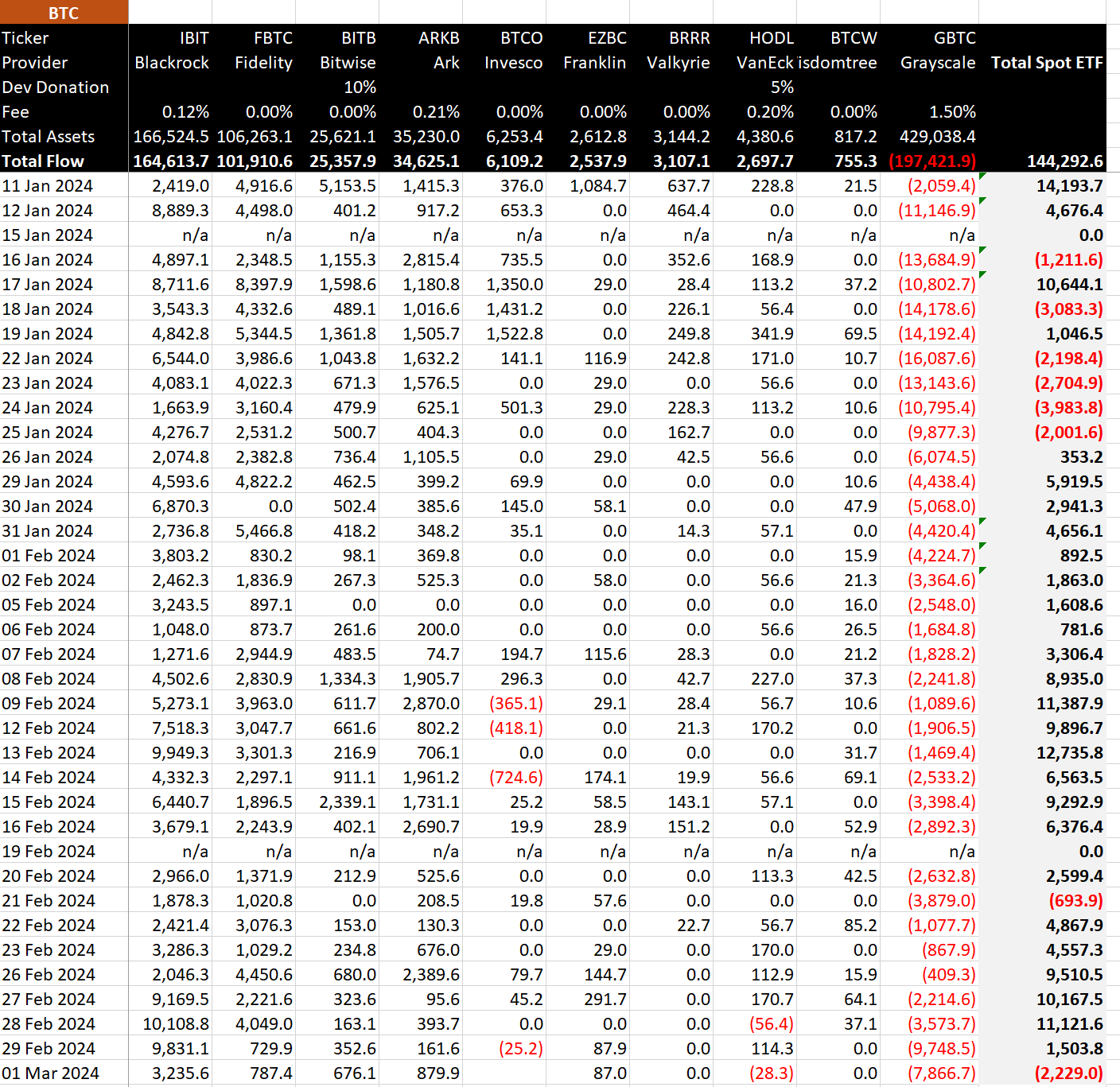
Meanwhile, BlackRock’s IBIT saw much quieter inflows of $203 million on Mar. 1, following consecutive record-breaking days. These inflows have taken their total net inflow to $8 billion, roughly equivalent to holding 165,000 Bitcoin, according to BitMEX.
BitMEX has noted that Invesco Galaxy Bitcoin ETF (BTCO) has not disclosed its data for Mar. 1.
The post GBTC AUM sees modest $1.6 billion drop post-ETF launch, despite major outflows appeared first on CryptoSlate.
Warren Buffett’s Latest $2.1 Billion Buy Brings His Total Investment in This Stock to More Than $74 Billion in Under 6 Years
For nearly six decades, Berkshire Hathaway (NYSE: BRK.A)(NYSE: BRK.B) CEO Warren Buffett has been putting on a clinic for Wall Street. Whereas the benchmark S&P 500 has delivered a total return, including dividends, of a little north of 33,000% since the “Oracle of Omaha” took over as CEO in the mid-1960s, Berkshire’s Class A shares (BRK.A) have galloped higher by an aggregate of more than 5,000,000% as of the closing bell on Feb. 28, 2024! An outperformance of this magnitude is going to get you noticed by professional and retail investors.
Warren Buffett’s phenomenal track record is a big reason why there’s a buzz surrounding Berkshire Hathaway every time the company files Form 13F with the Securities and Exchange Commission (SEC). A 13F gives investors an over-the-shoulder look at what Wall Street’s greatest money managers have been buying and selling, and is a required quarterly filing for institutions and investors with at least $100 million in assets under management.

Warren Buffett has been adding to a core position and building up his stake in a value stock
Throughout 2023, the Oracle of Omaha and his investment aides, Todd Combs and Ted Weschler, were very selective about their purchases. One core holding that’s continued to see somewhat regular additions is energy stock Occidental Petroleum (NYSE: OXY).
Accounting for Berkshire’s latest share purchases during the first week of February, Buffett’s company has gobbled up more than 248 million shares of Occidental Petroleum since the start of 2022. That’s a roughly $15 billion position, with $34 billion, in total, devoted to energy stocks, including Berkshire’s position in Chevron.
Having 9% of Berkshire’s invested assets tied up in two integrated oil and gas stocks is a pretty clear message that the company’s brightest minds anticipate crude oil prices will remain elevated for an extended period. With the global supply of oil remaining tight following years of capital underinvestment tied to the COVID-19 pandemic, there’s a real possibility the spot price of crude oil heads even higher.
What makes Occidental Petroleum an intriguing investment in the energy arena is its revenue breakdown. Despite being an integrated operator that generates some of its revenue from downstream chemical plants, Occidental derives the lion’s share of its sales from drilling. If the spot price of crude oil climbs, it’ll benefit more than virtually any other integrated oil and gas company.
Beyond Occidental, we’ve also seen Warren Buffett and his team piling back into satellite-radio operator Sirius XM Holdings (NASDAQ: SIRI). Though radio operators are often highly dependent on advertising revenue to keep the lights on, Sirius XM has an assortment of competitive advantages working in its favor that should help it navigate any economic climate better than terrestrial and online radio companies.
To start with the obvious, Sirius XM is the only licensed satellite-radio operator. While this doesn’t mean it’s free of competition for listeners, it does give the company reasonably strong subscription-pricing power.
What’s arguably even more important with Sirius XM is how the company generates revenue. Whereas terrestrial and online radio providers are reliant on advertising revenue, only 20% of Sirius XM’s sales came from advertising in 2023. Meanwhile, a whopping 77% of Sirius XM’s revenue can be traced to subscriptions. Subscribers are less likely to cancel their service during an economic downturn than businesses are to meaningfully pare back their advertising budgets.
Sirius XM is also historically cheap. Shares are currently trading for a multiple of 13 times forward-year earnings, which is a 32% discount to its average forward-year earnings multiple over the trailing five-year period.

The Oracle of Omaha has purchased in excess of $74 billion worth of this stock
Although Berkshire’s 13Fs have told an interesting story for more than a year — Buffett and his team have been net sellers of equities for the past five quarters — it’s what’s not in Berkshire’s 13Fs that’s an even bigger deal.
Warren Buffett’s favorite stock to buy isn’t Apple, Occidental Petroleum, or any of the nearly four dozen securities currently listed in Berkshire’s quarterly filed 13F. The only way to find this mystery stock that the Oracle of Omaha can’t stop buying is to dig into his company’s operating results. That’s where you’ll find the quarterly share-repurchase activity, because Warren Buffett’s favorite stock to buy is none other than shares of his own company! Don’t you love a good plot twist?
Prior to July 2018, the rules governing Berkshire’s share-buyback program didn’t allow its then-dynamic duo of Warren Buffett and Charlie Munger to get off the proverbial bench. Repurchases could only be undertaken if Berkshire’s share price fell to or below 120% of book value (i.e., no more than 20% above its listed book value, as of the end of the latest quarter). Because Berkshire’s share price never fell to or below this preset threshold, no buybacks were undertaken for years.
On July 17, 2018, everything changed for Buffett, Berkshire, and the company’s shareholders. The company’s board amended the buyback rules to allow their star players to “get in the game.” As long as Berkshire holds at least $30 billion in cash, cash equivalents, and U.S. Treasuries on its balance sheet, and Buffett and Munger agreed that their company’s stock was intrinsically cheap, buybacks could commence without a ceiling.
During the December-ended quarter, Berkshire retired 3,623 shares of Class A stock and 660,585 shares of Class B stock (BRK.B) at a total cost of $2,147,823,075! This marked the 22nd consecutive quarter that Buffett’s company has repurchased its own stock, and it brought the grand total of buybacks since July 2018 to more than $74 billion. To put this into context, Buffett and the late Charlie Munger spent roughly twice as much buying Berkshire stock compared to how much they spent purchasing shares of Apple.
Since Berkshire Hathaway doesn’t pay a dividend, share repurchases are the direct way Warren Buffett and his investment team can reward investors who align with their long-term vision. Steadily buying back stock should increase the ownership stakes of the company’s shareholders.
Furthermore, businesses like Berkshire Hathaway that tend to grow their operating income over time should enjoy a hearty boost to their earnings per share as their outstanding share count declines. This is only going to make the stock more attractive to fundamentally focused investors.
Buying back tens of billions in his own company’s stock is also a pretty clear indication that Buffett is betting on himself and the business he, Munger, Combs, and Weschler have built to succeed over the long run.
With a record $167.6 billion in cash on hand and few, if any, values piquing the interest of the Oracle of Omaha and his team, look for repurchases of Warren Buffett’s favorite stock to continue throughout the first quarter (and likely well beyond).
Should you invest $1,000 in Berkshire Hathaway right now?
Before you buy stock in Berkshire Hathaway, consider this:
The Motley Fool Stock Advisor analyst team just identified what they believe are the 10 best stocks for investors to buy now… and Berkshire Hathaway wasn’t one of them. The 10 stocks that made the cut could produce monster returns in the coming years.
Stock Advisor provides investors with an easy-to-follow blueprint for success, including guidance on building a portfolio, regular updates from analysts, and two new stock picks each month. The Stock Advisor service has more than tripled the return of S&P 500 since 2002*.
*Stock Advisor returns as of February 26, 2024
Sean Williams has positions in Sirius XM. The Motley Fool has positions in and recommends Apple, Berkshire Hathaway, and Chevron. The Motley Fool recommends Occidental Petroleum. The Motley Fool has a disclosure policy.
Warren Buffett’s Latest $2.1 Billion Buy Brings His Total Investment in This Stock to More Than $74 Billion in Under 6 Years was originally published by The Motley Fool
Stablecoin Sector Sees $3.26 Billion Growth Spurt; Tether Nears $100B Milestone, USDE Supply Swells by 374%
The stablecoin sector experienced a $3.26 billion expansion within the last eight days, climbing from $140.82 billion to $144.08 billion by Sunday, March 3, 2024. During February, increases in supply were observed in four of the top five stablecoins by market cap, with FDUSD’s supply growth leading amongst the five. Stablecoin Economy Rises 2.31% in […]


Source link
The Nigerian government has reportedly slapped the cryptocurrency exchange Binance with a $10 billion fine. According to a Nigerian government official, Binance is being punished for causing the local currency’s recent plunge against major currencies. Binance’s Alleged Influence on the Exchange Rate The Nigerian government is reportedly demanding a $10 billion fine from the crypto […]
Source link
BlackRock’s IBIT Joins Elite ‘$10 Billion Club’ Amidst Soaring Demand
The demand for spot Bitcoin exchange-traded funds (ETFs) has surged since their recent approval on January 10, with BlackRock’s IBIT Bitcoin ETF leading the way. This ETF has reached impressive milestones in less than two months, attracting significant investor interest and opening doors for various market participants to invest in the largest cryptocurrency directly.
As institutional and retail investors flock to these new investment vehicles, market experts predict a bullish trend and anticipate a potential price surge.
Bitcoin ETF Frenzy
According to Bloomberg ETF expert Eric Balchunas, BlackRock’s IBIT Bitcoin ETF has quickly joined the esteemed “$10 billion club,” reaching the milestone faster than any other ETF, including Grayscale’s Bitcoin Trust (GBTC), noting that only 152 ETFs out of 3,400 have crossed the threshold.
Balchunas notes that IBIT’s ascent to this club was primarily driven by significant inflows, which accounted for 78% of its assets under management (AUM). This reflects the growing appetite for Bitcoin exposure among investors seeking diversified and regulated investment options.
In particular, the current trajectory of the ETF market paints a picture of resilience and bullish sentiment in the market. Equity ETF flows, and leveraged trading levels are positive indicators, although they have not yet reached the euphoria seen in 2021, Balchunas notes.
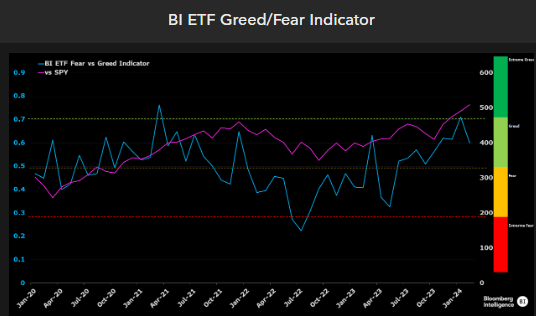
However, Bloomberg’s new BI ETF Greed/Fear Indicator, which incorporates various inputs, highlights the optimistic outlook shared by ETF investors, as seen in the chart below.

On this matter, crypto analyst “On-Chain College” went to social media X (formerly Twitter) to emphasize the significant demand for Bitcoin as evidenced by its rapid departure from exchanges.
In its analysis, On-Chain College highlights that Bitcoin ETFs buy approximately ten times the daily amount of BTC mined. At the same time, the upcoming halving event will further reduce the mining supply. The analyst predicts when demand will exceed available supply, leading to potential upward price pressure.
Highest Monthly Close Since 2021
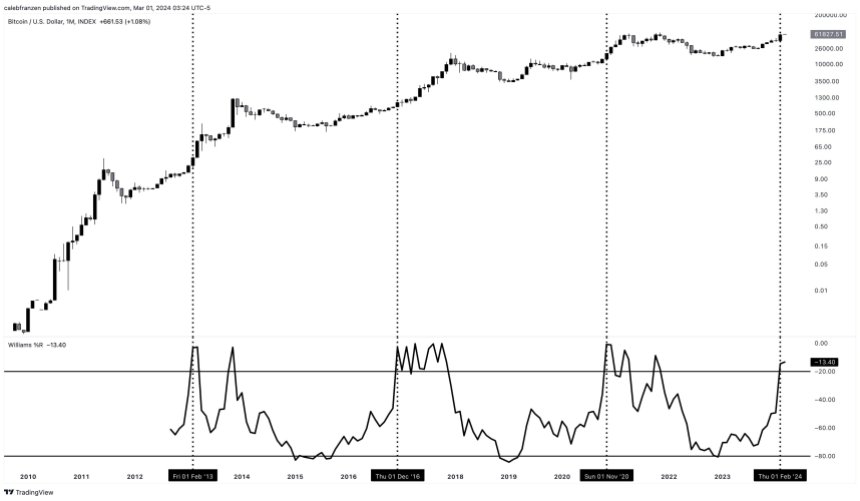
Bitcoin’s recent market performance has caught the attention of wealth manager Caleb Franzen, who highlights the significance of the highest monthly close since October 2021.
Franzen further emphasizes the bullish momentum by pointing out that the 36-month Williams%R Oscillator has closed above the overbought level for only the fourth time in history. Historical data reveals impressive returns following such signals, indicating the potential for substantial gains in the coming months.

Additionally, Franzen notes the changing dynamics of the market, with increased institutional participation and the ease of retail onboarding through ETFs.
Franzen presents a compelling case for the bullish nature of overbought signals, urging market participants to view them as momentum indicators rather than signals to fade. Previous instances of overbought signals have resulted in significant Bitcoin price appreciation:
- February 2013: +3,900% in 9 months
- December 2016: +1,900% in 12 months
- November 2020: +260% in 12 months
While acknowledging diminishing returns in each cycle, Franzen highlights the unprecedented level of institutional participation and the ease of retail access through ETFs.
Even if Bitcoin were to match the +260% gain from the November 2020 signal, it would reach a price of $180,000, surpassing Franzen’s minimum cycle target of $175,000.
Ultimately, Franzen notes that bull markets are typically characterized by a rising ETHBTC ratio and a falling BTC.D (Bitcoin dominance). While these characteristics have yet to manifest fully, Franzen suggests that a multi-quarter rally in the broader cryptocurrency market may be on the horizon.
Featured image from Shutterstock, chart from TradingView.com
Disclaimer: The article is provided for educational purposes only. It does not represent the opinions of NewsBTC on whether to buy, sell or hold any investments and naturally investing carries risks. You are advised to conduct your own research before making any investment decisions. Use information provided on this website entirely at your own risk.
Warren Buffett Bought $9.2 Billion of This Stock in 2023. And He’s Probably Buying More in 2024.
Warren Buffett hasn’t seen a lot to like in the stock market recently.
While he added to some positions in Berkshire Hathaway‘s (NYSE: BRK.A) (NYSE: BRK.B) portfolio in 2023 and started a couple of new ones, he’s been a net seller of stocks in each of the past five quarters. The strong performance of the stock market over the past 15 months has made it difficult for the Oracle of Omaha to find a lot of stocks worth sinking Berkshire’s growing cash pile into. As a result, the company ended 2023 with a record $167.6 billion of cash and equivalents on its balance sheet.
That said, there’s one stock Buffett hasn’t been able to stop purchasing. He bought shares every single month in 2023, and there’s a good chance he’ll continue to buy more this year.
That stock is none other than Berkshire Hathaway itself.

Giving shareholders a bigger stake in everything Berkshire Hathaway owns
Instead of adding to shares of anything in Berkshire Hathaway’s portfolio, Buffett views one of the best ways to increase investor’s exposure to Berkshire’s assets is through share repurchases. He explains in his 2023 letter to shareholders: “Though Berkshire did not purchase shares of either company in 2023, your indirect ownership of both Coke and AmEx [i.e., Coca-Cola and American Express] increased a bit last year because of share repurchases we made at Berkshire. Such repurchases work to increase your participation in every asset that Berkshire owns.”
When Buffett repurchases shares of Berkshire Hathaway on the open market, remaining shareholders subsequently own a larger stake of the company, and therefore all of the assets held by the conglomerate. But Buffett warns: “All stock repurchases should be price-dependent. What is sensible at a discount to business-value becomes stupid if done at a premium.”
Berkshire used to have a strict policy in place for its share repurchase program. Unless shares fell below 120% of their book value, Buffett couldn’t buy back any shares. The board amended the policy in mid-2018, enabling Buffett to buy back shares as long he believed the share price was below the stock’s intrinsic value, conservatively determined. He also must maintain at least $30 billion in cash and equivalents. Ever since, he’s bought back shares almost every month.
Will Buffett buy more in 2024?
It’s a good bet Buffett will keep buying shares of Berkshire Hathaway in 2024.
2023 purchases totaled $9.2 billion, an increase from 2022, when he repurchased $7.9 billion. That’s still down, however, from the massive sums Buffett spent buying back Berkshire stock in 2020 and 2021.
Despite the strong price performance of Berkshire stock to start the year, Buffett may still consider the shares undervalued. Operating income continues to grow, up 21% year over year, led by the strength of Berkshire’s insurance business. Moreover, Berkshire’s ability to generate huge sums of cash for shareholders is tough to beat. Its operating cash flow climbed to $49.2 billion last year, up from $37.4 billion.
Importantly, the cash pile at Berkshire is massive, and it’s only getting bigger. There are only a few things Buffett can do with cash.
-
He can find a new business to acquire all or part of (i.e., make stock purchases).
-
He can buy short-term Treasury bonds to maintain liquidity while waiting for an opportunity to acquire all or part of another business.
-
He can repurchase shares of Berkshire Hathaway.
Unfortunately, the first isn’t viable at the moment, and the second doesn’t offer market-beating returns in the long run. (Berkshire shareholders are certainly enjoying higher interest rates right now, though.) One of the best long-term uses of cash for Berkshire at the moment is to buy back shares. Until a better opportunity presents itself, investors should expect Buffett to continue returning cash to shareholders with repurchases.
Should you invest $1,000 in Berkshire Hathaway right now?
Before you buy stock in Berkshire Hathaway, consider this:
The Motley Fool Stock Advisor analyst team just identified what they believe are the 10 best stocks for investors to buy now… and Berkshire Hathaway wasn’t one of them. The 10 stocks that made the cut could produce monster returns in the coming years.
Stock Advisor provides investors with an easy-to-follow blueprint for success, including guidance on building a portfolio, regular updates from analysts, and two new stock picks each month. The Stock Advisor service has more than tripled the return of S&P 500 since 2002*.
*Stock Advisor returns as of February 26, 2024
American Express is an advertising partner of The Ascent, a Motley Fool company. Adam Levy has no position in any of the stocks mentioned. The Motley Fool has positions in and recommends Berkshire Hathaway. The Motley Fool has a disclosure policy.
Warren Buffett Bought $9.2 Billion of This Stock in 2023. And He’s Probably Buying More in 2024. was originally published by The Motley Fool
Over $3 billion in crypto tokens set to unlock this March, with Arbitrum ‘massive’ unlock

A total of 32 crypto projects are scheduled to unlock more than $3 billion worth of tokens into circulation this March, according to Token Unlocks data.
Arbitrum dominates, doubles supply
Arbitrum leads this month’s token unlocks, marking a significant milestone since its initial airdrop. The impending unlock is poised to double the asset’s current circulating supply.
Token Unlocks data reveals the project would release more than 1 billion ARB tokens, equating to 87% of its existing circulating supply, by March 16. This influx would be valued at approximately $2.2 billion at current market rates.
Breaking down the unlock, the project’s core team and advisors would receive 673.5 million ARB tokens, while investors in the layer2 network anticipate 438.25 million ARB tokens.
Tran Hoan, founder of the venture capital firm Capybara Investments, described the unlock as “massive.” He noted that such a substantial release may not necessarily induce immediate selling pressure on the market, as major investors and the project team typically exercise restraint.
According to him:
“Not all tokens will dump on the market immediately, Major investors don’t do that. Given the potential for massive growth ahead, it might not be wise to sell tokens now. However, there could be a point where the market becomes wary of a large unlock, leading to pressure on the token price.”
Arbitrum is the largest Ethereum-based layer2 network, with the total value of assets locked on the network valued at approximately $14 billion, according to L2beats data.
Other major unlocks
Aptos will introduce 24.84 million APT tokens, constituting 6.76% of its circulating supply, by March 13. This unlock has an estimated value of $290 million as of press time.
Throughout this year, the Aptos team has unleashed over $450 million worth of digital assets into the market. Despite this, its price performance has seen a modest 25% increase year-to-date.
Sui, another layer1 blockchain, is poised to unveil an additional 34.62 million units of SUI tokens, valued at $58.15 million, by March 3. Notably, the network has had new token releases since the beginning of the year.
Optimism, a layer2 blockchain network built on Ethereum, is slated to release 24.16 million OP tokens by March 29. These asset’s value surpassing $90 million.
It is important to note that the project has injected approximately $166 million worth of assets into circulation since the beginning of the year.
(Bloomberg) — Pig-butchering scammers have likely stolen more than $75 billion from victims around the world, far more than previously estimated, according to a new study.
Most Read from Bloomberg
John Griffin, a finance professor at the University of Texas at Austin, and graduate student Kevin Mei gathered crypto addresses from more than 4,000 victims of the fraud, which has exploded in popularity since the pandemic. With blockchain tracing tools, they tracked the flow of funds from victims to scammers, who are largely based in Southeast Asia.
Over four years, from January 2020 to February 2024, the criminal networks moved more than $75 billion to crypto exchanges, said Griffin, who has written about fraud in financial markets. Some of the total could represent proceeds from other criminal activities, he said.
“These are large criminal organized networks, and they’re operating largely unscathed,” Griffin said in an interview.
Pig butchering — a scam named after the practice of farmers fattening hogs before slaughter — often starts with what appears to be a wrong-number text message. People who respond are lured into crypto investments. But the investments are fake, and once victims send enough funds, the scammers disappear. As far-fetched as it sounds, victims routinely lose hundreds of thousands or even millions of dollars. One Kansas banker was charged this month with embezzling $47.1 million from his bank as part of a pig-butchering scam.
The people sending the messages are often themselves victims of human trafficking from across Southeast Asia. They’re lured to compounds in countries including Cambodia and Myanmar with offers of high-paying jobs, then trapped, forced to scam, and sometimes beaten and tortured. The United Nations has estimated more than 200,000 people are being held in scam compounds.
The study, “How Do Crypto Flows Finance Slavery? The Economics of Pig Butchering,” was released on Thursday. Griffin and Mei found that $15 billion had come from five exchanges, including Coinbase, typically used by victims in Western countries. The study said that once the scammers collected funds, they most often converted them into Tether, a popular stablecoin. Of the addresses touched by the criminals, 84% of the transaction volume was in Tether.
“In the old days, it would be extremely difficult to move that much cash through the financial system,” Griffin said. “You’d have to go through banks and follow ‘know-your-customer’ procedures. Or you’d have to put cash in bags.”
Paolo Ardoino, the chief executive officer of Tether, called the report false and misleading. “With Tether, every action is online, every action is traceable, every asset can be seized and every criminal can be caught,” Ardoino said in a statement. “We work with law enforcement to do exactly that.”
Tether has cooperated with authorities in some cases to freeze accounts tied to fraud. But often by the time the crime is reported, the scammers have already cashed out.
“Our paper shows they’re the currency of choice for criminal networks,” Griffin said.
Chainalysis Inc., a blockchain analysis firm, also said the study’s totals might be inflated. Just because a blockchain address receives some money from a pig-butchering scam doesn’t mean all the money received by that address comes from fraud. “Quantifying funds earned through pig-butchering scams is challenging given limited reporting,” said Maddie Kennedy, a spokesperson for Chainalysis. Tether is a one of the company’s customers.
Many of the fraud victims’ blockchain addresses were collected by Chainbrium, a Norwegian crypto investigations firm. Chainbrium also conducted its own analysis of the data and found that a large proportion of the funds flowed through a purportedly decentralized crypto exchange called Tokenlon. Scammers use the exchange to obscure the source of the funds, according to Chainbrium. Tokenlon didn’t respond to a request for comment.
“People in the US, their money is going straight to Southeast Asia, into this underground economy,” said Jan Santiago, a consultant to Chainbrium.
Eventually, the criminals would send the scam proceeds to centralized crypto exchanges to cash out for traditional money. Griffin said Binance was the most popular exchange, even after the company and its founder, Changpeng Zhao, pleaded guilty in November to criminal anti-money-laundering and sanctions charges and agreed to pay $4.3 billion to resolve a long-running investigation by prosecutors and regulators.
“Binance is the place where they can move large amounts of money out of the system,” Griffin said.
Like Tether, Binance has worked with law enforcement in some cases to freeze accounts tied to fraud and return money to victims. A spokesman for the company said it recently worked with authorities to seize $112 million in a pig-butchering case.
“Binance continues to work closely with law enforcement and regulators to raise more awareness of scams, including pig butchering cases,” the spokesman, Simon Matthews, said.
(Adds comments from Chainalysis in the 12th paragraph.)
Most Read from Bloomberg Businessweek
©2024 Bloomberg L.P.