Veteran trader Peter Brandt has provided an update on his bitcoin price prediction. He explained that the price target for “the current bull market cycle” scheduled to end in Aug/Sep next year has been raised from $120,000 to $200,000. Peter Brandt on Bitcoin Bull Market Cycle Peter Brandt provided an update on his bitcoin price […]
Source link
bitcoin
Bitcoin Futures’ Open Interest Reaches Lifetime High, Surpassing 2021 Bull Run
Bitcoin’s value has been on an impressive rise over the past month, and by the start of the week, the leading digital currency surpassed the $57,000 range for the first time since Nov. 2021. This upward trend in value has stimulated bitcoin-based derivatives, causing open interest in bitcoin futures to hit an unprecedented level, exceeding […]


Source link

Bitcoin rose above $57,000 on Monday to its highest level since November 2021, as exchange-traded funds investing directly in the cryptocurrency attract more capital into the space, while investors await the upcoming “halving” event, which has historically been bullish for bitcoin prices.
Bitcoin
BTCUSD,
rose almost 10% during the past 24 hours, according to CoinDesk data. It is roughly off 17% from its record high at $68,990, reached in November 2021.
Investors have seen significant inflows into bitcoin after the U.S. Securities and Exchange Commission approved 10 bitcoin ETFs for the first time in January.
They are also looking forward to the so-called “halving” event, which is expected to happen in April.
Halving is a mechanism written in the blockchain’s algorithm to control the supply of bitcoin, which has a cap of 21 million. At halvings, the reward for bitcoin mining is cut in half, meaning that miners will receive 50% fewer bitcoins for verifying transactions.
Halvings are scheduled to happen after every 210,000 blocks that are mined, or about every four years, until the maximum supply of 21 million bitcoins are all released. Historically, bitcoin has seen price appreciation months after halvings.
From the technical perspective, as bitcoin broke out of its sideways trading range that has been intact since Feb. 10, “this price gain should likely reach targets near $58.4 initially with a possibility of $62k which should be the last real area of resistance ahead of a possible challenge of former all-time highs,” Mark Newton, head of technical strategy at Fundstrat Global Advisors, wrote in a Monday note.
Seven days after the new Bitcoin ETFs launched, I analyzed how they could put pressure on Bitcoin’s supply dynamics in an article called “If BlackRock continues 6k BTC daily buys, we get a supply crunch within 18 months; here’s why.’ On the day of publication, Jan. 18, Bitcoin closed at $41,248 after falling from a high of $49,000 on Jan. 11. Since then, the flagship digital asset has soared 37% to break $57,000.
While Bitcoin had fallen consistently after the ETF launched, CryptoSlate noted the persistent BTC inflows, which, at the time, averaged around 6,266 BTC per day for BlackRock alone. The analysis identified that were such inflows continue, the liquid supply of Bitcoin could be absorbed this year, with the exchange balances or very liquid supplies targetable by mid-2025.

As noted at the time, the analysis was purely hypothetical and did not consider the outflows from Grayscale GBTC. Additionally, it only looked at BlackRock, the largest fund’s inflows, to simplify the data at that point. The exercise aimed to emphasize the potential for a supply squeeze and the lack of liquid Bitcoin to facilitate persistent ETF pressure on the supply. On Jan. 18, BlackRock had 25,067 BTC under management, valued at $1 billion.

Interestingly, while the inflows into BlackRock did not maintain the 6,266 BTC daily average pressure, inflows into the Newborn Nine have surpassed this level. BlackRock currently has 130,231 BTC under management, whereas the fund would have 275,707 BTC if it continued at 6,266 BTC daily. However, on Jan. 18, 6,266 BTC was valued at $258 million, which would now represent an inflow of $357 million, given the dramatic price surge.

It’s important to remember that the spot Bitcoin ETFs are purchased with dollars and denominated in dollars in a brokerage account. Thus, while inflows into the ETF have been consistent in dollar terms, they have been reduced in terms of Bitcoin purchases.
Across the Newborn Nine, 303,002 BTC is now held under management per K33 Research. Looking at the CryptoSlate table used for the Jan. 18 article, this aligns with inflows projected for BlackRock by March 2, 2024.

Using this data, should the Newborn Nine continue to absorb Grayscale’s declining outflows and purchase additional Bitcoin from the broader market at this pace, 1 million BTC could be under management by June. Further, this rate would swallow the BTC equivalent of the entire current liquid supply of Bitcoin (roughly 1.3 million BTC) by September.
On Feb. 8, I discussed the potential for the ‘Mother of all Supply Squeezes‘ for Bitcoin, which is akin to the GameStop saga but even more effective. The price has surged 29% since that article went live in just 19 days, an average of 0.65% per day. Bitcoin ETFs have continued to buy, and Grayscale’s outflows are slowing.
The requirements for a supply squeeze appear to be present; the only question I see is, at what level does the demand become affected by the price? Do Bitcoin ETF purchasers continue to buy if Bitcoin is at $100,000? Well, at that price, BlackRock’s IBIT would be around $60 per share. That doesn’t sound quite as expensive to new investors now, does it?
Ethereum Outperforms Bitcoin As Institutional Investors Clamor For ETH Exposure
Reports have revealed that institutional investors are shifting their focus to Ethereum, displaying a preference compared to the largest cryptocurrency, Bitcoin. Despite Bitcoin’s recent rally to over $55,000, Ethereum’s unique features and potential developmental capabilities continue to capture institutional players’ interest.
Institutions Favor Ethereum Over Bitcoin
On February 24, cryptocurrency exchange, Bybit, published a research report on its users’ asset allocation. The research examined investors’ hodling and trading behaviours, covering the period from July 2023 to January 2024. Bybit’s report also provided valuable insights into investors’ asset allocation across cryptocurrencies such as altcoins, stablecoins and meme coins, shedding light on the specific coins users are currently bullish or bearish on.
According to the research report, Ethereum has unexpectedly emerged as the primary cryptocurrency choice for institutional investors. The report revealed that “institutions are betting big on Ethereum,” allocating more of their funds to ETH compared to BTC.
Bybit has disclosed that the recent rise in interest in Ethereum began in September 2023, when ETH was still trading around $2,000. Subsequently, Ethereum’s market sentiment became more bullish, experiencing a surge in investor interest to about 40% by January 2024. The crypto exchange has confirmed that, as of January 31, ETH has become the single largest cryptocurrency held by institutions.
Bybit’s report also revealed that institutional investors’ interest in Bitcoin began to wane following the United States Securities and Exchange Commission (SEC) approval of Spot Bitcoin ETFs on January 10, 2024. At the time, Bitcoin had experienced massive selling pressures, resulting in investors trimming their BTC holdings to favour other cryptocurrencies.
The excessive allocation of Ethereum is reportedly attributed to investors anticipating a favourable outcome from Ethereum’s upcoming Decun Upgrade, slated to launch in March 2024.
Notably, Bybit has disclosed that it is still being determined if the recent shift to Ethereum is a short-term manoeuvre or a more prolonged move. However, the approaching Bitcoin halving in April potentially adds a layer of bearish risks, as projections indicate Bitcoin’s significant rise in value to new all-time highs during the halving phase.
ETH price rises to $3,230 | Source: ETHUSD on Tradingview.com
Retail Investors Think Otherwise
Bybit’s research report also examines the asset allocation trend for retail investors on the cryptocurrency exchange. The report revealed that retail investors are significantly more bullish on Bitcoin than Ethereum, allocating more funds into BTC than ETH despite Ethereum’s recent surge in value.
Over the past week, Ethereum has experienced a substantial hike in its price, jumping over 7% and outpacing Bitcoin, suggesting a potential for a more extensive upward trajectory. At the time of writing, Ethereum is trading at $3,227, reflecting a 4.05% increase in the last 24 hours, according to CoinMarketCap.
While Ethereum’s massive rally has successfully elevated the sentiment among institutional investors, retail investors remain less swayed, opting to hold onto or incorporate additional Bitcoin into their diversified portfolio of digital assets.
Featured image from Cointribune, chart from Tradingview.com
Disclaimer: The article is provided for educational purposes only. It does not represent the opinions of NewsBTC on whether to buy, sell or hold any investments and naturally investing carries risks. You are advised to conduct your own research before making any investment decisions. Use information provided on this website entirely at your own risk.
JPMorgan Says Bitcoin Halving and Ethereum Upgrade ‘Are Largely Priced In’
JPMorgan Chase has discussed three main catalysts driving crypto prices over the coming months. The global investment bank’s analysts believe that the Bitcoin halving event and the next major upgrade of the Ethereum network are largely priced in. JPMorgan on Catalysts Affecting Crypto Prices Global investment bank JPMorgan Chase has provided its insights into three […]
Source link
Open interest, the total number of outstanding derivative contracts that have not been settled, is an important metric for gauging market health and sentiment. An increase in open interest means new money entering the market, showing heightened trading activity and interest in Bitcoin. Conversely, a decline suggests closing positions, potentially indicating a change in market sentiment or a consolidation phase. Monitoring these trends is important for understanding the liquidity, volatility, and future price expectations in the market.
In a bullish market, an increase in open interest often correlates with rising prices, suggesting that new money is betting on further price appreciation. This scenario typically reflects a strong market sentiment and investor confidence in Bitcoin’s upward trajectory. On the other hand, in a bearish context, growing open interest might indicate that investors are hedging against expected price declines, revealing a more cautious or negative market outlook.
Furthermore, the balance between call and put options within the open interest provides deeper insights into market sentiment. A predominance of calls suggests a bullish market sentiment, with many investors expecting price rises, whereas a majority of puts can indicate bearish expectations.
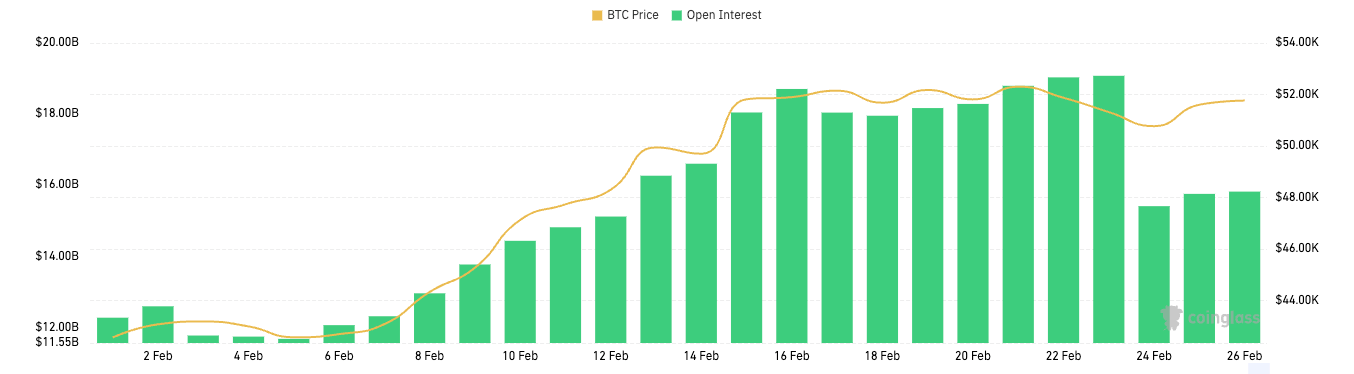
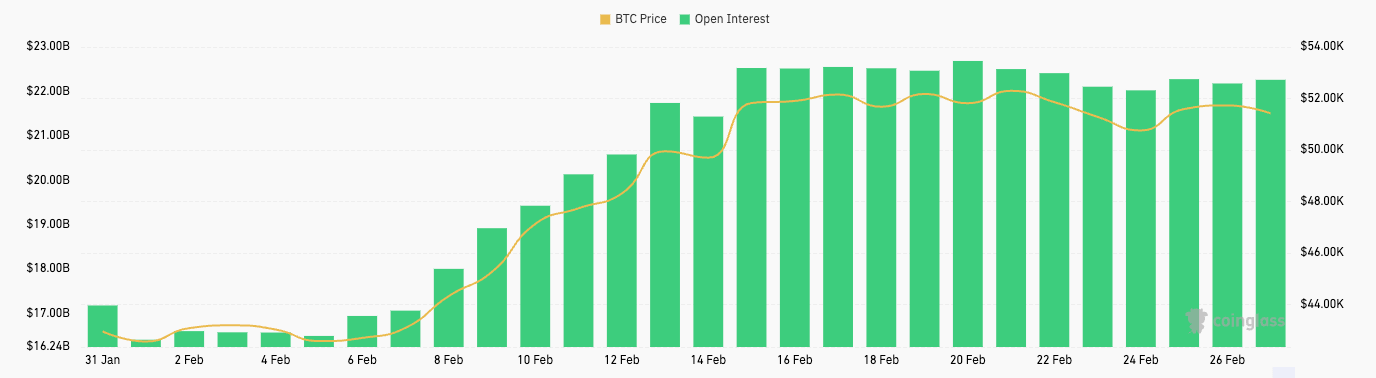
February saw a significant increase in open interest for Bitcoin futures and options.
From Feb. 1 to Feb. 20, Bitcoin futures open interest grew from $16.41 billion to $22.69 billion. This substantial rise suggests that traders were increasingly entering into futures contracts, anticipating higher volatility or making directional bets on Bitcoin’s price. Interestingly, this period aligns with a notable increase in Bitcoin’s price, from $42,560 to $52,303, suggesting a bullish sentiment among futures traders. The slight decrease in open interest by Feb.26 to $22.21 billion, alongside a marginal dip in Bitcoin’s price to $51,716, could indicate some traders taking profits or closing positions in anticipation of a consolidation phase or to reduce exposure ahead of potential volatility.

Similarly, Bitcoin options open interest saw a dramatic increase from $12.27 billion at the beginning of February to a peak of $19.08 billion by Feb.23 before dialing back to $15.82 billion towards the month’s end. Options provide the holder the right, but not the obligation, to buy (call option) or sell (put option) Bitcoin at a specified price, offering more complex strategies for traders to express bullish or bearish views or to hedge existing positions. The initial spike in options open interest reflects a robust engagement from investors, leveraging options for directional bets on Bitcoin’s price and protective measures against potential downturns.

The ratio between calls and puts for Bitcoin options provides a deeper insight into market sentiment and potential expectations for Bitcoin’s price direction. The distribution between calls and puts is a direct indicator of the market’s bullish or bearish inclinations, with calls representing bets on rising prices and puts on falling prices.
As of Feb. 26, the open interest in Bitcoin options was skewed towards calls, comprising 63.76% of the total, compared to 36.24% for puts. This distribution reinforces the bullish sentiment observed through the increase in options open interest earlier in the month. A predominance of calls in the open interest suggests that a significant portion of market participants were expecting Bitcoin’s price to continue rising or were utilizing calls to hedge against other positions.

However, the 24-hour volume tells a slightly different story, with calls accounting for 47.24% and puts for 52.76%. Compared to the overall open interest, this shift towards puts in the daily trading volume might indicate a short-term increase in caution among traders. It suggests that within the last 24 hours, there was a noticeable pick-up in defensive strategies or bearish bets.

The immediate implication for Bitcoin’s price is a potential increase in volatility. The bullish sentiment, as evidenced by the growing open interest and high proportion of calls, supports a continued positive outlook among many market participants. However, the recent uptick in puts volume may signal upcoming price fluctuations as traders adjust their positions in anticipation of or in response to new information or market trends.
Considering these, the market appears to be at a crossroads, with a strong bullish sentiment tempered by short-term caution. This scenario often precedes periods of heightened volatility as conflicting expectations play out through trading activities.
Crypto analyst Rager recently provided valuable insights to Bitcoin and Ethereum investors ahead of the imminent bull run. As part of his statements, he revealed the best time to go all in on the two largest crypto tokens by market cap, Bitcoin and Ethereum.
“Last Great Opportunity For This Cycle”
Rager opined in an X (formerly Twitter) post that the “last great opportunity for this cycle” will come around the Bitcoin Halving. In line with this, he also stated that he was still holding spot in positions and waiting for the “BTC and ETH pullback”, which he explicitly predicts will happen between now and May.
Going by Rager’s opinion, this “nice dip” presents the perfect time for crypto investors to position themselves ahead of this cycle’s bull run. His statement also suggests that Bitcoin and Ethereum (and possibly other crypto tokens) will run massively after that pullback occurs. Interestingly, analysts have continued to identify this event as what will kickstart the next bull run.
BTC price recovers above $51,000 | Source: BTCUSD on Tradingview.com
Bitcoin Run To $60,000 Might Be Close
In a subsequent X post, Rager gave an idea of what price level Bitcoin could drop to when the crash occurred as he hinted that he wouldn’t invest until Bitcoin dropped to $48,000. He also provided an analysis of Bitcoin’s current price action, noting that it has been “composed of a few days of strong price action followed by a lot of chop and pullbacks.”
He added that Bitcoin and the broader crypto market “has a lot of upside opportunity.” However, he warned that there could likely be a short-term pullback, which he predicts could be the last great opportunity to invest. Rager also claimed that Bitcoin would break the $60,000 resistance for the first time since 2021 once this pullback is done.
ETH To $3,500 Is The Next Target
In another X post, Rager mentioned that the $3,500 price level is the target for the current bullish momentum in the market. He also believes this will likely happen “sooner rather than later” with the help of the Ethereum Spot ETF rumours. Industry experts have expressed confidence that these funds will be approved.
$3,500 is just Rager’s first target for Ethereum in this cycle’s bull run, noting that it isn’t the “peak high by any means.” Meanwhile, the analyst stated that the peak of this bull run is still far off. Using the crypto fundraising data as an indicator to determine when the market top is almost in, he noted that fundraising was still at lower levels compared to peak bull market activity.
Featured image from LAB51, chart from Tradingview.com
Disclaimer: The article is provided for educational purposes only. It does not represent the opinions of NewsBTC on whether to buy, sell or hold any investments and naturally investing carries risks. You are advised to conduct your own research before making any investment decisions. Use information provided on this website entirely at your own risk.
Bitcoin surges to prices last seen two years ago in painful crash days after ATH

Bitcoin (BTC) surged 6% on Feb. 26 to a new two-year high of $54,910 after US markets began trading, an indication of rising interest in the flagship crypto from retail and institutional investors.
Bitcoin was trading at roughly $54,650 as of press time, up 5.6% on a daily basis, with a market cap of $1.07 trillion, according to CryptoSlate data.
Start of winter
The last time Bitcoin was trading at these levels was in December 2021 — 21 days after it hit a new all-time high of $69,044 on Nov. 10, 2021.
On Dec. 3, 2021, Bitcoin was trading around $54,365 after giving up significant gains over the past three weeks following its rally to a new all-time high amid profit-taking and shifting market conditions.
However, the drawdown had only just begun, as the flagship crypto saw a severe dip over the next 24 hours that took Bitcoin to a painful low of $42,000 before recovering some of the almost $15,000 in losses before the day closed.
By the end of Dec. 4, 2021, Bitcoin was trading at $49,191, down 8.6% over a single day.
ETF performance, halving hype
Spot Bitcoin ETFs have continued their strong performance over February and experienced a significant spike in volume on Feb. 26 to set a new record of $2.4 billion in daily volume.
According to data shared by Bloomberg ETF analyst Eric Balchunas, BlackRock’s spot Bitcoin ETF IBIT posted a record trading volume of $1.3 billion as of press time, which brings it to the top 0.3% of all ETFs and the top 25 of all stocks for the day.
Meanwhile, spot Bitcoin ETF inflows for the past week stood at $583 million. The total is made up of more than $1 billion in inflows, which are offset by $436 million of Grayscale’s GBTC outflows.
Notably, GBTC outflows have slowed down significantly over the past couple of weeks, with the ETF recording only $44.2 million in outflows on Feb. 23.
Bitcoin Market Data
At the time of press 8:47 am UTC on Feb. 27, 2024, Bitcoin is ranked #1 by market cap and the price is up 10% over the past 24 hours. Bitcoin has a market capitalization of $1.11 trillion with a 24-hour trading volume of $48.69 billion. Learn more about Bitcoin ›
Crypto Market Summary
At the time of press 8:47 am UTC on Feb. 27, 2024, the total crypto market is valued at at $2.13 trillion with a 24-hour volume of $111.16 billion. Bitcoin dominance is currently at 51.96%. Learn more about the crypto market ›
Quick Take
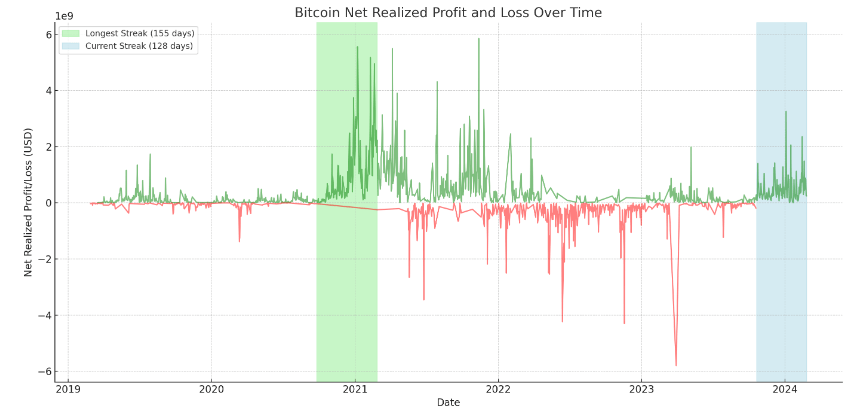
Net realized profit-taking for Bitcoin has witnessed an unbroken streak of 128 days, starting from Oct. 20, 2023, until Feb. 25, 2024. This period saw Bitcoin’s price catapult from below $30,000 to $50,000, providing lucrative opportunities for investors.
Defined by Glassnode, the net realized profit/loss represents the cumulative profit or loss from all coin transactions. It is calculated by deducting the realized loss from the realized profit.
This is not the first time such a trend has been noted. Looking back over the past five years, we find an even more extended period of consecutive net profit-taking: a staggering 155-day run from September 2020 to Feb. 26, 2021, during the significant bull run of 2021.

Interestingly, the frequency of profit-taking has dipped considerably in recent weeks as Bitcoin’s price has stabilized above $50,000. Notably, when Bitcoin’s price crossed significant milestones at $40,000 and $50,000, we noticed an intense surge in profit taking.

However, a contrast emerges when comparing the current trend with the 2021 bull run. The 2021 bull run witnessed multiple days where the profit-taking figures reached staggering heights of over $4 to $5 billion. In contrast, the highest profit-taking in 2024 peaked at $3.2 billion in a single day. This indicates a notably subdued level of profit-taking activities in the current year when compared to the intense trading during the 2021 bull run.
The post Bitcoin investors realize net profits for 128 consecutive days appeared first on CryptoSlate.