In its latest annual report, Riot Platforms, the publicly-listed bitcoin mining firm, outlines several significant risks that could impact its operations, including troubles in the broader crypto economy, potential decreases in onchain transaction fees, and the anticipated bitcoin halving event in April 2024. The company emphasizes the halving event’s potential to reduce mining rewards as […]
Source link

bitcoin
ECB Economists: Bitcoin Fails to Become Global Decentralized Digital Currency, BTC’s Fair Value Is Still Zero
The European Central Bank (ECB) has published a blog post claiming that “bitcoin has failed to fulfill its original promise to become a global decentralized digital currency.” The ECB economists who authored the post added that bitcoin’s fair value is still zero and bitcoin transactions are “still inconvenient, slow, and costly.” Moreover, they asserted that […]


Source link
Robert Kiyosaki Says If Bitcoin Crashes He Would Be Happy and Buy More
Rich Dad Poor Dad author Robert Kiyosaki has explained what he will do if the price of bitcoin crashes. The famous author has been recommending bitcoin alongside gold and silver for quite some time, and he recently increased his bitcoin holdings following the approval of U.S. spot bitcoin exchange-traded funds (ETFs). Robert Kiyosaki: ‘Sale’ Is […]


Source link
Microstrategy Chairman Says Bitcoin Is Superior to Other Asset Classes — Expects Capital to Keep Flowing Into BTC
Microstrategy’s executive chairman, Michael Saylor, sees bitcoin as “the strongest asset.” He believes that capital is going to keep flowing from other asset classes, such as gold and real estate, into bitcoin because the cryptocurrency is “technically superior to those asset classes.” He emphasized that bitcoin is an exit strategy and Microstrategy has no plan […]


Source link
Weekly NFT Sales Rise 17% With Bitcoin Climbing Back to Second in Volume
Based on the most recent international standings and weekly figures, sales of non-fungible tokens (NFTs) have surged by 17.66% in the past week, amassing slightly more than $306 million in sales. This uptick marks a jump from last week’s 16.8% rise in NFT sales, with the leading blockchains in terms of volume — Ethereum and […]
Source link
How Bitcoin ETFs, the halving, and bull market is shaping crypto, according to Bitget

In this interview with Jamie Elkaleh, Bitget Regional Growth & Country Manager, we delve into the dynamic landscape of the crypto market, examining the pivotal roles of Bitcoin Spot Exchange-Traded Funds (ETFs), the anticipated Bitcoin Halving in April 2024, and the current bullish market cycle. Jamie offers a comprehensive overview of Bitget’s impressive user growth, driven by innovative initiatives and a strong focus on inclusivity and user experience.
The conversation further explores Bitget’s strategic approach to catering to novice and experienced traders, unveiling upcoming features and developments poised to revolutionize the trading experience. Additionally, Jamie sheds light on Bitget’s commitment to transparency, security, and user education, ensuring a safe and informed trading environment amidst increasing regulatory scrutiny.
This interview promises valuable insights into the future of crypto trading and the strategic vision propelling Bitget’s growth and success.
Disclaimer: The following is a sponsored interview in partnership with Bitget.
What is your perspective on the current state of the crypto market, including the impact of the Bitcoin ETFs, the halving, and the ongoing bull market cycle?
The crypto market, especially Bitcoin, is experiencing a surge in optimism, driven by key developments such as the approval of Bitcoin Spot Exchange-Traded Funds (ETFs), the upcoming Bitcoin Halving in April 2024, and a bullish market cycle. The SEC’s approval of Bitcoin ETFs has attracted mainstream and institutional investors, boosting investment and market acceptance. Institutional involvement and the anticipated Bitcoin Halving, which historically leads to price increases due to reduced Bitcoin supply, are fueling market excitement.
Additionally, the rise in Bitcoin trading volumes and interest in decentralized finance (DeFi) and non-fungible tokens (NFTs) within the Bitcoin ecosystem are contributing to market liquidity and stability. However, despite a generally bullish outlook, investors are advised to exercise caution and consider broader economic and regulatory factors in their decisions.
Can you share insights into Bitget’s recent user growth and the initiatives that have contributed to this growth?
Bitget has experienced significant user growth due to a combination of improving user experience, introducing top-tier listings, and expanding its team to over 1,600 members during the bear market. Notably, Bitget’s derivatives trading volume surpassed market growth by 28%, with a 9.4% increase in spot trading volume, outperforming the market’s 2.6% growth. The platform has become a leader in copy trading, with copy traders generating over $15 million in profits from more than 2.2 million profitable trades. In January alone, Bitget attracted 4,400 elite traders and over 26,990 new followers.
Key to its growth has been initiatives like Blockchain4Her, dedicating $10 million to gender diversity and inclusivity in blockchain, Blockchain4Youth, investing $10 million to drive web3 adoption and strategic partnerships, such as the #MakeItCount 2024 campaign with Lionel Messi. Bitget’s commitment to social impact, alongside financial innovation, is evident in its efforts to bridge gender diversity gaps and in attracting banking sector professionals to the crypto industry. The addition of 52 new digital assets and leadership in copy trading further positions Bitget as a forward-looking platform, ready to serve a diverse and expanding global audience.
Bitget is known for enhancing the user experience. Could you elaborate on the consumer-centric features aimed at both novice and experienced traders, ensuring inclusivity?
Bitget has strategically positioned itself as a user-centric platform catering to both novice and experienced traders through a wide array of features designed to enhance the trading experience and ensure inclusivity. Here’s a detailed look at how Bitget achieves this through its consumer-centric features:
For Experienced Traders
- Bitget API: Offers experienced traders the ability to trade faster and more flexibly by integrating various APIs such as Spot trading API, Futures trading API, and Copy trading API. This includes Market APIs, Trading APIs, P2P APIs, Spot Margin Trading APIs, and Market WebSockets for both spot and futures trading. These APIs are designed to meet the needs of institutional and professional users, providing specialized solutions based on user requirements.
- Copy Trading: Bitget introduces Futures Copy Trading API and Spot Copy Trading API, catering to those who prefer a hands-off approach but with a professional touch. This feature is especially appealing for users who wish to leverage the expertise of successful traders.
- Market Makers: Offers better funding rates, lower latency, higher trading limits, and direct contact with business development for tailored support.
- Quantitative Trading: Provides free standardized API and SDKs in five programming languages, accompanied by 24/7 professional customer service, facilitating automated and algorithmic trading strategies.
- Third-Party Platform Integration: Allows for sharing of Bitget’s liquidity, integration of Bitget’s copy trading services, and a non-disclosure broker model, enhancing the platform’s flexibility and reach.
For Novice Traders
- Bot and Copy Trading: Recognized for its top-ranking global copy trading solution, Bitget enables novice traders to mimic the trades of successful traders, thereby reducing the learning curve and increasing the chances of success without the need for extensive market knowledge.
- Learn2Earn: A program designed to promote continuous learning among both novice and experienced traders. This initiative rewards users for engaging with educational content about trading and the industry, fostering a culture of knowledge and skill development.
- Bitget Wallet: A multi-chain ecosystem with aggregated DEX liquidity, ensuring that even those new to trading can manage their assets efficiently and securely across different blockchains.
Inclusive Features for All Users
- Spot Trading: Offers immediate trading with current market prices, available for both novice and experienced traders.
- Futures Trading with Liquidity: Provides the opportunity to trade on future prices of assets with enhanced liquidity.
- Margin Trading with Leverage: Enables traders to borrow funds to increase their trading position, amplifying potential returns.
- Convert Trading with Zero Fees: Allows users to convert cryptocurrencies without incurring transaction fees, making it accessible and cost-effective for all traders.
What are the key focus areas in Bitget’s roadmap for the next year, and are there any new developments or features that users can look forward to?
GetScribe for Bitget Wallet: This is an innovative feature that marks Bitget Wallet as the first to offer a full-stack omnichain inscription management. GetScribe supports over 19 blockchains, including major ones like Bitcoin, Ethereum, Polygon, and Avalanche. It facilitates single and batch inscriptions, features an integrated inscription market leaderboard for real-time ranking lists and price fluctuations, and provides market competition data.
An upcoming launchpad function for BRC-20 tokens will give users early access to high-potential tokens, enhancing the wallet’s utility and attractiveness to users interested in emerging tokens.
- Bitget Spot P2P Market: Bitget has introduced a P2P Spot market, a pioneering move among top 10 crypto exchanges, initially featuring three tokens (ORCA, BTCS, and DIMO). This market allows users to trade unlisted tokens with demand and supply, expanding trading opportunities and enabling access to new and potentially valuable tokens before they are listed on major exchanges. This feature democratizes access to emerging tokens and can lead to early investment opportunities.
- Smart Copy Mode for Futures Copy Trading: As the leading platform for crypto copy trading, Bitget has launched a new smart copy mode and introduced independent futures copy trading accounts. This development allows users to follow the investment strategies of Elite Traders with enhanced analysis and customize their investment amounts relative to their total assets, offering a more tailored and potentially more successful copy trading experience.
- Upgraded Platform Wallet Addresses with MPC Security Technology: Bitget has upgraded user wallet addresses to incorporate Multi-Party Computation (MPC) technology, significantly enhancing security. This eliminates single points of failure and ensures transaction security without exposing private keys. The addition of Trusted Execution Environment (TEE) technology further strengthens hardware security, providing users with increased confidence in the safety of their digital assets on the platform.
The Bitget Token (BGB) has been a top performer. What factors have contributed to its success, and what role does it play in the Bitget ecosystem?
Bitget is committed to making cryptocurrency more accessible and integrating DeFi and CeFi on its platform. The BGB token, central to Bitget’s ecosystem, embodies a vision for a user-friendly and inclusive crypto space. BGB, serving as more than just a token, is key to a comprehensive Web3 ecosystem that supports cryptocurrency holdings, community tokens, NFTs, and decentralized apps.
Recently, BGB achieved a new all-time high (ATH) of $0.9, marking a 14.7% increase over the last 30 days and standing out as one of the best-performing CEX tokens.
Aimed at enhancing the trading experience, Bitget plans to delve deeper into copy trading and broaden the range of financial products and services offered. BGB holders benefit from exclusive privileges such as fee discounts, access to Launchpad and Launchpool services, and more, with plans to introduce additional features like a BGB lottery and zero withdrawal fees. Currently, 1.4 billion of the total 2 billion BGB tokens are in circulation, reflecting Bitget’s commitment to a risk-free, globally inclusive cryptocurrency ecosystem.
How does Bitget ensure transparent operations and prioritize safety for its users, especially in the context of increasing regulatory scrutiny?
Bitget ensures transparent operations and prioritizes user safety by maintaining a $422 million Protection Fund and implementing a Proof of Reserves system. The Protection Fund, comprised of 6,500 BTC and 137 million USDT, offers an extra security layer against cybersecurity threats. Additionally, Bitget guarantees 100% of users’ assets in reserves, verified monthly through cryptographic proofs and audits.
This Proof of Reserves process allows users to independently verify their assets, ensuring Bitget has sufficient reserves to cover all withdrawals. The platform’s commitment to transparency and integrity is further demonstrated by the publication of reserve ratios and the open-source proof of reserves code on GitHub. These measures provide a robust framework for protecting user assets and maintaining trust in the face of regulatory scrutiny.
As a popular exchange, how does Bitget’s infrastructure handle a vast influx of new users while ensuring stability and efficiency?
Bitget’s approach to handling the vast influx of new users while ensuring platform stability and efficiency is multifaceted, reflecting its commitment to providing a seamless trading experience for its users worldwide. With a workforce of over 1,600 employees spread across 60 countries and regions, Bitget leverages its global talent pool to maintain a robust and responsive infrastructure. This international team comprises professionals from various industries, bringing a wealth of knowledge and expertise to the platform.
In contrast to other exchanges that may reduce staff during bear markets, Bitget has strategically expanded its team during these periods. This expansion is not just about numbers; it’s about enhancing our capacity to address the needs of our growing user base effectively. The operations and support teams, available 24/7, are a crucial part of this strategy. They ensure that user queries are resolved promptly and any potential issues are addressed efficiently, contributing to the overall stability of the exchange.
This proactive approach to scaling its workforce reflects Bitget’s commitment to user satisfaction and platform reliability. By continuously growing and adapting to the needs of its users, Bitget ensures that it remains a stable and efficient platform for cryptocurrency trading, even as the number of users continues to rise.
In light of regulatory changes such as the ‘cooling-off’ rule, how is Bitget providing educational resources and market insights to help users navigate these developments?
In response to regulatory changes like the ‘cooling-off’ rule, Bitget is enhancing user education and providing market insights through several initiatives. Firstly, Bitget has adapted its platform to comply with the Financial Conduct Authority’s (FCA) new regulations by implementing the ‘cooling-off’ period, clear risk warnings, and creating a webpage tailored for UK users. This webpage restricts access to approved trading features and does not promote campaigns or offers to UK users, ensuring compliance with local regulations.
Moreover, Bitget collaborates with an FCA-approved third-party agency for all marketing approvals, ensuring that all promotional content meets regulatory standards. To further support its users, Bitget offers two key educational resources:
- Bitget Research: This platform provides institutional-grade analysis of the cryptocurrency industry, offering insights and research to help users understand market trends and developments.
- Bitget Academy: Aimed at empowering users from beginners to more advanced traders, Bitget Academy offers a wide range of educational materials, including in-depth guides, practical tips, and market updates. These resources are designed to help users navigate the complexities of the cryptocurrency market, improve their trading skills, and make informed decisions.
All these resources are free and easily accessible, demonstrating Bitget’s commitment to educating its users and helping them navigate the ever-evolving cryptocurrency landscape amidst regulatory changes.
Connect with Jamie Elkaleh
Bitcoin Technical Analysis: BTC Price Oscillation Reflects Crossroads and Market Indecision
Bitcoin’s value on Friday added another page to its unfolding story, registering just under $51,000, showing a modest decline from its 24-hour peak of $51,965 down to a trough of $50,877. Despite this dip, bitcoin’s 24-hour trading volume remains at $25.07 billion, highlighting the crypto asset’s persistent market vigor. Additionally, the leading digital currency’s market […]
Source link
Quick Take
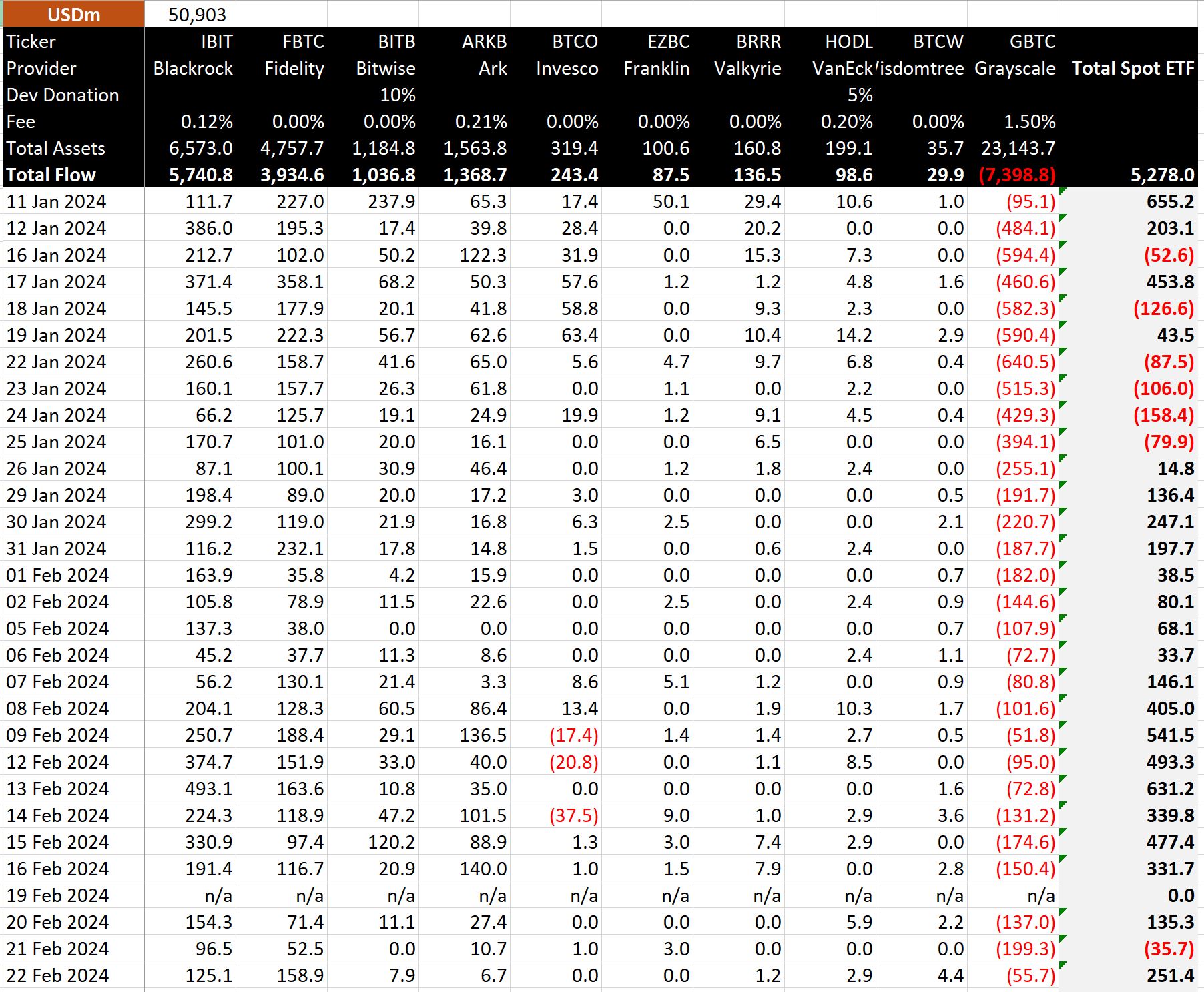
The landscape of Bitcoin ETFs witnessed significant activity on Feb. 22, according to BitMEX data, with a robust inflow of $251 million, the equivalent of 4,900 BTC.
BitMEX data shows that the spotlight was on Fidelity’s FBTC ETF, which reported a substantial inflow of $159 million, pushing its total inflows to the $4 billion mark. BlackRock’s IBIT was not far behind, absorbing $125 million to bring its total net inflow to an impressive $5.7 billion.

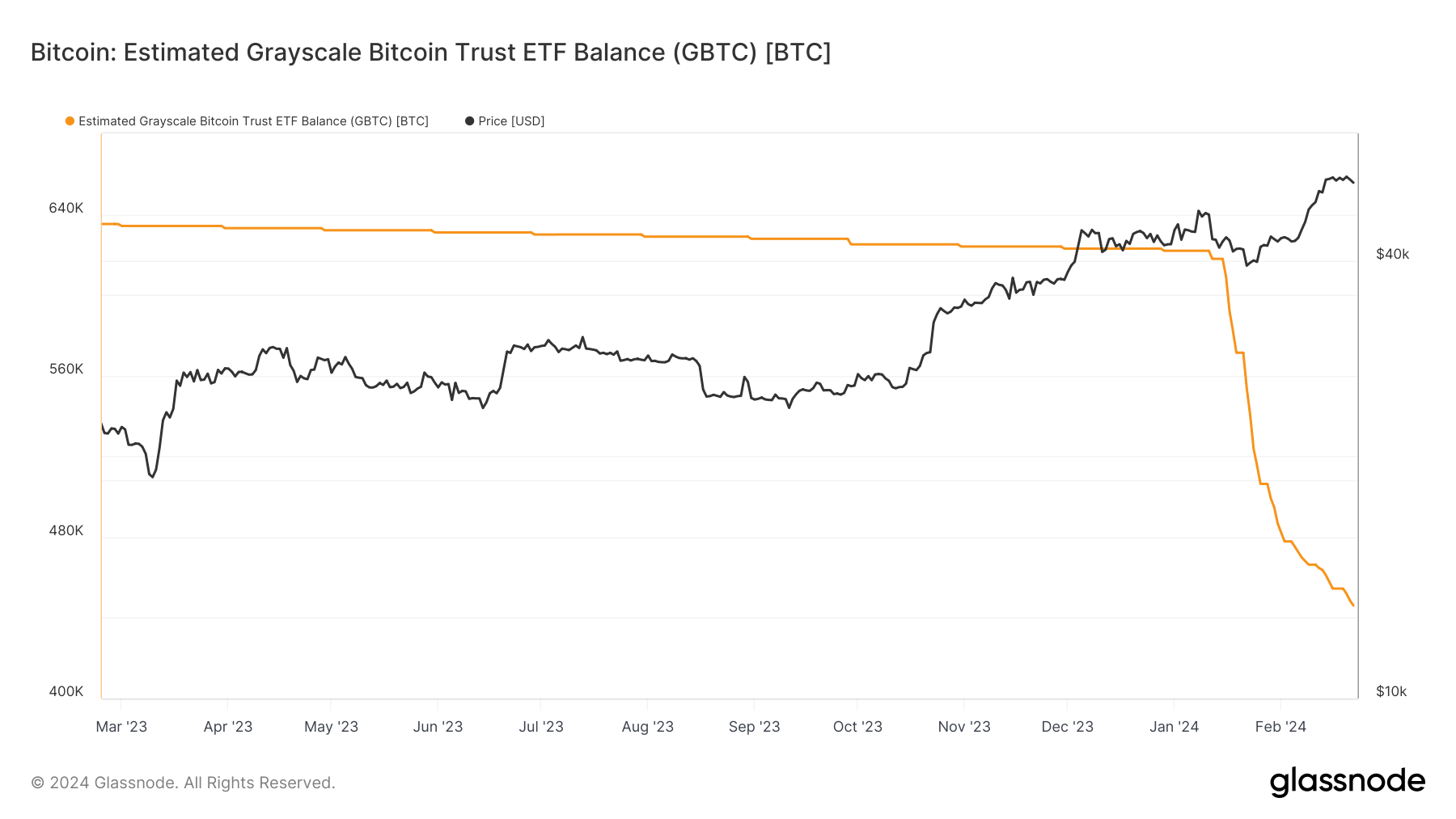
As BitMEX reported, on the opposite side of the spectrum, GBTC experienced more outflows, but they were subdued. The ETF recorded a $56 million outflow, albeit less than the $199 million outflow observed the previous day, Feb. 21; with an aggregate outflow of $7.4 billion to date, GBTC has witnessed a 33% departure from their total Bitcoin holdings, since the Bitcoin ETFs’ commencement on Jan. 11, according to Glassnode.

This surge reaffirmed the overall strength of the Bitcoin ETF market, taking the total net inflow for all Bitcoin ETFs to $5.3 billion, or the equivalent of 110k Bitcoin.
The post Fidelity’s FBTC ETF hits $4 billion mark amid Bitcoin ETF boom appeared first on CryptoSlate.
Despite the landmark launch of spot Bitcoin Exchange-Traded Funds (ETFs) spearheaded by industry behemoths BlackRock and Fidelity—ranking among the top five ETF launches in their initial month of all time—BTC’s price response has been notably subdued. Prior to the launch of these EFTs, BTC soared to a peak of $49,040 on January 11.
Fast forward to today and BTC is currently settling at $51,000, marking a modest appreciation of 4.3%. This tepid performance has puzzled market observers, particularly in light of massive net inflows of $5.278 billion into all Bitcoin ETFs within a mere six-week span. These could have been even significantly higher if there would have been $7.398 billion in outflows from Grayscale’s GBTC.
The Bombshell Discovery
Yet, CryptoQuant CEO Ki Young Ju may now have found the “real” reason that has had an even bigger impact on Bitcoin’s price action in recent weeks. Ju’s analysis highlights the transfer of over 700,000 BTC to Over-The-Counter (OTC) desks predominantly utilized by miners in the weeks succeeding the spot Bitcoin ETF approvals—an equivalent of approximately $35.6 billion at current prices.
He shared the below chart and stated: “700K BTC has moved to OTC desks used by miners over the past three weeks following spot Bitcoin ETF approval.” This revelation has sparked a reevaluation of the impact of such substantial transfers on the market dynamics of Bitcoin.

Ju later corrected his statement slightly and explained, “Got some questions about the data accuracy. These OTC addresses are not only used by miners. It could be used by other whales. We’ll let you know what addresses caused this spike,”acknowledging the complexity and multifaceted nature of these transactions.
The Bitcoin OTC Mechanism Explained
OTC desks facilitate direct transactions between two parties, unlike open exchanges where orders are matched among various participants. This method of trading can handle large volumes of Bitcoin without immediately affecting the market price.
When substantial amounts of BTC are bought or sold on public exchanges, the sudden increase in supply or demand can lead to significant price volatility. By opting for OTC transactions, large buyers, such as ETF issuers, can accumulate Bitcoin in vast quantities without triggering a steep price increase that would inevitably follow if these purchases were made on spot markets.
Thus, Ju theorizes that the issuers behind the newly launched Bitcoin ETFs are strategically purchasing Bitcoin via OTC desks. This approach serves a dual purpose: it allows these entities to fulfill the demand from ETF investors by securing enough Bitcoin to back the ETF shares while simultaneously mitigating the immediate price impact that such large-scale purchases would have if conducted on open exchanges.
The essence of Ju’s claim is that if the 700,000 BTC had been bought on the spot market instead of through OTC channels, the influx of demand would have likely propelled Bitcoin’s price significantly higher than the observed 4.3% increase. This subdued price action, therefore, could be attributed to the strategic use of OTC transactions by ETF issuers and other large-scale buyers.
However, there is also a silver lining. What will happen if the miners can only sell half of the current supply following the upcoming BTC halving in April, but the demand remains? Moreover, this constraint isn’t limited to miners alone.
Given that the OTC supply is finite and likely depleting rapidly, it appears inevitable that a supply shock could impact the market once the OTC reserves are fully tapped. When entities like BlackRock and others are compelled to purchase Bitcoin on the open market to back up their ETFs, the BTC price could react swiftly.
At press time, BTC traded at $51,030.

Featured image created with DALL·E, chart from TradingView.com
Disclaimer: The article is provided for educational purposes only. It does not represent the opinions of NewsBTC on whether to buy, sell or hold any investments and naturally investing carries risks. You are advised to conduct your own research before making any investment decisions. Use information provided on this website entirely at your own risk.
Elliot Wave Theory Predicts Bitcoin Bottom And Top, Here Are The Targets
Bitcoin looks to be stuck in a consolidation zone between $50,000 and $52,000, with neither the bulls nor the bears succeeding in completely taking control of the trend. This performance has sparked a number of speculations on whether the BTC price has finally found a local top. One of those who have speculated on the price direction is crypto analyst Alan Santana, who has used the Elliot Wave Theory to predict where the price of the cryptocurrency might be headed next.
Elliot Wave Points To Correction To $31,800
In the analysis shared by Alan Santana on TradingView, the Elliot Wave theory could point out the direction that the Bitcoin price could be headed next. The theory, which consists of five waves, has so far completed three waves, with the fourth wave expected to happen soon.
Given that the third wave is very bullish and the price has risen so fast, the fourth wave is expected to be more bearish. As Santana explains, this fourth wave points toward an upcoming correction. They also reveal that their analysis included Elliot’s Law of Alternation, and applying it to this scenario, the fourth wave is bearish, but would not go as low as the second wave.
Source: TradingView.com
Once this fourth wave moves into action, the Bitcoin price is expected to see a sharp correction. At the low end of this correction, though, is the $31,800 level, the analyst believes. So, in this scenario, there will be a return to the $20,000s before Bitcoin resumes its next leg up.
“This wave four of a higher degree cannot enter the territory of wave two, which puts the lowest price possible for the upcoming correction at $31,805 based on Elliot Wave Theory,” Santana said. He further added that: “Just as wave three would lead to a correction (wave four), wave four invariable leads to another impulse; the final and fifth wave of the higher degree.”
Bitcoin Top At $138,000
Not only does the Elliot Wave theory points toward a possible bottom, it also gives an idea for where the Bitcoin top might lie in the fifth wave. The crypto analyst uses one of the two Wave Principle methods to forecast this price, which takes into account the peak of the third wave and then uses that to give the peak of the fifth wave.
So far, the local top of this third wave looks to be $52,985, where Bitcoin peaked earlier this week. Since the Wave Principle says that the peak of Wave 5 would be three times higher than that of Wave 3, the analyst multiples $59,985 by 3, which gives a cycle top of $138,714.
As for when this peak will roll around, Santana explains that the whole thing could play out by 2025, which is when the peak would take place. “So the potential for the final impulse or fifth wave based on the Elliot Wave Theory system, amounts to $138,714. This can happen sometime in 2025,” the analyst stated.
BTC price at $51,700 | Source: BTCUSD on Tradingview.com
Featured image from Investopedia, chart from Tradingview.com
Disclaimer: The article is provided for educational purposes only. It does not represent the opinions of NewsBTC on whether to buy, sell or hold any investments and naturally investing carries risks. You are advised to conduct your own research before making any investment decisions. Use information provided on this website entirely at your own risk.