U.S. presidential candidate and former President Donald Trump has acknowledged the growing popularity of bitcoin, stating that “a lot of people are doing it” and the crypto has taken on “a life of its own.” Trump further shared: “More and more I’m seeing people wanting to pay bitcoin and you’re seeing something that’s interesting so […]
Source link
Bitcoins
Never-before-seen Satoshi Nakamoto emails add several details to Bitcoin’s origin lore

Private email correspondence between the pseudonymous Bitcoin creator Satoshi Nakamoto and an early contributor to the project, Martii Malmi, has shed further light on the origin story of the flagship crypto and its creator’s earliest thoughts about the future.
The emails were shared as evidence by Malmi in the Crypto Open Patent Alliance (COPA) vs. Craig Wright trial as part of his testimony. The trial has been ongoing since the beginning of February and will determine whether Wright’s claims of creating Bitcoin have any substance.
Never before seen emails
One group of emails concerns early conversations between Nakamoto and Malmi, who contributed to the Bitcoin website and project code starting in 2009.
The emails provide insight into Nakamoto’s earliest expectations regarding Bitcoin and its future growth. Based on the emails, he was aware of the challenges Bitcoin could face regarding its legal status.
In one email, he wrote:
“There are a lot of things you can say on the sourceforge site that I can’t say on my own site … Even so, I’m uncomfortable with explicitly saying ‘consider it an investment’. That’s a dangerous thing to say and you should delete that bullet point. It’s OK if [Bitcoin users] come to that conclusion on their own, but we can’t pitch it as that.”
Whether cryptocurrencies and related offerings are investment contracts has been a critical point of contention between the industry and regulators, especially the US SEC.
After years of negative sentiment, Bitcoin has generally established itself as a commodity, with many considering it “digital gold.” This is primarily because it was initially issued through mining rather than investment contracts, although Bitcoin exchanges allowed users to purchase the crypto asset as early as 2010.
Incidentally, the emails describe the creation of one of the first Bitcoin exchanges. Nakamoto was looking for ideas for Bitcoin applications, and Malmi suggested a fiat-to-Bitcoin exchange.
Malmi went on to operate and register Bitcoinexchange.com, as was previously known. However, the latest emails show that Nakamoto had been a key advisor for the exchange.
Nakamoto advised Malmi to initially operate the exchange individually instead of creating an “eBay-type” or peer-to-peer exchange. He also dropped his plans to incorporate an auction system in favor of Malmi’s idea for a set exchange rate.
Furthermore, Nakamoto secured a donation of $3,600, of which $1,000 was allocated to support the exchange’s initial operations.
Other topics included anonymity, mining profits, fees
Nakamoto also created the early distinction between anonymous and pseudonymous — or partially anonymous — transactions. He anticipated controversy around transaction analysis, now a major business for firms like Chainalysis and Elliptic.
Nakamoto wrote at the time:
“I think we should de-emphasize the anonymous angle … we can’t give the impression [Bitcoin is] automatically anonymous. It’s possible to be pseudonymous, but … If someone digs through the transaction history and starts exposing information people thought was anonymous, the backlash will be much worse if we haven’t prepared expectations …”
Nakamoto and Malmi also discussed other topics, such as mining profits, power consumption, and Bitcoin’s potential environmental impact. In response to the environmental concerns, Nakamoto wrote:
“Ironic if we end up having to choose between economic liberty and conservation.”
He told Malmi that “unfortunately,” the proof-of-work consensus method was the only way to ensure that Bitcoin could “work” without a trusted third party. He added that it was “fundamental” in preventing double-spending.
Nakamoto did not seem fazed by the idea of significant energy being dedicated to the Bitcoin network. He wrote that even “if it did grow to consume significant energy,” it would not be as “wasteful” as the resources spent on “conventional banking activity.”
He further stated:
“The cost would be an order of magnitude less than the billions in banking fees that pay for all those brick and mortar buildings, skyscrapers and junk mail credit card offers.”
Nakamoto had also been acutely aware that electricity prices would affect mining profitability. His analysis at the time did not take into consideration how quickly the mining industry would evolve after the inception of ASIC devices. However, the emails show that he was mindful of the pace at which technology could develop over the coming years.
“The value of bitcoins would be relative to the electricity consumed to produce them … If you run a computational task 24/7, not letting it idle, it uses significantly more power … The extra wattage consumed goes straight to your power bill, and the value of the bitcoins you produce would be something less than that.”
Another topic discussed by the two developers included the possibility of using Bitcoin time-stamping data. Later, Nakamoto’s own Genesis Block transaction famously included a financial headline.
The emails also revealed discussions around Nakamoto’s decision to initially “hide the transaction fee setting” because he felt the ability to customize fees would confuse users. He predicted that adjustable fees would not be needed until the “far away future, if ever.”
Nakamoto’s prediction was partially correct — average Bitcoin transactions cost just cents before 2017, but the cost has risen significantly over the years, and transactions have regularly cost several dollars recently.
Emails could disprove Craig Wright’s claims
Critically, Malmi’s emails contradict some of the claims Wright has made over the years in his attempt to prove he is Nakamoto.
Wright said that Malmi first approached Nakamoto starting in February 2009. However, email records show that Malmi approached Nakamoto months later, in May 2009.
Another contradiction pointed out by Malmi was Wright misspelling Malmi’s first name in court, which would be uncharacteristic of Nakamoto, who had known him very well.
Yet another contradiction comes from the fact that Wright misidentified Malmi’s nationality even though emails contained a Finnish email address ending in .fi — and, in one case, Malmi’s full street address, including his country.
Wright also claimed in an earlier case that Malmi created the dark net marketplace Silk Road. This supposedly led Wright (as Nakamoto) to leave Bitcoin publicly in 2010.
In his witness statement, Malmi called these allegations “ridiculous and false.” He noted that Ross Ulbricht was convicted years ago for creating and operating the illegal dark web operation.
CryptoSlate previously covered email submissions between Nakamoto and Adam Back, which were filed as part of COPA’s broader efforts to disprove Wright’s claims in court.
Satoshi Nakamoto to Martti Malmi: The Correspondence That Shaped Bitcoin’s Early Days
In a series of insightful emails between Martti Malmi and Satoshi Nakamoto, the foundational discussions shaping the early development of Bitcoin are revealed. These exchanges offer a rare glimpse into the critical thinking and technical challenges overcome in the cryptocurrency’s infancy. Blueprints of a Digital Revolution: Nakamoto’s Conversations With Sirius The dialogue initiated in May […]
Source link
Quick Take
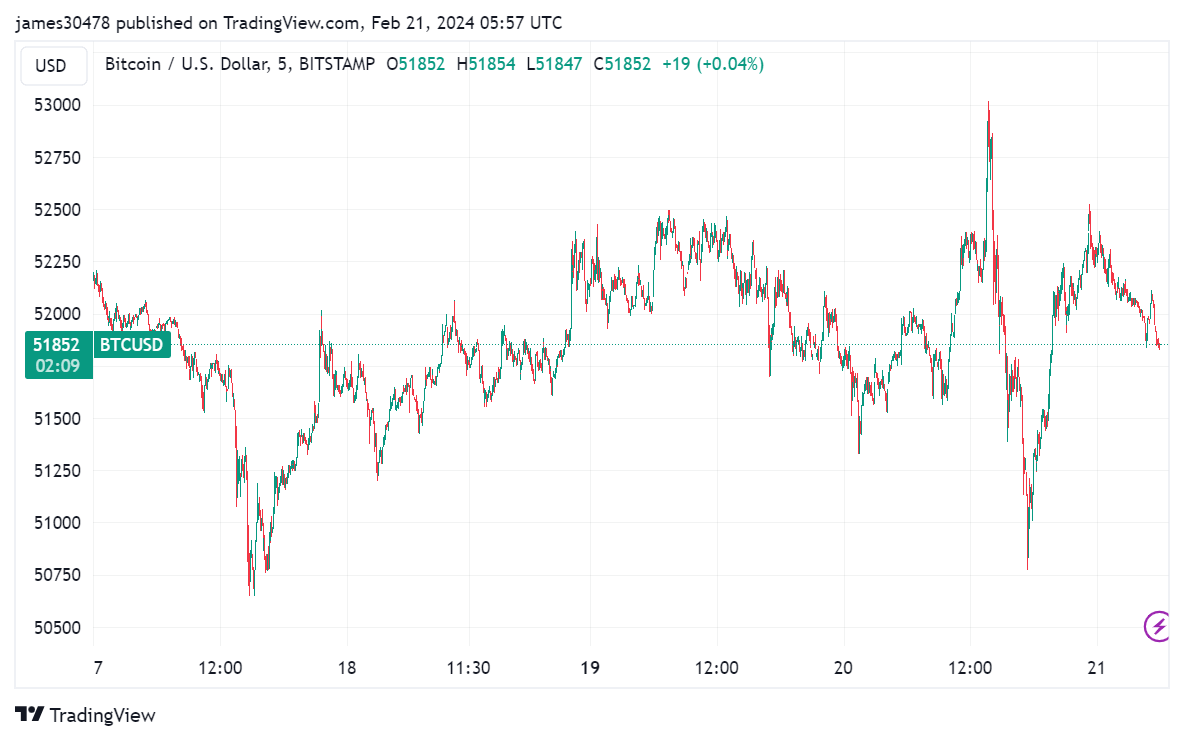
On Feb. 20, just before the US market opened, Bitcoin reached a yearly peak of $53,000, only to retreat into the $50k-$52k range shortly thereafter.
CryptoSlate reports indicate that approximately $1 billion worth of market liquidations were concentrated around Bitcoin’s $53,000 mark. Interestingly, during its short-lived surge to this value, Bitcoin experienced an estimated $70 million worth of these liquidations. While some of these liquidations happened during the rise, the majority are still impending.

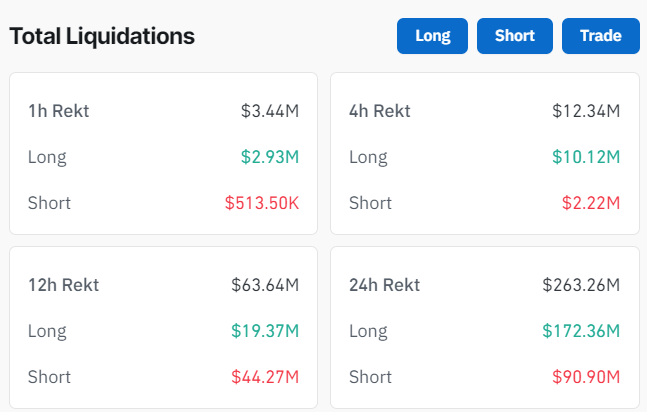
In the broader digital asset market, Coinglass reported that the past 24 hours have seen an estimated $260 million in liquidations, with approximately $170 million from longs and $90 million from shorts. Bitcoin bore the brunt of these liquidations, accounting for around $70 million. While, Binance saw the majority of the liquidations from an exchange at approximately $117 million.

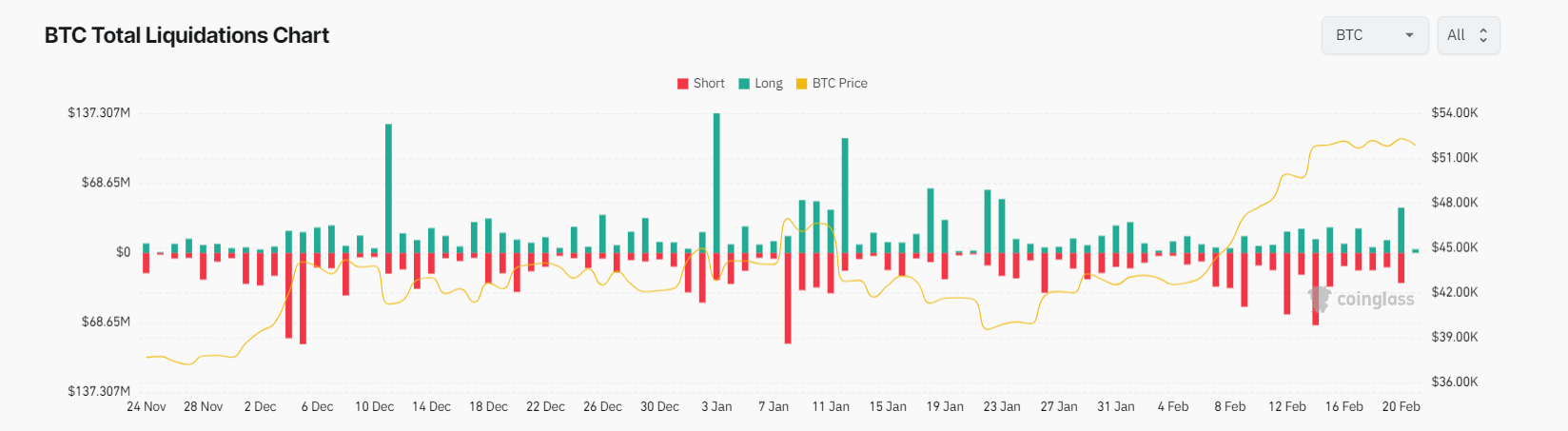
Out of Bitcoin’s $70 million liquidation, approximately $40 million was derived from long positions. This accounts for the largest long liquidation since Jan. 23, when Bitcoin was trading around the $40,000 mark.

The post Bitcoin’s climb to a yearly high triggers market shakeup appeared first on CryptoSlate.
Bitcoin’s Latest Difficulty Retarget Jumps 8.24%: Miners Navigate the Toughest Mining Landscape Yet
Bitcoin’s mining difficulty has hit an unprecedented peak, marking the most significant jump of 2024. On Thursday, at the milestone of block 830,592, the network experienced its fourth adjustment this year with a sharp 8.24% uptick. Bitcoin Mining Difficulty Skyrockets, Setting New Records in 2024 Mining bitcoin (BTC) has become considerably more challenging, following an […]
Source link
Ethereum, Solana see gains as Bitcoin’s rally above $50,000 causes $184 million liquidations
Bitcoin’s surge past $50,000 catalyzed a broader market upswing, propelling numerous large-cap alternative digital assets such as Ethereum (ETH), Solana (SOL), and others to significant gains.
According to data from CryptoSlate, Ethereum saw a 7% uptick, reaching $2,661, while SOL surged 8% to hit $114. Among the top 10 digital assets, Avalanche’s AVAX spiked 6% to $41, Cardano’s ADA rose by 3.74% to $0.5574, while BNB Coin (BNB) and Ripple’s XRP experienced more modest gains, each climbing by less than 3%.
Market analysts attribute this bullish trend to the buzz surrounding the multiple spot Bitcoin exchange-traded funds (ETFs) in the US. Vetle Lunde, a senior analyst at K33 Research, noted that inflows into these ETFs have remained robust more than a month after their launch.

“Yesterday saw a net inflow of 9,870 BTC, pushing the net U.S. spot ETF flow since launch to 72,312 BTC. The new nine now hold 228,000 BTC,” Lunde added.
During the past day, BTC’s price crossed the $50,000 threshold for the first time since late 2021. The top crypto’s value has risen 4.2% to $50,146 as of press time, extending a positive run that had seen it gain 16% over the past week.
$184 million in liquidation
The broader crypto market rally resulted in a significant liquidation totaling over $184 million from more than 56,000 traders, according to Coinglass data.
Short traders, or speculators betting against price increases, bore losses amounting to $134 million, while long traders betting on price increases lost approximately $50 million.
Across assets, Bitcoin led the liquidation charts with a total loss of $69.80 million. Short Bitcoin traders accounted for $55.04 million in losses, while long traders lost $14.76 million. Ethereum followed closely, contributing $39.85 million to the overall liquidation.
Other assets like Solana, LINK, and ORDI also experienced liquidations of $10.14 million, $5.93 million, and $4.81 million, respectively.
Across exchanges, Binance witnessed the highest proportion of liquidations at 43.13%, totaling $79.42 million. Other platforms like OKX and ByBit recorded liquidations of $58.29 million and $18.73 million, respectively.
Notably, the most significant liquidation order occurred on Bitmex for LINKUSD, amounting to $3.14 million.
Bitcoin’s Price Soars Past $48K, Nears $1 Trillion Market Cap Amidst Bullish Momentum
On Saturday, Feb. 10, 2024, bitcoin’s price soared beyond the $48K mark, reaching heights unseen since prior to Dec. 28, 2021. On Sunday, the leading digital currency maintained its robust momentum, consistently staying above the newly established price level. Over the last 24 hours, the crypto asset’s value has risen by over 2.6%, and it […]
Source link

What is CryptoSlate Alpha?
A web3 membership designed to empower you with cutting-edge insights and knowledge. Learn more ›
Connected to Alpha
Welcome! 👋 You are connected to CryptoSlate Alpha. To manage your wallet connection, click the button below.
Oops…you must lock a minimum of 20,000 ACS
If you don’t have enough, buy ACS on the following exchanges:
Connect via Access Protocol
Access Protocol is a web3 monetization paywall. When users stake ACS, they can access paywalled content. Learn more ›
Disclaimer: By choosing to lock your ACS tokens with CryptoSlate, you accept and recognize that you will be bound by the terms and conditions of your third-party digital wallet provider, as well as any applicable terms and conditions of the Access Foundation. CryptoSlate shall have no responsibility or liability with regard to the provision, access, use, locking, security, integrity, value, or legal status of your ACS Tokens or your digital wallet, including any losses associated with your ACS tokens. It is solely your responsibility to assume the risks associated with locking your ACS tokens with CryptoSlate. For more information, visit our terms page.
What Bitcoin’s trading patterns on centralized exchanges tell us about the market

What is CryptoSlate Alpha?
A web3 membership designed to empower you with cutting-edge insights and knowledge. Learn more ›
Connected to Alpha
Welcome! 👋 You are connected to CryptoSlate Alpha. To manage your wallet connection, click the button below.
Oops…you must lock a minimum of 20,000 ACS
If you don’t have enough, buy ACS on the following exchanges:
Connect via Access Protocol
Access Protocol is a web3 monetization paywall. When users stake ACS, they can access paywalled content. Learn more ›
Disclaimer: By choosing to lock your ACS tokens with CryptoSlate, you accept and recognize that you will be bound by the terms and conditions of your third-party digital wallet provider, as well as any applicable terms and conditions of the Access Foundation. CryptoSlate shall have no responsibility or liability with regard to the provision, access, use, locking, security, integrity, value, or legal status of your ACS Tokens or your digital wallet, including any losses associated with your ACS tokens. It is solely your responsibility to assume the risks associated with locking your ACS tokens with CryptoSlate. For more information, visit our terms page.
Quick Take
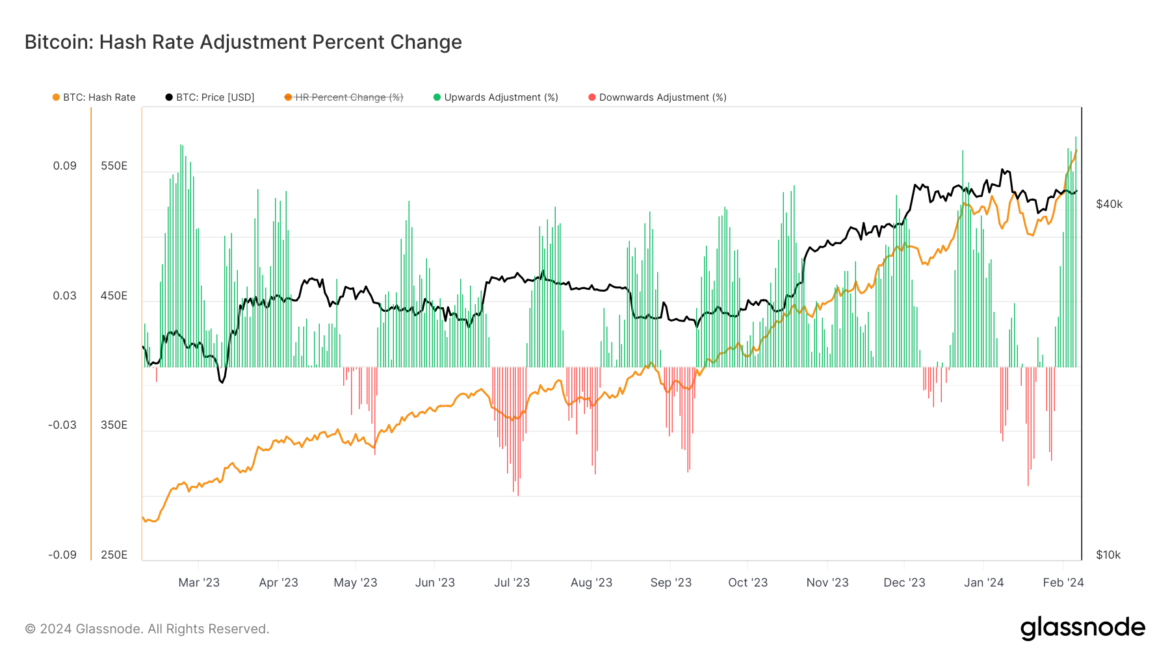
Bitcoin’s hash rate has reached an unprecedented high, marking a fourteen-day moving average of 566 exahashes per second (EH/s). This surge follows Feb. 2, a 7.3% rise in difficulty adjustment, bringing it to a record-setting 75.50T.

Over the past three weeks, since the Texas freeze-induced low, the hash rate has skyrocketed by 12%, further reinforcing the network’s resilience to external shocks. If this hash rate acceleration continues, the next difficulty adjustment epoch, scheduled around Feb. 15, is projected to adjust upwards between 7 and 12%, according to Newhedge.io.
This heightened hash rate has not only brought forward the projected halving date by a day to April 19 but also signifies the network is approximately 10,500 blocks away from this significant event, according to Clarkmoody.com. This upward trend in hash rate and difficulty adjustment reflects the increasing interest and heightened activity within the Bitcoin network.

The post Bitcoin’s hash rate soars to record heights appeared first on CryptoSlate.