
Bitcoin and several altcoins are taking a breather after the sharp rally of the past two days, but the general trend remains bullish.


Bitcoin and several altcoins are taking a breather after the sharp rally of the past two days, but the general trend remains bullish.


Bitcoin and the rest of the cryptocurrency market saw significant gains after Ripple secured a victory against securities regulators on July 13.
As of 8:30 p.m. UTC, Bitcoin (BTC) had gained 4.3% over 24 hours, achieving a $31,594.31 market value and a $613.8 billion market cap. That change represents more than a one-year high, as the asset has not seen comparable prices since June 2022.

Ethereum (ETH), meanwhile, gained 6.9% over 24 hours for a market cap of $239.8 billion. Its price briefly surpassed $2,000.
Those gains were likely influenced by the outcome of a legal case between Ripple and the U.S. Securities and Exchange Commission in which courts ruled that Ripple’s XRP sales are not securities. XRP itself gained 73% over 24 hours to reach a $42.6 billion market cap, making it the 4th largest cryptocurrency at present.
At least two major crypto exchanges — Coinbase and Gemini — have decided to list or are considering listing XRP following Ripple’s legal victory. Those decisions could further support the price of the XRP token.
Three coins named in unrelated SEC cases against Coinbase and Binance are also among the biggest gainers today: Cardano (ADA) rose 19.5%, Solana (SOL) rose 17.3%, and Polygon (MATIC) rose 17.8%. Those gains are perhaps due to more general optimism that is possible for crypto companies to win cases against regulators.
Various other assets have also seen gains. Stellar (XLM), which has early ties to Ripple but is otherwise an independent project, saw gains of 62.4%. The entire crypto market has gained 6.5% over 24 hours for a total market capitalization of $1.3 trillion.
Meanwhile, the crypto market saw $238.37 million in liquidations over a 24-hour period. That total includes $52.01 million of long liquidations and $186.36 million of short liquidations. About 66,800 traders were liquidated in total.

Three assets saw the most liquidations. Bitcoin saw $55.67 million in liquidations, Ethereum saw $37.81 million in liquidations, and XRP saw $47.97 million in liquidations.
Binance was responsible for $85.88 million in liquidations, while OKX was similarly responsible for $68.74 million in liquidations. Together, those two exchanges were responsible for about two-thirds of all liquidations across the cryptocurrency market.
Various other exchanges, including Bybit, Huobi, and CoinEX, were responsible for the remainder of those liquidations, as shown below:

The events of the day represent rare positive news amidst the crypto industry’s latest bear market. Though the broader implications of the Ripple case are still unclear, the latest developments seem to have generated optimism among cryptocurrency investors.

Bitcoin (BTC) may see a “parabolic curve” begin thanks to United States dollar weakness as the greenback falls to three-month lows.
In a tweet on July 11, popular trader Moustache suggested that the time is right for BTC price history to repeat itself.
Bitcoin’s formerly strong inverse correlation to dollar strength has waned this year, but its latest movements are a talking point among traders.
Data from Cointelegraph Markets Pro and TradingView shows the U.S. Dollar Index (DXY) on the way to testing support at 100 for the first time in months.
Previously above 105, the greenback has faced stiff resistance after 2022s 20-year highs.
As a result of its newfound bearish behavior — which would cement itself further should the 100 mark be lost — Bitcoin stands to win, Moustache believes.
“Calm before the storm. Big Move is still loading,” he summarized alongside a chart showing DXY challenging the bottom of a Gaussian channel on weekly timeframes.
“First candle of the DXY (Dollar) now falls OUT of the channel. This is the point where you want to be positioned. In 2016-2017 and 2020-2021 this led to the parabolic curve in $BTC.”

The dollar’s cause has not been helped by markets keen to tap a potential reversal in U.S. interest rate hikes. With inflation abating, this looks ever more likely despite a hawkish Federal Reserve.
The July 12 release of the Consumer Price Index (CPI) for the month prior came in below expectations, providing further fuel for risk assets.
Fellow trader Mikybull Crypto predicted that the downward DXY trend would continue, with BTC/USD hitting $35,000 as a result.
Bears in disbelief
90 next on DXY#Bitcoin to 35k$ pic.twitter.com/TczJMGKh5I
— Mikybull Crypto (@MikybullCrypto) July 12, 2023
Continuing the historical comparison, meanwhile, popular trader Josh Olszewicz called DXY the “single most important chart” for Bitcoin into 2024.
“DXY showing technical weakness coupled with a programmatic supply reduction of Bitcoin issuance may lead to an outsized price reaction for Bitcoin post-halving. Similar DXY moves from 100 to 90 after the previous two halvings provided a tailwind for significant multi-month bullish rallies,” he wrote in a TradingView update.
“DXY is currently forming a high timeframe descending triangle, which holds a bearish bias. This chart pattern becomes invalidated with any higher high in the DXY at 103.50 but does not necessarily invalidate the possibility of a move to the historic range low of 90.”

Adding a broader perspective, William Clemente, co-founder of crypto analysis firm Reflexivity Research, presented the year-on-year change in DXY against how BTC/USD behaved through the years.
Related: Bitcoin exchanges now hold the same BTC supply share as in late 2017
Since everyone wants to talk about DXY (US dollar) weakness, here’s Bitcoin’s price plotted against the YoY change in the DXY: pic.twitter.com/voJAfeF1ok
— Will Clemente (@WClementeIII) July 12, 2023
Looking back, the last time that DXY traded at 100 was in mid-April 2022. At the time, Bitcoin hovered at around $40,000.

Collect this article as an NFT to preserve this moment in history and show your support for independent journalism in the crypto space.
Magazine: Should you ‘orange pill’ children? The case for Bitcoin kids books
This article does not contain investment advice or recommendations. Every investment and trading move involves risk, and readers should conduct their own research when making a decision.


Bitcoin continues to face strong resistance at $31,000, but supportive macroeconomic factors could tilt the advantage in favor of the bulls.
Bitcoin and select altcoins are finding buyers at lower levels, indicating a pick-up in positive sentiment.

Riot Platforms, Inc. recently reported its June 2023 Bitcoin mining performance, revealing that it produced 460 Bitcoin while executing an effective power strategy.
The mining firm produced 40% fewer Bitcoin in June, mining just 460 BTC compared to 757 BTC in May.
| Metric | June 2023 | May 2023 | June 2022 | Month/Month | Year/Year |
|---|---|---|---|---|---|
| Bitcoin Produced | 460 | 676 | 421 | -32% | 9% |
| Average Bitcoin Produced per Day | 15.3 | 21.8 | 14.0 | -30% | 9% |
| Bitcoin Held | 7,250 | 7,190 | 6,654 | 1% | 9% |
| Bitcoin Sold | 400 | 600 | 300 | -33% | 33% |
| Bitcoin Sales – Net Proceeds | $10.6 million | $16.5 million | $6.2 million | -36% | 71% |
| Average Net Price per Bitcoin Sold | $26,456 | $27,568 | $20,627 | -4% | 28% |
| Deployed Hash Rate | 10.7 EH/s | 10.5 EH/s | 4.4 EH/s | 2% | 143% |
| Deployed Miners | 95,904 | 94,176 | 42,455 | 2% | 126% |
| Power Sales | $8.4 million | $0.5 million | $1.9 million | 1,452% | 338% |
| Demand Response Revenue | $1.6 million | $2.3 million | $0.7 million | -29% | 137% |
Source: Riot
Despite the drop in sales, Riot was able to leverage its power strategy to generate substantial revenue equivalent to $10 million in revenue. As a result, the combined power sales and demand response revenue equated to an equivalent of a “361 BTC” increase based on the average price of Bitcoin during the month.
Jason Les, CEO of Riot, commented,
“June was a momentous month for Riot, as the results from our mining operations, power strategy and growth plans have all come together.
We announced an initial order of 33,280 MicroBT miners for our Corsicana Facility, which is expected to add 7.6 EH/s to our self-mining fleet and also provides optionality for future orders at the same terms.”
The additional MicroBT miners would increase Riot’s hash rate by 71%, given the current reported figure of 10.7 EH/s.
The news comes as other U.S. miners looked to capitalize on BTC’s recent price surge to secure profits. In June, BTC mostly traded above $25,000, peaking at $30,750.
According to Glassnode data analyzed by CryptoSlate, Bitcoin miners sold a notable amount of their mined Bitcoin in June to fund their operations. Data shows that Bitcoin miners’ exchange flow peaked at 4,710 BTC on June 20, marking the highest rate in the past five years.
| MINER | BITCOIN PRODUCED | BITCOIN SOLD | PERCENTAGE SOLD | BTC HOLDINGS | TOTAL HOLDINGS SOLD |
|---|---|---|---|---|---|
| Riot | 460 BTC | 400 BTC | 87% | 7,250 BTC | 5.52% |
| Marathon Digital | 979 BTC | 700 BTC | 71.5% | 12,538 BTC | 5.58% |
| Hut 8 | 70 BTC | 217 BTC | 310%* | 9,136 BTC | 2.38% |
| Cleanspark | 491 BTC | 413 BTC | 84% | 529 BTC | 78.07% |
June BTC Miner Activity
*(Based on June Production)
Comparatively, Riot sold fewer Bitcoins monthly as the company reported a sale of 400 Bitcoins in June 2023, a decrease of 33% from May 2023.
However, Riot’s unique power strategy allowed the company to maintain a “competitive edge” and contribute meaningfully to the broader energy grid during Texas’s June heatwave without relying solely on Bitcoin sales for revenue. Les explained,
“As temperatures in Texas reached near record levels during the month and power demand was high, we made dynamic decisions on our power usage based on market signals.
Through our participation in various market programs within ERCOT, the Company generated $8.4 million in power sales and $1.6 million in demand response revenue.”
According to Riot, the power strategy involves participation in ERCOT’s ancillary services and the Four Coincident Peak (4CP) program. The company effectively uses these services to balance electricity supply and demand, even during peak periods.
Riot then sells access to electrical load to ERCOT and receives compensation regardless of whether ERCOT requires a power down. Through the 4CP program, Riot voluntarily reduces power usage during peak periods and, in return, receives credits for future transmission costs.
The flexibility of its long-term Power Purchase Agreement allows Riot to sell power back to the market when it’s more profitable than mining Bitcoin.

Bitcoin (BTC) miners sold a significant amount of their mined Bitcoin in June to fund their operations, according to Glassnode data analyzed by CryptoSlate.
According to the chart below, miners’ exchange flow peaked at 4,710 BTC on June 20—the highest rate of the past five years. Other days of the month also saw significant spikes, averaging over 2000 BTC to exchanges.
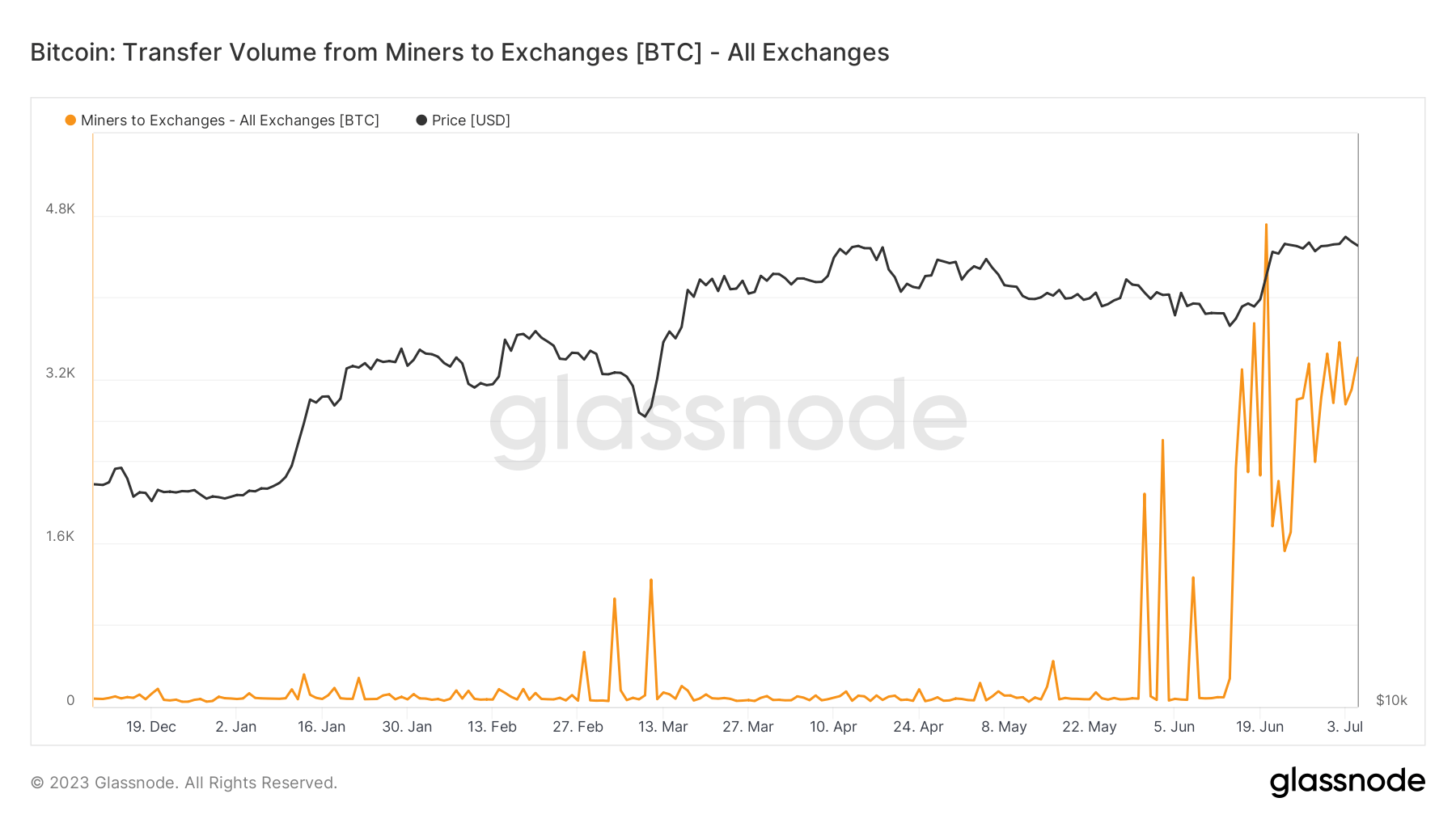
Glassnode stated that the seven days moving average hourly flow from miners to exchange reached as high as 120.77 BTC, one of the highest levels since 2015.
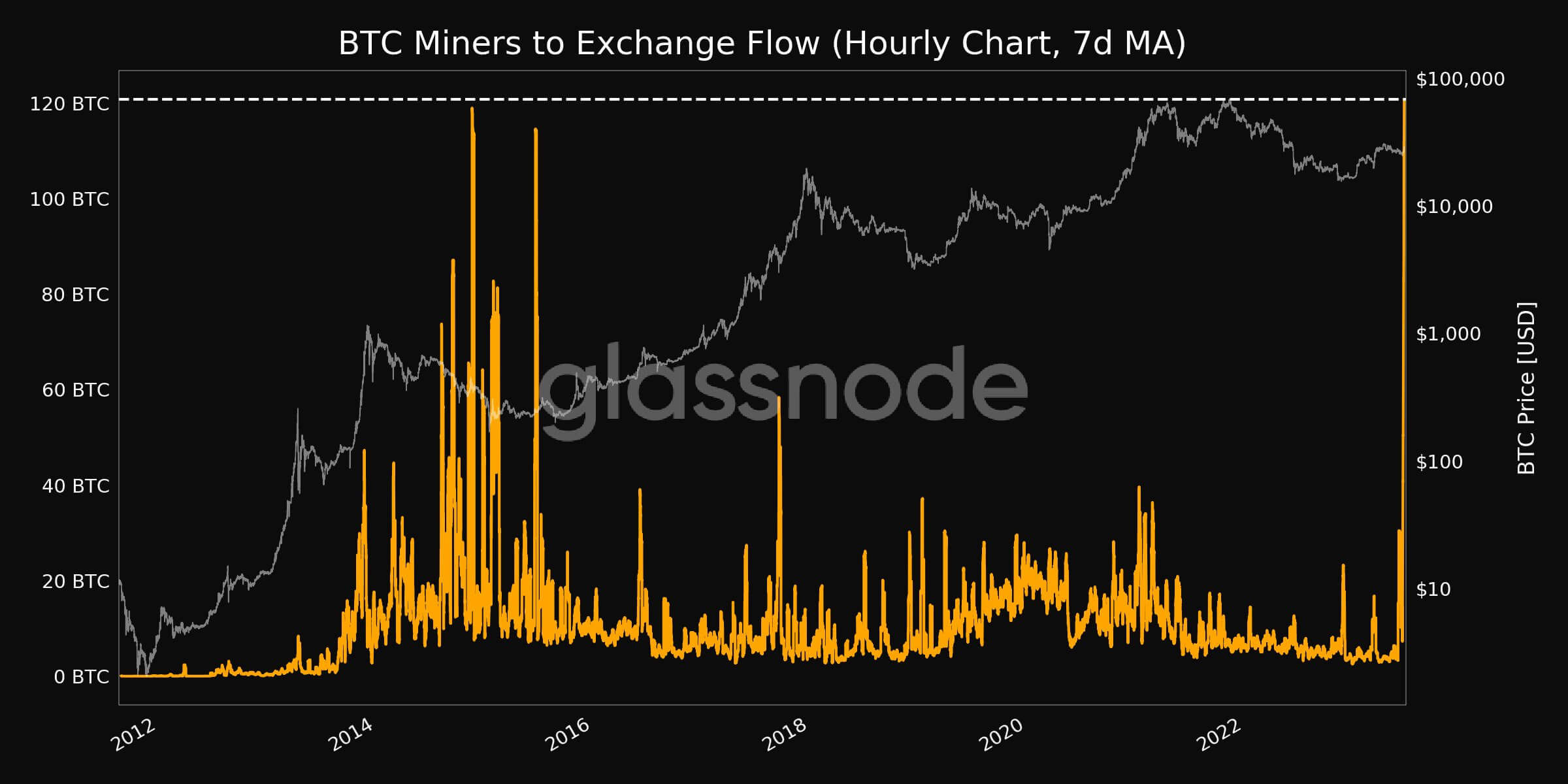
On July 4, CryptoQuant CEO Ki Young Ju said miners sent over 54,000 BTC to Binance in the past three weeks. Ju pointed out that there was “no significant change in BTC-USD open interest, suggesting less likelihood of filling collaterals to punt new long positions.”
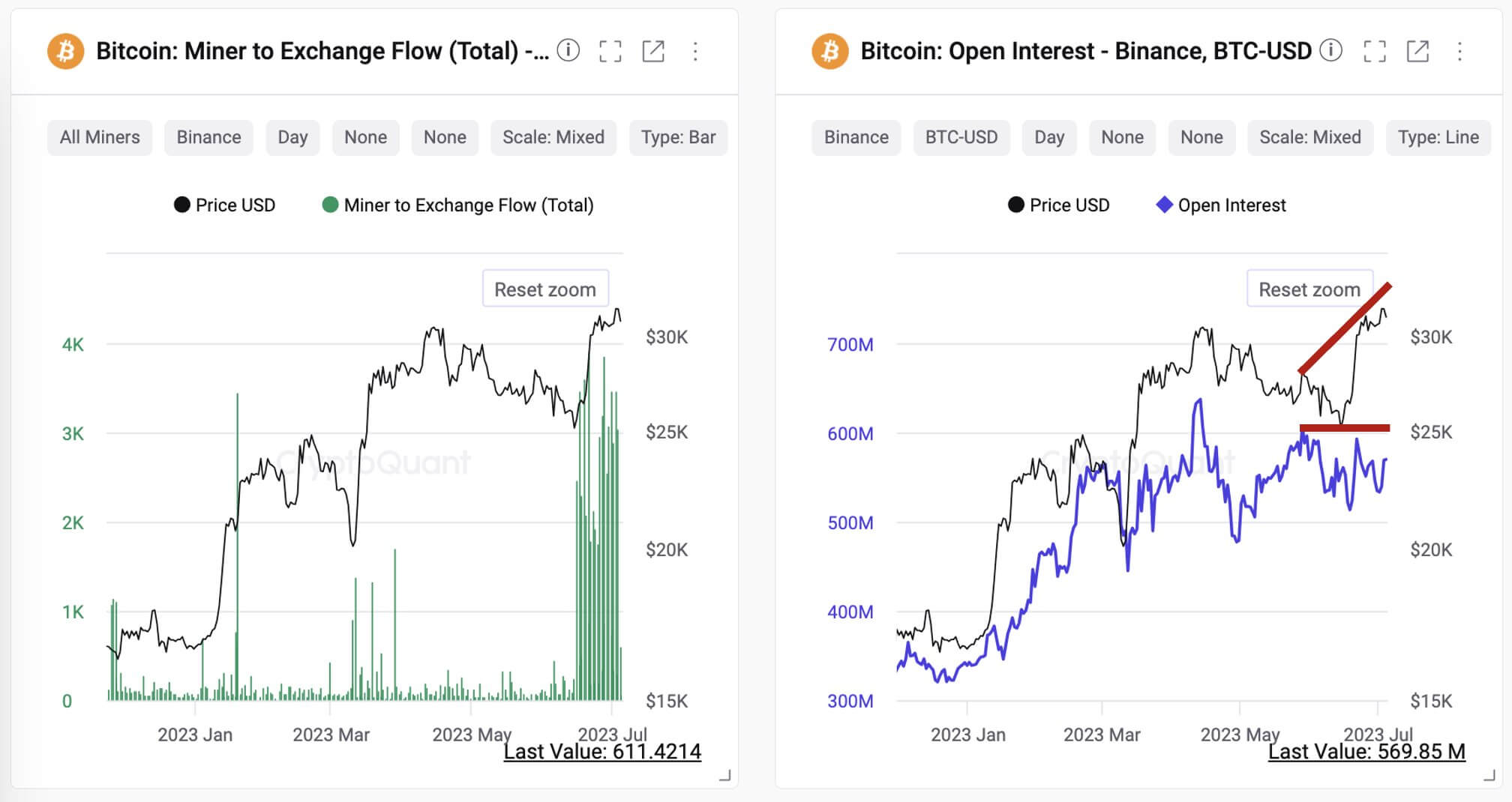
Ju added:
“Spot selling seems more likely.”
In their recently released operational updates, Bitcoin miners Marathon Digital, Cleanspark, and Hut 8 confirmed these transactions.
In a July 6 press statement, Marathon Digital said it sold 700 BTC, representing 71.5%, of its mined 979 BTC in June for an undisclosed sum. Its rival, Hut 8, sold 217 BTC—100% of the Bitcoin it produced in May and 70 Bitcoin produced in June—for $7.9 million.
Meanwhile, Cleanspark sold 84% of the 491 BTC it mined in June for $11.2 million, according to a July 3 statement.
These trading activities suggest miners wanted to capitalize on BTC’s recent price surge to secure profits. In June, BTC mostly traded above $25,000, peaking at $31,268 after several traditional financial institutions, including BlackRock and others, filed for Bitcoin ETFs.
The post Bitcoin miners cash in on June price surge, selling thousands of BTC appeared first on CryptoSlate.

Bitcoin (BTC) lingered below $31,000 at the July 3 Wall Street open, with bulls still in need of a catalyst.
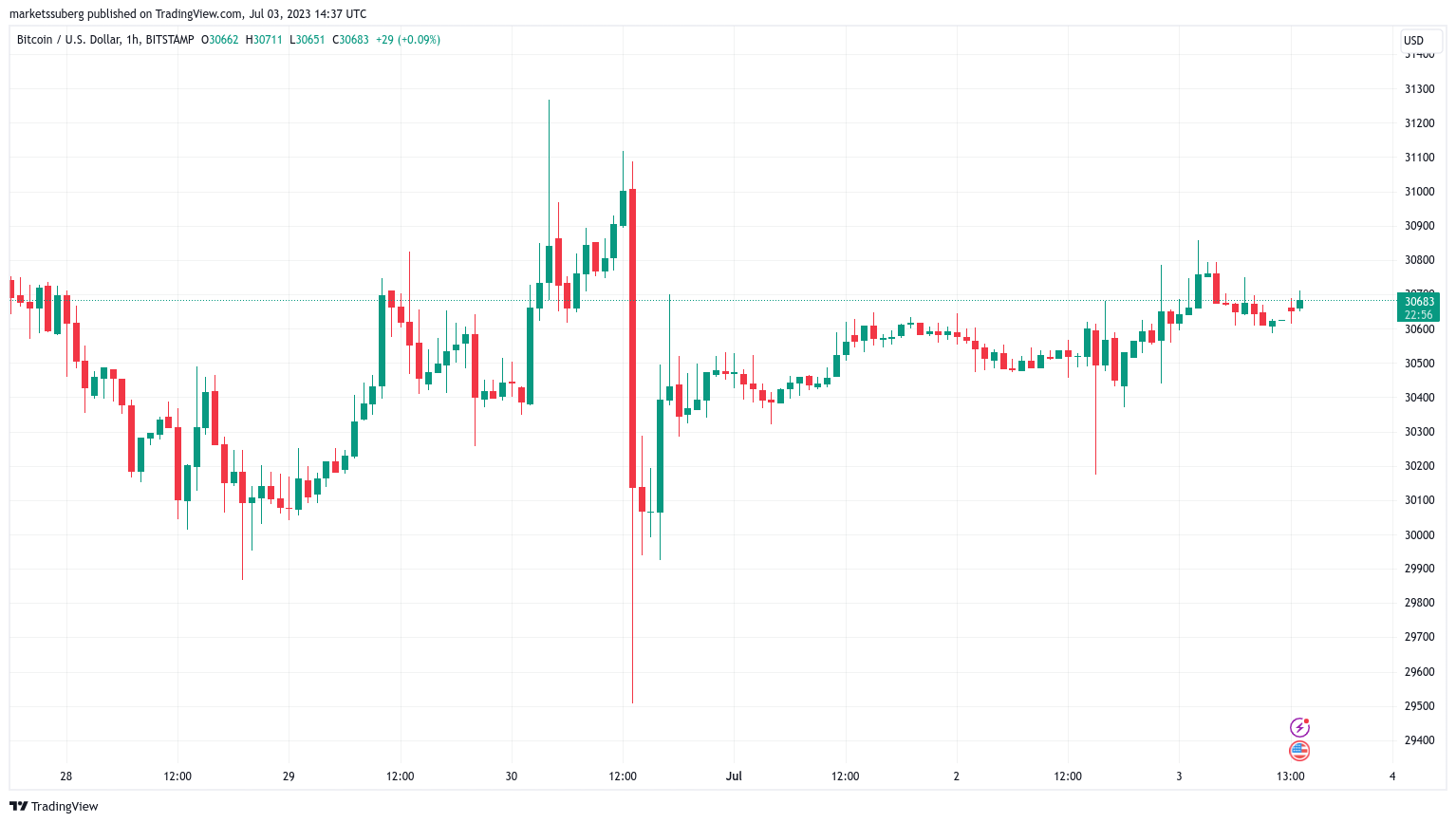
Data from Cointelegraph Markets Pro and TradingView showed BTC/USD acting in a tight range following the weekly close.
BTC’s price performance remained firmly sideways into the new week, punctuated only by modest attempts at attacking the $31,000 mark.
More optimistic market participants hoped that nearby resistance levels — and not only for Bitcoin — would soon fall.
“The more frequently a resistance line is tested, the weaker it becomes,” trading team Stockmoney Lizards argued.
“The day will come when ALL $31k sell orders have been filled.”
An accompanying chart uploaded to Twitter compared BTC price action this year with its pre-bull market behavior in 2016, in the run-up to previous all-time highs in December 2017.

Continuing, popular trader and analyst Rekt Capital suggested that the overall crypto market capitalization was also poised for a breakout.
Total #Crypto Market Cap is really trying to press beyond this black resistance and break out into uptrend continuation
Doing so and the entire Crypto Market Cap could see gains of +10% to up to +23% over time #BTC #Crypto #Bitcoin pic.twitter.com/X2qpgfhZO3
— Rekt Capital (@rektcapital) July 3, 2023
Others eyed downside potential in the face of stubborn resistance. Among them, trader Crypto Tony repeated calls for a trip to $28,000.
“This really is as simple as it gets for Bitcoin this week,” he told Twitter followers on the day.
“We are against the $31,000 resistance zone, so unless we take it out i expect us to draw down to $28,000 for a reload option from the bears. Much prefer if we just pump though this week.”
As Cointelegraph reported, consensus was also building around BTC/USD soon topping out, possibly in the mid-$30,000 range, after a final leg higher.
Meanwhile, the June monthly close had produced a significant move for Bitcoin on monthly timeframes.
Related: Miners send millions to exchanges — 5 things to know in Bitcoin this week
As noted by technical analyst Michael Nauss, BTC/USD, for the first time since the 2021 all-time highs, had closed above an adjusted volume-weighted average price (AVWAP).
AVWAP looks at important support and resistance levels based on trader behavior, and the close above $30,000 marked a resurgence not seen in two years.
First monthly close over the AVWAP from all-time highs in $BTCUSD #Bitcoin pic.twitter.com/AYBMCJvLpL
— Michael Nauss, CMT, CAIA (@MichaelNaussCMT) June 30, 2023
Retweeting Nauss, Caleb Franzen, CEO of Cubic Analytics, called on market observers to lengthen their time preference.
“When the BlackRock ETF application was announced, the price of Bitcoin was roughly $26k and it rose to new YTD highs above $31k,” part of commentary stated last week, referencing ongoing attempts to launch the first Bitcoin spot price exchange-traded fund (ETF) in the United States.
“We’re still trading above $30k and people are losing their minds? Couldn’t be me. Higher highs and higher lows.”
Magazine: How smart people invest in dumb memecoins: 3-point plan for success
This article does not contain investment advice or recommendations. Every investment and trading move involves risk, and readers should conduct their own research when making a decision.

The rejection of ETF applications by the SEC caused a knee-jerk reaction, but the shallow fall in Bitcoin and several altcoins suggests that lower levels are attracting buyers.

A web3 membership designed to empower you with cutting-edge insights and knowledge. Learn more ›
Welcome! 👋 You are connected to CryptoSlate Alpha. To manage your wallet connection, click the button below.
If you don’t have enough, buy ACS on the following exchanges:
Access Protocol is a web3 monetization paywall. When users stake ACS, they can access paywalled content. Learn more ›
Disclaimer: By choosing to lock your ACS tokens with CryptoSlate, you accept and recognize that you will be bound by the terms and conditions of your third-party digital wallet provider, as well as any applicable terms and conditions of the Access Foundation. CryptoSlate shall have no responsibility or liability with regard to the provision, access, use, locking, security, integrity, value, or legal status of your ACS Tokens or your digital wallet, including any losses associated with your ACS tokens. It is solely your responsibility to assume the risks associated with locking your ACS tokens with CryptoSlate. For more information, visit our terms page.