
This week’s Crypto Biz explores Elon Musk’s plans for X, the Italian central bank’s take on DeFi, PacWest’s merger with Banc of California and more.


This week’s Crypto Biz explores Elon Musk’s plans for X, the Italian central bank’s take on DeFi, PacWest’s merger with Banc of California and more.

Sequoia Capital, a renowned venture firm, has significantly scaled back its cryptocurrency fund in response to a considerable shift in the startup ecosystem.
According to individuals familiar with the matter, the fund has been cut from $585 million to a leaner $200 million, as reported by the Wall Street Journal (WSJ.)
This substantial reduction is part of an extensive downsizing strategy that the firm is implementing as it grapples with challenges in the startup industry.
The WSJ noted that Sequoia’s decision to downsize its funds, shared with its investors earlier this year, was driven by a change in market dynamics. The venture firm aims to adapt its approach to better align with the evolving landscape, planning to concentrate more on backing early-stage startups.
According to the Financial Times, Sequoia is retrenching in light of a steep inversion in private markets, and this move is also designed to provide liquidity to its limited partners.
Sequoia’s reduction is not confined to its cryptocurrency fund alone. According to WSJ, the firm also trimmed its ecosystem fund, which invests in other venture funds, from $900 million to $450 million.
The downsizing of its crypto funds comes in the wake of past crypto setbacks. Notably, in Nov. 2022, the firm had to write off its over $200 million investment in FTX, the cryptocurrency exchange, as worthless.
Despite running due diligence when FTX’s revenue was approximately $1 billion, its collapse diminished its value. However, Sequoia highlighted that its exposure to FTX was less than 3% of its Global Growth Fund III, and the loss was mitigated by gains of $7.5 billion from the fund.
According to the WSJ, Sequoia has maintained that it might still invest in crypto via its other funds.
The post Sequoia Capital scales back crypto fund by $350M amid industry challenges – reports appeared first on CryptoSlate.


The Indian Supreme Court on July 27 reprimanded the Union government for the lack of crypto regulations in the country, according to a report in a local media outlet.
The Supreme Court in its observation noted that it is “unfortunate” that the government has yet to release any clear guidelines around cryptocurrencies. The observation from the court came amid growing instances of criminal activities involving cryptocurrencies and directed the Union government to bring on record whether it plans to set up any dedicated federal agency to investigate such crypto criminal cases, the local daily reported.
According to the report, Justices Surya Kant and Dipankar Datta said:
“You still don’t have any law, unfortunately. Do you have an agency at the national level to understand these cases and investigate them properly? We want you to identify a national specialised agency, in the national interest.”
The court’s observation came during the hearing of petitions booked in connection with cryptocurrency fraud cases in different states of India. The court asked the government to file a response on whether they are capable of setting up a mechanism to investigate such cases.
The fight for clear government-issued crypto regulations in India has been a long-drawn one. The government started working on a crypto bill on the instructions of the Supreme Court as early as 2018. However, the government is yet to introduce the final draft of the crypto bill despite assuring it would be completed repeatedly over the past four years.
Related: Taxman: India’s new tax policies could prove fatal for crypto industry
While the Indian government is yet to come up with crypto guidelines, it was very quick to impose crypto taxation laws, which came into effect in April 2022. The law was first introduced during the bull market when India became one of the leading crypto markets with a number of crypto unicorns and trading volumes soaring into billions of dollars. However, the tax laws had a drastic impact on the thriving crypto market as the majority of the established firms decided to move away from India due to a lack of regulatory clarity.
Collect this article as an NFT to preserve this moment in history and show your support for independent journalism in the crypto space.
Magazine: Hall of Flame: Wolf Of All Streets worries about a world where Bitcoin hits $1M


The United States Senate passed the 2024 National Defense Authorization Act (NDAA) worth $886 billion on July 27. The bill includes a provision targeting crypto mixers, anonymity-enhancing coins and institutions engaging in crypto trading.
The NDAA is a bill that helps authorize how the country’s defense department can utilize federal funding. Within the bill, a crypto-related amendment was advanced by a group of senators, including Cynthia Lummis, Elizabeth Warren, Kirsten Gillibrand and Roger Marshall.
The amendment was created with provisions taken from the Digital Asset Anti-Money Laundering Act, which was introduced back in 2022, and the Responsible Financial Innovation Act, which aims to establish guardrails to prevent another FTX-style event from happening within the industry.
seems pretty obvious that democrats have abandoned any stablecoin bill in favor of sneaking through this provision in the NDAA must pass bill.
anyone wanna guess what janet yellen will decide about whether KYC-less transfers of USDC are allowed? pic.twitter.com/sys38GI31z
— Spreek (@spreekaway) July 27, 2023
More specifically, the amendment will require establishing examination standards for crypto. This would help assess risk and ensure that businesses comply with related sanctions and money laundering laws.
Apart from this, it compels the U.S. Treasury Department to perform a study aimed at cracking down on anonymous crypto transactions. This includes the use of crypto mixers like Tornado Cash, which are used to make transactions private.
Related: Crypto lobbyists still fighting to axe ‘unlawful’ Tornado Cash sanctions
In 2022, the Treasury issued sanctions against the crypto mixer Tornado Cash, barring residents from using the crypto mixer. While the mixer was designed for people to anonymize their crypto transactions, it was often utilized by malicious actors to hide their ill-gotten crypto from hacks and exploits. According to the Treasury, the mixer failed to impose controls that disallow money laundering from bad actors in the space.
Meanwhile, the NDAA also includes an amendment that will require companies in the U.S. to disclose investments in China. U.S. Senator Bob Casey said that this notification is necessary for the government to understand how much “critical technology” is being transferred to “adversaries.“
Magazine: Tornado Cash 2.0: The race to build safe and legal coin mixers

As per the UK Office for National Statistics, the UK unemployment rate was estimated at 4.0% for the second quarter of this year, which is 0.2% higher than the previous quarter.
The job market in the UK is suffering a sharp decline. The experts believe the crisis has been caused not only by the general economic recession but also by a shortage of talent on the market. According to the report by the Broadbean Technology firm, a fall in the number of open positions is accompanied by a 30% decline in the number of applicants. The shortage of staff is extremely sharp in engineering, science, architecture, hospitality and catering, as well as health services.
Alex Fourlis, Managing Director at Broadbean Technology, explained:
“Although the market is slowing down, the skills crisis is far from over. The UK simply doesn’t have enough of the highly trained and highly skilled professionals it needs to fill the demand. It’s imperative that employers stay focused on the skills agenda and continue to invest in talent attraction and development if they are to grow their competitive standing.”
He further added:
“The lack of candidates isn’t going to be solved overnight and is already a big issue for firms. Those that can get in front of the right people quickly, and via the right channels, will be the ones in a prime position to win the war for talent.”
As per the UK Office for National Statistics, the UK unemployment rate was estimated at 4.0% for the second quarter of this year, which is 0.2% higher than the previous quarter. Reed Recruitment has reported a 24.40% fall in the number of advertised positions over the past three months in comparison to the previous year. Notably, the number of available jobs is below the pre-pandemic era.
Meanwhile, crypto companies located in the UK are publishing new job offers and actively looking for employees.
For example, the Gemini exchange is looking for a Compliance Associate at its UK office. Coinbase Inc (NASDAQ: COIN) is hiring the Head of Mobile Business Development and International Policy Manager.
Further, Ripple is seeking Employment and Litigation Counsel to provide strategic legal advice and counseling globally on a broad range of employment law matters. The company is also in need of an Executive Assistant based in London. Recently, it won a court ruling in the US against the Securities and Exchange Commission (SEC).
Following the victory, the company applied for registration as a crypto asset firm with the UK’s Financial Conduct Authority and for a payment institution license in Ireland. Now, Ripple is definitely planning to expand its footprint in the UK. Over the past 18 months, Ripple has increased its UK and European employees count by about 75%, with over 100 of its approximately 900 global employees based in its offices in London, Dublin, and Reykjavik, Iceland.
Crypto trading company Robinhood Markets Inc (NASDAQ: HOOD) is also moving forward with plans to launch in the United Kingdom. As we have reported, the company has appointed former Barclays director Jordan Sinclair as its UK arm’s CEO. Among the jobs posted by Robinhood on LinkedIn are a senior risk and compliance associate, a compliance officer, and an operations lead, all based in London.
next

Darya is a crypto enthusiast who strongly believes in the future of blockchain. Being a hospitality professional, she is interested in finding the ways blockchain can change different industries and bring our life to a different level.

The U.S. Securities and Exchange Commission (SEC) issued a stern warning to accounting firms on July 27, outlining the potential risks and liabilities of serving clients in the rapidly evolving crypto industry.
Paul Munter, Chief Accountant to the SEC, said that many crypto companies have wrongly stated that certain non-audit work is equivalent to an audit.
Munter wrote in his statement:
“… Clients’ marketing and terminology risks misleadingly suggesting that these alternative, non-audit arrangements are at parity with, or even more “precise” than, a financial statement audit. Such suggestions are false.”
He explained that accounting firms could be held responsible for their own statements and any incorrect statements made by their clients.
Munter said there are a “variety of facts and circumstances” under which auditing firms could be liable for violating antifraud provisions of securities regulation. He warned that such violations could cause the accounting firm and its members to be censured, reprimanded, or even suspended from appearing or practicing before the SEC.
Munter added that Office of the Chief Accountant (OCA) staff believe that accounting firms should make a “noisy withdrawal,” meaning breaking ties with dishonest crypto clients by making a public statement or informing the SEC.
He also suggested that auditing firms consider risks before taking on crypto clients, take precautions with existing clients that move into cryptocurrency, and set rules for how clients can describe their relationship with the auditor.
The warning is notable as certain accounting firms broke ties with the crypto sector in late 2022. Armanino and Mazars reportedly dropped crypto companies as clients in December. The Guardian also reported that Binance was unable to secure audits from the “Big Four” accounting firms, though some of those firms provide such services.
Those service denials were seemingly motivated by the then-recent failure of FTX. It is unclear what developments, if any, prompted the SEC’s latest warning.
More recent reports suggest that the problem remains. A Bloomberg survey from May suggested many crypto firms are unable to find major audit firms willing to serve them.
The post SEC cautions accounting firms against accommodating non-compliant crypto clients appeared first on CryptoSlate.

Venture capital giant Sequoia Capital reportedly downsized its cryptocurrency fund from $585 million to $200 million, amid a liquidity crunch and a pivot away toward smaller crypto players.
According to a July 27 Wall Street Journal report, the tech-focused VC firm told investors in March it would reduce its Sequoia Crypto Fund — along with its ecosystem fund — to better reflect changed market conditions.
Sequoia Capital curbed crypto investments by a hefty 65% , opting for a nurturing stance on startups. Not a volatile market apathy, but strategic cognition, folks! #CryptoInvestments $BTC pic.twitter.com/8JvtyShg0n
— Chain Review (@Chain_Review) July 27, 2023
The cryptocurrency fund will now focus more on backing early-stage startups, given the recent crypto industry turmoil that took away many of the opportunities to back larger companies.
Another motive behind the cuts is to lower the capital threshold and thus the barrier to entry for investors to partake in Sequoia’s fund offerings, according to the sources.
“We made these changes to sharpen our focus on seed-stage opportunities and to provide liquidity to our limited partners,” Sequoia reportedly said in remarks to the Financial Times. The firm added it had returned more than $15 billion to investors over the past three years.
The firm’s cryptocurrency fund launched in February 2022, when the market cap of the cryptocurrency market was 39.1% down from its all-time high of $3 trillion in November 2021.
One of the firm’s toughest blows in recent times was its $214 million investment into the now-bankrupt FTX, which the firm later marked down to $0.
Sequoia Capital’s $214M #FTX stake marked down to $0 ⚰️ pic.twitter.com/RHQJaRq1dL
— CryptoSavingExpert ® (@CryptoSavingExp) November 10, 2022
Cointelegraph reached out to Sequoia Capital for comment but did not receive an immediate response.
Related: Crypto VCs share lessons on startup success at EthCC
Sequoia’s reported move is reflective of a broader trend among venture capital firms that are choosing to downsize their cryptocurrency bets.
Venture capital investments fell 29.7% in June, with $779.32 million raised across 62 separate deals, according to data from the Cointelegraph Research Venture Capital Database.
Venture capital inflows have fallen 77.7% from June 2023 compared to June 2022.

However not every VC firm is reducing its cryptocurrency portfolio.
Polychain Capital and Coinfund recently raised $200 million and $152 million for respective investment and seed funds earlier this month.
Magazine: The secret of pitching to male VCs: Helping female crypto founders blast off

A new bug called “Zenbleed” affecting specific AMD CPUs has been found that can potentially leak info, such as keys attached to crypto wallets.
As reported by the computer-focused news website Tom’s Hardware, a new vulnerability related to AMD CPUs has been discovered that can compromise sensitive info such as passwords and encryption keys.
This bug was independently found by Travis Ormandy, a Google Information Security researcher, who has now made public a documentation of this vulnerability.
The Zenbleed exploit works on all products that use AMD’s “Zen 2” architecture. Tom’s Hardware notes that even the AMD EPYC processors in data centers aren’t free from this vulnerability.
With this bug, a malicious hacker can potentially get locked information through the CPU and be able to access the user’s login credentials. Naturally, this also means that the keys of a crypto wallet, if installed on the same hardware, may no longer be safe.
This vulnerability is so powerful that the attacker doesn’t require physical access to the PC or server; it can be executed through javascript on a webpage, like that inside an ad.
AMD has released a new security advisory about Zenbleed that breaks down when the different patches may be released for its various products. According to this information, the consumer CPUs from the Ryzen 3000 and 4000 series, and some from the 5000 line, will not get appropriate fixes until November and December of this year. This would suggest that these home-computer processors might not be protected until the end of the year.
“AMD’s processors used in the PS5, Xbox Series X, and S, and Steam Deck are all also powered by Zen 2 chips, but it remains unclear if those are impacted,” explains Tom’s Hardware.
Any crypto wallets the user would directly install on their PC could be vulnerable to this exploit. However, keys stored on dedicated devices like hardware wallets should be safe.
Encryption keys stored on locked-down computers (that is, those disconnected from the internet) should also be unaffected by the vulnerability.
Recently, there has been a push towards self-custody in the crypto sector, as investors have slowly become aware of the risks related to centralized platforms after established players such as FTX have gone down during the past year.
However, Bugs like these showcase that although self-custodial wallets may be safer than keeping coins on centralized platforms, some types are less safer than others. For example, the hot wallets that need to be connected to the internet can potentially fall prey to such vulnerabilities.
At the time of writing, Bitcoin is trading around $29,300, down 2% in the last week.
Looks like the crypto has plunged recently | Source: BTCUSD on TradingView
Featured image from Mariia Shalabaieva on Unsplash.com, chart from TradingView.com

As the eagerly anticipated Federal Open Market Committee (FOMC) meeting approaches, the financial world is abuzz with speculation about the potential implications for Bitcoin and crypto. Tomorrow, on Wednesday, July 26th, at 2 pm EST, the FOMC will announce its interest rate decision. As usual, Federal Reserve (Fed) chair Jerome Powell will face the media at 2:30 pm EST.
According to the CME FedWatch tool, the majority of the market is expecting a 25 basis point increase (99.8%). However, the real intrigue lies in what comes after this move and whether it marks the end of the rate hike cycle.
After tomorrow’s decision, the market expects the Fed to keep the key interest rate high for a longer period of time. A first rate cut could come in March 2024 at the earliest, if not in May.
Tomorrow is #FOMC day, expect volatility. #Bitcoin #Crypto
98.9% probability of a 25 bps hike by the Fed.
Market expects the Fed to keep the key interest rate high for a longer period of time. A first rate cut could come in March ’24 at the earliest, if not in May. pic.twitter.com/C8wscv6BMd
— Jake Simmons (@realJakeSimmons) July 25, 2023
For the past 16 months, the U.S. Federal Reserve has been grappling with inflation while hiking interest rates to levels not seen in 20 years. But all signs point to a possible end of the tightening cycle. The market is firmly expecting the 0.25 bps hike to a range of 5.25 to 5.5% will be the last.

Meanwhile, Bitcoin and crypto have experienced a period of relative immunity to macroeconomic events and rate hike speculations in the first seven months of the year. However, investors must be aware that such conditions might not last indefinitely.
On Monday, the Bitcoin price retraced to $29,000 support level. Seemingly, market participants have been cautious in the lead-up to the FOMC’s July meeting, aware that the FOMC meeting can have a profound impact.
In June, Fed Chairman Jerome Powell hinted at the possibility of further rate hikes this year, with some committee members advocating for two more increases. The market now anxiously awaits the outcome of this meeting to ascertain the central bank’s future policy stance.
However, factors such as declining inflation in the United States and a weaker labor market strengthen the market expectations. The previously skyrocketing inflation, which led to the tightening cycle, has shown signs of abating. June’s Consumer Price Index (YoY) data revealed a decline in inflation to 3.0% from 4.0%. The core rate fell from 5.3% in May to 4.8% in June. Both declines were stronger than previously anticipated. Remarkably, the core rate is now trading below the level of the US federal funds rate, which was pretty rare in the last 20 years.
The prolonged strength of the US labour market has long been the biggest headache for the Federal Reserve because of the imbalance between supply and demand. At the peak of this imbalance, there were two job openings for every available worker, which drove up wages accordingly. As demand and supply approach equilibrium, job creation numbers have declined. Also, there are even early indications of declining consumer spending.
So, what does all of this mean for Bitcoin and crypto investors? As always, it’s essential to approach the market with a balanced perspective. While BTC and cryptocurrencies have shown resilience in the face of traditional economic events, they are not entirely insulated from larger macroeconomic trends.
Investors should closely monitor the FOMC’s interest rate decision and Jerome Powell’s subsequent statements. Any signals about the future rate hike cycle could have repercussions for both the traditional as well as Bitcoin and crypto markets, triggering a further sell-off.
At press time, the market continued to show indecision. BTC was trading at $29,200.
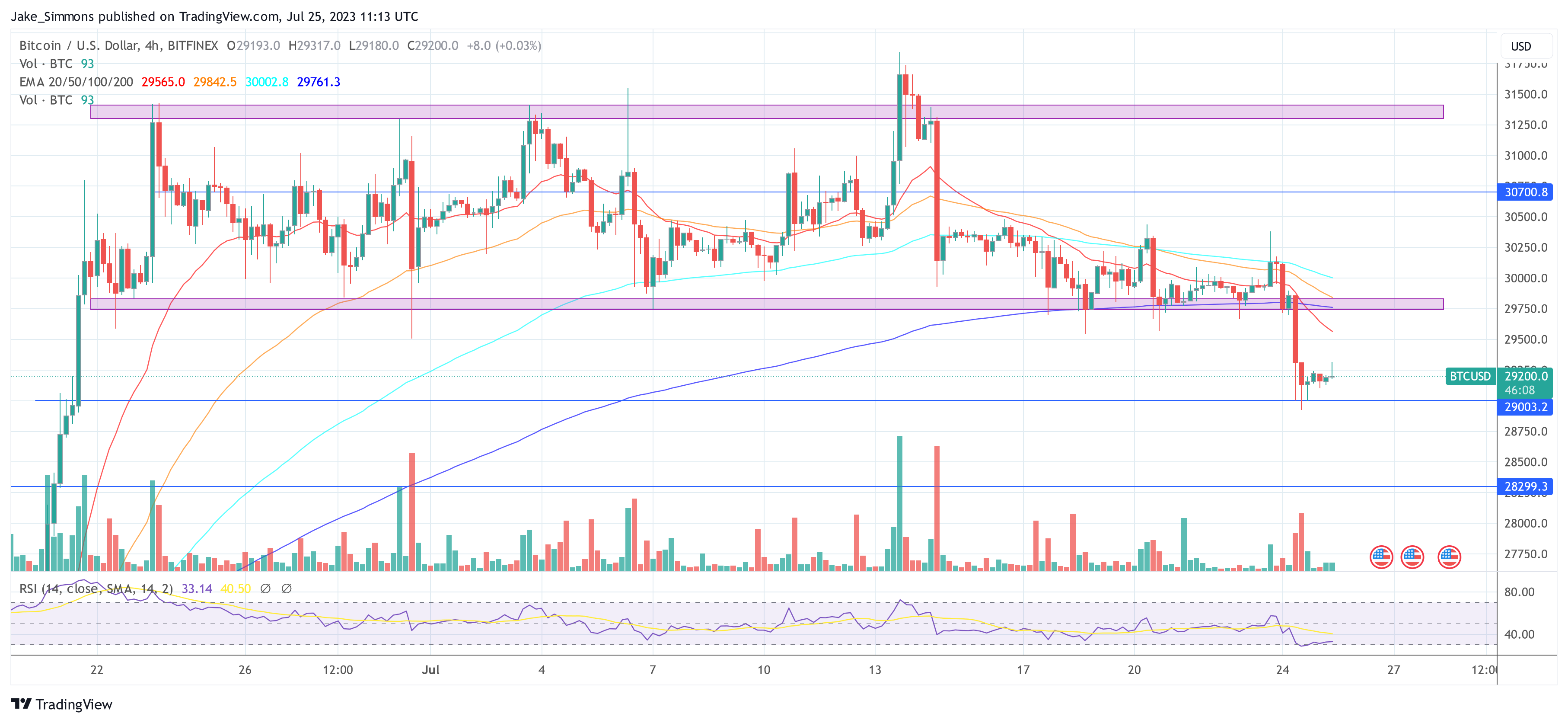
Featured image from iStock, chart from TradingView.com


The United States Government Accountability Office (GAO), a Congressional watchdog agency, has released a report it completed in June on the regulatory framework for the use of blockchain in finance.
The 77-page report was requested by Reps. Maxine Waters and Stephen Lynch before the midterm elections, when they were the chair and ranking member, respectively, of the House of Representatives Financial Services Committee. The report unsurprisingly found that more regulation is needed. The agency has a framework for evaluating regulatory reform proposals developed in 2009.
The report pointed to crypto asset trading platforms and stablecoins as products that lack regulation, but it examined regulators’ policies and activities without straying into “turf war” controversies related to defining securities. Thus, it identified the spot markets for nonsecurity crypto assets as the center of a regulatory gap and stated:
“By designating a federal regulator to provide comprehensive federal oversight of spot markets for nonsecurity crypto assets, Congress could mitigate financial stability risks and better ensure that users of the platforms receive protections.”
Traditional assets in that category enjoy robust regulation, the report noted. Crypto assets are subject to limited oversight, such as from the Treasury’s Financial Crimes Enforcement Network and through state money transmitter licensing.
Related: US Congress agency recommends 4 key policy options for blockchain
Stablecoins need regulation regarding the composition of their reserves, auditing and disclosures, and redemption rights. The report said current regulation is a hodgepodge of measures by the Securities and Exchange Commission, Commodity Futures Trading Commission and states that does not amount to “consistent and comprehensive prudential regulation and oversight.”
Decentralized finance is capable of being regulated in inverse relationship to the level of its decentralization, the GAO said. When an ecosystem is fully decentralized, there is no individual who can be identified as responsible for developing, operating or governing it. It may also span multiple regulatory jurisdictions in its operations.
Blockchain technology—like #cryptocurrency—could offer faster, cheaper financial transactions. But recent price crashes & bankruptcies have raised concerns about gaps in federal regulations that could put consumers at risk. Our new report & video explore: pic.twitter.com/nxHrk1g5dQ
— U.S. GAO (@USGAO) July 24, 2023
Moving closer to turf war issues, the report identified a need for greater coordination between regulators and noted complaints from market participants about the slow response of regulators to innovations in the market. The report noted that the Treasury’s Financial Stability Oversight Council was tasked with leading an effort to create a unified approach to crypto asset oversight by the March 2022 Executive Order on Ensuring Responsible Development of Digital Assets.
The report recommended that the seven pertinent regulatory agencies “jointly establish or adapt an existing formal coordination mechanism […] for collectively identifying risks posed by blockchain-related products and services and formulating a timely regulatory response.” Furthermore:
“This mechanism could include formal planning documents that establish the frequency of meetings and processes for identifying risks and responding to them within agreed-upon time frames.”
The National Credit Union Administration expressed agreement with that finding, while the others did not agree or disagree. The GAO is the country’s highest auditor. While its recommendations are not legally binding, the century-old agency’s findings carry considerable moral weight.
Magazine: Crypto regulation: Does SEC Chair Gary Gensler have the final say?
