The Financial Action Task Force (FATF) has lowered Russia’s rating owing to insufficient oversight of cryptocurrencies, as indicated by regional coverage. According to RBC, this downgrade highlights escalating worries about the country’s capacity to oversee and mitigate dubious transactions within the rapidly expanding realm of digital finance. Russia’s Financial Strategy Challenged by FATF Downgrade The […]
Source link
crypto
The crypto market has shown an incredible performance over the past week. Bitcoin has sustained momentum and risen above the $60,000 level, reaching $64,000.
The levels reached at the end of February have suggested to many investors that March could be an even more impressive month for the current bullish rally.
However, no prediction is set in stone, as many factors could swing investors’ sentiments and move the trends in the opposite direction. At the moment, the crypto market seems to have taken a small pause to catch its breath.
Crypto Market Momentarily Slows Down
The global crypto market reached a significant milestone for this bullish run a few days ago. As reported, the total crypto market cap hit $2T on February 27, an accomplishment not seen since April 2022.
As March begins, the market cap for the crypto market sits at $2.3 trillion, representing a 17.97% surge in the 7-day timeframe. This growth has surpassed the level established in early 2022 and potentially clears the path to the $2.4 trillion mark seen in December 2021.
Nonetheless, the market rise seemingly slowed down momentarily. The current market cap of $2.31 trillion represents a modest 1.32% decrease over the last day, according to CoinMarketCap data.
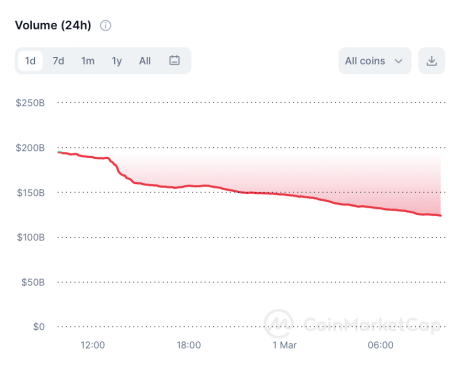
Similarly, the total crypto market trading volume was around $127.9 billion at writing time, registering a significant 35.77% drop from yesterday.

Trading volume chart in the last 24 hours. Source: CoinMarketCap
The data shows that Bitcoin and Ether have faced over 40% market activity decrease compared to the trading volume registered 24 hours ago. Similarly, some of the largest memecoins showed a slowdown in performance.
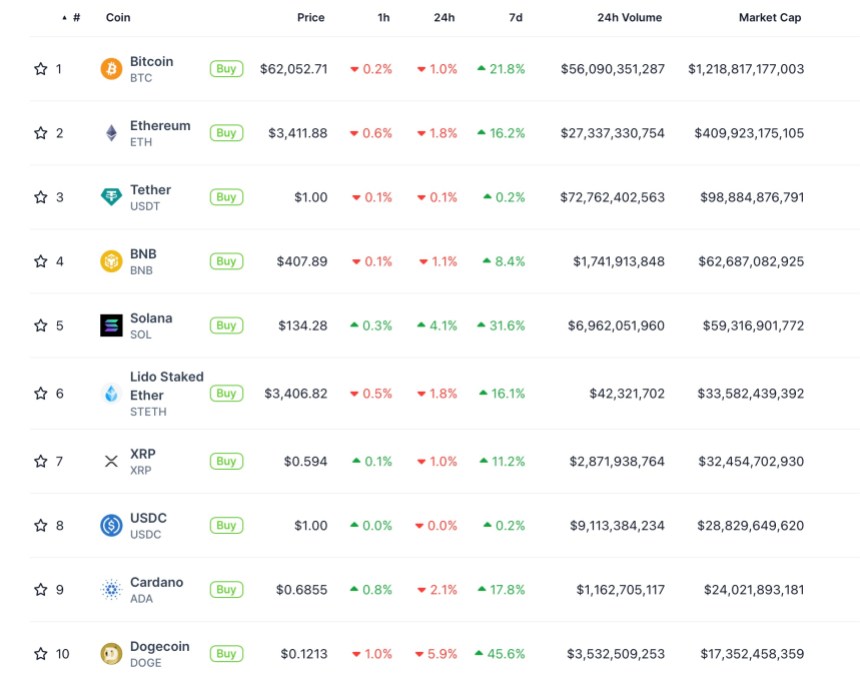
As the list below shows, Dogecoin (DOGE) registered a 5.9% price drop on the last day. Likewise, Shiba Inu’s (SHIB) price decreased by 5.8% in the same timeframe.

Price performance of the top ten cryptocurrencies in the last 24 hours. Source: CoinGecko
On the contrary, Solana (SOL) performed better on the last day than the top ten cryptocurrencies, registering a 4.1% price surge. SOL’s $134 price places it alongside DOGE as the best-performing cryptocurrencies among the top ten in the last seven.
Among the largest gainers on the last day, PEPE reversed yesterday’s 12% price drop after registering a 10.9% growth during the past 24 hours. Similarly, the dog-themed memecoins dogwifhat (WIF) and (BONK) registered a price increase of 20,66% and 6.65%, respectively.
Bitcoin And Ether Remain Strong Amid The Market Volatility
Some analysts expect a significant halving-related drop in Bitcoin’s price. Meanwhile, the King of crypto has shown strong resistance above a massive support wall, as crypto analyst Ali Martinez suggests.
Over 1 million addresses are buying over 671,000 BTC within the $60,000 and $62,000 price range. Which, according to the analyst, highlights a strong investor confidence. This confidence could be a crucial support level and a cushion against a future price drop.
#Bitcoin holds above a massive support wall, with 1 million addresses buying over 671,000 $BTC within the price range of $60,334 to $62,155.
This accumulation zone highlights strong investor confidence and could serve as a crucial level of support for #BTC, potentially… pic.twitter.com/lmghohWR1U
— Ali (@ali_charts) March 1, 2024
At writing time, the flagship cryptocurrency trades at around $62,052.71, which only accounts for a 1% decrease from the day before. BTC has increased over 21.8% in the last week, and it’s only 10.34% lower than its all-time high (ATH) of $69,000 registered in November 2021.
Likewise, it’s worth noting that Ether (ETH) has been showing a robust performance in the past few days amid the volatile crypto market. Maintaining its price range in the past 24 hours, the ‘king of altcoins’ registered only a 1.8% price decrease from yesterday. ETH currently trades at $3,411.88, representing a notable 16.2% rise in the past week.

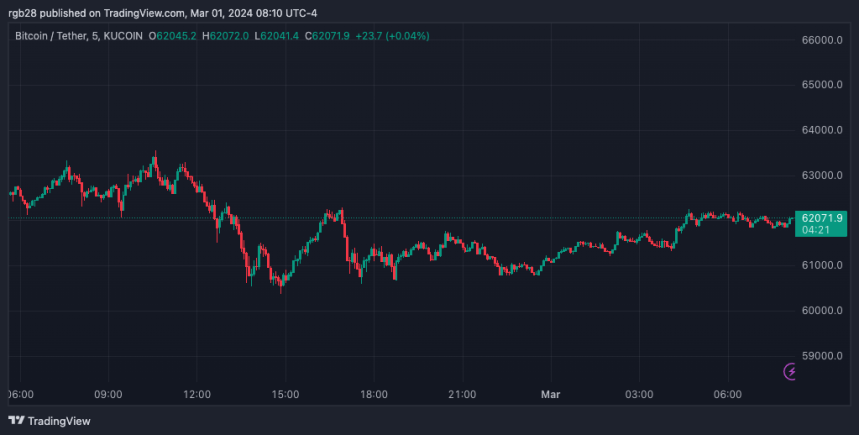
Bitcoin performance in the 1-day chart. Source: BTCUSDT on TradingView.com
Featured image from Unsplash.com, Chart from Tradingview.com
Disclaimer: The article is provided for educational purposes only. It does not represent the opinions of NewsBTC on whether to buy, sell or hold any investments and naturally investing carries risks. You are advised to conduct your own research before making any investment decisions. Use information provided on this website entirely at your own risk.

Hungary is advancing a legislative proposal that would enable banks, investment funds, and asset managers to offer services in Bitcoin and other cryptocurrencies, according to a March 1 report by Bloomberg Law.
The initiative marks a significant development in Hungary’s financial sector, aligning with a broader European movement towards the adoption of digital assets.
Should the Hungarian bill be enacted, it would represent a notable step forward in allowing traditional financial institutions to incorporate crypto services. The laws are scheduled to come into force on June 30 if they are approved.
Draft legislation
The draft legislation, proposed by the Hungarian Ministry of Economy, aims to create a regulatory framework for digital assets, with the Hungarian central bank serving as the primary supervisor.
The move is indicative of Hungary’s efforts to comply with the EU’s regulatory standards, including the Markets in Crypto Assets Regulation (MiCA) and stricter anti-money laundering and counter-terrorism financing measures.
According to Norton Rose Fulbright’s 2024 FinTech Outlook, such regulatory developments are part of a wider trend toward recognizing the importance of digital currencies in the financial industry.
The Hungarian bill is seen as a response to the EU’s efforts to harmonize regulations for crypto-assets, as the European Securities and Markets Authority (ESMA) continues to consult on the classification of crypto-assets and the details of reverse solicitation under MiCA.
EU pushing for regulation
Hungary’s legislation reflects a collective European interest in establishing a regulatory framework that is technology-neutral and can integrate crypto into the financial system without compromising security or compliance standards.
This could encourage similar legislative efforts throughout Europe, as countries aim to align with EU directives and foster innovation within their financial sectors.
The potential integration of cryptocurrencies into mainstream financial services suggests a shift in investment patterns, efficiency in transactions, and broader financial inclusion. Such a change could have far-reaching implications for Hungary’s economy and possibly influence the European financial landscape.
The inclusion of cryptocurrencies in the offerings of banks and other financial institutions marks a critical transition toward the future of finance.
SEC faces pushback from states over crypto regulations in Kraken case

Several US state attorneys general and pro-crypto factions have lodged amicus briefs opposing the Securities and Exchange Commission’s (SEC) case against Kraken.
Montana, others brief against SEC
On Feb. 29, a coalition of state attorneys general from Montana, Arkansas, Iowa, Mississippi, Nebraska, Ohio, South Dakota, and Texas jointly submitted a brief that does not support either party but challenges the SEC’s stand in the case.
An analysis of the filing by Paul Grewal, Coinbase Chief legal officer, pointed out that the states alleged that the “SEC’s ‘ecosystem’ theory was unlawful and in fact a danger to their citizens.”
He said:
“[The] States have a strong interest in preventing the potential preemption of consumer protection and other state laws by the SEC’s attempt to regulate crypto assets as securities.”
The lawyer further highlighted that numerous states have established legal frameworks treating digital assets like money transmitters. According to him, such entities must register, meet minimum net worth requirements, ensure ample security measures, and submit to regulatory examinations.
However, these state-level regulations face potential preemption risks with the SEC actions.
Pro-crypto lawyer Bill Morgan added that the amicus brief showed that “the whole world is against the SEC’s overreach in crypto except a few people such as Elizabeth Warren with agendas and motives that are anything but a concern with consumer protection.”
Pro-crypto groups step in.
Besides the state attorneys general, several pro-crypto groups, including the Chamber of Digital Commerce and the Blockchain Association, also made similar filings against the SEC.
In its filing, the Chamber of Digital Commerce argued that the SEC’s expansion of securities laws threatens blockchain technology. So, the group urged the court to end the SEC’s attempt to regulate the emerging industry without legislative authority.
Blockchain Association and the DeFi Education Fund made similar arguments in their filing. They stated:
“The brief critiques the SEC’s attempt to regulate digital assets beyond its authority granted by Congress. The agency’s inconsistent stance on investment contracts lacks legal precedent and is creating widespread confusion in the industry.”
Over $3 billion in crypto tokens set to unlock this March, with Arbitrum ‘massive’ unlock

A total of 32 crypto projects are scheduled to unlock more than $3 billion worth of tokens into circulation this March, according to Token Unlocks data.
Arbitrum dominates, doubles supply
Arbitrum leads this month’s token unlocks, marking a significant milestone since its initial airdrop. The impending unlock is poised to double the asset’s current circulating supply.
Token Unlocks data reveals the project would release more than 1 billion ARB tokens, equating to 87% of its existing circulating supply, by March 16. This influx would be valued at approximately $2.2 billion at current market rates.
Breaking down the unlock, the project’s core team and advisors would receive 673.5 million ARB tokens, while investors in the layer2 network anticipate 438.25 million ARB tokens.
Tran Hoan, founder of the venture capital firm Capybara Investments, described the unlock as “massive.” He noted that such a substantial release may not necessarily induce immediate selling pressure on the market, as major investors and the project team typically exercise restraint.
According to him:
“Not all tokens will dump on the market immediately, Major investors don’t do that. Given the potential for massive growth ahead, it might not be wise to sell tokens now. However, there could be a point where the market becomes wary of a large unlock, leading to pressure on the token price.”
Arbitrum is the largest Ethereum-based layer2 network, with the total value of assets locked on the network valued at approximately $14 billion, according to L2beats data.
Other major unlocks
Aptos will introduce 24.84 million APT tokens, constituting 6.76% of its circulating supply, by March 13. This unlock has an estimated value of $290 million as of press time.
Throughout this year, the Aptos team has unleashed over $450 million worth of digital assets into the market. Despite this, its price performance has seen a modest 25% increase year-to-date.
Sui, another layer1 blockchain, is poised to unveil an additional 34.62 million units of SUI tokens, valued at $58.15 million, by March 3. Notably, the network has had new token releases since the beginning of the year.
Optimism, a layer2 blockchain network built on Ethereum, is slated to release 24.16 million OP tokens by March 29. These asset’s value surpassing $90 million.
It is important to note that the project has injected approximately $166 million worth of assets into circulation since the beginning of the year.
3 Charts That Show How the Crypto Bull Market Is Just Getting Started
Finally, after two long years, things are picking back up in the crypto world. Since the beginning of the year, the total crypto market has grown by 35%, just 20% off from eclipsing its all-time high of $2.8 trillion in late 2021.
With such a significant jump, it’s reasonable to worry that crypto’s momentum may sputter, making an investment today too risky. However, when looking at the data, it appears crypto’s bull market has yet to hit a local peak.
In other words, while some gains may be behind us, there’s still plenty of potential in the crypto market. Let’s look at three charts showing how crypto’s best days remain ahead.
Breaking down Bitcoin
Since it makes up around half of the value in crypto, evaluating Bitcoin‘s (BTC -0.84%) current position can provide context on the market’s overall position. This is a chart of Bitcoin’s Market Value to Realized Value, better known as MVRV. Developed by analysts David Puell and Murad Muhmudov, MVRV divides Bitcoin’s market value by its realized value.
Market value is calculated by multiplying Bitcoin’s circulating supply by its current price. It is the same as the market capitalization. On the other hand, realized value is calculated by determining the price of each Bitcoin the last time it was involved in a transaction. This can provide a more granular insight into market dynamics, as it removes the generalization that every Bitcoin in circulation was purchased at the most recent price.
By dividing the two, we get the MVRV value and a better glimpse into Bitcoin’s current position. In fact, MVRV has historically proven to be a timely indicator of when the crypto market as a whole has topped or bottomed. With its current value at just 2.3, Bitcoin is far from levels of around 3.5 when bull markets tend to start losing steam.
Analyzing Coinbase trading volume
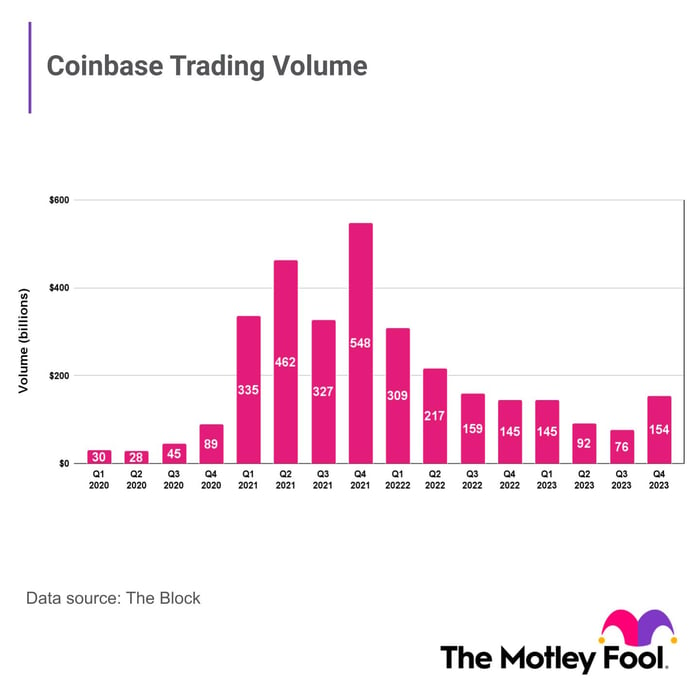
As one of the most popular crypto platforms in the world, we can extrapolate trading data from Coinbase Global (COIN 1.38%) to better understand the state of affairs in crypto. Similar to Bitcoin’s MVRV, trading volume on Coinbase shows there is still room for the crypto market to grow.
Based on the graph, it’s abundantly clear that investors have yet to make their way back to crypto. We can see that during the last bull market of 2021, trading volume on the platform surpassed more than $548 billion in Q4 alone. As of the most recent earnings report, total trading volume sits at just $154 billion, levels last seen when crypto was in the middle of a brutal crypto winter.
Data source: The Motley Fool.
Until these numbers get closer to that of the last bull market, there’s little reason to believe crypto’s recent surge is just scratching the surface. Even then, since crypto has historically notched new all-time highs with each bull-market cycle, don’t be surprised if the total volume in this cycle outdoes previous records.
Checking in on DeFi
Still in its beginning stages, decentralized finance (DeFi) is one of the most prominent use cases of cryptocurrencies and blockchain technology. Composed of non-fungible tokens (NFTs), stablecoins, lending protocols, and much more, the DeFi economy is brimming with innovative applications pushing the boundaries of finance.
There are several blockchains that make up DeFi. As of today, Ethereum (ETH -0.95%) dominates the space, but dozens of others are vying for market share.
With so many blockchains contributing to the DeFi economy, tracking its value can be a meaningful proxy to measure the crypto market’s progress and position. Currently in an uptrend due to the recent resurgence, the collective value of DeFi currencies is around $85 billion today.
Yet, this is still considerably off of its all-time high hit during the last bull run that peaked in November 2021. At the time, DeFi amassed a whopping value of more than $175 billion.
In a similar vein to trading volumes, it is safe to assume that due to DeFi’s burgeoning potential, it should surpass previous records. Should this prove to be the case, then there is plenty of catching up to do before we can even begin to consider crypto’s bull market to have peaked.
RJ Fulton has positions in Bitcoin, Coinbase Global, and Ethereum. The Motley Fool has positions in and recommends Bitcoin, Coinbase Global, and Ethereum. The Motley Fool has a disclosure policy.
Data shows the cryptocurrency futures market has seen liquidations amounting to $700 million in the past day as Bitcoin has gone through its volatility.
Bitcoin Has Seen Intense Price Action In Past 24 Hours
The past day has been a bit of a rollercoaster for Bitcoin, with the asset registering sharp price action in both directions but ultimately going up as the bulls win out.
The chart below shows what the price action for the cryptocurrency has looked like recently.
The price of the asset seems to have enjoyed sharp bullish momentum recently | Source: BTCUSD on TradingView
From the graph, it’s visible that Bitcoin initially witnessed some sharp bullish momentum, in which the coin not only broke above the $60,000 level, but went up to touch the $64,000 mark.
This high, which is the peak for the year so far, only lasted briefly, however, as BTC crashed down spectacularly to under the $59,000 mark. The asset has since recovered to higher levels, now floating around $62,700.
The rest of the cryptocurrency sector has also gone through its volatility, with prices fluctuating across the coins. As is usually the case with such sharp price action, the futures market has suffered many liquidations.
Crypto Futures Market Has Gone Through A Squeeze In The Past Day
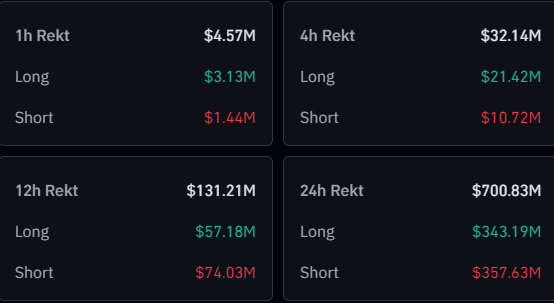
According to data from CoinGlass, the cryptocurrency futures market has witnessed the liquidation of contracts worth more than $700 million in the last 24 hours.
The table below displays the relevant information about the liquidations.

A massive amount of liquidations appear to have occurred in the past day | Source: CoinGlass
It would appear that only $131 million of the liquidations came within twelve hours, suggesting that most of the flush was situated inside the preceding half-day period. This makes sense, as Bitcoin was most volatile inside this window.
It also seems that the long-to-short ratio in this liquidation event has been quite balanced, even though the price has increased in the past day. This would suggest that some aggressive longing occurred as Bitcoin approached $64,000, and the subsequent pullback wiped these top buyers.
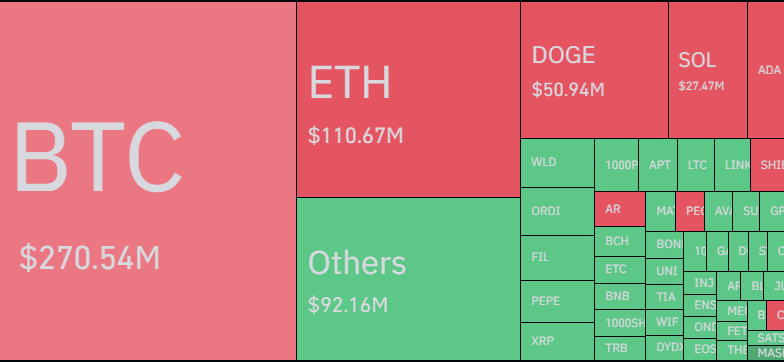
The table below shows how the distribution has looked for the various symbols.

Looks like BTC has topped the charts once more | Source: CoinGlass
As is generally the case, Bitcoin futures contracts have again been responsible for the largest portion of the total market liquidations, contributing around $270 million.
What’s different this time, however, is that this share, although the largest, isn’t even half the total liquidations. This could come down to the fact that speculators may now be playing around with altcoin positions after gaining confidence from the BTC price surge.
Dogecoin, the best performer among the top coins with its 34% jump, has occupied the largest share among the alts, with almost $51 million in liquidations.
Featured image from André François McKenzie on Unsplash.com, CoinGlass.com, chart from TradingView.com
Disclaimer: The article is provided for educational purposes only. It does not represent the opinions of NewsBTC on whether to buy, sell or hold any investments and naturally investing carries risks. You are advised to conduct your own research before making any investment decisions. Use information provided on this website entirely at your own risk.
Sanctioned and terrorist entities receive most global illicit crypto
Andrea Gacki, director of the Office of Foreign Assets Control (OFAC) of the U.S. Department of the Treasury, appears onscreen during the Chainalysis Links conference in New York, US, on Thursday, May 19, 2022.
Bloomberg | Bloomberg | Getty Images
Sanctioned entities, like those linked to North Korean hacking groups and U.S.-designated terrorist organizations such as Lebanon’s Hezbollah, continue to rely on cryptocurrency for fundraising, according to a new report from Chainalysis.
The American blockchain analysis firm’s “2024 Crypto Crime Report” found that $24.2 billion of illicit cryptocurrency was transferred in 2023, based on already identified illicit crypto wallets. Chainalysis retroactively updates its yearly crypto figures when new illicit wallets come to light.
While last year’s numbers currently represent a drop from the previous year, Chainalysis noted a much higher proportion of the funds were attributed to sanctioned or terrorist-linked recipients, accounting for about 61.5% of total illicit transaction volume in 2023.
“Actors subject to sanctions are often cut off from international traditional financial systems, and crypto can become an attempted alternative mechanism to store, send, and receive funds,” Andrew Fierman, head of sanctions strategy at Chainalysis, told CNBC on Thursday.

Crypto to avert sanctions
Crypto mixers are software that obscure the history and origin of digital assets sent through them.
The amount of crypto transferred to sanctioned entities has climbed in recent years in tandem with a greater share of new trade restrictions specifying crypto wallets.
In 2023, the U.S. Office of Foreign Assets Control sanctions list imposed a total of 18 new sanctions on individuals and entities, including their associated crypto wallets.
At least nine of the new sanctions were against individuals and entities across China and Latin America for their alleged role in fentanyl manufacturing and trafficking. Meanwhile, five of the sanctions targeted entities deemed to have violated sanctions on North Korea.

The top crypto recipient added to the sanctions list last year was Sinbad.io — a bitcoin mixer that was shut down in November of 2023 — which received $665.4 million in crypto from the Lazarus Group.
Still, sanctions have shown the ability to slow the flow of crypto funds to their targets. Tornado Cash’s monthly inflows dropped by as much as 93% immediately following its placement on the U.S. list, according to Chainalysis. Though the firm noted inflows slowly rebounded from that low in the following months.
Of sanctioned countries, Iran was a major recipient of illicit funds, with 73.3% of inflows coming from international mainstream exchanges indicating the services might be used to subvert sanctions, Chainalysis said.
Terrorist financing
Illicit crypto volume identified by Chainalysis as terrorist financing accounted for a much smaller proportion than that of transactions to sanctioned entities in 2022.
Chainalysis argued that, contrary to popular belief, cryptocurrency is not an effective tool for terrorism funding because blockchain allows funds to be traced at a level of detail not typically available in traditional finance.
“The transparent nature of cryptocurrency combined with blockchain analytics provides an invaluable forensic tool that empowers governments to identify, trace, and disrupt the flow of funds – something that isn’t possible with other forms of value transfer, especially cash,” said Chanalysis’s Fierman.
Despite these obstacles, terrorist organizations have continued to try to utilize cryptocurrencies for fundraising, deploying intricate networks of crypto exchanges and service providers, the report said.

Last year, tracing efforts resulted in the seizure of millions in funds. In one such case, Israel’s National Bureau for Counter Terror Financing said in June that it had seized $1.7 million of cryptocurrency linked to Hezbollah and Iran’s Quds Force through a Syria-based financial facilitator named Tawfiq Muhammad Said Al-Law.
Chainalysis’s report outlined how Al-Law’s relied on a network of legitimate mainstream exchanges and an extensive network of wallets for cryptocurrency transactions to aid Hezbollah’s cryptocurrency financing infrastructure.
The wallets linked to Al-Law collectively received funds ranging from millions to over $1 billion in cryptocurrency, involving up to tens of thousands of transfers.
Meanwhile, entities and individuals linked to designated terrorist groups, such as ISIS and Hayat Tahrir Al-Sham, have continued to solicit cryptocurrency through crowdfunding efforts.

However, according to Fierman, efforts in tracing and seizing these funds have become increasingly sophisticated.
“The data also shows that as crypto adoption by illicit actors continues to grow, sanctioning bodies like OFAC are continually evolving their methods to identify these actors and disrupt their activities,” he added.
In another example cited in the Chainalysis report, Al-Qassam Brigades, the military wing of Hamas, announced their decision to stop accepting crypto donations last year due to the risk of potential donors being traced. This followed reports that Hamas had received large amounts of cryptocurrencies in the lead up to its attack on Israel on Oct. 7.
Although terrorism financing is a “small share” of illicit crypto activity, it still presents an “ever-present concern” in the ecosystem, said Chainalysis in its report.
Strengthened public and private partnerships are needed to help bolster these efforts and to decipher between illicit actors and funds sent to conflict zones for legitimate causes, it added.
Webull ended crypto offerings due to SEC opposition during past IPO attempts

Online brokerage Webull decided to cut its crypto offerings because of the unfavorable regulatory landscape in the US as it waits for approval to list on Nasdaq via a special purpose acquisition company (SPAC), Bloomberg News reported on Feb. 28.
The company said that its previous attempt to carry out an initial public offering (IPO) was likely blocked due to its crypto-related services. Webull has attempted to carry out several initial public offerings (IPOs) but failed on each occasion.
Webull US CEO Anthony Denier said:
“For different reasons we were unsuccessful … I can name a few, and I think the latest one is crypto exposure. The [SEC has] not been friendly, which is widely known.”
End of crypto services
According to Bloomberg, Webull sold its digital asset business and discontinued its crypto offerings at the end of the third quarter of 2023 because of the SEC’s unclear rules for registered broker-dealers that work with crypto.
The firm continues to offer crypto buying and selling in partnership with Bakkt through its Webull Pay App, which is described as a separate business in the firm’s support pages.
However, despite Webull’s concerns around SEC regulation, at least one retail brokerage with crypto services succeeded in launching an IPO.
Webull’s major competitor, Robinhood, has offered crypto trading features since 2018 and successfully completed its IPO in 2021.
Listing via SPAC
Webull currently plans to list on Nasdaq via a $7.3 billion special purpose acquisition company (SPAC) deal with SK Growth Opportunities Corp, a blank check company.
Though there are various advantages, SPACs are broadly considered less demanding than IPOs and notably allow an upfront valuation.
According to a press release, the deal will see ordinary SKGR stock begin trading under a new ticker label, while the combined company will take on the name “Webull Corporation.”
The deal is not yet complete but awaits shareholder and regulatory approval.
SKGR shares were trading at $11.11 as of press time — up 1.18% over the last 24 hours.
Senator Warren asserts desire for crypto collaboration while claiming industry accepts criminals

Senator Elizabeth Warren expressed willingness to engage the crypto industry if players in the industry adhere to regulatory standards akin to those in traditional finance.
In a Feb. 27 Bloomberg interview, Warren said:
“I want to collaborate with the industry, what I don’t understand is why the industry seems to be saying that they only way that they can survive is if there’s plenty of space for the drug traffickers and the human traffickers.
Oh and the terrorist, and the ransomware scammer, and the consumer scammers and the rogue nations, North Korea that is financing about half of its nuclear missile program with crypto, that all of that has to be left open.
Warren’s stance towards crypto has faced steep criticism from stakeholders within the burgeoning industry who argue that her policies drive innovation overseas.
Notably, a prominent pro-crypto lawyer challenging her seat in the Senate, John Deaton, accused Warren of engaging in a “politics of division and destruction.”
“Level playing field”
Senator Warren emphasized the need for uniform regulatory standards across the US financial landscape, urging the crypto sector to adhere to existing rules. The lawmaker noted that major traditional financial entities, including banks, credit unions, and stockbrokers, abide by the established regulations, whereas the crypto industry operates outside this framework.
“In our financial system, pretty much everybody follows the same set of rules. I’m talking banks and credit unions and credit card companies, gold traders and stockbrokers. Private equity now has to follow the rules. Precious metal dealers, Venmo, Western Union, but not crypto,” she explained
In advocating for regulatory parity, Warren highlighted the similarity in activities and associated risks between traditional and crypto finance. She stressed the importance of enforcing existing laws rather than creating new regulations. She added:
“I just want a level playing field here if you’re part of the financial system moving around literally billions of dollars. Remember, my bill is not a regulatory bill. It’s a bill about law enforcement.”
Her proposed legislation, the Digital Asset Anti-Money Laundering Act, seeks to bring the crypto ecosystem into greater compliance with anti-money laundering frameworks governing the traditional financial system.
Despite criticism from some corners of the crypto industry, the bill has garnered significant support from several US lawmakers.