Authorities in Egypt recently allowed the local currency’s exchange rate versus the U.S. dollar to decrease by more than 60%. Additionally, the central bank raised interest rates by 600 basis points. Both steps were key conditions set by the IMF which Egypt had to meet before the approval of a new financial aid package. IMF […]
Source link
devalues
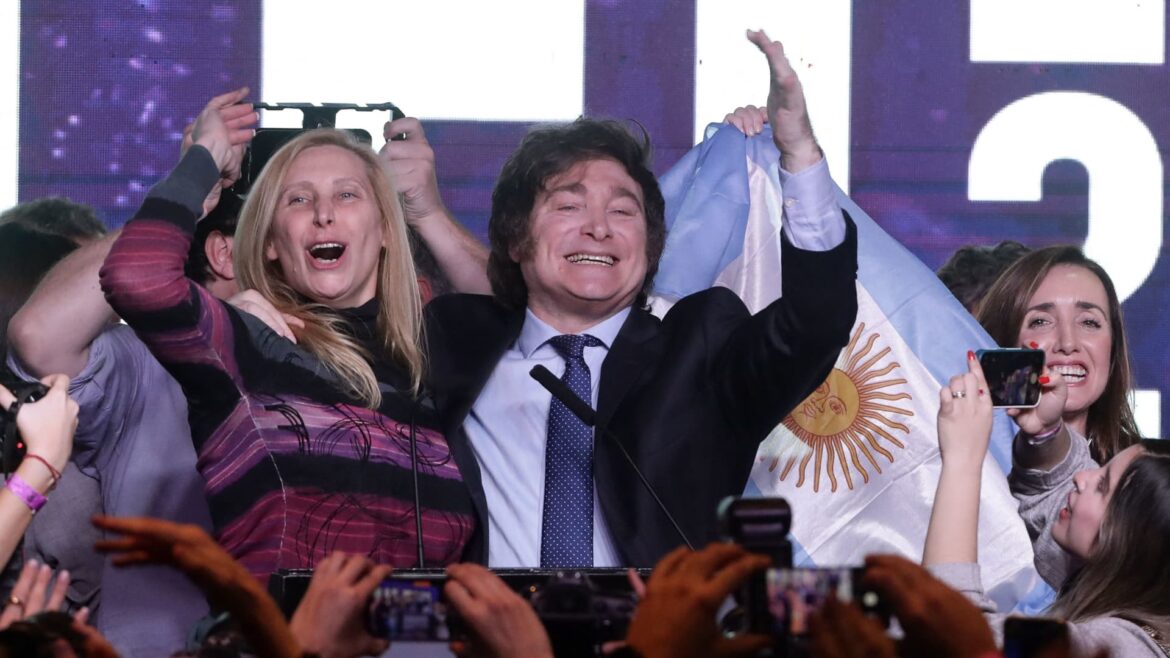
Argentine far-right libertarian economist and presidential candidate Javier Milei celebrates the results of the primary elections with his sister Karina Milei at his headquarters in Buenos Aires on August 13, 2023.
Alejandro Pagni | Afp | Getty Images
Argentina’s central bank devalued its currency, the peso, by close to 18% and hiked its benchmark interest rate by a whopping 21 percentage points to 118% on Monday following a shock primary election win by far-right libertarian Javier Milei.
The moves were a bid by the government to calm markets in the wake of the Argentinian congressman’s surprise victory, which gave him the largest share of votes in the country’s presidential primary election at roughly 30%, far exceeding forecasts.
Markets had been betting on favorable results for moderate candidates. Argentina’s presidential election will be held in October.
Argentinian stocks and its sovereign dollar bonds were also lower Monday.

The central bank said Monday that the peso would be held at 350 to the dollar until the October vote.
Milei, riding on a wave of popular discontent, has vowed to get rid of the central bank and dollarize Argentina’s economy. He has also advocated for sharp spending cuts.
Latin America’s third-largest economy, Argentina has been mired in economic and financial crisis for years. The country’s foreign reserves are shrinking fast and its inflation is forecast at 142.4% for the year.
Argentina is on the brink of its sixth recession in a decade. Milei is a vocal critic of what he calls the corrupt political class, saying the country’s leaders have thrown it from one crisis to another. He believes replacing the peso with the dollar could calm inflation, but many economists warn that would trigger financial chaos.
By Eliana Raszewski and Jorgelina do Rosario
BUENOS AIRES/LONDON (Reuters) -Argentina’s government devalued its currency by nearly 18% on Monday while the benchmark interest rate was raised by 21 percentage points to 118%, the central bank said, as financial markets reeled the day after a shock primary election result.
Congressman Javier Milei, a far-right libertarian who wants to axe the central bank and dollarize the economy, shook up the presidential elections on Sunday, winning 30% of the vote, the largest share with over 97% of ballots counted.
It was a huge shake-up in a ballot that acts as a dress rehearsal for the national election in October. Markets had been betting on a strong performance by more moderate candidates. Some investors noted that regardless of the ultimate winner, the balance of power looks likely to shift to the right.
“We think Argentine USD sovereign bonds present an attractive risk-reward profile, given their depressed valuations, positive correlation to commodity prices, and the potential political regime change,” said Alejo Czerwonko, CIO for Emerging Markets Americas at UBS Global Wealth Management.
The official FX rate will be fixed at 350 pesos per dollar until the October elections, the central bank said. The parallel informal peso dropped near 10% to a record low of 675 per dollar before ending at 665 according to Eikon data.
“The move to devalue the currency will help to bring it closer to fair value,” said William Jackson, chief emerging markets economist at Capital Economics.
“But the fact that the peso will be held steady until the election, rather than be allowed to fall gradually (as has been the policy up till now) will just result in the currency becoming severely overvalued again in the coming months.”
Dollar-denominated international bonds fell, but pared losses in afternoon trading. Foreign investors sold Argentine stocks, pushing the Global X MSCI Argentina ETF down 2.9% in U.S. trading. The local S&P Merval index fell as much as 3.5% during the session but closed 3.3% higher.
The country’s sovereign dollar bonds fell as much as 4 cents on the dollar, with the 2030 note leading the slide, according to Eikon data.
The 2041 bond fell 3 points to 30.375 cents on the dollar, and the 2038 was down 3.25 points at 33.875 cents on the dollar at 1402 GMT.
Investment bank JPMorgan recommended staying “market weight” on Argentina’s government bonds as the financial landscape “is set to deteriorate further.”
Goldman Sachs said in a note that the exchange rate policy “adopted in the future is even more important than the decision taken today to devalue.”
YEARS OF CRISIS
Argentina’s markets have long been wobbly as the country endured years of economic crisis. Inflation has been running at over 100% and four out of 10 Argentines live in poverty.
After a similar primary election shock result in 2019, bonds and the currency crashed and remain in distressed territory. The government has been unable to unwind capital controls used to support the peso as Latin America’s third-largest economy grapples with sky-high inflation and falling central bank reserves. Gross reserves stand at $23.8 billion but private analysts say net reserves, discounting liabilities, are in the red by over $8 billion in the red.
Sunday’s win by Milei adds another unknown factor that could dent market confidence, though he faces a tough fight in October and a likely November run-off. The rock-singing economist will compete in a three-way race in October against former security minister Patricia Bullrich, who won the conservative Together for Change nomination, and Peronist coalition candidate and Economy Minister Sergio Massa.
A candidate needs 45% of the Oct. 22 vote to win outright or 40% and a 10-point lead over second place. If there is no outright winner, as seems likely, a head-to-head vote between the top two candidates will be held in November.
“What we are left with is a much more uncertain scenario than the one we expected,” said Ricardo Delgado, director of the Argentine economics consultancy Analytica.
Argentina is the largest debtor to the International Monetary Fund, with a $44 billion programme approved last March to refinance a 2018 loan.
“We welcome the authorities’ recent policy actions and commitment going forward to safeguard stability, rebuild reserves and enhance fiscal order,” said IMF director of communications Julie Kozack in a statement.
The cash-strapped economy had to tap Chinese swap line and get a loan with Qatar to repay debt owed to the Washington-based IMF. Further disbursements are now delayed even though the country recently reached a staff-level agreement with the Fund to unlock about $7.5 billion. That agreement still needs approval of the executive board, which will meet to discuss it on Aug. 23.
(Reporting by Eliana Raszewski and Jorgelina do Rosario; Additional reporting by Rodrigo Campos, Jorge Otaola and Medha Singh; Writing by Adam Jourdan; Editing by Bernadette Baum, John Stonestreet, Andrew Cawthorne and David Gregorio)