The Mortgage Market Is So Bad Lenders Want Ex-Employees to Give Back Their Bonuses
Source link


The Mortgage Market Is So Bad Lenders Want Ex-Employees to Give Back Their Bonuses
Source link

The unlucky (and sad) millennial housing story may be getting tedious and repetitive, but maybe millennials have reason to be upset. Just consider this, they’re constantly getting crushed in the housing market, and boomers keep coming out on top. Even one of the biggest investment banks on Wall Street thinks so.
There’s been a “massive wealth transfer from the public to the private sector,” Bank of America Research strategists led by Ohsung Kwon wrote in a new note, resulting from two things: Government debt has risen from 31% of the gross domestic product to 120%, from 1980 to today, and 10-year treasury yields had gone from 12% to 4.6% at the time of writing (the 10-year treasury was sitting at 4.9% as of press time). Add it all up and household wealth increased from $17 trillion to $150 trillion, a record high.
The winners of this great wealth transfer? Baby boomers—and they especially won the housing market. They and the “traditionalist” generation hold two-thirds of total net worth, BofA said, and boomers alone hold more than half of all wealth, the majority in financial assets, including real estate.
To be sure, when boomers were entering the housing market in the 1980s, mortgage rates were extremely high, peaking at roughly 18% as Federal Reserve Chair Paul Volcker attempted to lower inflation that was raging at 14%. But, boomers have by now had many years to refinance their mortgages as rates fell, and they did just that, leaving the vast majority of them with mortgage rates below the current market rate.
In a replay of sorts of the 1980s, inflation hit a four-decade high in June of last year, and the Federal Reserve has since raised interest several times as chair Jerome Powell has adopted a Volckerian strategy. With that, mortgage rates that were hovering around 3% throughout the pandemic-driven housing boom skyrocketed, reaching 8%, a more than two-decade high. Currently, the 30-year fixed rate is just below 8%. This means, BofA notes, that as before mortgage rates escalated, many homeowners locked in low rates—just not millennials.
“Everyone locked in 3% mortgage rates, except Millennials,” the bank said. “On the cost side, most Boomers locked in low mortgage rates, where the effective mortgage rate remains below pre-COVID levels. The only group that took out mortgage debt meaningfully since 2021 is Millennials, seeing a 20% jump.”
Nearly all outstanding borrowers have below-market mortgage rates, fueling the so-called lock-in effect or the golden handcuffs of mortgage rates. To put it simply, would-be sellers aren’t selling, in fear of losing their low rate. That’s putting a strain on supply, which is already tight given the housing market is underbuilt. With that, existing home sales have already fallen to their lowest level since 2010, by one measure, and could fall further to their lowest level since the early 1990s, according to a separate forecast.
So, consider this, a mortgage rate shock, limited supply, and home prices that rose substantially during the pandemic-driven housing boom have all left millennials in likely the worst position than any other generation, so far.
For one, homeownership is much lower for younger generations. Those under 35 make up less than 40% of homeownership by age group; those 35 to 44 make up over 60%; those 55 to 64 make up over 70%; and those older than 65 make up slightly below 80%.
Additionally, affordability has decreased significantly since 2021, Bank of America said, citing the National Association of Realtors’ affordability index. It’s clear that mortgage rates jumping in such a short period of time coupled with home prices that are still high, and in some markets are continuing to rise, has deteriorated affordability to levels worse than at the height of the housing bubble.
“Boomers have certainly not felt the impact of higher rates as much, and we believe many wealthy Boomers are actually benefiting,” the bank wrote.
And, they’re definitely spending. Bank of America’s data, strategists wrote, show that boomers and traditionalists (also known as the silent generation) are the only groups that are increasing their consumption; they also make up 40% of total consumer spending.
“Boomers typically spend less on big ticket items (housing and autos), but spend more on health care, home improvement and slightly more on entertainment,” Bank of America said. “As ultra-low rate mortgages incentivize people to live in their homes longer, we could see increased home improvement spending by wealthy Boomers.”
Meanwhile, younger generations are bearing the brunt of higher interest rates, given their spending has fallen and their credit card delinquency has risen, the note read. Younger Millennials, ages 30 to 39 are the only group with higher credit card delinquency today versus pre-pandemic levels. Still, millennials as a whole, are spending more on housing—potentially because of increased housing costs. Although, we could be in the midst of the next great wealth transfer.
“Housing could struggle given higher rates, but the wealth transfer from Boomers to Millennials is supportive, especially for luxury housing,” the bank said.
This story was originally featured on Fortune.com
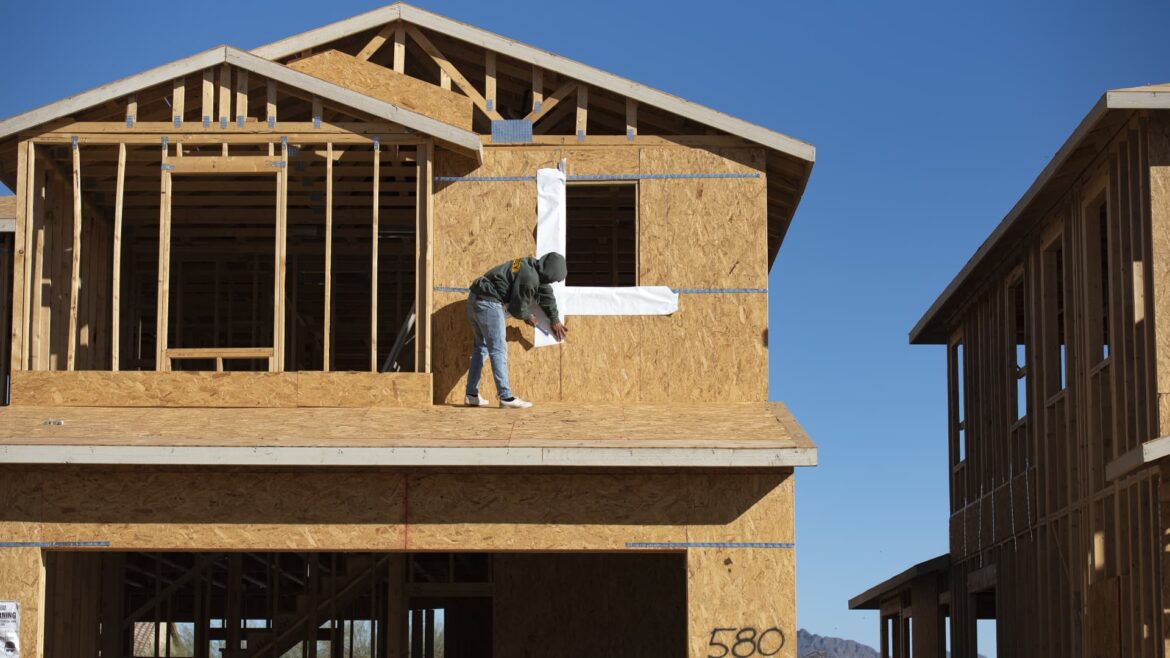
A contractor works on a new home under construction in Tucson, Arizona, on Tuesday, Feb. 22, 2022.
Rebecca Noble | Bloomberg | Getty Images
Builder confidence in the market for single-family homes dropped to the lowest level since January, as builders contend with a market dominated by high mortgage rates and costs for financing.
The monthly National Association of Home Builders/Wells Fargo Housing Market Index dropped 4 points to 40 in October, and September’s read was revised down 1 point. Anything below 50 is considered negative. This marks the third straight monthly decline in builder confidence.
Builders point squarely to mortgage rates, which are now at a 23-year high. The average rate on the popular 30-year fixed mortgage has remained over 7% for two months. Affordability has fallen to near record lows.
“Builders have reported lower levels of buyer traffic, as some buyers, particularly younger ones, are priced out of the market because of higher interest rates,” said Alicia Huey, NAHB’s chairman and a homebuilder and developer from Birmingham, Alabama. “Higher rates are also increasing the cost and availability of builder development and construction loans, which harms supply and contributes to lower housing affordability.”
Of the index’s three components, current sales conditions fell 4 points to 46, sales expectations in the next six months dropped 5 points to 44, and buyer traffic dropped 4 points to 26.
In order to get buyers in the door, builders are using more incentives again. This includes buying down mortgage interest rates. About 62% of builders reported offering sales incentives of all forms in October, up from 59% in September and tied with the previous high for this cycle set in December 2022.
In addition, 32% of builders said they cut home prices. That is unchanged from the previous month but still the highest rate since December (35%). The average price discount is steady at 6%.
“The housing affordability crisis can only be solved by adding additional attainable, affordable supply,” said Robert Dietz, NAHB’s chief economist. “Boosting housing production would help reduce the shelter inflation component that was responsible for more than half of the overall Consumer Price Index increase in September and aid the Fed’s mission to bring inflation back down to 2%. However, uncertainty regarding monetary policy is contributing to affordability challenges in the market.”
Regionally, on a three-month moving average, builder sentiment in the Northeast fell 4 points to 50 and in the Midwest dropped 3 points to 39. In the South it fell 5 points to 49, and in the West it fell 6 points to 41.
Don’t miss these CNBC PRO stories:
Oct 08, 2023, 2:00 am EDT
Share
Higher mortgage rates are likely to drive home sales back to a 13-year low as more buyers put their searches on hold—but they aren’t scaring everybody away.
Continue reading this article with a Barron’s subscription.
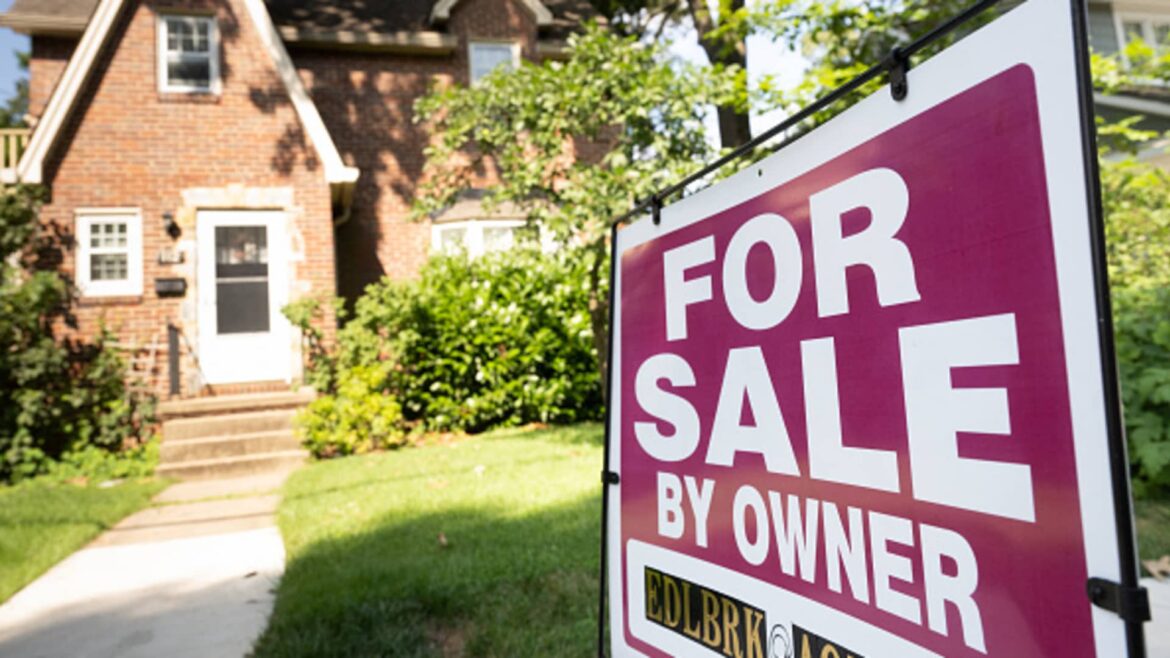
A house is for sale in Arlington, Virginia, July 13, 2023.
Saul Loeb | AFP | Getty Images
Mortgage rates just continue to climb higher, taking a particularly big leap last week. As a result, total mortgage demand fell 6% compared with the previous week, according to the Mortgage Bankers Association’s seasonally adjusted index.
The average contract interest rate for 30-year fixed-rate mortgages with conforming loan balances ($726,200 or less) increased to 7.53% from 7.41%, with points rising to 0.80 from 0.71 (including the origination fee) for loans with a 20% down payment. That rate was 6.75% the same week one year ago.
“Mortgage rates continued to move higher last week as markets digested the recent upswing in Treasury yields,” said Joel Kan, MBA’s vice president and deputy chief economist. “As a result, mortgage applications ground to a halt, dropping to the lowest level since 1996.”
Applications to refinance a home loan dropped 7% for the week and were 11% lower than the same week one year ago. Refinances now make up less than one-third of all mortgage applications. Just two years ago, when rates were setting multiple record lows, refinance demand made up roughly three-quarters of all mortgage applications.
Applications for a mortgage to purchase a home fell 6% for the week and were 22% lower than the same week one year ago.
“The purchase market slowed to the lowest level of activity since 1995, as the rapid rise in rates pushed an increasing number of potential homebuyers out of the market,” said Kan, who also noted that adjustable-rate mortgage (ARM) applications increased. The ARMs made up 8% of purchase applications, up from 6.7% about a month ago, when interest rates were slightly lower. ARM’s offer lower rates but are fixed for a shorter term, usually five or 10 years.
A separate, daily survey on mortgage rates from Mortgage News Daily showed the average rate on the 30-year fixed rising even higher this week, hitting 7.72% on Tuesday. Investors are responding to better-than-expected economic data, which could push the Federal Reserve to be more aggressive in its higher interest rate policy.

Ryan Ratliff (L), Real Estate Sales Associate with Re/Max Advance Realty, shows Ryan Paredes (R) and Ariadna Paredes a home for sale on April 20, 2023 in Cutler Bay, Florida.
Joe Raedle | Getty Images News | Getty Images
Mortgage interest rates just hit a level not seen since the year 2000. As a result, mortgage demand is now sitting near a 27-year low.
Total mortgage application volume fell 1.3% last week compared with the previous week, according to the Mortgage Bankers Association’s seasonally adjusted index. Volume was 25.5% lower than the same week one year ago.
The average contract interest rate for 30-year fixed-rate mortgages with conforming loan balances ($726,200 or less) increased to 7.41%, from 7.31%, with points decreasing to 0.71 from 0.72 (including the origination fee) for loans with a 20% down payment. The rate was 6.52% one year ago.
The 30-year fixed jumbo mortgage rate increased to 7.34%, the highest rate in the history of the MBA’s jumbo rate series dating back to 2011.
“Based on the FOMC’s most recent projections, rates are expected to be higher for longer, which drove the increase in Treasury yields,” said Joel Kan, an MBA economist, referencing the Federal Open Market Committee. “Overall applications declined, as both prospective homebuyers and homeowners continue to feel the impact of these elevated rates.”
Applications to refinance a home loan fell 1% for the week and were 21% lower than they were one year ago. After record low interest rates throughout the first few years of the pandemic, and a refinance boom, there are precious few borrowers now with mortgage rates high enough to benefit from a refinance.
Applications for a mortgage to purchase a home fell 2% for the week and were 27% lower than the same week year over year.
Today’s potential buyers are facing an unprecedented dynamic of a historically low supply of homes for sale, coupled with both rising interest rates and rising prices. Higher interest rates historically throw cold water on home prices, but the supply and demand imbalance is so severe that it is pushing prices higher even though more and more buyers are unable to afford a home.
Interest rates continued to move higher this week, according to a separate survey from Mortgage News Daily. Even sales of newly built homes, which had been rising due to the short supply on the resale market, took a hit in August, according to another report this week. Sales dropped nearly 9% in August from July’s pace, hitting the lowest level since March.

A for sale sign in front of a home in Arlington, Virginia, on August 22, 2023.
Andrew Caballero-Reynolds | AFP | Getty Images
Mortgage rates rose again last week, and so did demand for refinances, which at face value doesn’t make a lot of sense.
Applications to refinance a home loan jumped 13% last week compared with the previous week, according to the Mortgage Bankers Association’s seasonally adjusted index. Application volume was still 29% lower than the same week one year ago.
Refinancing demand usually moves in the opposite direction as mortgage rates, but that was not the case. Last week the average contract interest rate for 30-year fixed-rate mortgages with conforming loan balances ($726,200 or less) increased to 7.31% from 7.27%, with points remaining unchanged from 0.72 (including the origination fee) for loans with a 20% down payment.
It may be that borrowers are concerned rates could go even higher, and so they’re jumping in now. It may also be that the number of refinances are so small right now that any minor change results in a big percentage move.
Applications for a mortgage to purchase a home increased 2% for the week and were 26% lower than the same week one year ago.
“Purchase applications increased for conventional and FHA loans over the week,” said Joel Kan, an MBA economist in a release. “Homebuyers continue to face higher rates and limited for-sale inventory, which have made purchase conditions more challenging.”
With home prices now rising again, the average loan size on a purchase application was $416,800, the highest level in six weeks. Demand may be coming back, because more homes have recently come on the market. The overall level of supply, however, is still quite low, which is leading to bidding wars again.
Mortgage rates haven’t moved much this week, as investors wait to hear the results of Wednesday’s Federal Reserve meeting and commentary from Chair Jerome Powell on the future of interest rates.

In this difficult housing market — with high mortgage loan rates and a dearth of home sellers because so many are locked in with much lower interest rates — the spread between the 30-year and 15-year rates may not seem very important if you are looking to buy a home.
But it might be the most important thing for you to look into. Or maybe you know someone about to enter the housing market who could be well served by gathering more information.
Most people (and chances are, the loan officers you speak to) work under the assumption that their only choice for financing a home purchase is to take out a 30-year mortgage loan. But doing so can be so much more expensive than the 15-year option that it can cause you financial harm for decades.
And 30 years is quite a long commitment to paying interest, considering how long a typical working career lasts.
If you are looking to buy a home and need to borrow to do so, you should always consider your options. You can use MarketWatch’s mortgage calculator to make a comparison.
To keep things simple and only compare fixed-rate loans (while leaving insurance and property taxes out), we can begin with the median U.S. home listing price of $440,000 in July, according to Realtor.com. For a “conforming” loan — that is, one which your lender can easily sell to Fannie Mae or Freddie Mac, and for which mortgage insurance won’t be required — the minimum down payment is 20%, unless you are eligible for a special government-subsidized program allowing a smaller down payment.
For our example, the home costs $440,000 and the down payment is 20%, or $88,000, so the loan will be for $352,000. For our loan comparison, we used national average interest rates of 7.23% for a conforming 30-year fixed-rate mortgage loan and 6.55% for a 15-year loan as of Aug. 24, according to Freddie Mac.
A fixed-rate mortgage loan is amortized, which means the payment (combined principal and interest) remains the same for the life of the loan, but the weighting of principal and interest changes over time. For our $352,000 loan example, the monthly payment at the national average interest rate of 7.23% for a 30-year loan is $2,396.
For the first monthly loan payment, only $276 is principal, while the rest is interest. Over time this reverses. For example, halfway through the life of the loan, your 180th payment will be weighted $808 to the principal, with the rest being interest. And at that time, you will have paid off $89,152 of the principal. That’s right — after 15 years you will still owe $262,848 on your house. Assuming you didn’t take out a second mortgage loan.
If you had gone with a 15-year loan at the lower rate of 6.55%, your payments would be much higher at $3,076 a month. Your first payment would be weighted $1,155 to principal. You would be finished in 15 years and your total interest paid for the life of the loan would be $201,676.
For the 30-year loan, total interest for the life of the loan would be $510,732. For the first 15 years of the 30-year loan, total interest paid would be $342,216.
So for an extra $679.50 a month, not only do you get the loan off your back 15 years earlier, you save $309,056 in interest.
Arguments against the shorter loan include the likelihood that you will move within a few years. But you don’t really know if that will happen. Five years can go by in 15 minutes.
With the 15-year loan, you build up equity much more quickly. After five years, you will have paid down the balance on a 15-year loan by $81,709, while you will have paid down the balance of a 30-year loan by $19,855. The 15-year loan will put you in a much better equity position if you decide to sell your home and make a move.
Another argument against the shorter loan might be that you would make more money investing the $679.50 a month in the stock market. But would you have the discipline to do this? Or would the stock market have high enough returns during your investment period if you were to sell the home in five years? The beauty of the 15-year fixed-rate loan is that the savings on interest (when compared with the 30-year loan) is guaranteed.
Here’s a summary of attributes for a 15-year fixed-rate residential mortgage loan and a 30-year fixed-rate loan:
| 30-year fixed | 15-year fixed | |
| Interest rate | 7.23% | 6.55% |
| Loan amount | $352,000 | $352,000 |
| Monthly Payment | $2,396 | $3,076 |
| First-month principal | $276 | $1,155 |
| First-month interest | $2,121 | $1,921 |
| Loan balance after 60 payments | $332,145 | $270,291 |
| Loan balance after 180 payments | $262,848 | $0 |
| Total principal paid – first five years | $19,855 | $81,709 |
| Total interest paid – first five years | $123,934 | $102,850 |
| Total interest paid -15 years | $342,216 | $201,676 |
| Total interest paid – 30 years | $510,732 | N/A |
How can you come up with that $679.50 a month? You might delay your next new-vehicle purchase, or buy less car, or both. You might also scale down your home choice to make a 15-year loan possible. A combination of decisions might help you to save an incredible amount of money over the course of decades. Feeling some pain now can set you up for a much easier financial life down the line.
Over time, your loan payment won’t increase, but hopefully your income will go up. At some point you will be glad you were able to tighten your belt and take the 15-year loan instead of suffering under the weight of a 30-year loan.

Dear MarketWatch,
My husband and I are retired. We have about $80,000 in a regular savings account with our bank, $10,000 in checking and a growing $257,000 in a money market account which is very low risk, according to our fiduciary investment contact. We both have a comfortable pension and Social Security and have no trouble paying our monthly bills.
We married late in life, in our mid-40’s, and have moved several times. We purchased our last home about a year and a half ago and owe $132,000 on a 30-year fixed rate.
The big question is: should we pay off our home?
Thank you,
To Pay Off or Not to Pay Off
See: I’m 49, have $1.2 million in savings and just lost my job — can I trust the retirement calculators telling me it’s OK to retire?
Dear To Pay Off or Not to Pay Off,
Paying off your home may sound like a dream, but if it’s taking a big chunk out of your savings, it could easily become a nightmare.
If you’re able to pay off your monthly bills with no issue, and you’re comfortable doing so, there’s no harm in having a mortgage. Although mortgages are debt, they aren’t considered “bad debt” like credit cards are, and while rates may be high these days, if you’re able to pay this bill without a problem, it’s not hurting you to have it.
Think about it this way. If your mortgage is $132,000 and you have about $350,000 in savings, checking and that money market account, paying off the mortgage would take more than a third of the money you have set aside.
The temptation is real though, and for some homeowners, so is the agony of having any sort of debt over their heads. If you can’t stand having a mortgage, try talking to that fiduciary adviser about it. You mentioned this person was a “contact,” but I’m not sure if that means you have a professional relationship and you’re a client. If you’re not, now may be a good time to start working with a qualified financial planner, such as a certified financial planner, who can review all of your assets and help you make sense of the best next steps.
You’re certainly not the only ones wondering if you should pay off a mortgage in retirement. This retired reader was thinking about paying off her mortgage with some of the $300,000 she had in her 403(b) plan because the interest rate was “killing” her, she said.
In response to another couple considering a mortgage payoff, advisers said paying off the mortgage can sometimes be more of an “emotional” achievement than just a financial one.
Interest rates can play a very important role in deciding what to do, other advisers said. I’m not sure what your interest rate is, but take this for example: money kept in a retirement portfolio could potentially generate returns at a higher rate than your mortgage interest rate (say 5-9% compared to a mortgage interest rate around 4%). Or, perhaps they’re about the same rate, in which case you’re breaking even. Of course, it might be a bit more difficult to weigh the pros and cons of that perspective these days, when some interest rates are hovering around 7% and we not too long ago saw unnerving market volatility.
One adviser put it as being “house rich and cash poor” — that’s when you have your house completely paid off, but little in liquid assets.
Also see: I’m 67 and retired with $57,000 left on my mortgage and $600,000 saved for retirement — should I pay off my home now?
There are so many factors to consider when making this decision though. Home equity, for instance, is a helpful resource for retirees — it may actually save some retirees who are struggling to keep up with inflation.
While you’re deciding what to do about your mortgage, take this time to also look at your finances in a “big picture” sort of way. For example, you didn’t mention how old you and your husband are, but you said you’re in low-risk assets. If it’s working for you, that’s great, but if you could potentially have decades to go in retirement, you’ll need your savings to stretch over your lifetime. Ask a fiduciary adviser if there are any strategies you can deploy to help you and your investments, while taking into consideration your risk tolerance.
Always, always have back-up plans. Social Security likely won’t go anywhere, but say there was a pay-cut to beneficiaries (Congress has never let that happen, but let’s play devil’s advocate for a moment and say it does happen in 10 or so years) — would you still be able to live comfortably and pay all of your bills? How much of your nest egg would have been dwindled by then, and how much more would you potentially have to take from it every year? How would you handle paying for an unexpected emergency? Does your pension have an expiration date, or tax implications later in life? These are all questions you should have an answer to — and again, a qualified adviser working in your best interest can help you figure those answers out.
Readers: Do you have suggestions for this reader? Add them in the comments below.
Have a question about your own retirement savings? Email us at HelpMeRetire@marketwatch.com


For many Americans, paying the mortgage bill is by far the largest expense they deal with each month. While home prices and other factors (like property taxes) vary widely from state to state, the National Association of Realtors reports that the average monthly mortgage payment for a 30-year fixed mortgage in the United States is now a hefty $2,317. However, what if you could pay for this large, recurring monthly expense with passive, recurring monthly income from your investment portfolio?
One way to do this would be through a high-yield, monthly-dividend ETF like the popular JPMorgan Equity Premium Income ETF (NYSEARCA:JEPI). This ETF pays a dividend each month and its dividend yield is currently 10.2%, making it an investment instrument that is well-suited to pursuing this goal. Let’s walk through the idea of paying this large, recurring bill with recurring dividend income and the steps it would take to get there.
Monthly Dividends
Before diving into the specifics, let’s first touch on what JEPI’s strategy is. This is a $28.5 billion ETF from JPMorgan that launched in 2020 and has quickly gained popularity on its way to becoming the largest actively-managed ETF in the market today.
According to JPMorgan, JEPI “generates income through a combination of selling options and investing in large-cap U.S. stocks, seeking to deliver a monthly income stream from associated option premiums and stock dividends.” Additionally, JEPI seeks to “deliver a significant portion of the returns” of the S&P 500 with less volatility.
While most dividend stocks pay out a dividend on a quarterly basis, JEPI pays them monthly, so its payout schedule aligns nicely with our objectives of making a monthly mortgage payment.
Double-Digit Yield
It should be noted that JEPI’s dividend payout can vary from month to month, but it currently yields an attractive 10.2%. Using the last 12 months’ payments, which range from $0.29 to $0.61 cents, we can simplify things by saying that the average dividend payment works out to $0.46 per month.
To reach $2,307 in monthly dividend payments from JEPI to pay off the average mortgage, an investor would need to buy 5,016 shares of the ETF. At a current price of $54.49, this would come out to an investment of $273,321.84.
While this is a large amount for the average individual investor to accumulate, it shows that an investor could theoretically pay their mortgage each month using passive income from a high-yield dividend ETF like JEPI.
Diversification
An advantage of using a dividend ETF JEPI to pay a monthly mortgage payment versus a dividend stock is that while it is a single security, it reduces single-stock risk because this income-oriented ETF owns 120 stocks.
JEPI is further diversified in that its top 10 holdings make up just 17.6% of the fund, so it doesn’t leave investors overexposed to just one or two stocks. In fact, no position has a weighting of more than 2%. Below, you can take a look at JEPI’s top 10 holdings using TipRanks’ holdings tool.

JEPI’s portfolio contains a wide variety of large-cap, blue-chip U.S. stocks, ranging from tech stocks like Amazon, Microsoft, and Adobe to dividend mainstays from the consumer staples sector like Coca-Cola, Pepsi, and Hershey.
Additional Considerations
While the idea of “setting and forgetting” your mortgage payment with a dividend ETF like JEPI is certainly appealing, there are some additional items investors should consider before considering an idea like this.
Though it’s certainly possible to build up a large position of ~$273,000 in one security and use the dividend payments from this ETF to pay your mortgage, you generally want to avoid putting all of your eggs in one basket. Yes, JEPI is diversified, but investing this much in one security could still leave you with a lot of exposure to just one investment vehicle, which could backfire if something goes wrong.
Over the long term, it’s probably preferable to build a diversified portfolio of at least 15-20 stocks to build long-term wealth.
There is also the JEPI-specific consideration that investors could miss out on long-term capital appreciation by investing such a large amount in this type of ETF. By selling covered calls, JEPI runs the risk of leaving upside on the table as the market rises. Selling covered calls caps an investor’s upside at a certain point because if the price of the underlying stock rises beyond the strike price of the option, JEPI investors forgo the additional gains.
It should also be noted that if an investor has accrued this much capital to put into an investment like JEPI, they may also be able to simply pay the mortgage off all in one fell swoop and eliminate the concern of making monthly payments altogether.
Conversely, a mortgage can also give homeowners a tax break, and if they have a low interest rate locked in for their mortgage, they may not want to pay it off. Even if an investor could theoretically pay off their mortgage all at once with the principal that they are allocating to JEPI in this exercise, I still like the idea of remaining liquid and maintaining optionality by keeping the large position in JEPI and paying for the mortgage on a monthly basis.
Is JEPI Stock a Buy, According to Analysts?
Turning to Wall Street, JEPI earns a Moderate Buy consensus rating based on 103 Buys, 17 Holds, and zero Sell ratings assigned in the past three months. The average JEPI stock price target of $62.32 implies ~14% upside potential.

Starting with a Single Step
This strategy might not be right for everyone, but it shows what you can achieve by saving, investing, and building up positions in dividend ETFs. While accruing over $273,000 to achieve this goal might sound daunting at first, the largest journeys begin with a single step.
Allocating over $273,000 to JEPI sounds like a lot, but what if you could allocate $5,000 to start receiving ~$50 in dividend payments each month or put in $10,000 and start receiving $100 in monthly payments? By starting a position, reinvesting the monthly dividends, and adding a bit more to your position each month, you can eventually achieve this goal.
The added bonus is that even if you don’t have enough to receive the $2,307 needed to pay the full monthly mortgage, any passive income coming in from investments to help you pay for it (or pay for other expenses) is an added bonus and gives you a nice helping hand.