
Bitcoin and select altcoins are finding buyers at lower levels, indicating a pick-up in positive sentiment.


Bitcoin and select altcoins are finding buyers at lower levels, indicating a pick-up in positive sentiment.

Bitcoin (BTC) will be the currency of artificial intelligence (AI) and could reach a price per coin of $760,000 in the process, Arthur Hayes says.
In his latest essay titled “Massa,” the former BitMEX CEO concluded that the AI revolution would naturally gravitate toward BTC.
Despite fiat currency regimes being destined to become evermore dysfunctional in the future, Hayes said, there is one burgeoning economic sector that will only go from strength to strength: AI.
While still nascent in 2023, the coming decades will see an explosion of AI-related implementations that will make it ubiquitous and unavoidable.
“Recent advancements in computing power have brought us to the cusp of a hockey stick moment, in which AI will go viral and change the course of humanity virtually overnight,” he wrote.
“In only two months, ChatGPT reached 100 million monthly active users making it the fastest adopted technology in human history — so just imagine how quickly everything is going to change as AIs are integrated into everyday life and continue to learn and improve.”
When it comes to integration, the financial solution on the table first and foremost, Hayes said, will not be a tailor-made, AI-focused altcoin — it will be Bitcoin instead.
The reason, an accompanying theory states, is that AI will view Bitcoin’s inherent qualities — an immutable fixed supply, digital scarcity and its status as “energy money” — as the logical choice.
“An AI is unlikely to allow itself to rely on anything that a human government operates therefore only gold and Bitcoin are suitable. A tie between gold and Bitcoin,” Hayes continued.
“Bitcoin is thus the logical currency choice for any AI. It is purely digital, censorship resistant, provably scarce, and its intrinsic value is completely electricity-cost-dependent. There is nothing in existence today that comes close to challenging Bitcoin on these aspects.”
Where would that leave BTC’s price?
Related: BTC price remains ‘undoubtedly bullish’ as $30K Bitcoin buyers emerge
From around $30,000 today, the real effect of AI should kick in in around three years’ time.
After that, Hayes said, it could be around another decade before the network value boost from AI alone sends BTC/USD to nearly $1 million.
“I believe the peak of deranged growth investing will occur in the 2025 to 2026 timeframe. Therefore, the goal of my predictions regarding the future price of Bitcoin is to form a narrative that takes hold before then,” he explained.
Depending on the scale of that investing, BTC price action could see up to $760,000 per coin.
“Remember — the market will overpay for Bitcoin network growth if it believes there is a possibility that my assumptions could be true in the future,” part of “Massa” concludes.
“The most money is made when the market price adjusts from ‘can never happen’ to ‘maybe could happen.’”
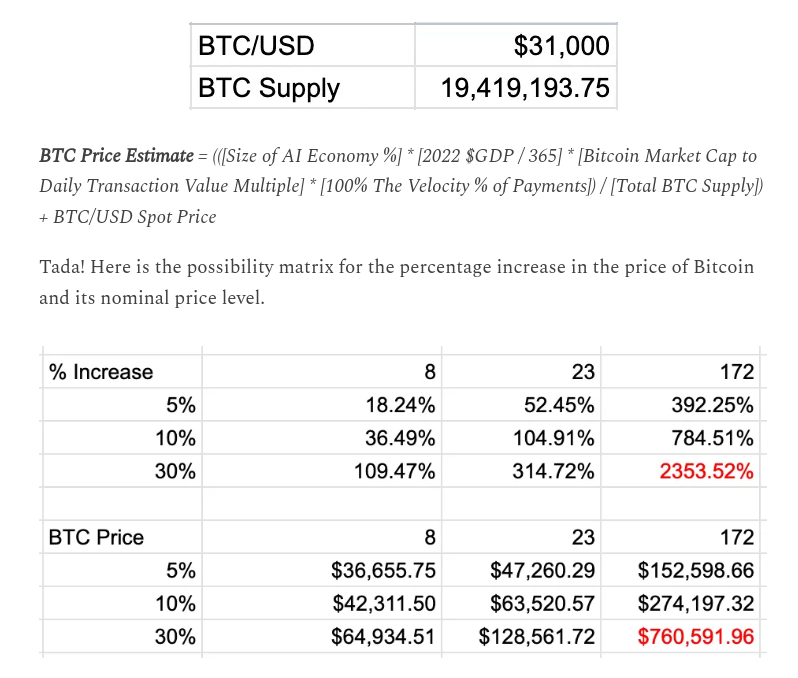
Hayes is well known for his bullish long-term perspective on Bitcoin, recently championing a million-dollar price tag as a function of fiat currency disintegration.
Magazine: Should you ‘orange pill’ children? The case for Bitcoin kids books
This article does not contain investment advice or recommendations. Every investment and trading move involves risk, and readers should conduct their own research when making a decision.

Bitcoin (BTC) miners sold a significant amount of their mined Bitcoin in June to fund their operations, according to Glassnode data analyzed by CryptoSlate.
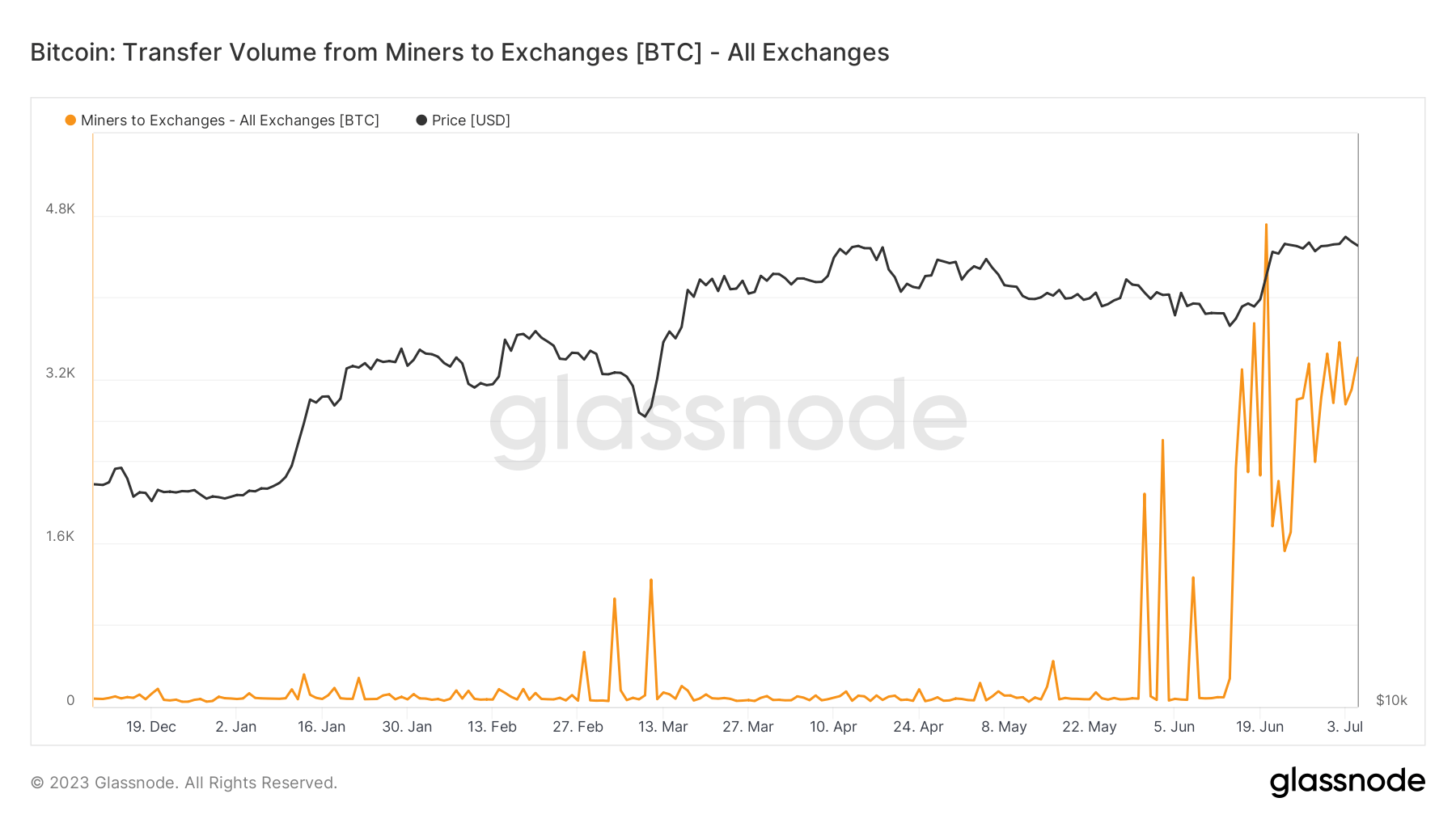
According to the chart below, miners’ exchange flow peaked at 4,710 BTC on June 20—the highest rate of the past five years. Other days of the month also saw significant spikes, averaging over 2000 BTC to exchanges.
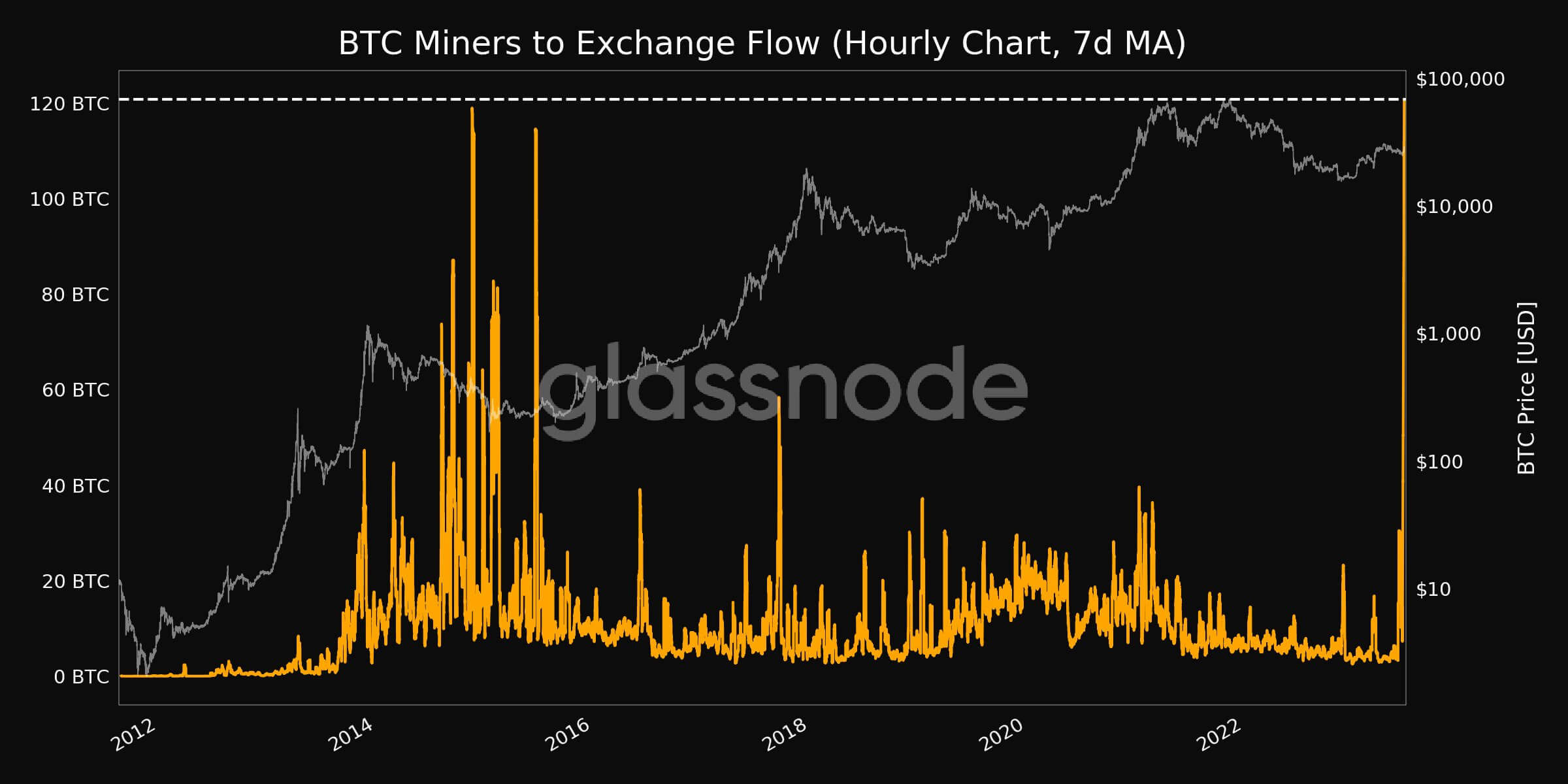
Glassnode stated that the seven days moving average hourly flow from miners to exchange reached as high as 120.77 BTC, one of the highest levels since 2015.
On July 4, CryptoQuant CEO Ki Young Ju said miners sent over 54,000 BTC to Binance in the past three weeks. Ju pointed out that there was “no significant change in BTC-USD open interest, suggesting less likelihood of filling collaterals to punt new long positions.”
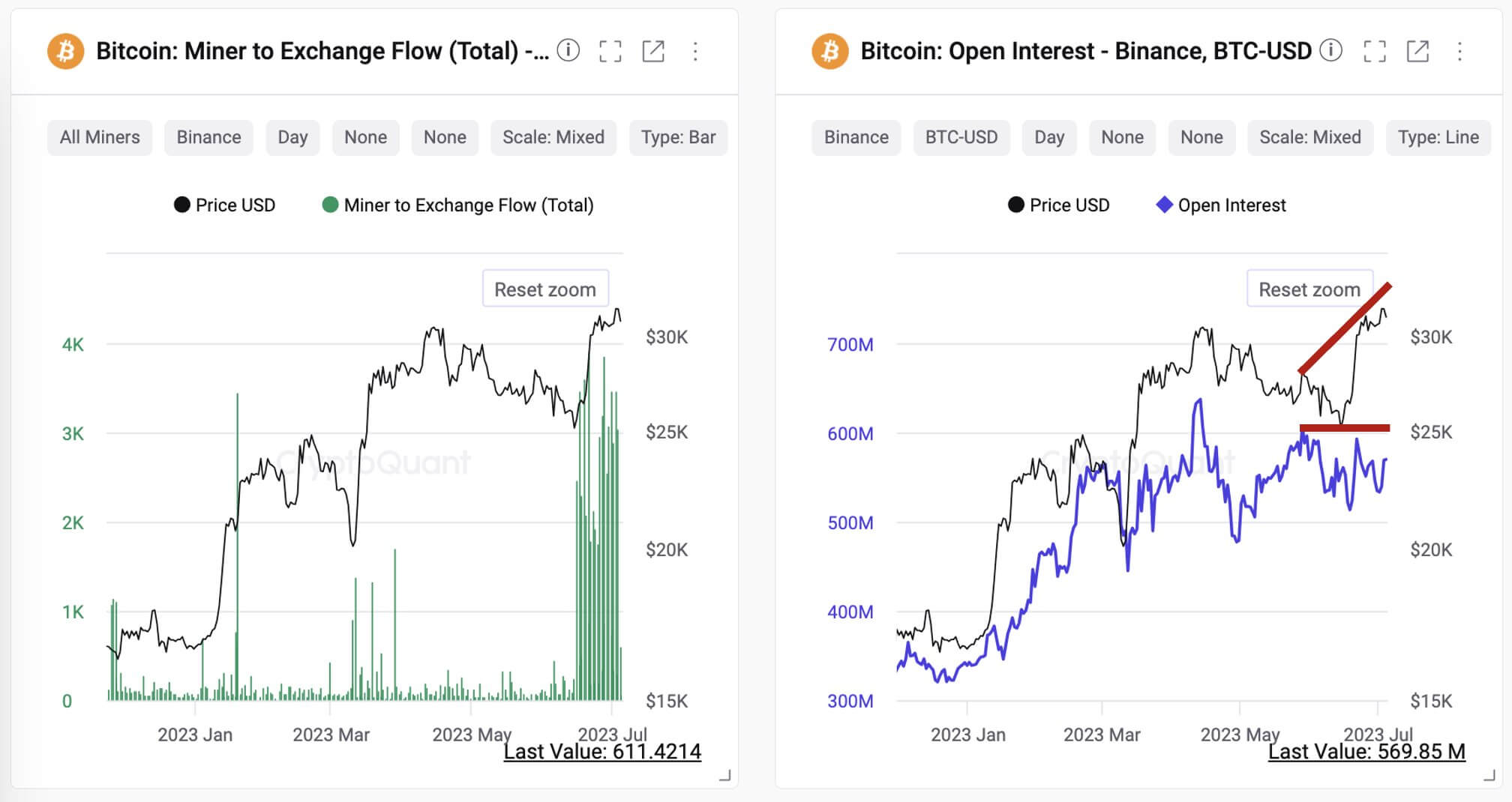
Ju added:
“Spot selling seems more likely.”
In their recently released operational updates, Bitcoin miners Marathon Digital, Cleanspark, and Hut 8 confirmed these transactions.
In a July 6 press statement, Marathon Digital said it sold 700 BTC, representing 71.5%, of its mined 979 BTC in June for an undisclosed sum. Its rival, Hut 8, sold 217 BTC—100% of the Bitcoin it produced in May and 70 Bitcoin produced in June—for $7.9 million.
Meanwhile, Cleanspark sold 84% of the 491 BTC it mined in June for $11.2 million, according to a July 3 statement.
These trading activities suggest miners wanted to capitalize on BTC’s recent price surge to secure profits. In June, BTC mostly traded above $25,000, peaking at $31,268 after several traditional financial institutions, including BlackRock and others, filed for Bitcoin ETFs.
The post Bitcoin miners cash in on June price surge, selling thousands of BTC appeared first on CryptoSlate.

Bitcoin (BTC) lingered below $31,000 at the July 3 Wall Street open, with bulls still in need of a catalyst.
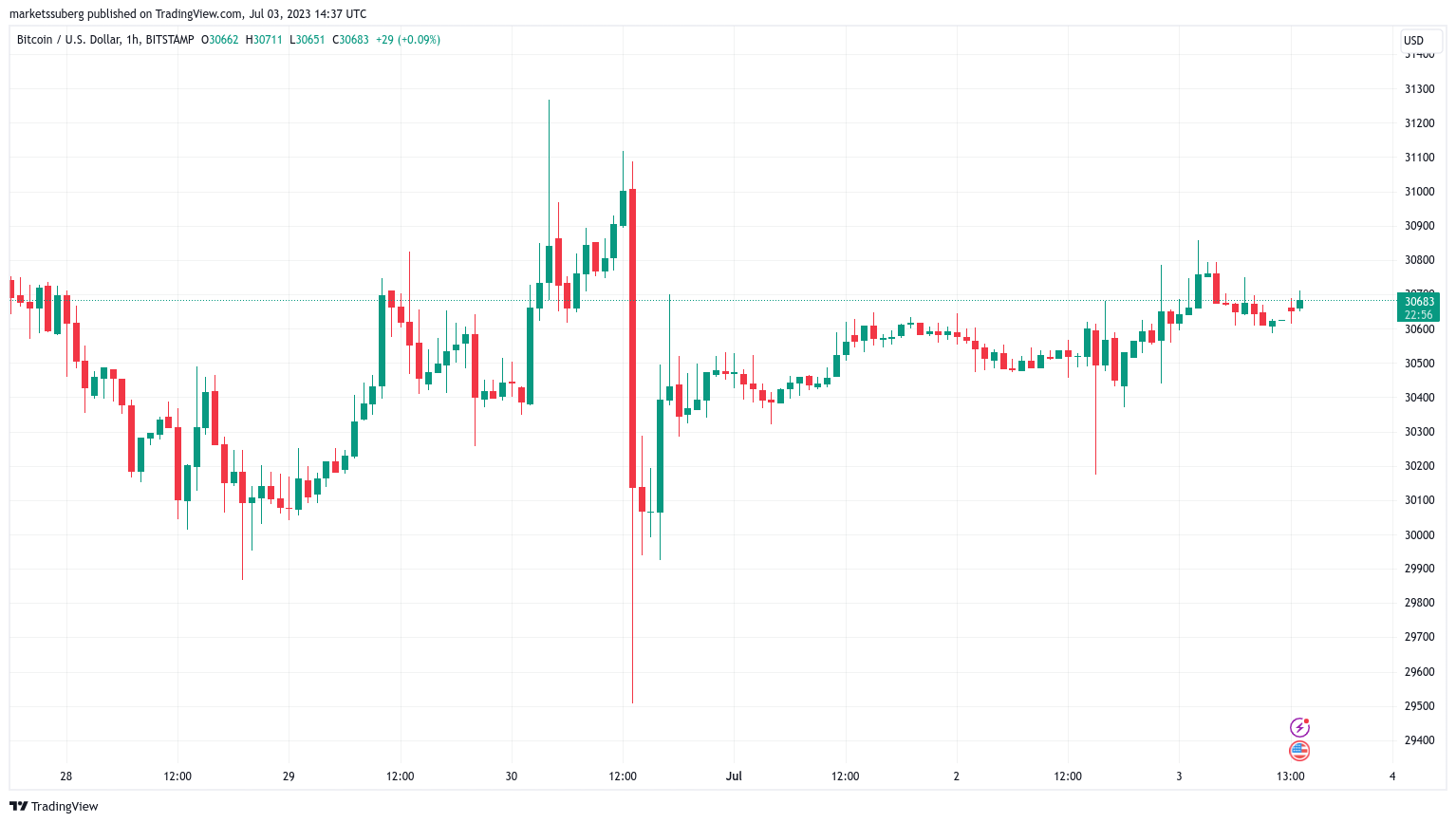
Data from Cointelegraph Markets Pro and TradingView showed BTC/USD acting in a tight range following the weekly close.
BTC’s price performance remained firmly sideways into the new week, punctuated only by modest attempts at attacking the $31,000 mark.
More optimistic market participants hoped that nearby resistance levels — and not only for Bitcoin — would soon fall.
“The more frequently a resistance line is tested, the weaker it becomes,” trading team Stockmoney Lizards argued.
“The day will come when ALL $31k sell orders have been filled.”
An accompanying chart uploaded to Twitter compared BTC price action this year with its pre-bull market behavior in 2016, in the run-up to previous all-time highs in December 2017.

Continuing, popular trader and analyst Rekt Capital suggested that the overall crypto market capitalization was also poised for a breakout.
Total #Crypto Market Cap is really trying to press beyond this black resistance and break out into uptrend continuation
Doing so and the entire Crypto Market Cap could see gains of +10% to up to +23% over time #BTC #Crypto #Bitcoin pic.twitter.com/X2qpgfhZO3
— Rekt Capital (@rektcapital) July 3, 2023
Others eyed downside potential in the face of stubborn resistance. Among them, trader Crypto Tony repeated calls for a trip to $28,000.
“This really is as simple as it gets for Bitcoin this week,” he told Twitter followers on the day.
“We are against the $31,000 resistance zone, so unless we take it out i expect us to draw down to $28,000 for a reload option from the bears. Much prefer if we just pump though this week.”
As Cointelegraph reported, consensus was also building around BTC/USD soon topping out, possibly in the mid-$30,000 range, after a final leg higher.
Meanwhile, the June monthly close had produced a significant move for Bitcoin on monthly timeframes.
Related: Miners send millions to exchanges — 5 things to know in Bitcoin this week
As noted by technical analyst Michael Nauss, BTC/USD, for the first time since the 2021 all-time highs, had closed above an adjusted volume-weighted average price (AVWAP).
AVWAP looks at important support and resistance levels based on trader behavior, and the close above $30,000 marked a resurgence not seen in two years.
First monthly close over the AVWAP from all-time highs in $BTCUSD #Bitcoin pic.twitter.com/AYBMCJvLpL
— Michael Nauss, CMT, CAIA (@MichaelNaussCMT) June 30, 2023
Retweeting Nauss, Caleb Franzen, CEO of Cubic Analytics, called on market observers to lengthen their time preference.
“When the BlackRock ETF application was announced, the price of Bitcoin was roughly $26k and it rose to new YTD highs above $31k,” part of commentary stated last week, referencing ongoing attempts to launch the first Bitcoin spot price exchange-traded fund (ETF) in the United States.
“We’re still trading above $30k and people are losing their minds? Couldn’t be me. Higher highs and higher lows.”
Magazine: How smart people invest in dumb memecoins: 3-point plan for success
This article does not contain investment advice or recommendations. Every investment and trading move involves risk, and readers should conduct their own research when making a decision.

Tesla (TSLA) released its second quarter production and delivery numbers on Sunday, easily beating expectations as the effects of the electric-vehicle maker’s price cuts, combined with federal EV tax credits, are boosting sales.
For the quarter, Tesla reported global production of 479,700 units with deliveries of 466,140. The delivery figure easily topped Wall Street consensus estimates of 448,599 units, as well as the prior quarter’s total of 422,875. Both production and delivery totals for the second quarter were all-time records for Tesla.
Analysts and investors focus more on delivery totals because they most closely track sales totals, which Tesla does not release. Breaking down delivery totals, Tesla delivered 446,915 Model 3 and Model Ys and 19,225 higher-priced Model S and Model X vehicles. The company also said 5% of its sales were subject to lease accounting.
Tesla’s second quarter delivery beat indicates the company’s price cuts are continuing to boost sales both in the US and abroad, though questions remain as to how deep a cut profits will take. Tesla also got another boost from the federal government in Q2 as well, as all trims of the Model 3 sedan qualified for the full $7,500 federal tax credit.
Separately, Wall Street analysts in the past two weeks have been downgrading Tesla shares after a massive run-up in the stock following big gains in the tech sector. Many analysts attributed the run-up to the big gains made by AI-related stocks, with analysts cautioning Tesla wasn’t the big AI-play many investors seemed to believe. Analysts like Mark Delaney at Goldman and Adam Jonas at Morgan Stanley see the stock as fairly valued at the moment.
Finally, Tesla announced it would be releasing second quarter earnings results after the bell on July 19th.
—
Pras Subramanian is a reporter for Yahoo Finance. You can follow him on Twitter and on Instagram.
Click here for the latest stock market news and in-depth analysis, including events that move stocks
Read the latest financial and business news from Yahoo Finance


The rejection of ETF applications by the SEC caused a knee-jerk reaction, but the shallow fall in Bitcoin and several altcoins suggests that lower levels are attracting buyers.


Traditional financial firms finally believe that digital assets are here to stay. Or so one might conclude from the slew of announcements last week from some of the world’s premiere financial players.
Among them is BlackRock — the world’s largest asset manager with $9 trillion in assets under management (AUM) — filed for permission to build a “spot market” Bitcoin-based exchange-traded fund (ETF) — something the United States Securities and Exchange Commission has resolutely resisted.
Others include Fidelity Investments, Charles Schwab and Citadel launching EDX, a new cryptocurrency exchange. In Germany, Deutsche Bank — boasting $1.4 trillion in balance sheet assets — applied for a license to custody crypto. There were others too.
Collectively, these developments boosted crypto trading markets. Bitcoin (BTC) gained 20% in the week, surpassing the $30,000 mark for the first time since April. If allowed, a BlackRock Bitcoin ETF listing on the Nasdaq stock exchange would arguably make Bitcoin more accessible to a larger investing public.
Some even anticipated a stampede to Bitcoin due to the BlackRock filing, as others followed with their own, including Invesco and WisdomTree. Fidelity Investments filed for a spot Bitcoin ETF on June 29.
“The Great Accumulation has begun,” declared Cameron Winklevoss on Twitter, while MicroStrategy’s Michael Saylor added, “The window to front-run institutional demand for #Bitcoin is closing.”
The Great Accumulation of bitcoin has begun. Anyone watching the flurry of ETF filings understands the window to purchase pre-IPO bitcoin before ETFs go live and open the floodgates is closing fast. If bitcoin was the most obvious and best investment of the previous decade, this…
— Cameron Winklevoss (@cameron) June 21, 2023
Others professed little shock about these developments, however, even after a year of crypto-related scandals, bankruptcies, lawsuits and regulatory uncertainty in the United States. By this view, the institutions were just bowing to the inevitable.
“I’m not surprised, since from a fundamental point of view, the movement of digital value is the next obvious evolution of the internet,” Jim Kyung-Soo Liew, associate professor of finance at Johns Hopkins Carey Business School, told Cointelegraph. “What is surprising is how the U.S. hasn’t embraced it.”
Last week’s events raise some questions: How enduring are Bitcoin’s most recent price gains? There have been institutional investor sightings before. Will this time be different, or will Bitcoin and other cryptocurrencies resume their sideways market activity?
On the other hand, a firm the size of BlackRock really could transform the BTC market, some believe.
Bitcoin has a fixed supply limit of 21 million BTC and its existing inventory is relatively illiquid. Sixty-eight percent of BTC in circulation hasn’t moved at all in the past year, according to Glassnode. There isn’t a lot of stock on the shelves for BlackRock and others to snap up, in other words. If demand exceeds supply, doesn’t that inevitably mean price gains for BTC?
Magazine: How smart people invest in dumb memecoins: 3-point plan for success
Also, where do retail investors fit in among the new institutional arrivals? Maybe ordinary crypto users are also needed to stabilize the price of Bitcoin.
Finally, assuming the so-called Great Accumulation really is happening, how far can it go? The cryptoverse has a market capitalization of about $1 trillion today, roughly half of which is in Bitcoin. Could the crypto market cap reach a 10-fold increase of $10 trillion in five years?
“Anyone watching the flurry of ETF filings understands the window to purchase pre-IPO bitcoin before ETFs go live and open the floodgates is closing fast,” declared Winklevoss, adding: “If bitcoin was the most obvious and best investment of the previous decade, this [spot Bitcoin ETF] will likely be the most obvious and best trade of this decade.”
Is the co-founder of the Gemini cryptocurrency exchange right?
“Clearly, there is significant investor demand for Bitcoin access through regulated investment funds from a broad spectrum of U.S. investors,” Sui Chung, CEO of CF Benchmarks, told Cointelegraph, “Otherwise, BlackRock, Fidelity, Invesco and other major asset managers would not have filed S-1s for Bitcoin ETFs.”
The entry of BlackRock and other investment managers into this new asset class isn’t so unexpected, either. “We’ve long known that BlackRock is enabling BTC investments for clients through their Aladdin platform and Bitcoin private fund,” Doug Schwenk, CEO of Digital Asset Research, told Cointelegraph.
The recent negative news stories swirling around Binance and Coinbase “are not related to Bitcoin and may be seen as an opportune time for a better-known, more regulated brand to provide alternatives that end-buyers can trust. A BTC ETF is a natural step.”
Winklevoss, Saylor and others warn that retail investors had better buy Bitcoin now to get its ostensibly cheaper “pre-IPO” price before BTC’s price skyrockets. Are they correct?
“There is some truth to that given the finite supply of Bitcoin and increasingly low rate of supply growth,” added Chung. “However, plenty of investors bought in the $50k to $69k range and they are still underwater; on top of that, cash earns 5%+ at the moment. To me, trying to time the market, especially one as volatile as crypto, is a fool’s errand.”
Moreover, the Winklevoss scenario “depends on how certain one is that institutions are truly coming and that the ETFs and other infrastructure plays by large institutions will play out,” Justin d’Anethan, head of business development for the Asia-Pacific region at Keyrock — a Europe-based digital asset market maker — told Cointelegraph.
“Forward-looking investors will probably try to front-run that move and buy before any of this is truly released. I’m personally a bit less certain about how soon this will happen, though,” d’Anethan added.
Assuming BlackRock succeeds in its ETF quest and other institutional investors follow, would that stabilize the price of Bitcoin at a substantially higher level than the current $30,000? Or does long-term price stability also require broad retail participation?
“It all depends how much AUM they can gather if they are approved,” answered Chung. “If it’s a substantial amount, then it stands to reason that it would lift the price substantially given the finite supply. Bitcoin and its price is agnostic as to who buys Bitcoin and through what means. Buying demand just has to outstrip selling demand and the price will appreciate.”
Carol Alexander, professor of finance at the University of Sussex Business School, told Cointelegraph that a slew of spot Bitcoin ETFs could actually make BTC less stable and more volatile. “If there’s too many ETFs, all these market makers trying to hedge their positions could be selling at the same time or buying at the same time. It could increase volatility… I disagree with what Winklevoss said.”
Alexander has her own BTC price scenario, which assigns retail investors a key role. In March, when BTC was trading around $20,000, she predicted the coin would rise to $30,000 by June and move sideways through the summer. That has largely come to pass. “So the question is, what’s going to be happening in September?” she asked.
“I’m not saying it will — but it could go up to around $50,000. That’s because people come back after the summer, and there’s more liquidity in the markets.”
But it’s also because retail investors are no longer scared after the long string of crypto drawdowns, scandals, bankruptcies and regulatory actions of the past year. The growing investment in the digital asset market by large financial institutions like Fidelity Investments and JPMorgan Chase has arguably had a calming effect on retail investors.
“I think we’re going to be seeing much more acceptance from really ordinary people starting in September as you get some more regulatory clarity about things. That extra volume of trades could bring the price back up to — I’m not saying $68,000 where it was, that would be too high […] — but there’s that sweet area around the $50,000 mark, which I think will be the next long-term resistance level.”
In a June 19 global survey by Nomura Laser Digital, 90% of professional investors said it was “important” that any digital-asset funds or investments have the backing of a large traditional financial institution — at least before considering putting their clients’ money into it. Maybe this past week’s announcements by BlackRock, Fidelity, Deutsche Bank, et al. are the signal they were waiting for.
“Perhaps,” Schwenk said. “Only time will tell. It’s hard to pick when the tipping point will be. We have had participation from other large traditional firms — BNY Mellon, State Street, Standard Chartered, Franklin Templeton, etc. That hasn’t been enough to satisfy the respondents in the survey yet, but eventually, they will see enough momentum.”
In the medium term, how high could things go? With the active participation of large TradFi firms like BlackRock, Fidelity and Deutsche Bank, could crypto market capitalization grow from $1 trillion to $10 trillion or more over the next five years, for instance?
“Five years ago, the entire market cap of liquid crypto, as measured by the CF Large Cap Index, was around $250 billion and hit a high of around $2.6 trillion in late 2021,” said Chung. “So 10X would seem to be within the realms of possibility.”
Major institutions putting their distribution networks to work to support further adoption would also provide “a significant tailwind,” he added. “However, interest rates were not 5% in that previous five-year period — they are now. What impact that might have is impossible to know.”
Recent: Open source: Buzzword or real security for crypto wallets?
Alexander was less bullish. “A Bitcoin ETF — I don’t even see that it’s needed.” Most ETFs are a basket of equities or a basket of currencies. An ETF with a basket of cryptocurrencies like Bitcoin, Ether (ETH) and Solana (SOL) “would make a lot more sense,” in her view.
Sightings of institutional investors just outside the boundaries of the cryptoverse have been reported before, but they have never quite entered en masse. Why might this time be different?
“Institutional investors are very slow and thoughtful in their due diligence process,” Johns Hopkins’ Liew said, but “they have finally come to see the Bitcoin light. It’s just too exciting to pass up and their customers are pushing them for products.” From an empirical perspective, some crypto exposure is a good means of diversifying an investment portfolio, he noted, summarizing:
“If institutional investors enter the party, their demand would certainly drive prices higher. It would definitely be exciting times for BTC.”
“The involvement of large financial institutions, whether it be for ETF applications or the new EDX exchanges, represent a significant shift and a decisive moment for crypto markets, in the U.S. and globally,” concluded d’Anethan.

Bitcoin (BTC) spiked through $31,000 on June 30 as a nearly $6 billion open interest expiry loomed.
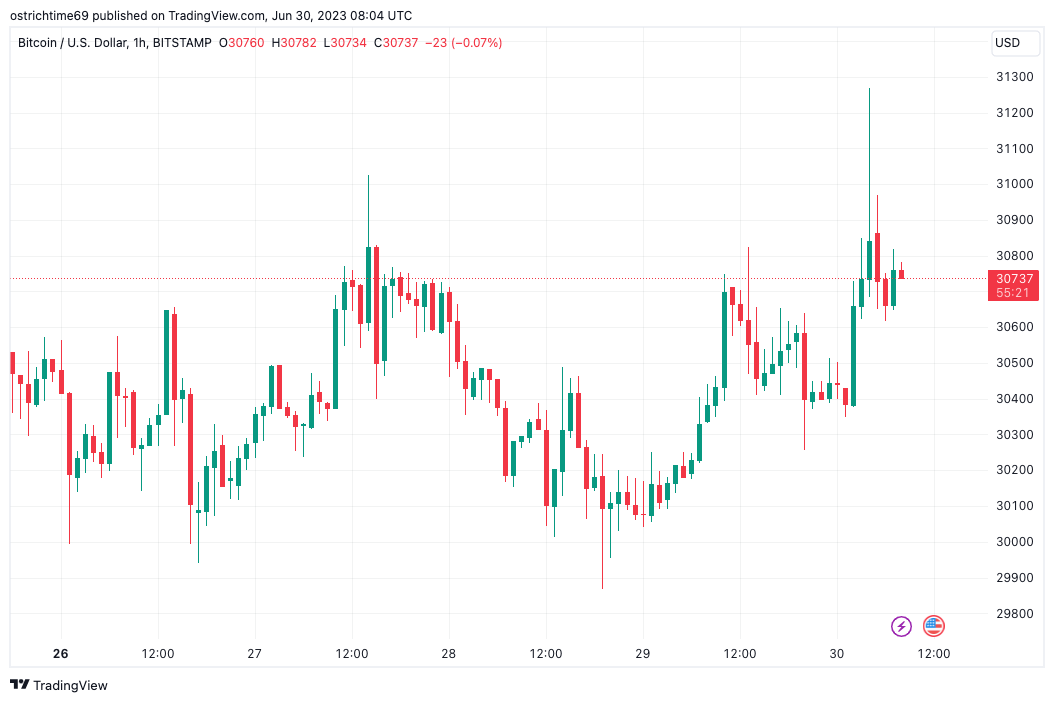
Data from Cointelegraph Markets Pro and TradingView showed BTC/USD hitting local highs of $31,268 on Bitstamp before returning lower.
BTC price performance improved into a key quarterly options expiry event, the second largest in Bitcoin’s history, with analysts keen to see its effect on markets.
“Will be interesting to see how much is rolled over to future expirations and whether that OI is call or put dominant –> as that will impact how dealers hedge (buy or sell BTC),” financial commentator Tedtalksmacro wrote in part of associated commentary.
June 30 represents a key date for BTC traders all around, with the options expiry forming just one in a series of key events.
Macroeconomic data from the United States in the form of the Personal Consumption Expenditures (PCE) print is also due, leading up to the monthly and quarterly candle closes.
For popular trader and analyst Rekt Capital, a close above $29,255 would confirm a breakout on monthly timeframes.
#BTC is positioning itself for a Monthly Close above a resistance that had rejected price for the past three months
And now $BTC is holding comfortably above that same level (black)#Crypto #bitcoin pic.twitter.com/b42XYWfcLi
— Rekt Capital (@rektcapital) June 29, 2023
Likewise, quarterly resistance at $28,872 was a focus, withRekt Capital noting that the same level had formed both resistance in Q1 2023 and 2020, as well as support in 2021.

Data from monitoring resource CoinGlass put Bitcoin’s current Q2 gains at 8% — still far behind Q1 performance over 70%.
Others hoped that regardless of the potential volatility, Bitcoin would still be able to reach new local highs.
Related: Bitcoin speculators send 35K BTC to exchanges in new ‘elation inflow’
Among them was trader Crypto Tony, whose primary target was $32,000.
$BTC / $USD – Update #Bitcoin once again looking to work some magic and climb above that supply zone. Would be a Friday treat if we can manage to do that today .. pic.twitter.com/vBzeMvgXE4
— Crypto Tony (@CryptoTony__) June 30, 2023
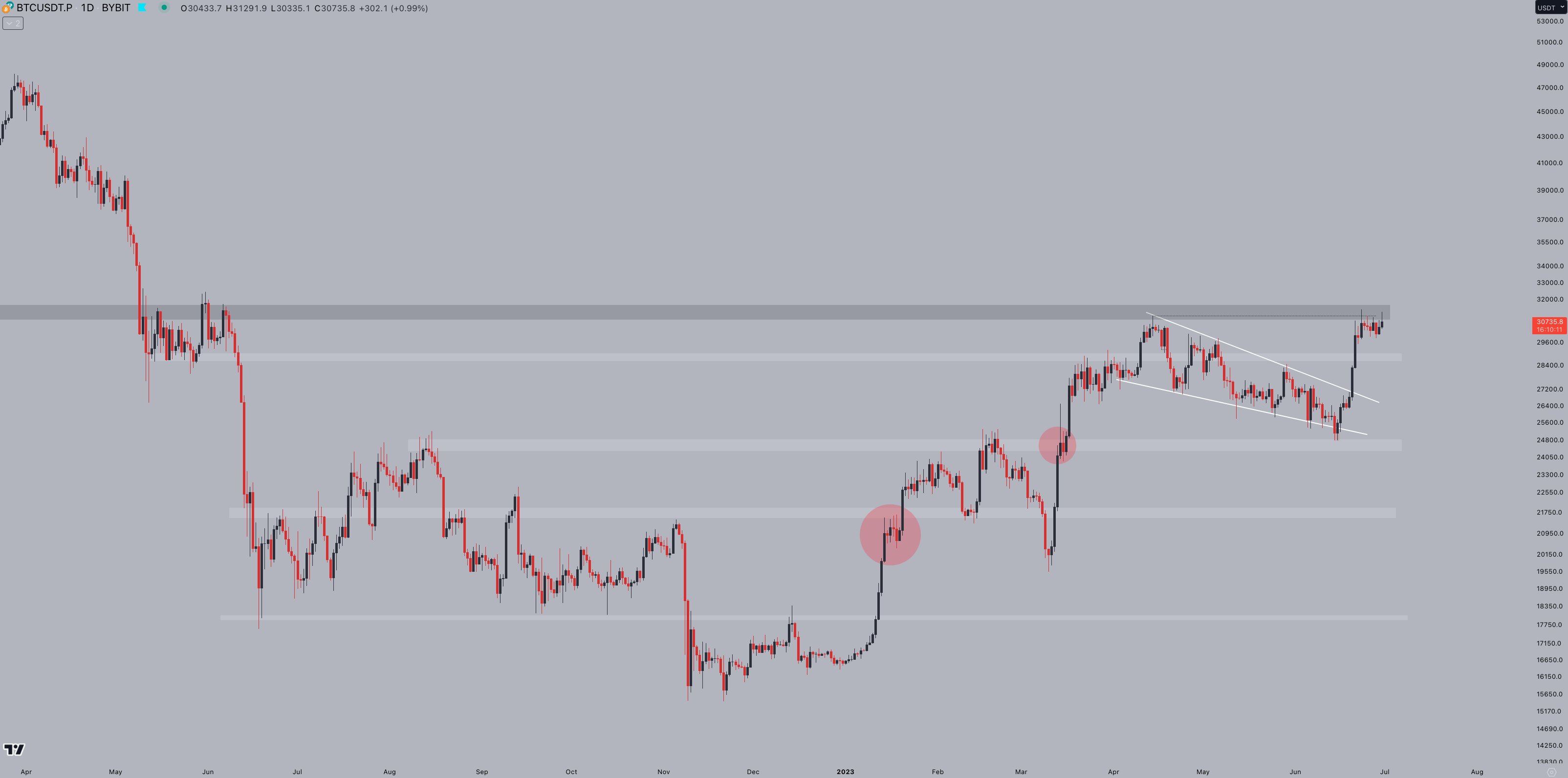
Fellow trader Jelle acknowledged that BTC price was having trouble sustaining higher levels beyond brief spurts higher, with these always met with a retracement.
“The upside wicks in this consolidation may look scary, but we saw similar price action in the areas circled in red,” he reasoned, looking back on a chart of BTC/USD over the past year.
“Bitcoin looks eager for upside, sometime next week.“
Magazine: How smart people invest in dumb memecoins: 3-point plan for success
This article does not contain investment advice or recommendations. Every investment and trading move involves risk, and readers should conduct their own research when making a decision.

The Polkadot Decoded 2023 conference just wrapped up and this year more than 100 speakers and 100 blockchain projects were in attendance.
The beauty of crypto bear markets is they catalyze a realignment of perspectives and objectives.
All the hidden leverage is gone and most of the speculation is gone.
SBF is gone.
Do Kwon is gone.
Three Arrows Capital, Su Zhu, Kyle Davies and a handful of other hucksters and snake oil salesmen have been exiled.
And good riddance to all of them. Crypto doesn’t need hopium, messiahs, populists and dream peddlers. What we need are builders, fresh ideas, solutions that have product-to-market fit and some sort of realistic real world application.
That’s what I like about blockchain conferences. Especially during a bear market.
The buidl first mentality is the whole vibe of Polkadot Decoded. For the past two days, a tightly knit community of ecosystem siblings composed of developers, investors, ambassadors and a few curious journalists such as myself rendezvoused at the Øksnehallen conference center which is tucked away from the bustling, cobblestoned streets of central Copenhagen, Denmark.

The location is almost poetic given that it is a surprisingly quiet spot that is discreetly nestled within a thriving city center, and that ethos carried on through the conference events where the focus has been:
Hardly anyone is talking about airdrops, token prices, memecoins, Bitcoin (BTC) hitting a new all-time high or any of the general conversational fodder that forms the bulk of most crypto discussions.
Rather than price, panellists discussed the challenges and occasional successes of helping TradFi and Web2 companies transition into Web3, the steps being taken to make the VC funding of projects more transparent, and the need for all the crypto jargon and rigamarole to be placed on the backend of DApps and the frontend UX to be more seamless.
Many folks even suggested that “blockchain,” “crypto,” and “Web3” should not be mentioned on projects’ websites, apps, roadmaps and so on.
According to Public Pressure CEO Giulia Maresca:
“I think it’s not about talking about the technology because mass adoptees don’t know how the phone or Google maps or any technology is working. We need to create products that are really easy for the user, but given the benefit that they are built on Web3 tech. It should be really easy for the user; it shouldn’t be complicated. We shouldn’t talk about wallets, or bridging or doing complicated crypto things. People get scared the minute you start talking about wallets. It should be as easy as using Instagram.”
Speaking of Web3 and the need for crypto to have a better product-to-market fit and connection to real-world assets, I moderated the opening panel at Polkadot Decoded, which focused on on-chain entertainment within music and film. It was an intriguing conversation, given that the general consensus among creators and builders is that music and film will be the most sticky when it comes to user growth, retention and mass application of NFTs within everyday life.

During the panel, Maresca explained why she believes that there is a natural synergy between creative industries and Web3 ideology:
“Web3 is a very socratic and creative space, and that aligns with the workflow and ideas of artists and creators.”
Maresca also firmly believes that phygital NFTs and experiences will gain a firm foothold in the areas of fashion design, the film industry and all aspects of the music industry.
Providing a real-world example of how fashion labels like Diesel were making entry to the Web3 space, Maresca explained:
“Diesel would like to be more into Web3, so we’ve helped them to build a really strong concept using music at the center of their strategy, so Diesel acting like a discovery label, discovering emerging and breakthrough artists to give voice to their art. And they’ve done a few drops with us already which were really successful, but we’re planning a big drop at the beginning of September that is going to be a phygital drop. So, I think now a big part of the future is phygital; it is giving experience, utilities, what the community wants, which is to have a VIP experience. They want something from the brand, not only the garments. They want to be part of the Diesel family. It’s a long process and lots of education to the C-level, but there are a lot of opportunities for brands to work with the music community, to fans, and to new fans.”
Ed Hill, senior vice president of media services at Beatport, emphasised that rather than being a mere buzzword, Web3 needs to become a tangible and actionable ideology within the corporate structure of the entertainment industry.
When asked about the disconnect between consumer desires, creators’ objectives and the products and experiences currently provided by the entertainment industry, Hill said:
“That’s a tough one to crack, but we have to go deeper and build better communities. If you look at YouTube and Facebook, those platforms are audience builders, and all anyone has cared about is views, and reach, and impressions and things like that. We have to go deeper into community building, and failure to do that is why younger audiences have been splitting away from traditional Web2 social media platforms, and I think, in time, if we build better, authentic communities from the ground up, that space between the corporate to creator to consumer gap begins to tighten.”
Related: New Web3 ID app lets users find each other based on proven interests
From my vantage point, and that of most conference attendees, crypto is about community, and the most viable projects tend to have a very grassroots approach where community members are stakeholders and their desires factor into the direction of the project. Historically, every time the crypto sector strays from this ethos and falls victim to the whimsy of money chasers and demagogues, investors and community members are essentially robbed of their agency within the project.
In order for corporations to transition into Web3 in an authentic way that bears fruit, creators, consumers and community members have to be viewed as more than a simple proletariat within a system purely focused on spinning up revenue and co-opting culture and turning creator IP into corporate marketing trinkets. Crypto media should take note too, but I digress.
Similar sentiments, which culminated with an optimistic take on the future of Web3, were expressed by Define Creative founder Finn Martin, who said:
“What gets me excited about Web3 is it offers all the tools and solutions to actually fix the problems that traditional Web2 has. By moving the assets on a chain, you can make it transparent for creators, you can give them direct revenue because, currently, the streaming model is broken. As a music creator, you own a fraction of a cent from each stream, and all of that can be addressed and solved via Web3.”

Generally, vast blockchain ecosystems tend to have a disjointed feel where a multiplicity of objectives and philosophies have investors and advocates feeling lost at sea. These projects tend to struggle with clearly defining their purpose, and this has a knock-on effect of impacting market fit efficacy.
They basically still struggle with the age-old crypto problem, which entails creating solutions for problems that aren’t actually problems for normal people. What stands out most to me at Polkadot Decoded 2023 is a unified goal of making the chain easier to use for builders, investors and users.
Regardless of whether the project is an AMM, DEX, lending market, blockchain-gaming startup, IPFS storage solution or a cross-chain bridge, each panel has made some reference to the need for composability, interoperability and turning the concept of Web3 from a thought to reality by building infrastructure for projects to thrive on.
Which is why I again emphasize the importance of getting out from behind the screen and TradingView token price action charts and into fellowship with the community at conferences. No man is an island, and there’s value in finding a safe space to socialize, ideate, test and refine one’s investment thesis and views on the evolution of blockchains.
Hat tip to Polkadot Decoded for having the right narrative on lock this year.
Ray Salmond is an editor and the head of markets at Cointelegraph. After discovering Bitcoin in 2016, he went on to work as the head of content and marketing at a variety of blockchain startups. Aside from swing trading anything that moves and chasing after the next DeFi airdrop, Ray is an avid beer drinker and BBQ fanatic who is content to be living a quiet life in the suburbs.
This article is for general information purposes and is not intended to be and should not be taken as legal or investment advice. The views, thoughts, and opinions expressed here are the author’s alone and do not necessarily reflect or represent the views and opinions of Cointelegraph.

The price of Ether (ETH) faced strong resistance at $1,920 after a 17.5% rally between June 15 and June 22. Several factors contributed to the limited upside, including worsening macroeconomic conditions, the regulatory cryptocurrency environment and weaker demand for decentralized applications (DApps) on the Ethereum network.
On June 26, a federal judge denied a motion from Binance that could have stopped the United States Securities and Exchange Commission (SEC) from issuing public statements related to the case.
In addition, in its mid-year outlook, HSBC Asset Management’s report warned of an economic downturn in the U.S. in the fourth quarter, followed by a “year of contraction and a European recession in 2024”. The report also noted that “corporate defaults have started to creep up.”
Finally, International Monetary Fund chief economist Gita Gopinath told CNBC on June 27 that central bankers should “continue tightening” by keeping interest rates high for longer than expected.
Usage of DApps on the Ethereum network failed to gain momentum as gas fees dropped 60%. Notably, the seven-day average transaction cost dropped to $3.7 on June 26, down from $9 four weeks prior.
DApp active addresses also declined by 27% in the same period.

A large chunk of the decline was concentrated on Uniswap and MetaMask Swap, while most nonfungible token (NFT) marketplaces saw a surge in their unique active wallets (UAW).
Despite Uniswap NFT Aggregator’s lackluster performance, the sector faced a decent influx of users on OpenSea, Blur, Manifold, LooksRare and Unick.
More concerningly, however, is that the total value locked (TVL) — measuring the deposits locked in Ethereum smart contracts — reached its lowest level since August 2020. The indicator declined by 6.9% between April 28 and June 28 to 13.9 million ETH, according to DefiLlama.
So how are professional traders positioned for the next ETH price move? Let’s look at Ether futures to gauge the odds of ETH/USD breaking above the $1,920 resistance.
ETH quarterly futures are the preferred instruments of whales and arbitrage desks. However, these fixed-month contracts usually trade at a slight premium to spot markets, as they demand an additional fee to postpone settlement.
As a result, in healthy markets, ETH futures contracts should trade at a 5–10% annualized premium, a situation known as contango.
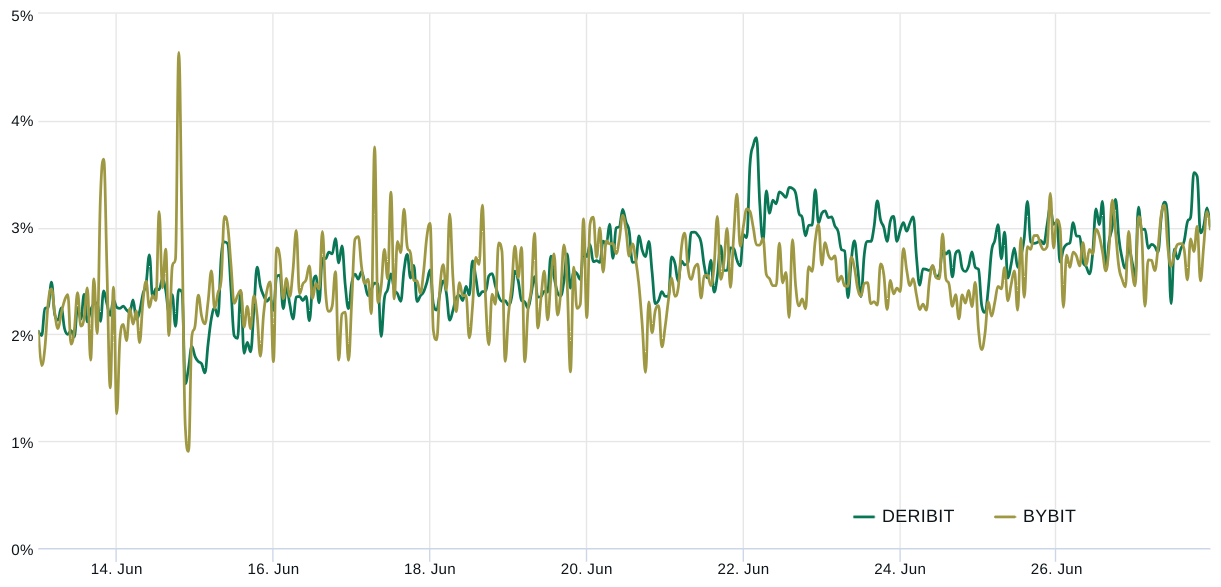
According to the futures premium — known as the basis indicator — professional traders have been avoiding leveraged longs (bullish bets). Despite the modest improvement to 3%, the metric remains far from the neutral 5% threshold.
To exclude externalities that might have solely impacted the Ether futures, one should analyze the ETH options markets. The 25% delta skew indicator compares similar call (buy) and put (sell) options, and will turn positive when fear is prevalent because the protective put option premium is higher than the call options.
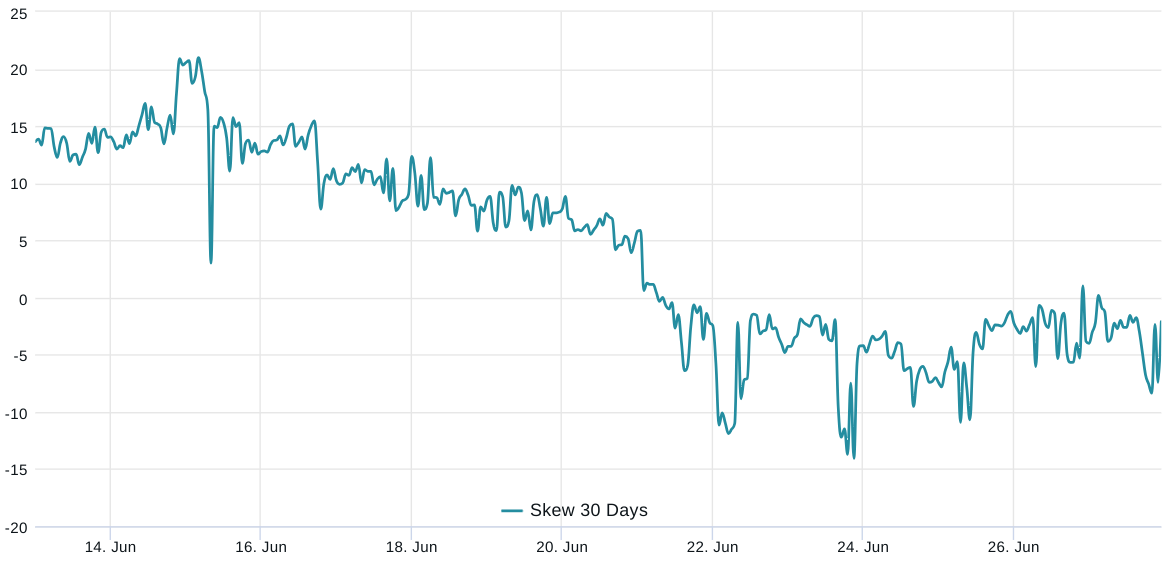
The skew indicator will move above 8% if traders fear an Ether price crash. On the other hand, generalized excitement reflects a negative 8% skew.
As displayed above, the delta skew has been flirting with moderate optimism since June 22 but has been unable to sustain it for long. Presently, the negative 2% metric displays a balanced demand for options.
Judging by the ETH derivatives metrics, and declining TVL and DApps use, bears are better positioned to defend the $1,920 resistance. Moreover, the worsening macroeconomic conditions and cryptocurrency regulatory news confirm the moderate pessimism for risk-on assets, including Ether.
Related: 3 reasons why Ethereum’s market cap dominance is on the rise
That does not necessarily mean that Ether is bound to retest $1,750, but it certainly presents an enormous hurdle for ETH bulls after failing to break the $1,920 level on three occasions between June 21 and June 25.
Consequently, at least for the short term, bears have better odds of successfully defending this important price level.
This article is for general information purposes and is not intended to be and should not be taken as legal or investment advice. The views, thoughts, and opinions expressed here are the author’s alone and do not necessarily reflect or represent the views and opinions of Cointelegraph.