
A Bitcoin-themed van promoting adoption around Europe has seen its fair share of drama, including a midnight stop and search by law enforcement agencies.


A Bitcoin-themed van promoting adoption around Europe has seen its fair share of drama, including a midnight stop and search by law enforcement agencies.
Google Cloud is the latest company to show interest in Bitcoin (BTC) Lightning. The $225-billion cloud and data service recently partnered with Voltage, an infrastructure provider specializing in the Bitcoin Lightning Network.
The partnership will allow one of the world’s largest cloud computing providers to roll out Bitcoin-based services worldwide while assisting the expansion of Voltage’s operations. Graham Krizek, CEO of Voltage, told Cointelegraph:
“Voltage is leveraging Google Cloud to go to service our customers more globally. So, we have larger customers that need nodes deployed in specific geographic regions like the U.K. or Asia.”
Conversely, Google can use “Voltage as sort of their outsourced Bitcoin and lightning team.” He said, “We service that business for them of actually, you know, helping companies that are interested in adding Bitcoin or Lightning into their services.”
The announcement received significant traction on social media and reflects Google’s growing understanding and acceptance of Bitcoin and Lightning. But crucially, the implications of the partnership run deeper.
Christopher Calicott, managing director of venture capital firm Tramell Venture Partners, told Cointelegraph, “We had some people that were former Googlers in backchannels […] saying this is the kind of unexpected [social media] engagement that definitely gets people’s attention at Google.”
Moreover, Google’s open-minded approach to Lightning diametrically opposes that of its competitor, Apple. Apple delisted Damus, the Lightning-friendly decentralized social media protocol, from the App Store recently, demonstrating an aversion to Lightning. Calicott explained that the tech world could be warming up to Lightning:
“There is a growing and broad-based corporate tinkering with Lightning in particular right now. If they’re adjacent to payments, they would ignore Lightning at their peril.”
Google Cloud operates under the umbrella of its parent company, Alphabet. The payments platform Google Pay boasts hundreds of millions of users in more than 15 countries.
Since 2020, the investment arm of Google, Google Ventures (GV), has shown a robust interest in blockchain and Web3 companies, as well as Bitcoin.
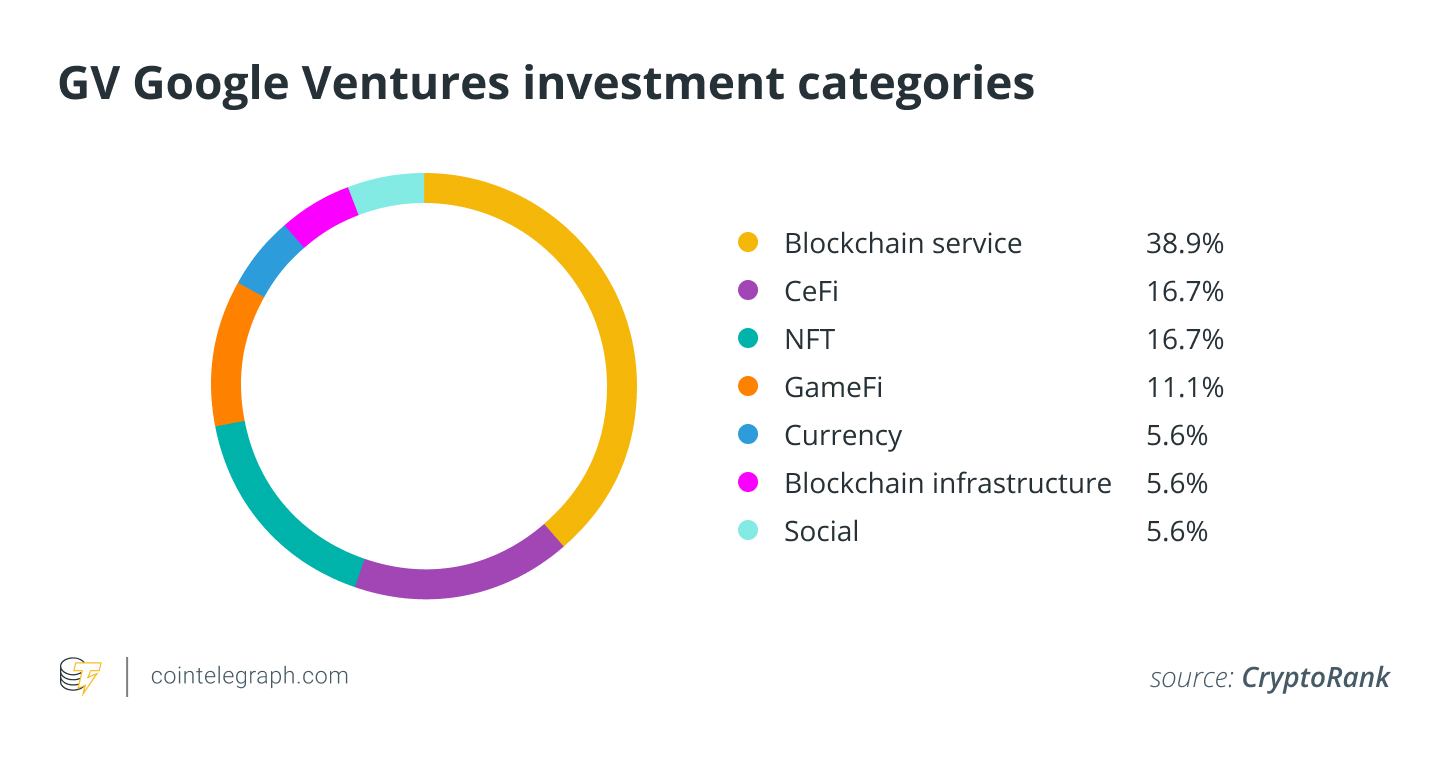
GV participated in a $6-million seed round for Voltage in 2021. For Calicott, the interest of such a big player in the crypto space could be a sign of growing momentum:
“I hate to over-index on any one particular corporation here, but just for me, like anything in life, when people put their money where their mouth is, it sends a very strong signal of where they’re focusing.”
Krizek agreed, “I think that this really is a big signal into enabling more Bitcoin-focused strategies amongst Google specifically, but also just larger organizations.”
Despite Apple striking off the Lightning-friendly app Damus — much to the chagrin of the former Twitter CEO Jack Dorsey — Lightning continues to gain traction among billion-dollar businesses worldwide. One of Mexico’s largest companies has begun experimenting with Lightning, while two major crypto exchanges, Binance and Coinbase, recently promised Lightning integrations.
Related: The world’s biggest Bitcoin conferences: Decentralize with Cointelegraph
Nonetheless, it’s still early, and “we’ve got to observe this as it grows,” Calicott noted. Krizek, who’s seen his fair share of Bitcoin ups and downs, having participated in the Bitcoin space since 2012, underscored why the partnership is important:
“As we start to expose these organizations more so into Bitcoin and what is possible with it via Lightning, I think we’ve caught their attention already with the amount of interest and demand that we’ve had from this.”
He added that more services should be rolled out in the near future, complemented by efforts in Bitcoin education.
Magazine: Peter McCormack’s Real Bedford Football Club puts Bitcoin on the map
In mid-April 2023, a frog memecoin called Pepe dominated discussions in crypto circles after going up parabolically in the span of a few hours, going up by as much as 21,000%. Pepe follows a long list of memecoins led by Doge and Shiba Inu that made millions for some and lost even more money for others.
In early April 2023, Elon Musk temporarily made the Dogecoin logo the face of Twitter. Again, the value shot up, then went back down again after.
Critics point to the memecoins as the worst of the tokens that have absolutely no underlying and redeeming value. Rightfully so, these memecoins might suddenly skyrocket parabolically, but then just crash down and burn spectacularly. There is no buy-and-hold strategy for memecoins. You don’t really hold these.
I hold zero memecoins and am merely examining these from a cultural perspective. I do agree these have no underlying value. These simply reflect a very short time in history when these are valued, but that value is only because it could make money for the holder. There is no emotional attachment to memetokens.
What possible use could memecoins have?
The only possible use that meme coins can have (and this in no way should encourage people to purchase these risky tokens) is these memes make blockchain and crypto less scary.
Take for example Ethereum (I own some) and the new layer-2 scaling solutions like Optimism, Arbitrum, zkEVM, zkSync, Linea, Base, Starkware, MATIC and others (that I don’t own). Personally, I do not really grasp how these things really work. I do know these have future potential for migrating a lot of Web2 functions owned by giant centralized companies to decentralized Web3.
Join the community where you can transform the future. Cointelegraph Innovation Circle brings blockchain technology leaders together to connect, collaborate and publish. Apply today
But other than a high level of understanding, I don’t really know how these work. All I know is they help speed up Ethereum and have lower gas fees.
The terms sound too technical, and too nerdy. I consider myself fairly proficient with technology, but what about the rest of humanity that we claim we want to encourage to migrate to the blockchain? The tribal culture seems almost like a religion or a secret society that has its own jargon, practices and other customs. Seriously, how can ordinary folks adopt it?
Memecoins fill a cultural need. People may not understand zero-knowledge succinct argument of knowledge (SNARK) scaling solutions, but they might own dogs, cats or other pets. It gets through the emotional part of our psyche, not the logical part — especially with cute pets as memes.
Putting a cute face to this technology might be one way to encourage people to experiment with it. Wallets are already too clumsy to use because of hexadecimal wallet addresses. Remembering not to send ETH to a BTC wallet and vice versa is another thing to keep track of for those new to the space. There is actually lots of things you need to learn and remember. Most people will shrug it all off and say, “Why bother?”
Mind you, experimentation could mean buying a few dollars worth. Not plunking several hundred or thousand which is really a gamble on your part. More like buying a few tokens in an amusement park to have a good time. That’s all.
Again, I do not encourage jumping into meme coins. Unlike crypto blockchain infrastructure tokens like Bitcoin, Ethereum, Solana and others, these memecoins tend to be pump-and-dump tokens. Sure you might make a hundred to even a thousand times your money if you enter at the right time, but most people will end up losing their money, so it’s really a gamble.
Looking at the big picture, however, they may help get people into the space. A small way to get their feet wet, before they take the plunge into more serious crypto.
The information provided here is not investment, tax or financial advice. You should consult with a licensed professional for advice concerning your specific situation.
Zain Jaffer is the CEO of Zain Ventures focused on investments in Web3 and real estate.
This article was published through Cointelegraph Innovation Circle, a vetted organization of senior executives and experts in the blockchain technology industry who are building the future through the power of connections, collaboration and thought leadership. Opinions expressed do not necessarily reflect those of Cointelegraph.
Learn more about Cointelegraph Innovation Circle and see if you qualify to join

Riot Platforms, Inc. recently reported its June 2023 Bitcoin mining performance, revealing that it produced 460 Bitcoin while executing an effective power strategy.
The mining firm produced 40% fewer Bitcoin in June, mining just 460 BTC compared to 757 BTC in May.
| Metric | June 2023 | May 2023 | June 2022 | Month/Month | Year/Year |
|---|---|---|---|---|---|
| Bitcoin Produced | 460 | 676 | 421 | -32% | 9% |
| Average Bitcoin Produced per Day | 15.3 | 21.8 | 14.0 | -30% | 9% |
| Bitcoin Held | 7,250 | 7,190 | 6,654 | 1% | 9% |
| Bitcoin Sold | 400 | 600 | 300 | -33% | 33% |
| Bitcoin Sales – Net Proceeds | $10.6 million | $16.5 million | $6.2 million | -36% | 71% |
| Average Net Price per Bitcoin Sold | $26,456 | $27,568 | $20,627 | -4% | 28% |
| Deployed Hash Rate | 10.7 EH/s | 10.5 EH/s | 4.4 EH/s | 2% | 143% |
| Deployed Miners | 95,904 | 94,176 | 42,455 | 2% | 126% |
| Power Sales | $8.4 million | $0.5 million | $1.9 million | 1,452% | 338% |
| Demand Response Revenue | $1.6 million | $2.3 million | $0.7 million | -29% | 137% |
Source: Riot
Despite the drop in sales, Riot was able to leverage its power strategy to generate substantial revenue equivalent to $10 million in revenue. As a result, the combined power sales and demand response revenue equated to an equivalent of a “361 BTC” increase based on the average price of Bitcoin during the month.
Jason Les, CEO of Riot, commented,
“June was a momentous month for Riot, as the results from our mining operations, power strategy and growth plans have all come together.
We announced an initial order of 33,280 MicroBT miners for our Corsicana Facility, which is expected to add 7.6 EH/s to our self-mining fleet and also provides optionality for future orders at the same terms.”
The additional MicroBT miners would increase Riot’s hash rate by 71%, given the current reported figure of 10.7 EH/s.
The news comes as other U.S. miners looked to capitalize on BTC’s recent price surge to secure profits. In June, BTC mostly traded above $25,000, peaking at $30,750.
According to Glassnode data analyzed by CryptoSlate, Bitcoin miners sold a notable amount of their mined Bitcoin in June to fund their operations. Data shows that Bitcoin miners’ exchange flow peaked at 4,710 BTC on June 20, marking the highest rate in the past five years.
| MINER | BITCOIN PRODUCED | BITCOIN SOLD | PERCENTAGE SOLD | BTC HOLDINGS | TOTAL HOLDINGS SOLD |
|---|---|---|---|---|---|
| Riot | 460 BTC | 400 BTC | 87% | 7,250 BTC | 5.52% |
| Marathon Digital | 979 BTC | 700 BTC | 71.5% | 12,538 BTC | 5.58% |
| Hut 8 | 70 BTC | 217 BTC | 310%* | 9,136 BTC | 2.38% |
| Cleanspark | 491 BTC | 413 BTC | 84% | 529 BTC | 78.07% |
June BTC Miner Activity
*(Based on June Production)
Comparatively, Riot sold fewer Bitcoins monthly as the company reported a sale of 400 Bitcoins in June 2023, a decrease of 33% from May 2023.
However, Riot’s unique power strategy allowed the company to maintain a “competitive edge” and contribute meaningfully to the broader energy grid during Texas’s June heatwave without relying solely on Bitcoin sales for revenue. Les explained,
“As temperatures in Texas reached near record levels during the month and power demand was high, we made dynamic decisions on our power usage based on market signals.
Through our participation in various market programs within ERCOT, the Company generated $8.4 million in power sales and $1.6 million in demand response revenue.”
According to Riot, the power strategy involves participation in ERCOT’s ancillary services and the Four Coincident Peak (4CP) program. The company effectively uses these services to balance electricity supply and demand, even during peak periods.
Riot then sells access to electrical load to ERCOT and receives compensation regardless of whether ERCOT requires a power down. Through the 4CP program, Riot voluntarily reduces power usage during peak periods and, in return, receives credits for future transmission costs.
The flexibility of its long-term Power Purchase Agreement allows Riot to sell power back to the market when it’s more profitable than mining Bitcoin.

Data from Zerohedge on U.S. data
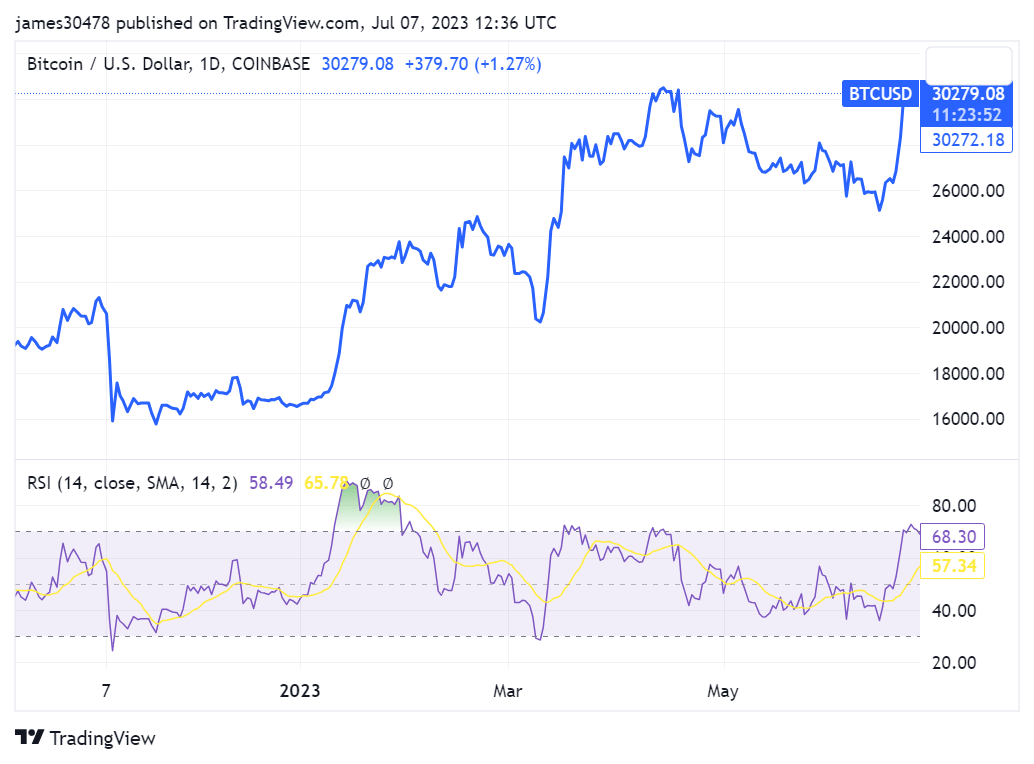
The post Unemployment rate stays at historic lows, Bitcoin jumps 1.5% appeared first on CryptoSlate.

In addition to launching Shibarium in August after the blockchain conference, Shiba Inu would likely provide more information on ecosystem projects.
The long-awaited Shibarium layer 2 (L2) blockchain will likely go live in August. Shiba Inu lead developer Shytoshi Kusama revealed the upcoming launch in a blog post published on Thursday, stating that Shibarium would go public after a scheduled conference in Toronto.
In the blog post, Kusama revealed a few other plans for the conference:
“The completed Worldpaper will be exhibited, all Shib branded projects will be published and Treat will be published in detail for the first time. In addition, it is very likely that we will also discuss and release the long-awaited L2 Shibarium.”
Members of the Shiba Inu community now expect a Shibarium launch at the Blockchain Futurist Conference in Toronto in August. Shiba Inu may also introduce DoggyDAO, a decentralized autonomous organization (DAO) controlled by SHIB holders. DoggyDAO would be used to fund Shibarium projects.
Shiba Inu has been working on Shibarium for several months, launching a testnet for the L2 platform called PuppyNet, on March 11, 2023. PuppyNet allows anyone to develop and deploy dApps (decentralized applications) for different uses. Also, users can integrate PuppyNet into their businesses for several functions, including a crypto payments processor, or a decentralized governance module.
As of June 11, PuppyNet’s total number of transactions crossed 20 million with an average block time of 5 seconds across more than 16.7 million wallet addresses. Public participation on the testnet indicates Shibarium’s potential acceptance as it points to significant demand for the L2 network. This could also potentially spike the prices of BONE and SHIB, Shibarium’s native tokens.
Although information about Shibarium is the most anticipated, the Shiba Inu team has other plans for the Blockchain Futurist Conference in August. The team plans to show the SHIB community multiple presentations and demonstrations about several other projects from the ecosystem. There will also be discussions and expected feedback from the community about the future of Shiba Inu. Attendees will enjoy unveilings, showcases, and added information on several Shiba Inu projects, including Shiboshis, Shiba Eternity, Shibacals, and SHIB: The Metaverse.
Shiba Inu recently announced Shibacals, a project that links non-fungible tokens (NFTs) to real-world assets to better confirm authenticity and ownership. Kusama explained that the Shibacals project will digitally authenticate real-world goods using NFC chips. At the point of purchase, users can verify these tags on a blockchain to ensure purchases are for authentic products and not reproduced copies. In response to the announcement, SHIB jumped 11%.
In April, Shiba Inu developers revealed a December launch date for the ecosystem’s metaverse. Calling it a “partial” release, the developers specified that the metaverse may not be complete at the release. However, they promised its an “ongoing project”, with continuous improvements even after launch.
SHIB: The Metaverse will allow users to mint 100,595 plots of land where landowners can earn passive income and accumulate resources. Users can also create avatars and enjoy a metaverse economy that supports easy interaction with others, as well as more earning opportunities.
next

Tolu is a cryptocurrency and blockchain enthusiast based in Lagos. He likes to demystify crypto stories to the bare basics so that anyone anywhere can understand without too much background knowledge.
When he’s not neck-deep in crypto stories, Tolu enjoys music, loves to sing and is an avid movie lover.

The Kraken founder is not the first public figure in the crypto industry to be investigated by federal authorities.
Jesse Powell, the controversial founder and former CEO of Kraken, one of the leading cryptocurrency exchanges, has recently found himself at the center of an investigation by the Federal Bureau of Investigation (FBI). According to a New York Times report citing people familiar with the matter, the FBI raided Powell’s residential home in Brentwood earlier in March following allegations of cyberstalking made against him by a non-profit organization (NGO) called Verge Center for the Arts.
The raid stemmed from claims made by the NGO, which accused Powell of unauthorized access to its computer systems and impeding its communication channels by blocking access to emails and other essential messages. In conjunction with the US attorney’s office for the Northern District of California, the FBI has been actively investigating the case for several months.
The former Kraken CEO, who remained on the company’s board after stepping down in September last year, was also part of the founders of the NGO Art Center. However, he was ousted from the board of directors of the foundation following the expression of his controversial views. In response to his dismissal, Powell initiated a lawsuit against the arts center, claiming that his removal was unjustifiable.
During the search at Powell’s residence in the affluent Brentwood neighborhood of Los Angeles, FBI agents seized electronic devices belonging to the Kraken founder, people familiar with the matter told the New York Times. However, it is important to note that no formal charges have been filed against Powell concerning the cyberstalking claims.
Brandon Fox, the attorney representing Powell, acknowledged that his client is indeed the subject of an investigation by federal prosecutors in Northern California. However, Fox stressed that the probe solely revolves around the allegations made by Verge Center for the Arts and is entirely unrelated to Powell’s professional endeavors and conduct within the crypto industry.
The lawyer firmly asserted that Powell did not participate in any wrongdoing. He further noted that the art center provided one-sided information to the bureau, claiming that the authorities would have found him not guilty if presented with the complete story.
“We have reason to believe Verge provided a one-sided account that did not provide the government with the full picture, which would have shown that he did nothing wrong,” Fox said.
The Kraken founder is not the first public figure in the crypto industry to be investigated by federal authorities. A few months ago, the FBI searched the Potomac, Maryland, residence of Ryan Salame in April. Salame, who previously held the position of Chief Executive Officer at FTX’s Bahamian subsidiary, was scrutinized for the catastrophic collapse of the $32 billion-valued exchange, FTX. While details regarding the raid were not disclosed, it was speculated that the investigation may be linked to Salame’s potential involvement in the exchange’s downfall.
A Kraken spokesperson responded to the news, emphasizing that the Verge investigation has no connection to the operations or activities of the company. He further reiterated that there is no reason to believe that prosecutors are investigating any other potential issues beyond the scope of the Verge case.
While the most recent investigation has no possible connection to Kraken, the crypto exchange and Powell have faced legal scrutiny in the past. Recently, prosecutors have examined allegations raised in a wrongful termination lawsuit against Kraken in 2019. The lawsuit accused the company of generating revenue from accounts in countries under US sanctions. The suit alleged that Kraken’s bank accounts were missing millions of dollars in customer deposits.
next

Chimamanda is a crypto enthusiast and experienced writer focusing on the dynamic world of cryptocurrencies. She joined the industry in 2019 and has since developed an interest in the emerging economy. She combines her passion for blockchain technology with her love for travel and food, bringing a fresh and engaging perspective to her work.

Blockchain network Avail has launched a testnet data availability bridge to Ethereum, according to a July 7 announcement. Once testing is completed, the bridge will allow developers to easily create “validiums” or low-cost layer 2s that do not store full transaction data on Ethereum, the announcement stated.
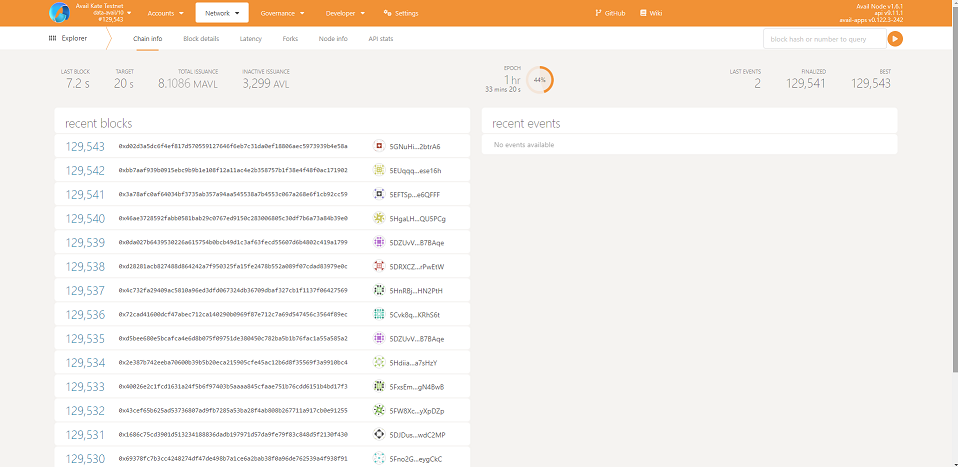
Layer-2 rollup networks like Optimism, Arbitrum, Polygon zkEVM, and zkSync Era lower transaction fees by batching transactions into compressed “rollups” and periodically adding them to the base layer. However, because these networks must write all the transactions to the base layer, they often have higher transaction fees than layer-1 competitors.
To get around this problem, some networks have opted to write only the validation proofs of each transaction to the base layer, while storing the full transaction data off-chain. This produces a type of network called a “validium.” For example, StarkEx features a validium mode that stores data with a data availability committee (DAC) instead of on Ethereum. Polygon proof-of-stake may become a validium that stores its data on a proof-of-stake chain in 2024.
Related: Starknet’s Quantum Leap hits testnet with TPS reaching ‘triple figures’
According to the announcement, the new bridge allows developers to create custom validiums quickly and easily by storing their transaction data on the Avail network, eliminating the need to create their own DAC or proof-of-stake data availability network. When a user tries to withdraw cryptocurrency from layer 2 back to the base layer of Ethereum, the Avail bridge will transmit an attestation that the data is available on Avail, allowing the withdrawal to occur.
“Today’s launch of the Data Availability attestation bridge marks a major advancement in our mission to optimize blockchain scalability and efficiency,” said Arjun. “By enabling rollup constructions to run in validium, optimistic chains, and volition modes, we are not only reducing costs but also paving the way for a more inclusive and efficient layer-2 and layer-3 ecosystem.”
Arjun previously told Cointelegraph that data availability solutions would become essential to the Web3 space as zero-knowledge proof rollups are more widely used.


Twitter executive chairman Elon Musk alleged in a social media post that Meta is “cheating” over the release of Threads, a text-based social network resembling Twitter.
While Musk wrote that he is fine with competition, he made it clear that he would not tolerate cheating. The billionaire’s remarks come after Twitter lawyer Alex Spiro sent a letter to Meta CEO Mark Zuckerberg threatening legal action.
Competition is fine, cheating is not
— Elon Musk (@elonmusk) July 6, 2023
On July 5, Spiro wrote in the letter that Twitter has the intention to “strictly enforce its intellectual property rights.“ The firm also demanded that Meta immediately stop using Twitter’s trade secrets.
According to Spiro’s letter, Meta hired former Twitter employees with access to confidential information, including Twitter’s trade secrets. Spiro wrote that Meta assigned these employees to develop a “copycat” application called Threads, alleging that the company used Twitter’s trade secrets and intellectual property to speed up the development of the competitor app.
Furthermore, Spiro also highlighted that the letter serves as a formal notice to Meta to preserve any documents relevant to a dispute between Twitter and Meta, as well as former Twitter employees that Meta now employs.
Related: Crypto Twitter will see less exposure on Google due to rate limit slash
Spiro also noted that Meta is not allowed to engage in any crawling or scraping of Twitter’s followers or following data. The lawyer wrote that this is prohibited for any reason without the company’s prior consent.
On July 5, Meta’s new text-based social network, Threads, was released in 100 countries. The app was rolled out days after Twitter’s rate limit debacle when the social platform temporarily limited the number of posts users could read.
Magazine: Cryptocurrency trading addiction: What to look out for and how it is treated

Worldwide traffic for the popular artificial intelligence (AI) chatbot ChatGPT has experienced a decline from May to June, suggesting a decline in interest in the AI assistant tool developed by OpenAI.
According to data estimates from the traffic analytics site Similarweb, desktop and mobile web traffic for ChatGPT dropped by 9.7% in June. In addition, the site’s unique visitors and the amount of time users spend on the site have also declined by 5.7% and 8.5%, respectively. In the United States, the recorded month-on-month decline in the website’s traffic was 10.3%.
Despite the decline in traffic, the website is still ahead of Google’s Bard, Microsoft’s Bing and Character AI, another popular AI-powered chatbot.
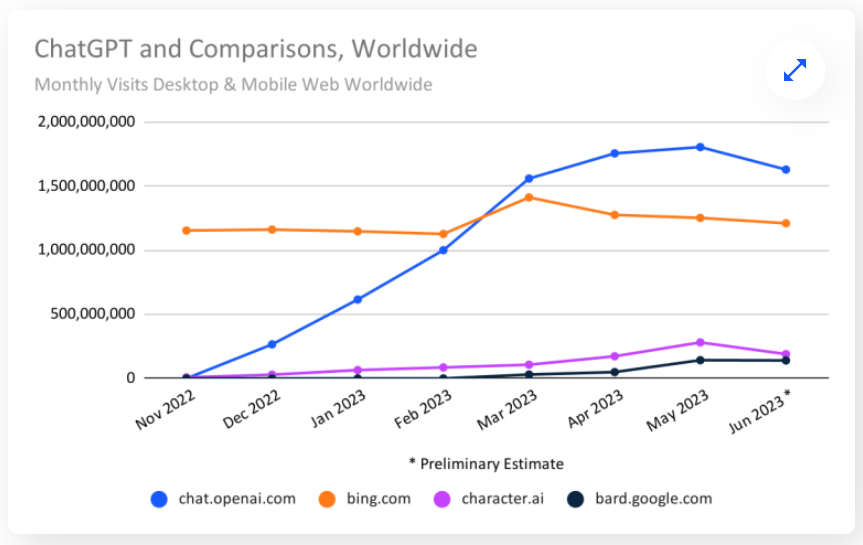
As the data was released, some argued that the drop might be due to the tools’ users being students who are currently on their summer break, as well as the AI chatbot’s novelty starting to wear off.
Related: OpenAI pauses ChatGPT’s Bing feature, as users were jumping paywalls
On the other hand, a community member disputed the reasons behind the drop, as it did not include the traffic taken from the AI chatbot’s recently-released iOS application. According to the Twitter user, there could simply be a “change in how ChatGPT is accessed.”
On May 18, OpenAI officially launched ChatGPT’s mobile application for iOS. The firm initially rolled out the app in the United States and promised to expand the release to other countries in the following weeks.
Meanwhile, Lighting Labs, the development firm behind the Bitcoin Lightning Network, has announced tools for AI to send and receive Bitcoin (BTC) on its layer-2 solution. The firm released the toolkit with the aim of helping make payments faster, cheaper and easier for developers working on AI-focused projects.
Magazine: AI Eye: AI travel booking hilariously bad, 3 weird uses for ChatGPT, crypto plugins