Bitcoin and select altcoins are finding buyers at lower levels, indicating a pick-up in positive sentiment.

Bitcoin and select altcoins are finding buyers at lower levels, indicating a pick-up in positive sentiment.


Cryptocurrency exchange Gemini, founded by the Winklevoss twins, has filed a civil lawsuit against Digital Currency Group (DCG) and its CEO Barry Silbert. The lawsuit is rooted in a dispute over the insolvency of Genesis Capital, a firm with which Gemini had a significant business partnership.
Gemini co-founder Cameron Winklevoss announced the suit on social media, along with several allegations of fraud and foul play against Silbert for his role in hiding the troubles at Genesis.
DCG said in a statement that the allegations and the lawsuit are a “publicity stunt” by the Winklevoss twins to dodge responsibility for running the Gemini Earn program.
The firm said the allegations made against it and its employees are “baseless, defamatory, and completely false.” DCG added that it remains committed to finding an amicable solution for all parties involved in the bankruptcy proceedings.
Winklevoss said the collapse of Three Arrows Capital “blew a $1.2 billion hole” in Genesis’ balance sheet — making it “wildly insolvent” as early as June 2022. However, instead of alerting investors and creditors, the firm hid this fact with the help of DCG and Silbert.
Said Winklevoss:
“Barry, DCG, and Genesis all conspired to create false financial reports to hide the truth from Gemini and creditors.”
Winklevoss claimed that the principal “architect and mastermind” of this “fraud” was Silbert and that the top leadership at DCG was aware and involved in “hiding the truth.”
The exchange facilitated its Earn program in collaboration with Genesis. However, when Genesis became insolvent, it halted withdrawals, effectively locking up approximately $1.45 billion worth of assets belonging to users of the Gemini Earn program
The exchange decided to end the program and asked DCG to repay the debt over five years.
According to the Gemini founder, Silbert directly intervened and tried to dissuade Gemini from ending its Earn program with Genesis despite knowing the company was essentially bankrupt. Silbert told the exchange the troubles at Genesis were temporary and stemmed from a “timing issue.”
Winklevoss alleged:
“This fraud goes to the very top. Barry Silbert and other DCG executives were directly involved in these lies and they lied again and again to conceal the truth from Gemini and other creditors.”
Genesis had told creditors everything was fine operationally because DCG had stepped in to cover the losses, but the latter never had any intention of absorbing the losses.
According to Winklevoss, DCG never provided any cover or “real capital” and instead gave Genesis a “sham” 10-year promissory note that had no real value . The firms then falsified financial documents to pretend it was a “receivable” with a value of $1.1 billion.
He said:
“One report pretended that this phony 10-YEAR promissory note was a ‘Current Asset.’ A total lie and complete misrepresentation.”
The troubles eventually culminated in Genesis filing for bankruptcy in January, six months after the firm allegedly became insolvent.
Gemini had set a July 6 deadline for DCG and Genesis to settle the repayment issue or it would pursue litigation. DCG, Genesis and Silbert are also being sued by various creditors of Genesis in a separate class-action lawsuit.
Winklevoss’s allegations against Silbert and DCG in these matters are allegations only and have not been proven.

The crypto market is up today with slight gains of over 1% in the past 24 hours as investors assess the latest United States’ jobs report.
On July 7, the crypto market’s net worth rose nearly 1.5% to $1.14 trillion after falling for three days in a row. That includes a rebound across the market’s top-ranking assets, with Bitcoin (BTC) and Ether (ETH) gaining a modest 1.8% and 1.75%. Meanwhile, Solana (SOL) was one of the best performers jumping 8.5%.

The crypto market’s intraday recovery coincided with the release of the U.S. Labor Department report. The labor market added 209,000 jobs in June compared to 306,000 in the previous month, prompting hopes that the Federal Reserve may ignore raising interest rates in its July meeting.
“Hawks could push for a September hike,” noted Nick Timiraos, chief economic correspondent at the Wall Street Journal, adding:
“Doves will want to at least skip and give more time to see if the data decay by Halloween. But the June jobs report will be old news by September. It neither shows a sudden stop or a big re-acceleration in hiring.”
Moreover, the U.S. dollar index (DXY), which measures the greenback’s strength against a basket of top foreign currencies, weakened after the jobs report headline, dropping to a two-week low.

Interestingly, the crypto market rose during the dollar’s decline, displaying negative correlation with the greenback on the hourly chart, and climbing to nearly $1.2 total market capitalization.
In addition, the crypto market’s bounce on July 7 occurred near its 50-day exponential moving average (50-day EMA; the red wave) near $1.12 trillion.

As shown in the image above, the 50-day EMA has limited the crypto market’s downside bias since late June 2023. For instance, the wave’s last retest on June 29 preceded a 7.5% rebound in the crypto market’s valuation.
Despite weaker monthly jobs data, the market sees a 95% probability of the Fed hiking rates by 25 basis points (bps) in July. That risks limiting the crypto market’s upside prospects in the month with one technical pattern potentially hinting at downside ahead.
Related: Here’s what happened in crypto today
Notably, the crypto market has formed what appears to be head-and-shoulders (H&S), a bearish reversal pattern.

As a rule, this opens the possibility for a drop toward the neckline at around $1 trillion. Pending a decisive close, another drop toward $800 billion is on the cards.
Conversely, the crypto market’s rise toward $1.3 trillion may trigger an inverse-head-and-shoulders (IH&S) pattern.

This pattern is considered bullish and would have an upside target of over $2 trillion for the remainder of 2023, up about 100% from the current levels.
This article does not contain investment advice or recommendations. Every investment and trading move involves risk, and readers should conduct their own research when making a decision.


From 2012 to the present, over $30 billion in crypto has been hacked in 1,101 documented incidents, a July 7 report from SlowMist has revealed.
According to the blockchain security firm, the top five most common hacks are smart contract vulnerabilities, rug pulls, flash loan attacks, scams and private key leaks. The losses represent roughly 2.5% of the current market capitalization of cryptocurrencies.
Out of total incidents, there were 118 exchange hacks, 217 Ethereum ecosystem hacks, 162 BNB Smart Chain ecosystem hacks, 119 EOS ecosystem hacks and 85 hacks related to nonfungible tokens, or NFTs. Exchange losses were the steepest, amounting to over $10 billion lost in the past decade.
Hack events with over $1 billion lost peaked in the early 2010s and from 2019 to 2021. Security incidents have been somewhat muted from 2022 onwards, which is consistent with other reports.
According to our SlowMist Hacked archives, as of July 7, 2023, the total losses from #blockchain related incidents have soared to an astounding $30 billion!
In light of these staggering numbers, it’s abundantly clear that projects and users alike need to place a much higher… pic.twitter.com/9LC07PD4Xe
— SlowMist (@SlowMist_Team) July 7, 2023
In the early days of Bitcoin (BTC), notable attacks included the 2014 Mt. Gox hack and the 2016 Bitfinex hack. Mt. Gox was the biggest Bitcoin exchange in the world at the time when it filed for bankruptcy in 2014 after discovering that 850,000 of its customers’ BTC ($25.2 billion at the time of publication) had been stolen via discreet hacks and siphoning over several years. The exchange has since recovered 200,000 BTC ($6.1 billion) and is redistributing them to creditors.
Likewise, in 2016, Bitfinex suffered a security breach resulting in the loss of 119,576 BTC worth around $70 million at the time and $3.7 billion now. On Feb. 8, 2022, 94,000 stolen BTC was recovered by special agents working for the United States Department of Justice.
Magazine: Thailand’s $1B crypto sacrifice, Mt. Gox final deadline, Tencent NFT app nixed

A web3 membership designed to empower you with cutting-edge insights and knowledge. Learn more ›
Welcome! 👋 You are connected to CryptoSlate Alpha. To manage your wallet connection, click the button below.
If you don’t have enough, buy ACS on the following exchanges:
Access Protocol is a web3 monetization paywall. When users stake ACS, they can access paywalled content. Learn more ›
Disclaimer: By choosing to lock your ACS tokens with CryptoSlate, you accept and recognize that you will be bound by the terms and conditions of your third-party digital wallet provider, as well as any applicable terms and conditions of the Access Foundation. CryptoSlate shall have no responsibility or liability with regard to the provision, access, use, locking, security, integrity, value, or legal status of your ACS Tokens or your digital wallet, including any losses associated with your ACS tokens. It is solely your responsibility to assume the risks associated with locking your ACS tokens with CryptoSlate. For more information, visit our terms page.

A 2023 H1 survey from Salesforce, which covered 6,058 financial service institution (FSI) customers worldwide, offered significant insights into sentiments surrounding artificial intelligence (AI), cryptocurrency, and the digital shift in the financial services industry.
According to the Salesforce Financial Services Report, the survey was conducted from March 7 to April 12, 2023, and encompassed respondents from 12 countries across five continents.
A noteworthy finding is that 61% of customers have either researched or plan to research cryptocurrency, highlighting a growing interest in digital currency. Despite two-thirds of customers expressing interest in digital currencies, only 29% have desired blockchain digital currency services from their financial institutions.
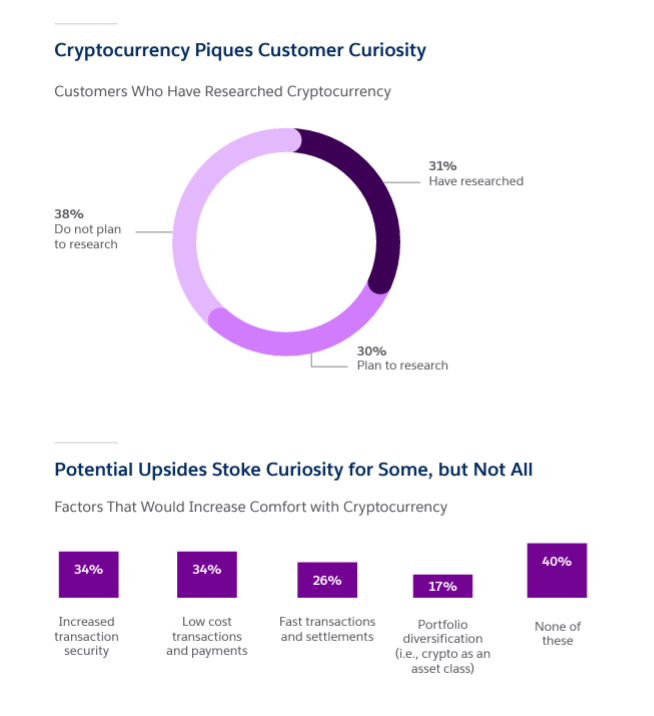
This may underscore a perceived gap in current FSI offerings, a discomfort with the emerging technology, or perhaps an indication there is a real appetite for self-custody, as the report showed that 60% of customers are comfortable with cryptocurrency.
The survey also found that 31% of customers have researched, and 30% plan to explore portfolio diversification, including crypto as an asset class. Despite its volatility, this data suggests a developing curiosity and acceptance of crypto as a valid part of a diversified portfolio.
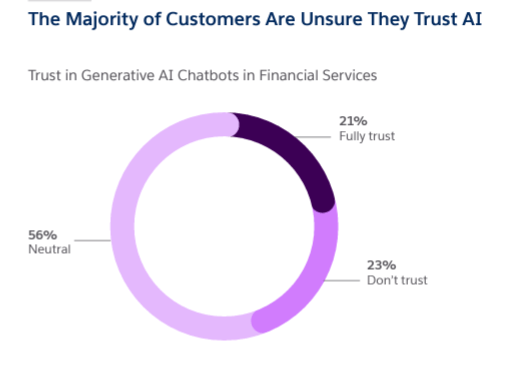
Generative AI has become a hot topic of interest, with consumers revealing uncertainty about trusting AI, specifically financial service chatbots powered by generative AI. This leaves room for potential improvement in the integration and intelligence of chatbots, which, according to the report, are currently a significant area of digital friction.
Only 21% of respondents “fully trust” AI Chatbots, while 56% were neutral. To give context to this data, many experiences will be based on older AI models rather than groundbreaking LLMs, such as the GPT-4 API, which was recently released to all customers. With the advent of the next wave of Chatbots, it will be interesting to see whether this metric improves and customers become more trusting of Chatbots powered by the latest generative AI technology.
The survey also revealed an expectation that AI could enhance financial transactions, with a significant share (46%) of the respondents expressing optimism about AI’s time-saving potential. However, 40% neither agreed nor disagreed with this sentiment, indicating that more work is needed to establish AI’s benefits in consumers’ minds.
Overall, the Salesforce report provides a snapshot of the shifting landscape in financial services, with consumers expressing a growing interest in blockchain technologies, cryptocurrency, and AI. It underscores the challenges and opportunities facing FSIs as they navigate the intersection of emerging technologies.
Most respondents were millennials making up 43% of respondents, followed by Gen X at 25%, Generation Boomers at 20%, and Gen Z at 12%.

Bitcoin (BTC) will be the currency of artificial intelligence (AI) and could reach a price per coin of $760,000 in the process, Arthur Hayes says.
In his latest essay titled “Massa,” the former BitMEX CEO concluded that the AI revolution would naturally gravitate toward BTC.
Despite fiat currency regimes being destined to become evermore dysfunctional in the future, Hayes said, there is one burgeoning economic sector that will only go from strength to strength: AI.
While still nascent in 2023, the coming decades will see an explosion of AI-related implementations that will make it ubiquitous and unavoidable.
“Recent advancements in computing power have brought us to the cusp of a hockey stick moment, in which AI will go viral and change the course of humanity virtually overnight,” he wrote.
“In only two months, ChatGPT reached 100 million monthly active users making it the fastest adopted technology in human history — so just imagine how quickly everything is going to change as AIs are integrated into everyday life and continue to learn and improve.”
When it comes to integration, the financial solution on the table first and foremost, Hayes said, will not be a tailor-made, AI-focused altcoin — it will be Bitcoin instead.
The reason, an accompanying theory states, is that AI will view Bitcoin’s inherent qualities — an immutable fixed supply, digital scarcity and its status as “energy money” — as the logical choice.
“An AI is unlikely to allow itself to rely on anything that a human government operates therefore only gold and Bitcoin are suitable. A tie between gold and Bitcoin,” Hayes continued.
“Bitcoin is thus the logical currency choice for any AI. It is purely digital, censorship resistant, provably scarce, and its intrinsic value is completely electricity-cost-dependent. There is nothing in existence today that comes close to challenging Bitcoin on these aspects.”
Where would that leave BTC’s price?
Related: BTC price remains ‘undoubtedly bullish’ as $30K Bitcoin buyers emerge
From around $30,000 today, the real effect of AI should kick in in around three years’ time.
After that, Hayes said, it could be around another decade before the network value boost from AI alone sends BTC/USD to nearly $1 million.
“I believe the peak of deranged growth investing will occur in the 2025 to 2026 timeframe. Therefore, the goal of my predictions regarding the future price of Bitcoin is to form a narrative that takes hold before then,” he explained.
Depending on the scale of that investing, BTC price action could see up to $760,000 per coin.
“Remember — the market will overpay for Bitcoin network growth if it believes there is a possibility that my assumptions could be true in the future,” part of “Massa” concludes.
“The most money is made when the market price adjusts from ‘can never happen’ to ‘maybe could happen.’”
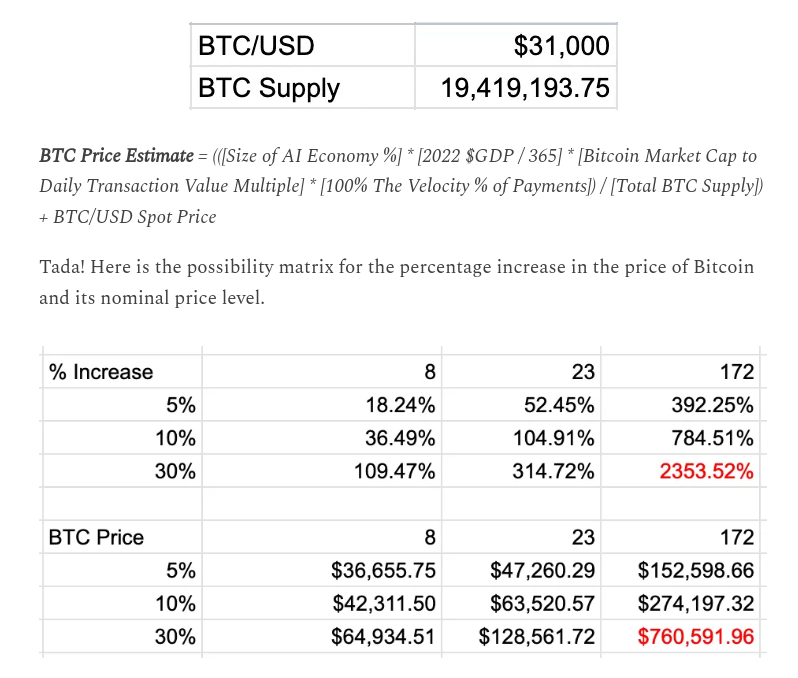
Hayes is well known for his bullish long-term perspective on Bitcoin, recently championing a million-dollar price tag as a function of fiat currency disintegration.
Magazine: Should you ‘orange pill’ children? The case for Bitcoin kids books
This article does not contain investment advice or recommendations. Every investment and trading move involves risk, and readers should conduct their own research when making a decision.

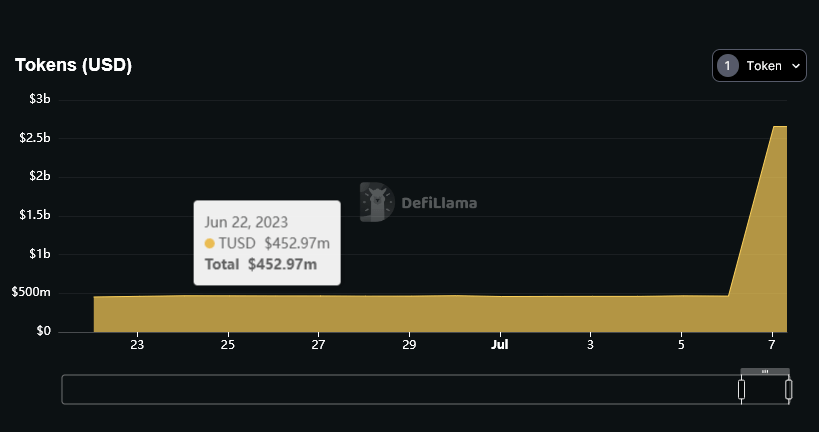
Binance saw nearly $2 billion in inflows in the last 24 hours, according to DeFillama data, despite the alleged FUD surrounding the exit of its key executives.
The inflow can be attributed to the massive spike in the exchange’s TrueUSD (TUSD) balance during the last 24 hours.
TUSD’s balance on Binance jumped to $2.65 billion from less than $500 million recorded on June 6, according to DeFillama data.
Meanwhile, data from Glassnode shows that TUSD’s total balance across all exchanges is $512.92 million as of July 6. However, $498.58 million, representing 96% of the $512.92 million balance, is on Binance.
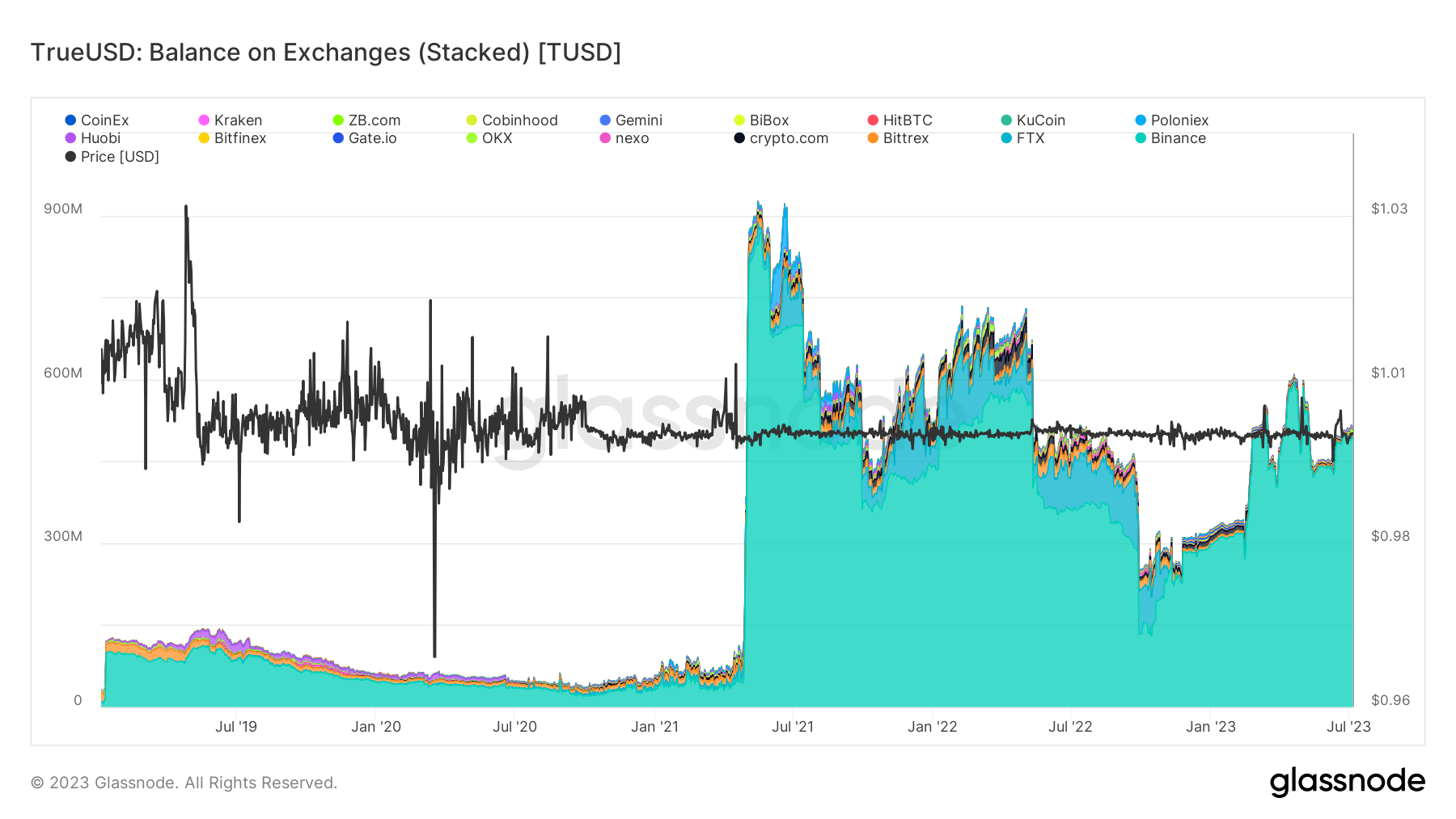
Other exchanges like OKX, Bitfinex, Gate.io, Huobi, and others hold less than $20 million of the stablecoin.
Since Binance USD’s (BUSD) struggles began with regulators, Binance mainly promoted TUSD as its successor for the embattled stablecoin. The exchange has minted more of the TUSD stablecoin and added new trading pairs for the asset.
TUSD has faced increased scrutiny over its alleged ties to Justin Sun and its exposure to the insolvent crypto custodian, Prime Trust.
Binance was yet to respond to CryptoSlate’s request for comment at the time of writing.
Meanwhile, Binance CEO Changpeng ‘CZ’ Zhao said the reasons attached to the company’s key executives’ exits were “completely wrong.”
On July 6, Binance chief strategy officer Patrick Hillmann and the exchange’s senior vice president for compliance Steven Christie confirmed they were leaving the platform.
While some crypto community members quickly linked their exits to the exchange’s recent regulatory challenges, the executives stated they left the firm on good terms.
In his July 7 statement, CZ described the outcry surrounding these exits as another FUD, adding that every company experiences turnover. CZ thanked the exiting executives for their services and assured users that the platform can ” protect our users at all times.”
“As markets and the global environment for crypto changes, as our organization evolves, and as personal situations change, there is turnover at every company.”
The post Binance sees nearly $2B inflow amid exit of key executives appeared first on CryptoSlate.

Multichain has now warned that because of the exploit, all transactions will be stuck on source chains until further notice.
Open-source cross-chain router protocol Multichain (MULTI) has confirmed that an exploit occurred on its protocol, affecting $130 million worth of tokens. The protocol asked its users to suspend all related transactions for now.
In a recent tweet, Multichain said although it is currently investigating the anomaly, it is not sure exactly what happened. The tweet then warned:
“It is recommended that all users suspend the use of Multichain services and revoke all contract approvals related to Multichain.”
In a subsequent tweet, Multichain said all services have been stopped, and “all bridge transactions will be stuck on the source chains”. The protocol added that there is no “resume time” for restoring the chain or completing its investigation exploit. According to data from CoinMarketCap, MULTI has lost 15% over the last 24 hours and more than 23% in the last 7 days.
Binance CEO Changepeng Zhao responded to Multichain’s announcement in a tweet. Zhao assured users that the Multichain exploit has no bearing on Binance:
“Looks like another hack happened on Multichain. This DOES NOT affect users on Binance or Binance itself. We have swapped all assets out and closed deposits a while back. Regardless, we offer our assistance in helping with the situation.”
MetaSleuth, a crypto visualization and analysis tool by BlockSec, provided more details. According to MetaSleuth, over $120 million worth of assets were moved from Multichain: Moonriver Bridge and Multichain: Fantom Bridge. MetaSleuth added that the funds have been spread across 6 different addresses. The BlockSec tool also stated that the players behind the exploit have burned 1.2 million ICE, worth $1.8 million, from a “0x9d57” address.
On Wednesday, July 7, Binance said it would suspend support for withdrawals and deposits of several Multichain-bridged tokens starting today. The delisting follows a previous suspension that stemmed from delays in the Multichain protocol. In May, Binance suspended the tokens as transactions were delayed, and Multichain did not offer much information.
Following the recent suspension announcement, blockchain intelligence firm Arkham Intelligence confirmed that about $3 million in MULTI tokens moved to Gate.io, resulting in a 26.5% crash in the price of MULTI.
Multichain has had a few problems for a while now, including the alleged disappearance of its CEO. In May, the protocol suspended cross-chain routes for several chains, a problem caused by “unforeseeable circumstances.” The tweet explained that fixing the problem was beyond the current permissions and ability of its team members and required input from its CEO. However, Multichain stated that it could not reach CEO Zhaojun to obtain the required permissions. The issue affected 11 chains, including Dyno Chain, PublicMint, Findora, and ONUS.
Several news reports stated that Chinese law enforcement had arrested a few members of Multichain’s team, including the CEO Zhaojun. Rumors also suggested that authorities seized a wallet containing tokens worth more than $1.6 billion. According to Defi Llama, Multichain has $1,262 billion in Total Value Locked (TVL) as of press time.
next

Tolu is a cryptocurrency and blockchain enthusiast based in Lagos. He likes to demystify crypto stories to the bare basics so that anyone anywhere can understand without too much background knowledge.
When he’s not neck-deep in crypto stories, Tolu enjoys music, loves to sing and is an avid movie lover.

Coin Stories host Natalie Brunell — who has 302,600 followers on Twitter — recalls feeling very tense before meeting with Salvadoran President and Bitcoin maximalist Nayib Bukele in March 2022.
“It was very formal, there were guards outside his office. What is funny is it felt very formal outside of his actual office. Then you walk in, and he’s very warm, very gracious and very humble,” she says.
Brunell was blown away by Bukele’s knowledge of Bitcoin.
“He was very educated and well-read on the topic of Bitcoin and economic theory, and he seemed to genuinely want positive change for his country through expanding monetary freedom.”

Brunell, who is also the host of the Hard Money show, took an unconventional approach to get the meeting, relying on the power of memes suggesting Bitcoiners will all end up working at McDonald’s every time the price goes down — so she put out a call on Twitter asking which McDonald’s she could find Bukele at.
Surprisingly, it worked out very well.
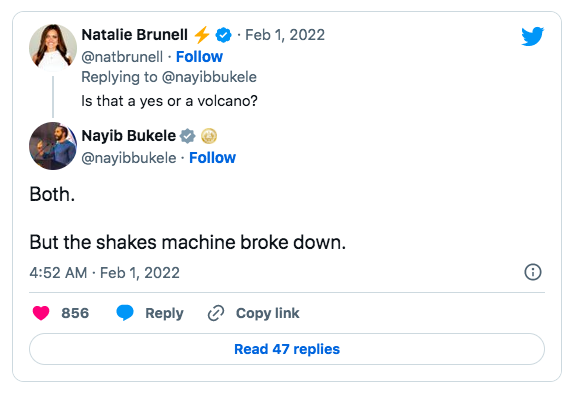
Brunell used to work as an investigative journalist covering politics, particularly “public corruption and public officials engaging in things like bribery and manipulation.” But as Bitcoin is trustless, she points out there’s no actual need to trust politicians who embrace it.
“I’m naturally skeptical of politicians, especially because of my news background. […] I think it’s a very powerful statement that he’s chosen to make sure it’s legal tender and protected in El Salvador.”
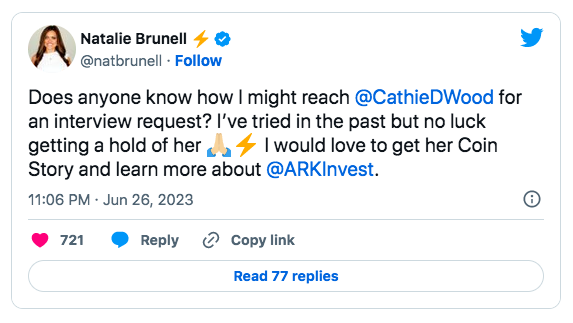
Despite her best efforts, Brunell’s attempt to contact ARK Invest’s Cathie Wood using the same method proved to be unsuccessful in June.
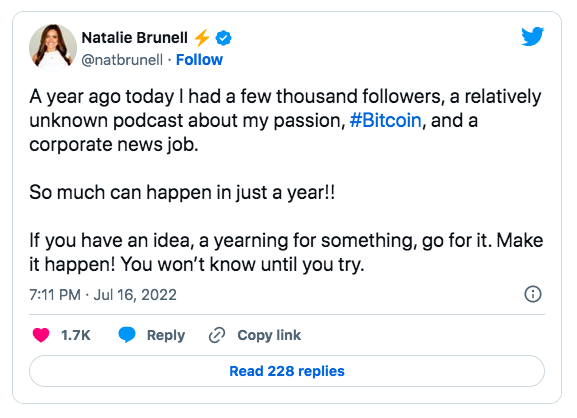
Brunell never imagined that her follower count would blow up in the way that it has.
“I think the biggest shock, honestly, was when I reached 100,000 followers because I didn’t intend for the Bitcoin and the podcast work to be my full-time job.”
She reckons she was so caught up in her obsession with Bitcoin that when her Twitter follower count reached six figures, it caught her by surprise.
“I’m really passionate about Bitcoin, and I love teaching people about Bitcoin, and I love interviewing people about the topic, and I didn’t know what would happen. So when that following was reached, I was really grateful.”
The majority of her content is “a lot about Bitcoin.”
Whether she is dishing out her opinions on the latest developments, sharing video interviews of cool people in the space, or calling on prominent Bitcoiners to join her on her podcast, Brunell’s Twitter is a one-stop shop for all things Bitcoin.
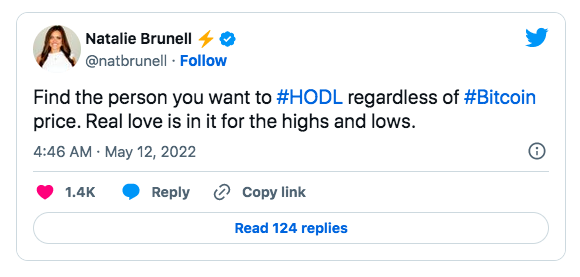
However, there’s a wholesome vibe to her Twitter content that’s missing on some of the other orange-pilled accounts.
“I try to keep it real and try to keep it positive, and I try to talk about the things that can really be fixed in our society. And a lot of it can be fixed with Bitcoin.”
Read also
Features
DeSci: Can crypto improve scientific research?
Features
Agents of Influence: He Who Controls The Blockchain, Controls The Cryptoverse
Brunell says that she “loves” the Twitter content from “prominent Bitcoiners” such as MicroStrategy’s Michael Saylor, economist Lyn Alden, Bitcoin advocate Jeff Booth and Bitcoin Fundamentals host Preston Pysh.
“They are generous with their knowledge, and I’m grateful to learn from them,” she says.
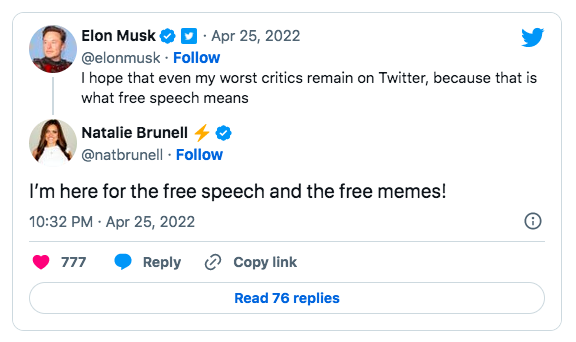
“I am a fan of Bitcoin memes, and I love how genuinely clever some accounts are in this space,” she says.
Brunell predicts that Bitcoin will face “a lot of headwinds” over the next six to 12 months, but believes it will “hit six figures” and new all-time highs within the next “24 months.”
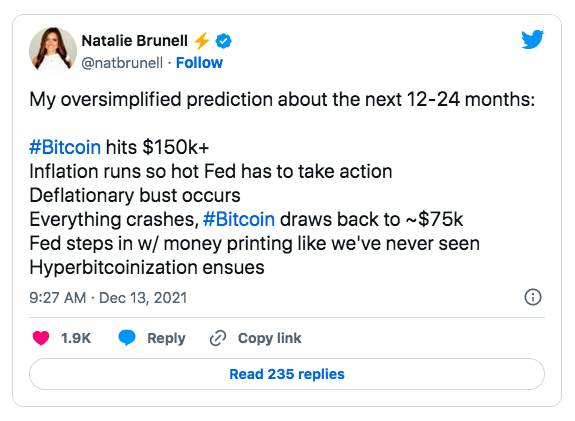
While many cannot wait for the return of the bull market, Brunell finds herself in a slightly different boat.
“I don’t want Bitcoin to hit an ATH anytime soon because I didn’t start stacking until 2017 and I always want to stack more.”
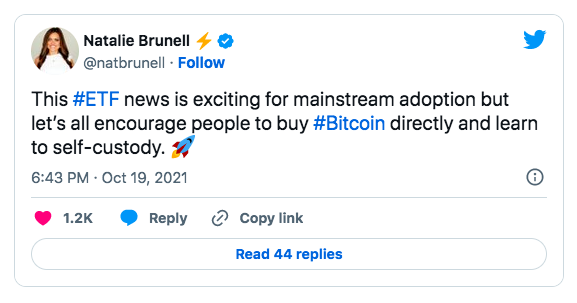
However, she is pretty excited about the recent developments with Bitcoin ETFs.
“What is different this time is the entities applying for the ETFs are not crypto-native companies, but rather respected institutions like BlackRock and Fidelity that are deeply ingrained into the traditional financial system.”
“This could create a major on-ramp for institutions and retail investors, allowing them to easily gain exposure to Bitcoin,” Brunell says.
Subscribe
The most engaging reads in blockchain. Delivered once a
week.